
Machine Guarding Systems for Automated Production Lines
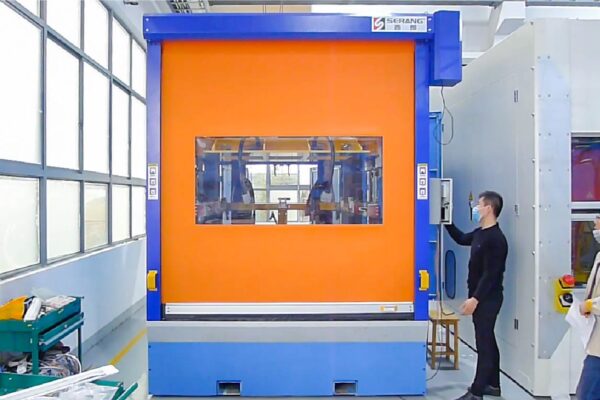
Machine guarding systems are essential for controlling access to hazardous areas in automated production lines. As factories introduce industrial robots, conveyors, automated assembly equipment, and material-handling systems, engineers must ensure that personnel are protected from hazardous machine movements.
One important component of an automated safeguarding system is the machine safety door. Combined with fixed guarding, appropriate interlocks, and validated safety-related controls, machine safety doors can support controlled access and automated material transfer.
However, a high-speed industrial door is not automatically a safety-rated robot cell guard. The complete safeguarding system must be designed according to the machine risk assessment.
This guide explains how machine guarding systems work, seven essential requirements for robot cell safety doors, safety PLC integration, guard locking, industrial applications, relevant standards, and engineering selection criteria.
Reference: International Federation of Robotics .
What Are Machine Guarding Systems?
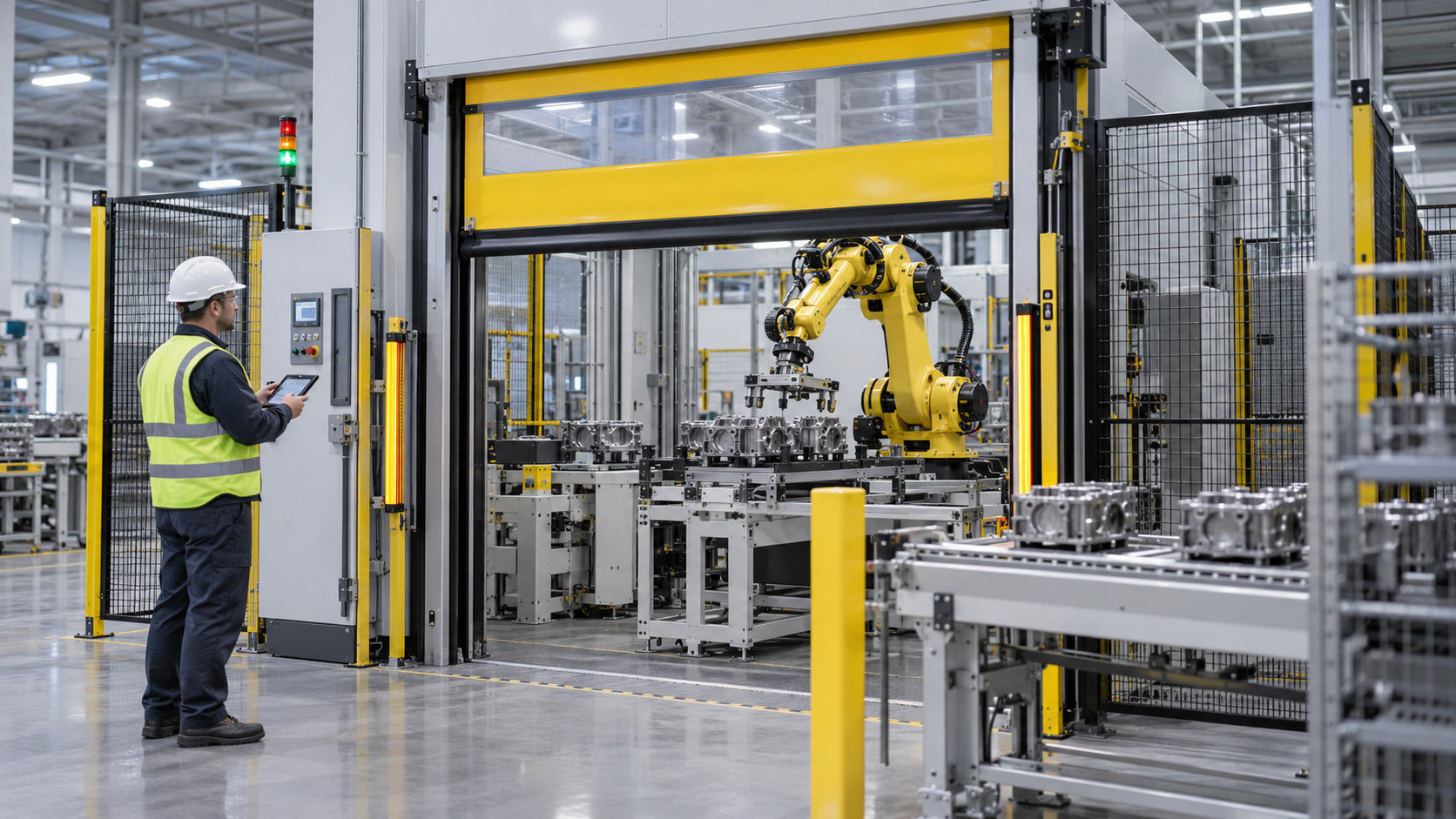
A machine guarding system is a combination of physical guards, protective devices, access controls, and safety-related measures used to reduce exposure to hazardous machinery.
Depending on the application, safeguarding may involve:
- Fixed safety fencing
- Machine safety doors
- Interlocked access gates
- Safety light curtains
- Laser safety scanners
- Guard locking devices
- Safety relays and safety PLCs
- Emergency-stop systems
- Restart prevention measures
- Hazardous-energy isolation procedures
In conventional machinery, fixed guards may provide suitable protection when personnel rarely need access.
In automated production lines, however, conveyors, industrial robots, pallets, and material-handling equipment may need to pass through the guarding boundary repeatedly.
Machine safety doors can provide controlled openings while supporting automated production requirements.
Why Automation Guarding Matters in Robot Cells
Automation guarding is particularly important in facilities where industrial robots operate near personnel, conveyor systems, and moving equipment.
Typical hazards may include:
- Unexpected robot movement
- Crushing or trapping between equipment
- Moving conveyors and transfer devices
- Welding operations
- Rotating machinery
- Automated pallet movement
- Unexpected startup after a stop
A safeguarding system must account for the machine's operating modes, personnel access requirements, stopping characteristics, and foreseeable misuse.
The objective is not simply to install a physical barrier. It is to create a controlled production environment where material movement and human access are managed according to the required protective functions.
What Role Does a Machine Safety Door Play?
A machine safety door provides a movable barrier at an access or material-transfer opening within a guarded machine area.
Typical applications include:
- Robotic welding cells
- Automated assembly stations
- Conveyor transfer openings
- Robot palletizing systems
- CNC loading and unloading areas
- Automated packaging lines
Depending on the risk assessment, the door may need to prevent access during hazardous movement, interact with safety-related interlocks, or remain locked until the machinery reaches a safe condition.
A normal door-open or door-closed signal used for automation should not automatically be treated as evidence of personnel safety.
Machine Safety Door vs Fence vs Light Curtain
Different safeguarding methods provide different forms of protection.
| Safeguarding Method | Physical Barrier | Material Transfer | Typical Application |
|---|---|---|---|
| Fixed Safety Fence | Yes | Requires a designed opening | Robot cell perimeter |
| Safety Light Curtain | No | Possible under validated control conditions | Access points with suitable stopping performance |
| Interlocked Access Gate | Yes | Usually limited | Personnel entry and maintenance |
| Machine Safety Door | Yes | Can support automated transfer | Robot cells, conveyors, automated equipment |
The correct guarding arrangement depends on the hazard, required access, stopping time, operating environment, and applicable safety standards.
7 Essential Requirements for Robot Cell Safety Doors
When specifying robot cell safety doors, engineers should evaluate the complete protective function rather than choosing a door solely by operating speed.
1. Risk Assessment and Hazard Identification
The machine integrator must identify foreseeable hazards associated with robot motion, tooling, material handling, maintenance access, and unexpected startup.
Important questions include:
- Can a person enter the hazardous area?
- Can a person remain inside the cell undetected?
- What hazardous movements occur behind the door?
- Can the equipment stop before a person reaches the hazard?
- Does the application require protective locking?
The required safety functions should be derived from the documented risk assessment.
2. Machine Stopping Time and Safe Access
A machine may continue moving after receiving a stop command.
For example, robot arms, rotating equipment, and moving tooling may require a measurable period to reach a safe state.
Door access must be coordinated with the actual stopping performance of the machinery.
If hazardous movement can remain accessible before it stops, an appropriate guard-locking or alternative protective arrangement may be required.
The stopping time must be measured and verified under the relevant operating conditions.
3. Safety Interlocks and Guard Locking
A safety interlock is designed to connect the status of a protective guard with safety-related machine functions.
Depending on the design, opening an interlocked guard may initiate a protective stop or prevent hazardous motion from starting.
Guard locking is a separate consideration. It may be needed when access must remain prevented until hazardous motion has stopped or another safe condition has been achieved.
Engineers should consider:
- Interlock device suitability
- Guard locking requirements
- Monitoring of guard position
- Protection against foreseeable defeat
- Fault detection
- Emergency release and escape provisions where required
For technical guidance, review ISO 14119 — Interlocking Devices Associated with Guards .
4. Safety PLC and Control System Integration
A standard PLC and a safety PLC do not necessarily perform the same functions.
A conventional PLC may manage normal production commands, such as requesting that a door open for a conveyor transfer.
Safety-related functions must instead be implemented using a suitable control architecture with the required reliability and diagnostic performance.
Depending on the application, this may involve a safety PLC, safety relay, safety-rated interlock, or other validated components.
ISO 13849-1:2023 provides requirements and guidance for designing safety-related parts of control systems.
Reference: ISO 13849-1:2023 .
5. Door Dimensions, Construction and Operating Frequency
Door selection must account for the physical transfer opening and production requirements.
Important information includes:
- Clear opening width and height
- Largest product or pallet dimensions
- Conveyor or robot transfer arrangement
- Required opening frequency
- Available installation clearance
- Environmental conditions
- Required barrier construction
- Visibility and inspection requirements
High-speed doors may help maintain production flow, but opening speed alone does not establish a protective function.
6. Presence Detection and Restart Prevention
A robot cell safeguarding system should consider whether personnel could remain inside the hazardous area after the door closes.
Presence detection, trapped-person protection, reset positioning, and unexpected restart prevention may be necessary depending on the risk assessment.
For example, a person may be obscured by a large pallet or fixture inside the cell.
A conventional photoelectric sensor intended to detect products passing through a doorway should not automatically be considered suitable for personnel protection.
7. Safety Validation and Maintenance
Before a robot cell enters normal production, its safeguarding functions must be tested and documented.
Validation may include:
- Safety interlock operation
- Guard-locking behavior
- Machine stopping performance
- Loss-of-power response
- Emergency-stop functions
- Fault detection and response
- Manual reset operation
- Unexpected restart prevention
- Required maintenance inspections
The acceptance process should produce documented results rather than relying on unverified safety claims.
How Does a Safety Interlock Work with a Machine Guarding Door?
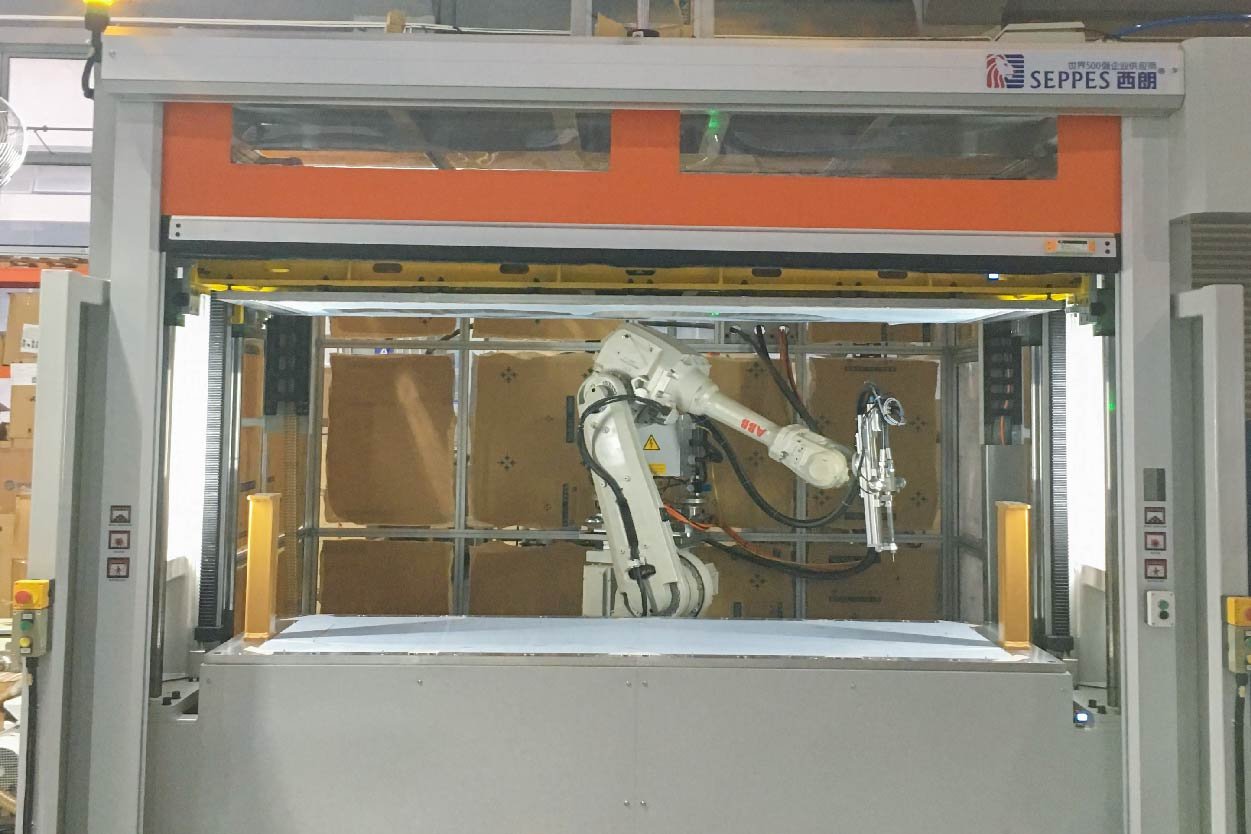
A safety interlock helps coordinate access through a protective door with the safety-related operation of industrial machinery.
The actual control logic depends on the machine risk assessment, the equipment stopping characteristics, and the required protective functions.
Robot Cell Safety Door Control Sequence
The following example illustrates how a robot cell safety door may be coordinated with the production process.
- The production system receives a material-transfer or access request.
- The safety-related control system enforces the required stop or safe operating condition.
- Where necessary, guard locking prevents access until hazardous movement has ceased.
- The door opens when the validated control conditions permit.
- The material transfer takes place under the required protective arrangement.
- The door closes and the relevant closed or locked status is verified.
- Required presence detection, manual reset, and restart interlocks are evaluated.
- Only an authorized restart command permits the machinery to return to operation.
Machine Guarding for Robot Cells
Industrial robots can operate through large working envelopes at high speeds.
Machine guarding should account for foreseeable robot movements, tools, workpieces, fixtures, material-transfer systems, and personnel access.
ISO 10218-1:2025 and ISO 10218-2:2025 address safety requirements for industrial robots and industrial robot applications, including robot cells.
The second part is particularly relevant to machine builders and integrators designing complete robot applications.
Reference: ISO 10218-2:2025 — Industrial Robot Applications and Robot Cells .
Where Are Machine Safety Doors Used?
1. Robotic Welding Cells
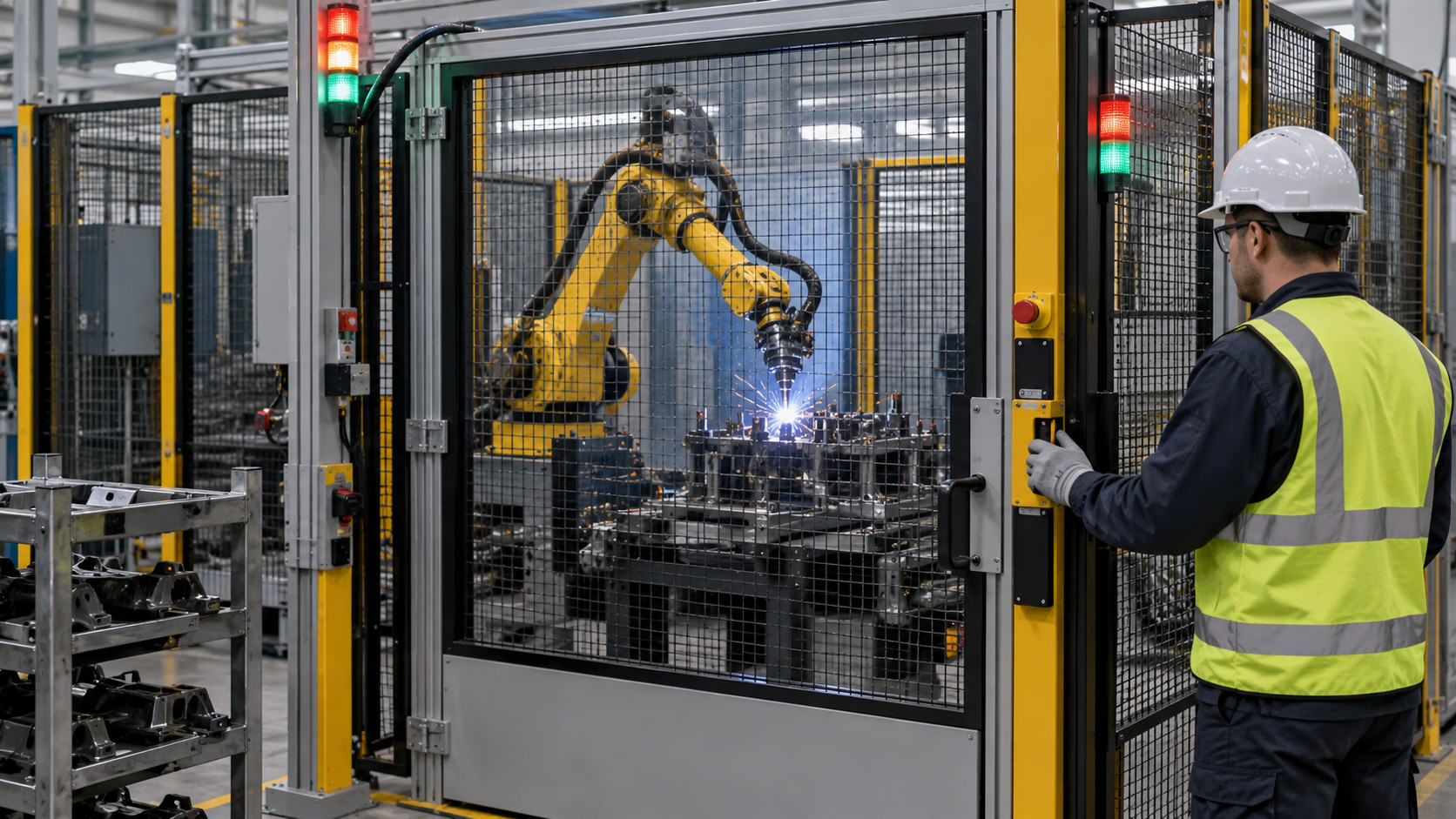
Robotic welding cells may require controlled material transfer while preventing personnel exposure to hazardous robot movement and welding-related risks.
A suitable machine safety door can form part of the physical safeguarding boundary.
However, welding spatter, radiation, fumes, and other process hazards may require additional protective measures.
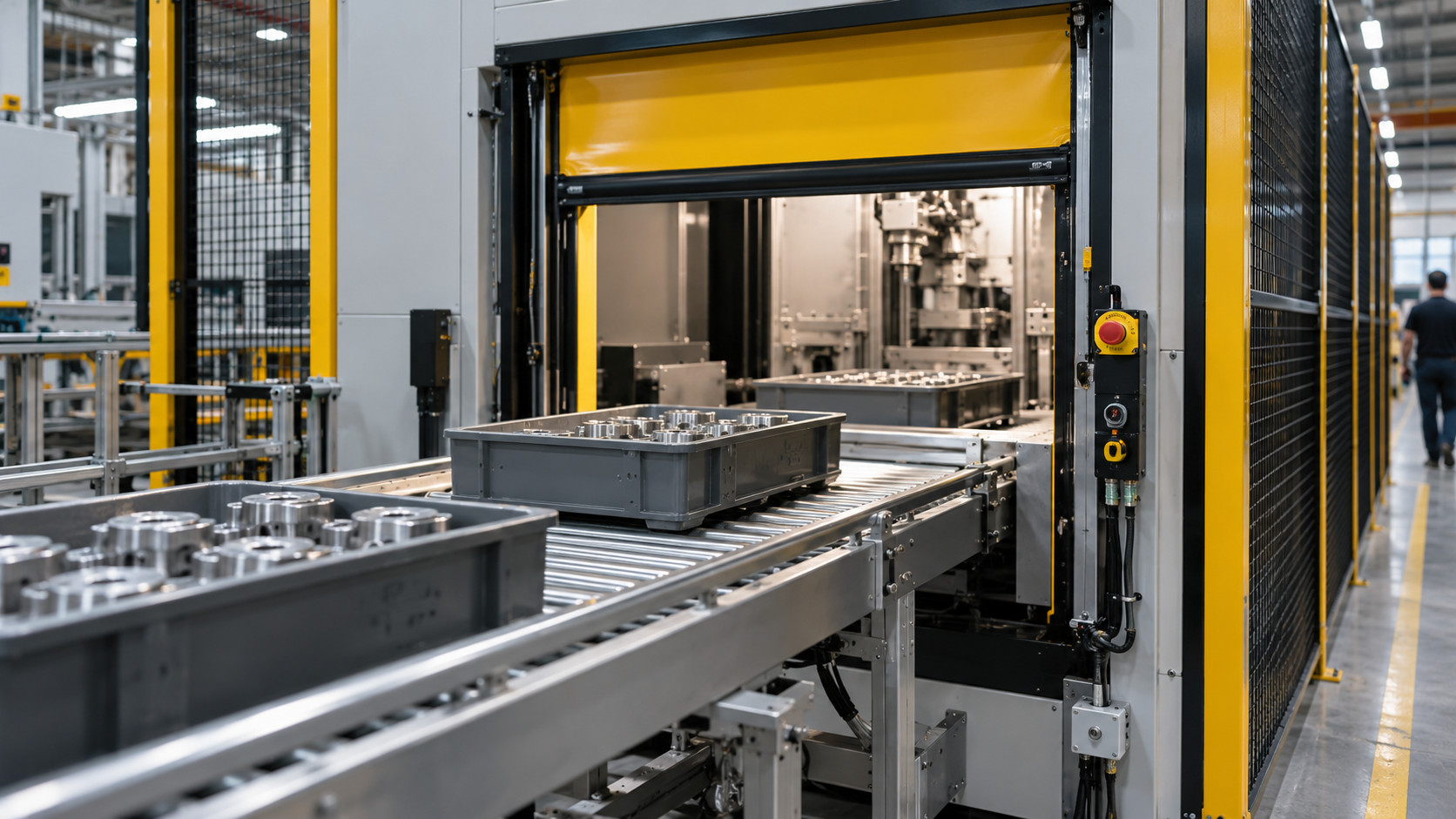
2. Conveyor Production Lines
Conveyors frequently pass through robotic workstations or enclosed manufacturing areas.
A machine safety door may help control the transfer opening between production stages.
The door's operating sequence must be coordinated with the conveyor, machine controller, and required safety functions.
3. Automated Assembly Cells
Automated assembly lines may combine robots, fixtures, conveyors, presses, and inspection systems.
Suitable safeguarding helps separate hazardous machine areas from surrounding operations.
4. CNC and Automated Machining Areas
Machine protection doors may be used around machining centers, robotic loading systems, and equipment containing moving tooling.
Door construction must also account for any process-specific containment hazards.
5. Packaging and Palletizing Lines
Automated packaging and palletizing systems may require frequent transfer of cartons, finished goods, and pallets.
A fast-moving barrier may support material flow where integrated with a suitable safeguarding strategy.
Machine Guarding Standards and 2026 Regulatory Updates
ISO 10218-2:2025 — Robot Cell Integration
Published in 2025, ISO 10218-2:2025 addresses the safety of industrial robot applications and robot cells.
For equipment procurement, the practical implication is that safety door specifications should be linked to the complete robot-cell risk assessment.
The door supplier, machine builder, and system integrator must clearly define their respective technical responsibilities.
ANSI/A3 R15.06-2025 — United States
The 2025 American robot safety standard incorporates updated industrial robot and robot-cell safety requirements.
For U.S. manufacturing projects, buyers should discuss the applicable standard, machine risk assessment, safety functions, and validation responsibilities with the robot-cell integrator.
Reference: ANSI/A3 R15.06-2025 .
European Union Machinery Regulation
Regulation (EU) 2023/1230 on machinery generally applies from January 20, 2027.
For machinery projects being designed in 2026, manufacturers and integrators supplying equipment into the European market should review the transition and applicable conformity requirements.
A safety door alone does not establish regulatory compliance for a complete robot cell.
Official reference: Regulation (EU) 2023/1230 .
Why Physical Machine Guarding Still Matters
Even as sensors, machine vision, and industrial automation advance, physical guarding remains important for many hazardous industrial applications.
In a February 26, 2026 enforcement announcement, OSHA described a fatal machinery incident involving inadequate machine guarding and hazardous-energy controls at a concrete products manufacturer.
The incident does not establish that a specific safety door would have prevented the injury. It does reinforce the importance of risk assessment, restricted access, safeguarding, and hazardous-energy isolation.
Reference: OSHA — February 26, 2026 Enforcement Announcement .
Machine Guarding Specification and Acceptance Checklist
When requesting a robot cell safety door, engineers should provide the following technical information.
| Requirement | Information to Provide |
|---|---|
| Opening dimensions | Clear width × height in mm |
| Machine application | Robot welding, assembly, packaging, CNC or other process |
| Material transfer | Product, pallet, conveyor or transfer-equipment dimensions |
| Operating frequency | Expected door cycles per hour |
| Hazardous stopping time | Measured and validated machine stopping characteristics |
| Safety functions | Interlocking, guard locking, reset and restart prevention |
| Safety controller | Required PLr or SIL target and proposed control architecture |
| Feedback requirements | Door closed, locked and diagnostic signals where applicable |
| Environment | Dust, welding spatter, temperature and other exposure |
| Installation space | Available headroom, sideroom and structural clearance |
| Acceptance testing | Commissioning, fault tests and validation documentation |
| Project documents | Layout drawings, wiring diagrams, photos and risk assessment |
Common Robot Cell Guarding Design Mistakes
Using a Standard Fast Door as a Safety-Rated Guard
Fast opening and closing capability does not automatically establish protective safety performance.
Confusing Normal PLC Signals with Safety Functions
An ordinary PLC status input does not necessarily provide the reliability required for personnel protection.
Ignoring Machine Stopping Time
Hazardous movement may continue after the stop command. Access conditions must reflect actual stopping performance.
Failing to Prevent Unexpected Restart
A robot cell should not restart unexpectedly when someone may remain inside the hazardous area.
Ignoring Guard Locking Requirements
Where hazardous movement persists, a suitable guard-locking arrangement may be necessary.
Skipping Validation
Correct installation should be supported by required functional tests and safety documentation.
Assuming a Certificate Covers the Entire Robot Cell
A component certificate does not automatically establish compliance of the completed machinery installation.
Frequently Asked Questions About Machine Guarding Systems
What is a machine guarding system?
A machine guarding system combines physical barriers, protective devices, access controls, and safety-related measures to reduce exposure to hazardous machinery.
What is a robot cell safety door?
A robot cell safety door is a movable barrier at a controlled access or material-transfer opening within a safeguarded robot application.
Can a machine safety door work with a robot cell?
Yes. Suitable machine safety doors may be integrated with robotic welding, assembly, palletizing, and material-transfer applications under an appropriate safeguarding design.
Can a machine safety door connect to a PLC?
Yes, compatible doors may exchange operational signals with PLCs. Safety-related functions must be implemented and validated using a suitable safety-control architecture.
Are machine safety doors suitable for conveyor systems?
They may be suitable for conveyor transfer openings where the door and conveyor are integrated into the required guarding and control strategy.
Does a machine safety door automatically make a robot cell compliant?
No. Compliance depends on the complete machinery design, risk assessment, safety functions, documentation, and validation.
Does a standard PLC door-closed signal provide personnel protection?
No. An ordinary operational door-position signal should not automatically be treated as safety-rated feedback.
When is guard locking necessary?
Guard locking may be necessary when personnel could reach hazardous motion before it has stopped or when the risk assessment identifies another reason to prevent access.
Which safety performance level is required for a robot cell door?
There is no universal performance level for every application. The required PLr or other target must be determined from the machine risk assessment and the specific protective functions.
SEPPES Machine Protection Doors and Related Solutions
SEPPES provides customizable industrial machine protection doors for automation, industrial equipment, and factory production applications.
Door configurations can be reviewed according to clear opening dimensions, operating frequency, material-transfer requirements, installation space, and automation interfaces.
The machine builder or integrator remains responsible for determining and validating the complete robot-cell safeguarding architecture.
Explore the following resources:
- SEPPES Machine Protection Door
- High-Speed Door Conveyor PLC Integration Guide
- Industrial High-Speed Door Solutions
Need a Machine Safety Door for Your Automated Production Line?
Every robot cell and automated production line has different dimensions, cycle requirements, hazardous movements, and control interfaces.
SEPPES can help review the mechanical door requirements and available equipment configurations for automated production applications.
To request a product recommendation or quotation, provide your opening width and height, robot or machine type, expected operating frequency, control requirements, and installation drawings.
Contact SEPPES About Your ProjectTechnical References
- ISO 10218-2:2025 — Industrial Robot Applications and Robot Cells
- ISO 14119 — Interlocking Devices Associated with Guards
- ISO 13849-1:2023 — Safety-Related Parts of Control Systems
- ANSI/A3 R15.06-2025
- Regulation (EU) 2023/1230 — Machinery Regulation
- OSHA — February 26, 2026 Machine Guarding Enforcement Announcement
- International Federation of Robotics
Technical Disclaimer: This article provides general engineering guidance. Machine guarding requirements depend on the specific application, applicable standards, risk assessment, and validated safety functions. Equipment should not be represented as safety-certified for a particular robot cell without appropriate evidence.