
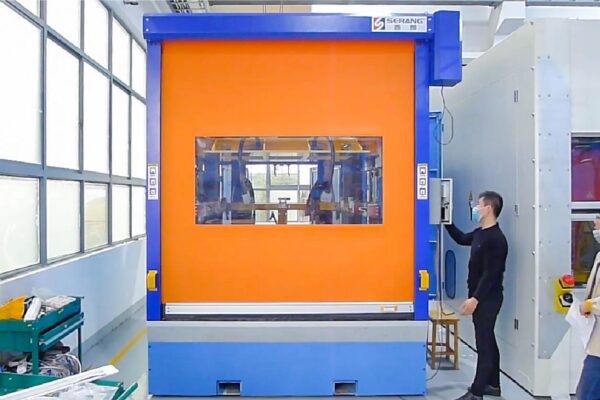
Machine Guarding Systems for Automated Production Lines: How Safety Doors Protect Robot Cells
As factories add more industrial robots, conveyors, automated assembly systems and material-handling equipment, machine guarding systems are becoming an increasingly important part of production-line design. Automation can improve productivity, but it also creates areas where moving robots, tooling and machinery need to be physically separated from personnel.
One increasingly practical solution is the machine safety door. Integrated with fencing, sensors, a PLC and a safety interlock, an automated safety door can create controlled access points for robot cells while still allowing materials, pallets, conveyors or automated equipment to move through the production line.
Source: International Federation of Robotics – World Robotics 2026
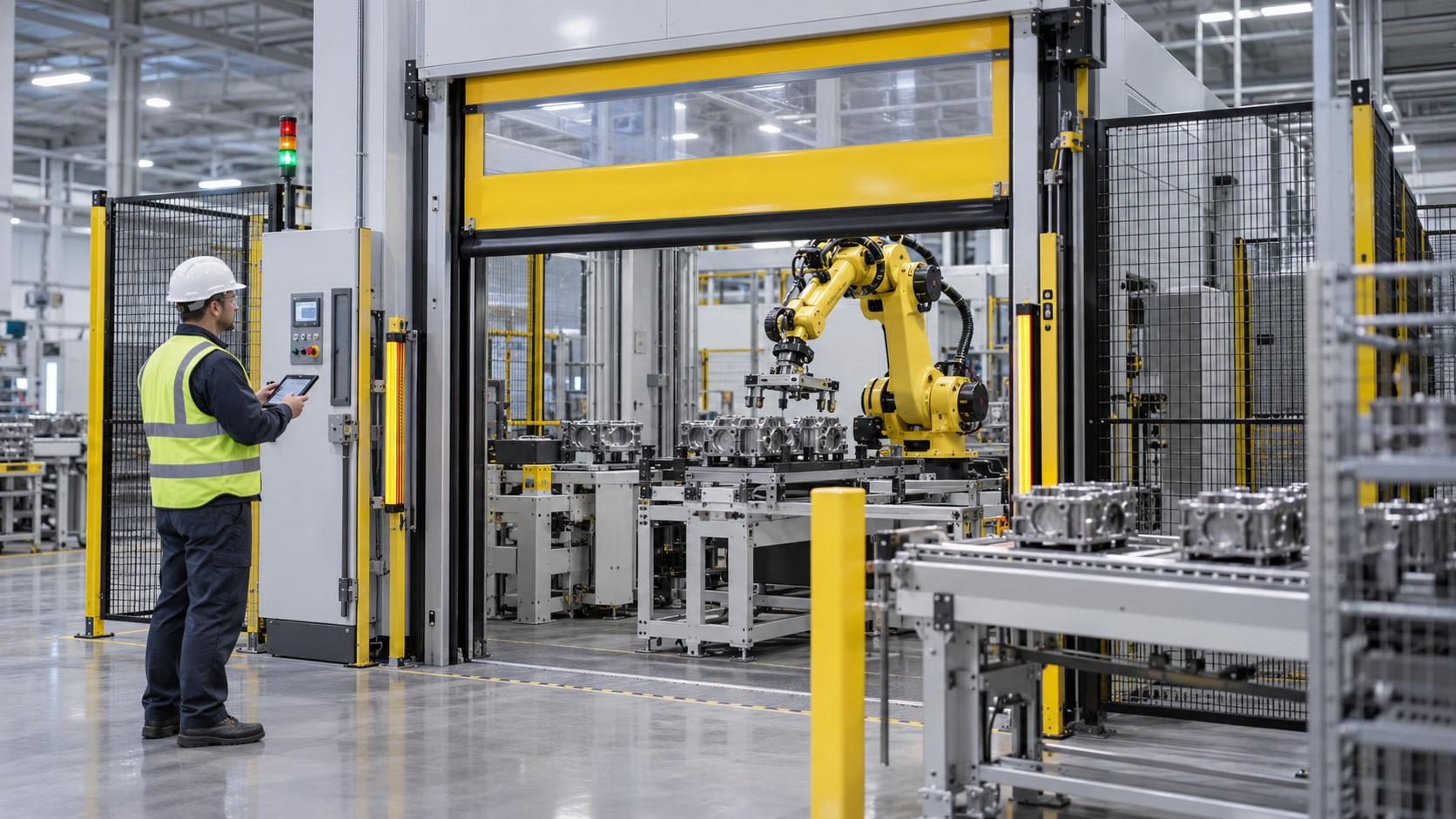
What Are Machine Guarding Systems?
A machine guarding system is designed to reduce access to hazardous areas around industrial machinery. Depending on the application and risk assessment, safeguarding may involve fixed fencing, access doors, interlocked guards, light curtains, safety scanners, emergency stops and other protective devices.
In traditional machinery, a fixed guard may be sufficient because operators rarely need access to the hazardous area. Modern automated production lines are more complex. Parts may continuously enter and leave robot cells, conveyors may run through protected areas, and technicians may require controlled access for maintenance.
This is where machine safety doors can become part of a larger machine guarding system.
Why Machine Guarding Matters More as Factory Automation Grows
Industrial automation is no longer limited to automotive assembly plants. Robot cells, automated conveyors and programmable machinery are increasingly being used in metalworking, electronics, packaging, food processing, logistics and general manufacturing.
The International Federation of Robotics reported that the number of industrial robots operating globally increased by 9% in 2025. Annual installations increased by 11%, pushing the global operating stock to approximately five million units.
More automation means factories need to manage an important design challenge:
The answer is rarely a single product. Effective machine safeguarding can involve several technologies working together.
- Physical safety fencing
- Machine safety guards
- Interlocked access doors
- High-speed machine safety doors
- Safety light curtains
- Laser scanners
- Safety relays or safety PLCs
- Emergency stop systems
- Lockout/tagout procedures for servicing
What Role Does a Machine Safety Door Play?
A machine safety door creates a movable physical barrier at locations where fixed guarding cannot completely close the opening.
Common examples include openings where:
- Parts enter a robot welding cell.
- A conveyor transfers products between production processes.
- Pallets move into an automated machine area.
- AGVs or automated handling equipment enter a protected zone.
- Operators require controlled maintenance access.
Unlike a permanent fence, the door can open when access or material transfer is permitted and close before hazardous equipment resumes normal operation.
Machine Safety Door vs. Fence vs. Light Curtain
Different safeguarding technologies solve different problems. The right solution depends on the application, stopping time, access requirements, process risks and applicable safety standards.
| Safeguarding Method | Physical Barrier | Material Flow | Automated Integration | Typical Application |
|---|---|---|---|---|
| Fixed Safety Fence | Oui | Limité | Faible à moyen | Permanent robot-cell perimeter |
| Light Curtain | Non | Bonne | Élevé | Open access points where machine stopping can provide protection |
| Interlocked Access Gate | Oui | Limité | Élevé | Personnel maintenance access |
| Machine Safety Door | Oui | Bonne | Élevé | Robot cells, conveyors and automated material-transfer openings |
How Does a Safety Interlock Work with a Machine Guarding Door?
One of the most important concepts in modern machine guarding systems est la safety interlock.
Rather than operating as an independent industrial door, the safety door can communicate with the production equipment or robot control system.
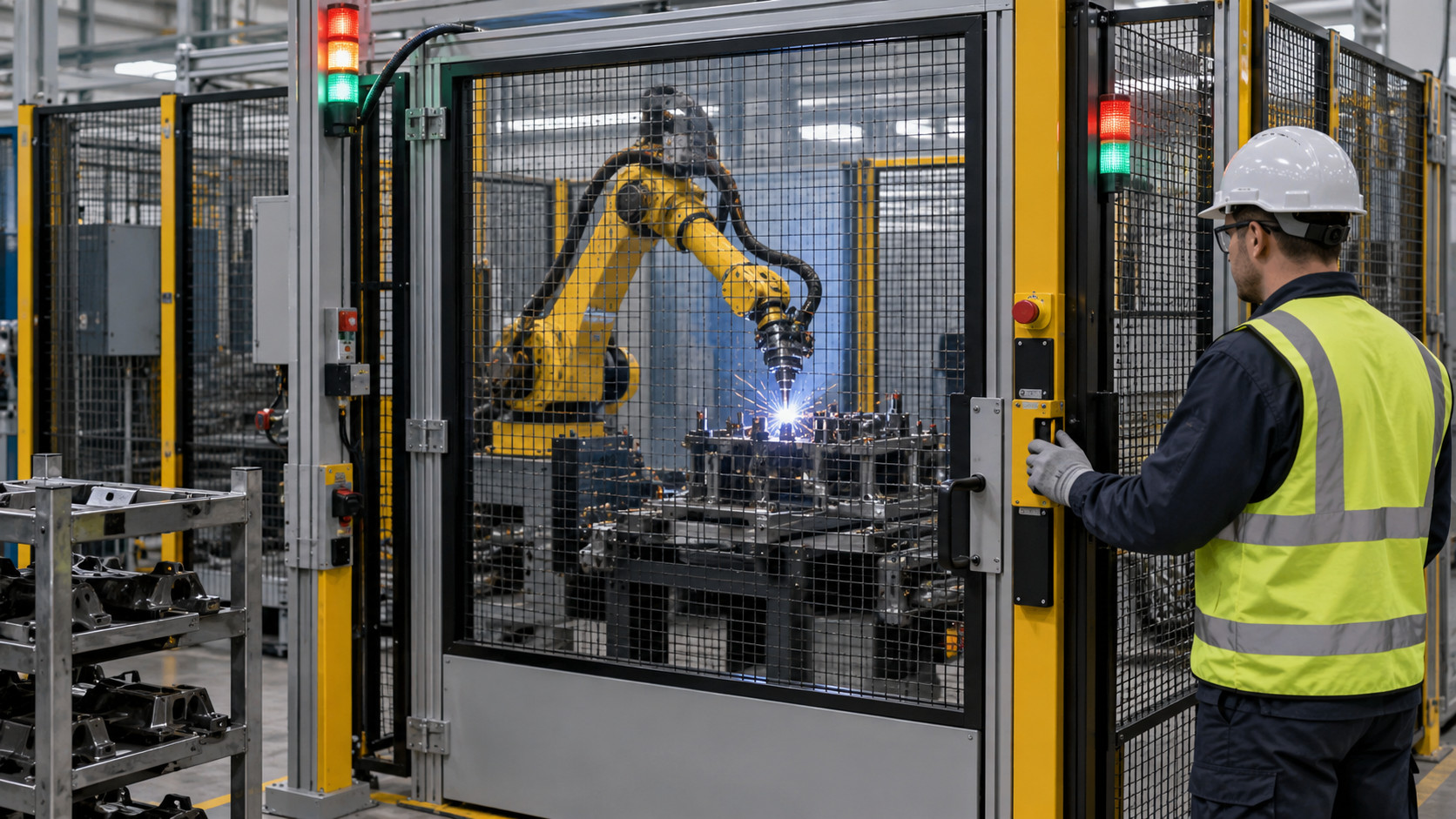
A simplified operating sequence may look like this:
- The robot or machine completes the current hazardous movement.
- The control system confirms that the cell has reached the required safe condition.
- The machine safety door receives an opening command.
- The door opens and allows a product, pallet or conveyor load to pass.
- After the material clears the opening, the door closes.
- The control system receives confirmation that the protective opening is secured.
- The machine or robot is permitted to resume production according to the validated safety-control architecture.
Depending on the project, communication and automation interfaces may involve dry contacts, PLC I/O, safety relays or industrial communication networks. The precise architecture should always be determined by the machine builder or safety integrator.
Machine Guarding for Robot Cells
Robot cells are one of the most common applications for industrial machine guarding because an industrial robot can move quickly through a large working envelope.
According to the 2025 edition of ISO 10218, industrial robot safety is addressed through requirements for both the robot itself and its integration into complete robotic applications.
ISO lists:
- ISO 10218-1:2025 – Robotics — Safety requirements — Part 1: Industrial robots
- ISO 10218-2:2025 – Robotics — Safety requirements — Part 2: Industrial robot applications and robot cells
You can review the standards information through the International Organization for Standardization .
For machine builders and production engineers, this reinforces an important principle: robot safety is not only about the robot arm. The entire application—including access points, guarding, control systems and interactions with personnel—needs to be considered.
Where Are High-Speed Machine Safety Doors Used?
1. Robotic Welding Cells
Robotic welding frequently requires components to move into and out of an enclosed area. A physical safety barrier can help separate welding operations from surrounding personnel while a controlled opening supports production flow.
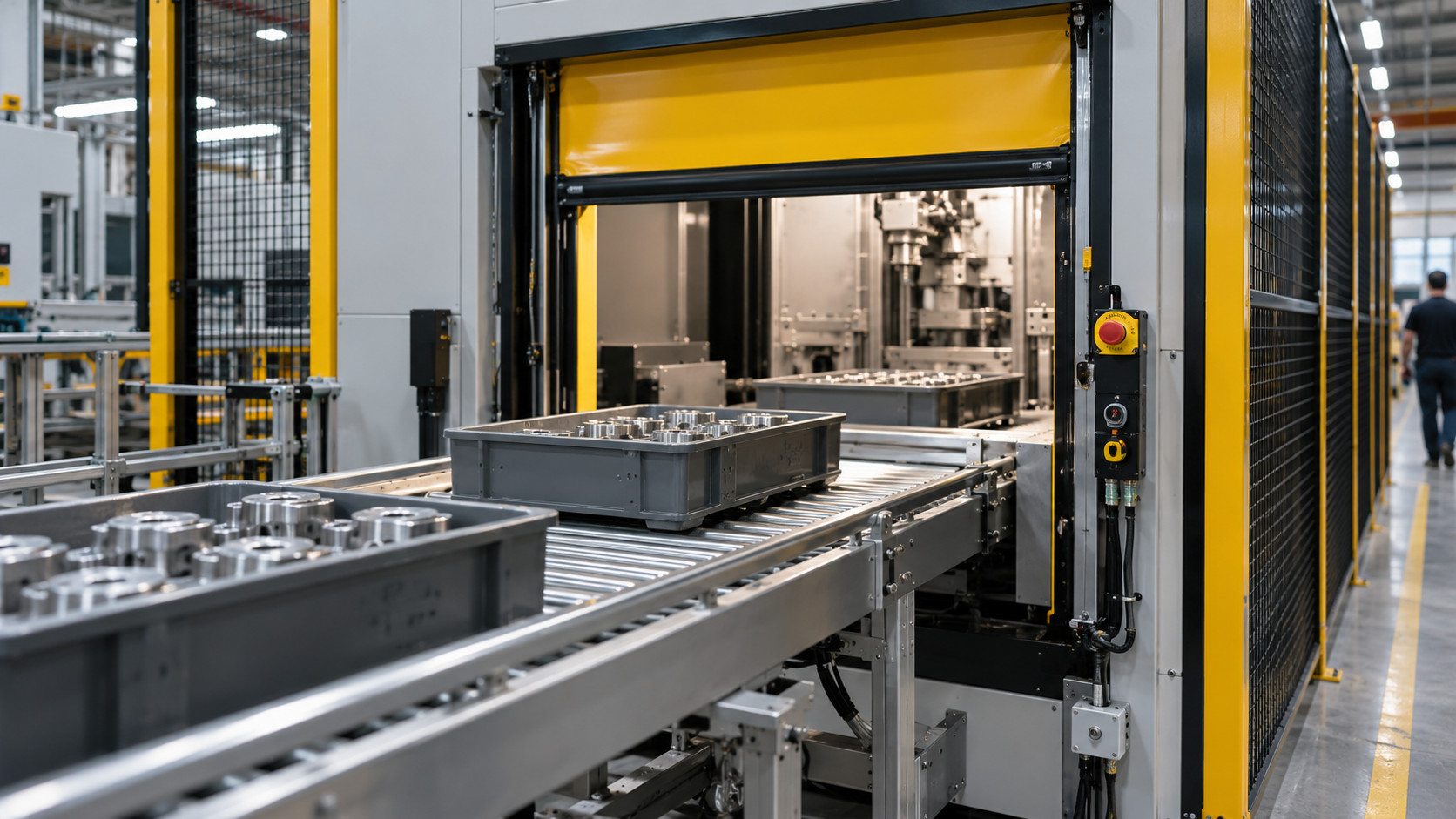
2. Conveyor Production Lines
A conveyor often needs to pass directly through a guarded machine area. Leaving the opening permanently exposed can undermine the purpose of physical machine guarding.
A high-speed machine safety door can open for product transfer and close between cycles, depending on the designed safeguarding strategy.
3. Automated Assembly Cells
Assembly cells may combine robots, fixtures, presses, conveyors and inspection systems. Automated doors can help create controlled material-transfer points between connected processes.
4. CNC and Automated Machining Areas
Automated machining areas can contain moving tooling, spindles, loading robots and material-handling equipment. Physical separation can help restrict access while equipment is operating.
5. Packaging and Palletizing Lines
High-throughput packaging lines often require frequent movement of cartons, pallets or finished products. A fast-opening barrier can help support cycle efficiency while maintaining separation between people and automated equipment.
Why Physical Machine Guarding Still Matters
Advanced sensors, cameras and software are changing manufacturing, but physical machine guarding remains important in many applications.
A February 2026 enforcement announcement from the U.S. Occupational Safety and Health Administration illustrates the continuing relevance of guarding. OSHA cited a concrete products manufacturer after a worker entered an unprotected area of a concrete block cubing machine and suffered fatal injuries. OSHA reported violations involving inadequate machine guarding and lockout/tagout practices.
The case does not mean that one particular type of safety door would have prevented the incident. However, it demonstrates why machine access, guarding and hazardous-energy controls continue to require careful engineering attention.
Source: U.S. Occupational Safety and Health Administration .
Machine Safeguarding Requirements: What Should Engineers Consider?
There is no universal machine guarding configuration that fits every automated production line. Before specifying a machine safety door, engineers should evaluate the complete machine system.
Hazardous Movement
Identify the type of hazard behind the door, such as robotic movement, cutting, welding, pressing, material handling or rotating machinery.
Machine Stopping Time
The control strategy must account for how long hazardous movement takes to reach a safe state before access becomes possible.
Taille de l'ouverture
The opening should be designed around the largest product, pallet, conveyor load or equipment that must pass through it.
Required Cycle Frequency
A door operating a few times per shift has different performance requirements from a door opening hundreds or thousands of cycles during production.
Integration Method
Determine how the door will communicate with the machine or automation system. Possible interfaces may include conventional I/O, dry contacts, PLC integration and industrial communication protocols.
Dispositifs de sécurité
Depending on the design, the system may incorporate interlocks, safety switches, light curtains, photoelectric sensors, safety edges or other devices.
Preparing Automated Machinery for the EU Machinery Regulation
European machinery requirements are also entering an important transition period.
Le Règlement (UE) 2023/1230 sur les machines will generally apply from 20 January 2027. Manufacturers, system integrators and companies supplying machinery into the European market should therefore consider how machinery, safeguarding and safety-related control functions fit within the applicable regulatory framework.
Official text: EUR-Lex – Regulation (EU) 2023/1230 .
A machine safety door alone does not establish regulatory compliance. Compliance depends on the complete machinery design, risk assessment, safety functions, documentation and applicable conformity-assessment process.
How to Choose a Machine Safety Door for an Automated Production Line
Before requesting a machine guarding door, provide the supplier or system integrator with as much application information as possible.
| Project Information | Pourquoi c'est important |
|---|---|
| Clear opening width × height | Determines the required door dimensions. |
| Type of robot or machine | Helps define the operating environment and integration requirements. |
| Product or pallet size | Determines the required transfer opening. |
| Cycle frequency | Influences door speed, motor selection and durability requirements. |
| Existing PLC/control system | Helps define communication and control interfaces. |
| Safety concept | Determines how the door fits into the overall safeguarding architecture. |
| Available installation space | Determines whether the door structure fits around the robot cell or conveyor. |
| Site drawings/photos | Helps suppliers understand the actual installation conditions. |
Machine Safety Door Integration with Conveyors and Automation
For many automated factories, the biggest advantage of a machine safety door is not simply opening speed. It is the ability to become part of the overall automated process.
This type of integration is particularly useful for factories that want to maintain physical separation without requiring an operator to manually open and close a barrier during every production cycle.
Machine Guarding Systems Are Becoming Part of Smart Factory Design
The rapid growth of industrial robotics is changing how factories think about safety barriers.
In older production environments, machine guards were often treated as static structures positioned around individual machines. In modern automated facilities, guarding increasingly needs to interact with production equipment.
That means the future of machine guarding systems is likely to involve closer integration between:
- Industrial robots
- Machine safety doors
- Safety PLCs and relays
- Conveyor systems
- AGVs and automated material handling
- Production control systems
- Access-control devices
- Safety sensors and scanners
The objective is not simply to place a barrier around a robot. It is to create a controlled production environment where machines and materials can move efficiently while personnel access remains appropriately managed.
Machine Guarding Door Project Checklist
- Required opening width and height
- Robot or machine type
- Production-line layout
- Conveyor or pallet dimensions
- Required opening frequency
- Desired opening/closing sequence
- PLC or automation interface
- Existing machine safeguarding design
- Available installation space
- Site photos, drawings or videos
Frequently Asked Questions About Machine Guarding Systems
What is a machine guarding system?
A machine guarding system is a combination of physical guards, access controls, safety devices and control measures designed to help restrict personnel from hazardous machinery areas.
What is a machine safety door?
A machine safety door is an automated or controlled physical barrier installed at an access or material-transfer opening in a guarded machine area.
Can a machine safety door work with a robot cell?
Yes. Machine safety doors are commonly considered for robotic welding, automated assembly, material handling, conveyor transfer and other robot-cell applications.
Can machine safety doors connect to a PLC?
Depending on the door control system and project design, machine safety doors can exchange signals with PLCs, relays and other automation equipment.
Are machine safety doors suitable for conveyor systems?
They can be particularly useful where a conveyor must pass through a physical machine-guarding boundary.
Does installing a machine safety door automatically make a robot cell compliant?
No. A safety door is only one component of the overall safeguarding system. Compliance depends on the complete risk assessment, control architecture, guarding design and applicable standards or regulations.
Need a Machine Safety Door for Your Automated Production Line?
Every robot cell and automated production line has different opening dimensions, cycle requirements and automation interfaces.
If you are designing a machine guarding system for a robot cell, conveyor or automated production line, provide your opening dimensions, equipment layout and site drawings so the application can be reviewed.
Contact Us About Your ProjectLearn More About Industrial Door Solutions
Machine safety doors are only one part of industrial access and automation. You can explore additional industrial door solutions for manufacturing, logistics and automated facilities at WorkshopDoor.com .
Reference sources: International Federation of Robotics, ISO, U.S. Occupational Safety and Health Administration, and EUR-Lex. Standards and regulatory requirements may vary by country, machinery type and application.