
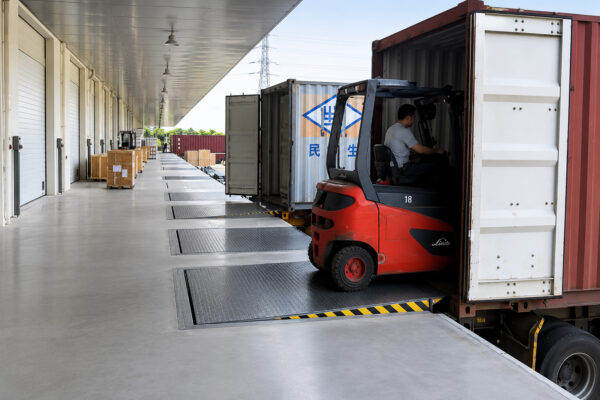
Die Lagerautomatisierung entwickelt sich schnell von isolierten Maschinen zu vernetzten Materialtransportsystemen.
Roboter transportieren Waren. Automatisierte Förderanlagen bewegen Kartons zwischen Arbeitsstationen. Lagerverwaltungssysteme koordinieren den Bestand. AGVs und AMRs werden zunehmend eingesetzt, um Materialien ohne kontinuierliche menschliche Steuerung zu bewegen.
Doch es gibt einen Bereich, der bei einem Automatisierungsprojekt leicht übersehen werden kann:
Im Juni 2026, stellte Amazon die nächste Generation seines autonomen mobilen Roboters Proteus vor als Teil einer bedeutenden europäischen Fulfillment-Investition. Der ursprüngliche Proteus ist bereits in 25 Fulfillment-Centern in den Vereinigten Staaten im Einsatz und arbeitet hauptsächlich in Rampebereichen, wo er schwere Wagen transportiert. Die nächste Generation ist darauf ausgelegt, über die Rampe hinauszugehen und in gesamten Fulfillment-Centern zu operieren.
Dies ist ein anschauliches Beispiel für einen breiteren Wandel.
Wenn der Materialfluss innerhalb eines Lagers schneller und automatisierter wird, kann die Ladebucht nicht länger als ein völlig separater manueller Vorgang behandelt werden.
Für Lager mit hohem Durchsatz, Distributionszentren und Produktionsanlagen, wird die Laderampenautomatisierung zu einem wichtigen Bestandteil des gesamten Logistikworkflows.
Doch wie sieht eine automatisierte Laderampe tatsächlich aus, und wie sollten Unternehmen eine solche gestalten?
Inhaltsübersicht
Umschalten aufWarum Laderampenautomatisierung im Jahr 2026 wichtig ist
Automatisierung ist nicht länger auf eine kleine Anzahl hochmoderner Fulfillment-Center beschränkt.
DHL berichtete, dass das Unternehmen mehr als 1 Milliarde € in Automatisierung investiert hat in seiner Vertragslogistiksparte über drei Jahre. Sein Netzwerk nutzt mehr als 7.500 Roboter und nahezu 800.000 IoT-Sensoren, während mehr als 90% der DHL-Lager weltweit mindestens eine Automatisierungs- oder Digitalisierungslösung besitzen.
DHLs neuerer Logistics Trend Radar Echo, basierend auf Antworten von mehr als 2.500 Supply-Chain-Fachleuten, stuft Robotik ebenfalls als einen der bedeutendsten Technologiecluster ein, die die Logistik prägen, wobei die operative Effizienz zu den Hauptgründen gehört, warum Unternehmen in diese Technologien investieren.
Diese Entwicklungen werfen eine einfache operative Frage auf:
Was geschieht, wenn Waren schnell durch ein automatisiertes Lager bewegt werden, aber dennoch an einer manuell betriebenen Laderampe warten?
Eine Laderampe kann zum Engpass werden, wenn:
- Lkw zu lange auf eine verfügbare Rampe warten;
- Mitarbeiter Tore und Rampengeräte manuell koordinieren müssen;
- Überladebrücken nicht mit anderen Geräten integriert sind;
- Gabelstapler oder AGVs auf die korrekte Beladesequenz warten;
- Fahrer und Lagerbetreiber sich ausschließlich auf verbale Kommunikation verlassen;
- Geräte in der falschen Reihenfolge betrieben werden können;
- Informationen über die Rampenbelegung dem Lagersystem nicht zur Verfügung stehen.
Das Ziel der Laderampenautomatisierung besteht daher nicht einfach darin, eine Überladebrücke automatisch zu bewegen.
Es besteht darin, einen koordinierten Ladeprozess.
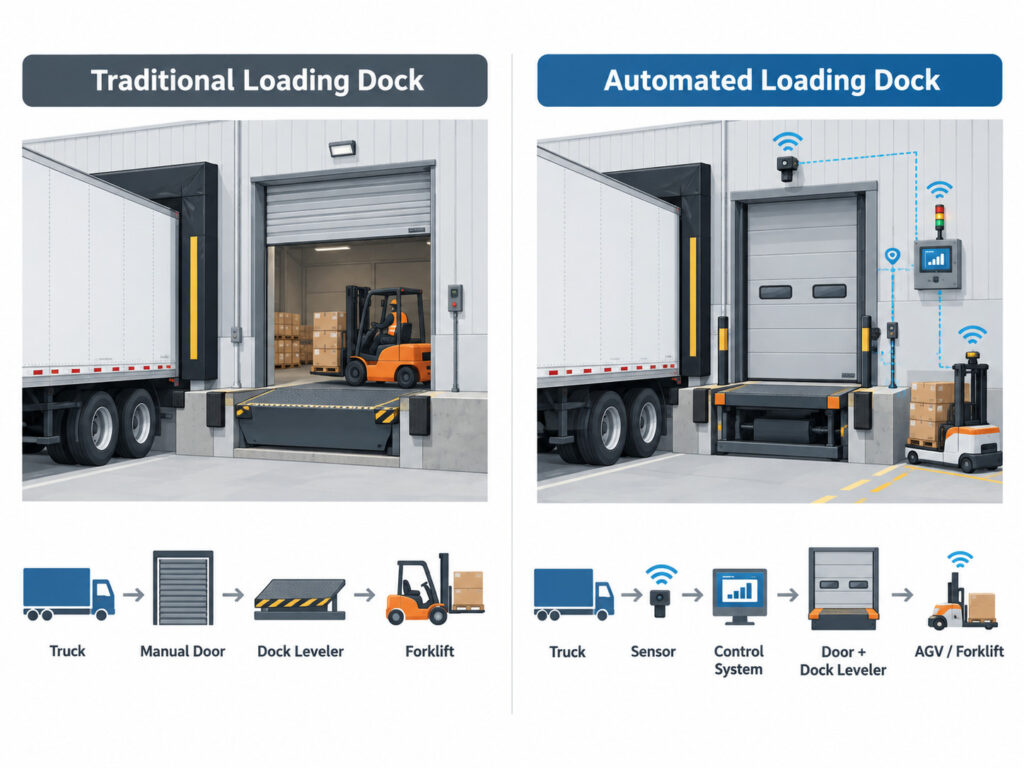
Vorgeschlagenes Bild 1 – Hier einfügen
Bildkonzept:
Traditionelle Laderampe vs. automatisierte Laderampe.
Links:
Lkw → Manuelles Tor → Manuelle Überladebrücke → Gabelstapler
Rechts:
Lkw → Sensor → Steuerungssystem → Industrietor + Überladebrücke + Rückhaltevorrichtung → Gabelstapler / AGV
Die Grafik sauber halten mit minimalem englischen Text.
Was ist Laderampenautomatisierung?
Laderampenautomatisierung bezeichnet die Nutzung automatischer Geräte, Sensoren, Steuerungssysteme und Kommunikationsschnittstellen zur Koordinierung der Aktivitäten zwischen dem Lager und dem Fahrzeug an der Laderampe.
Eine konventionelle Rampe könnte bestehen aus:
- Industrietor;
- Laderampenausgleichern;
- Rampendichtung;
- Drucktastensteuerung;
- Gabelstapler.
Eine stärker automatisierte Laderampe könnte zusätzlich umfassen:
- Fahrzeugerkennungssensoren;
- Rampenbelegungsüberwachung;
- automatische Torsteuerungen;
- hydraulische Überladebrückensteuerungen;
- Fahrzeugrückhaltevorrichtungen;
- Ampeln;
- Sicherheitsverriegelungen;
- SPS-Kommunikation;
- WMS- oder Yard-Management-Integration;
- AGV- oder AMR-Schnittstellen.
Der Unterschied liegt nicht einfach in der Anzahl der Geräte.
Der entscheidende Unterschied besteht darin, dass die Geräte kommunizieren und gemäß einer kontrollierten Sequenz arbeiten.
Von eigenständigen Geräten zu einer vernetzten Ladebucht
Betrachten wir einen traditionellen Ladevorgang.
Ein Lkw kommt an.
Ein Mitarbeiter bestätigt, dass er korrekt positioniert ist.
Das Industrietor wird geöffnet.
Die Überladebrücke wird aktiviert.
Ein Gabelstapler fährt in den Auflieger.
Nach Abschluss des Beladens bringt der Bediener die Überladebrücke in ihre Ruheposition zurück und schließt das Tor.
Jeder Schritt hängt stark davon ab, dass Personen das korrekte Verfahren befolgen.
In an automated loading dock, some of these steps can be monitored, controlled or interlocked.
A simplified sequence might look like this:
Truck arrives
↓
Vehicle position detected
↓
Truck secured / loading permission confirmed
↓
Industrietor öffnet
↓
Überladebrücke fährt aus
↓
Loading authorization activated
↓
Forklift / AGV begins material transfer
↓
Loading completed
↓
Dock leveler returns
↓
Door closes
↓
Vehicle released
Not every warehouse needs every step to be fully automatic.
The important principle is that the equipment should work as one loading bay system rather than several unrelated products.
1. Automatische Überladebrücken werden Teil der Steuerungssequenz
The dock leveler remains one of the most important components of a loading bay.
Its job is to bridge the height and distance difference between the warehouse floor and truck bed, allowing forklifts and other material-handling equipment to move between them.
Hydraulic dock levelers are particularly suitable for high-frequency loading environments because platform lifting and lip operation can be controlled electrically and hydraulically.
But in a smart loading dock, the question changes from:
“Can the dock leveler operate automatically?”
to:
“Can the dock leveler operate safely as part of the warehouse loading sequence?”
For example, the system may prevent the leveler from deploying before:
- the truck is correctly positioned;
- the industrial door is open;
- the loading area is authorized for operation.
Likewise, the door should not necessarily close while the leveler remains deployed.
This type of interlocking reduces dependence on operator memory and helps create a more controlled workflow.
2. Industrietore und Überladebrücken können zusammenwirken
The industrial door is another critical part of loading dock automation.
Instead of treating the door and leveler as independent machines, their control logic can be coordinated.
Zum Beispiel:
Step 1
Truck reaches the loading position.
Step 2
The system confirms that loading conditions are ready.
Step 3
The industrial sectional door opens.
Step 4
The hydraulic dock leveler deploys.
Step 5
The loading process begins.
When loading is complete:
Step 6
The dock leveler returns to its stored position.
Step 7
The industrial door closes.
This sequence is particularly useful in warehouses with:
- high truck traffic;
- multiple loading bays;
- strict safety procedures;
- cold-storage requirements;
- automated material-handling systems.
It can also reduce situations where equipment is operated in the wrong order.
3. Sensoren verleihen der Laderampe Wahrnehmungsfähigkeit
Automation requires information.
That is why sensors are becoming increasingly important around loading bays.
Depending on the project, sensors may be used to detect:
- vehicle presence;
- truck position;
- door status;
- Position der Überladebrücke;
- loading area occupancy;
- obstacles;
- vehicle restraint status.
This information can then be sent to a PLC or other control system.
Instead of asking an employee:
“Is the truck ready?”
the system can use defined signals to determine whether the next operation should be permitted.
This becomes increasingly important as warehouses introduce autonomous equipment.
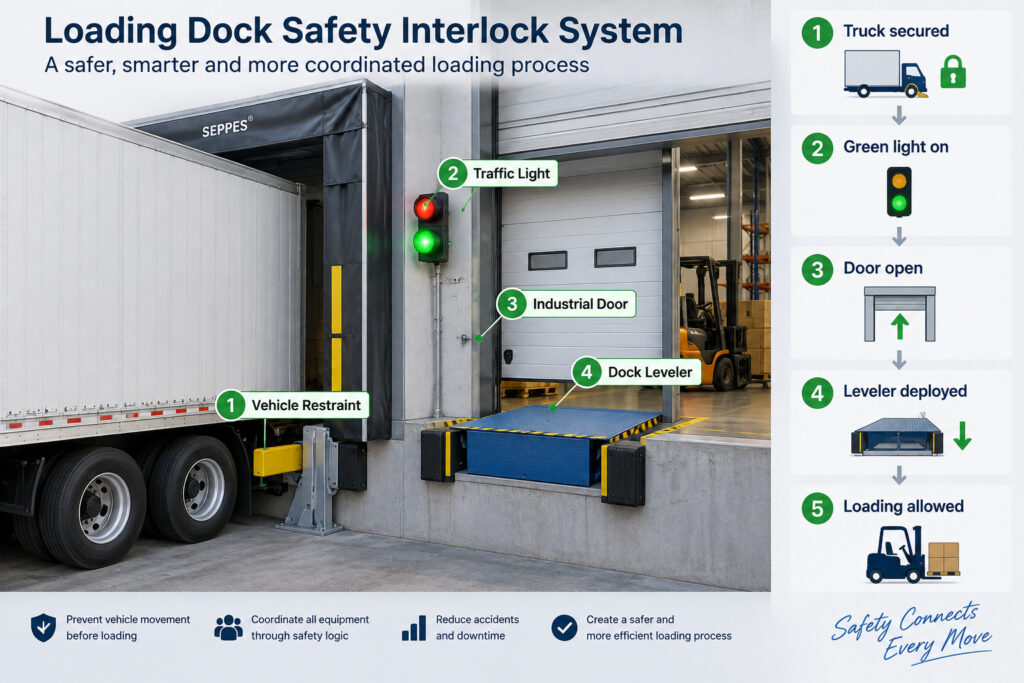
4. Ampeln und Fahrzeugrückhaltesysteme verbessern die Koordination
A loading dock connects two very different environments:
the warehouse und the truck yard.
That means automation must coordinate not only machines but also people.
Traffic lights can provide clear visual signals to warehouse employees and truck drivers.
Zum Beispiel:
Outside: Red light
The driver should remain stationary while loading is taking place.
Inside: Green light
Warehouse personnel are authorized to begin loading.
Vehicle restraints can provide another layer of protection by helping prevent unexpected trailer movement or premature departure.
This is especially important when forklifts travel between the dock and trailer.
OSHA identifies loading docks as potentially dangerous areas for forklifts and specifically warns about risks including forklifts falling from dock edges or between docks and unsecured trailers. OSHA requirements also address preventing trucks or trailers from moving during loading and unloading operations.
Automation therefore should not be designed only around speed.
Safety logic must remain part of the control strategy.
Suggested Image 2 – Insert here
Bildkonzept:
Loading dock safety interlock diagram:
Lkw
↓
Fahrzeugrückhaltung
↓
Ampel
↓
Industrielle Toranlagen
↓
Dockleveler
↓
Gabelstapler / AGV
Use arrows to show the operating sequence.
5. Laderampen können mit Lagersteuerungssystemen verbunden werden
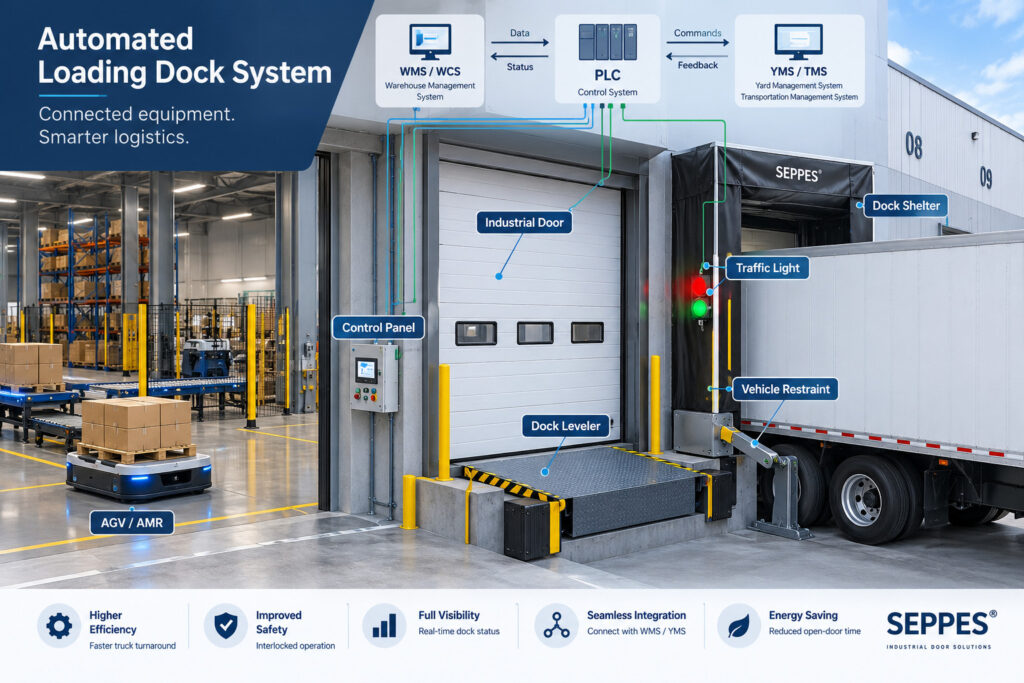
The next stage of loading dock automation is system integration.
Modern warehouses often use combinations of:
- WMS — Warehouse Management System;
- WCS — Warehouse Control System;
- PLC — Programmable Logic Controller;
- YMS — Yard Management System;
- TMS — Transportation Management System.
The loading dock can provide operational status information to these systems.
Zum Beispiel:
Dock 01 — Available
Dock 02 — Truck detected
Dock 03 — Loading
Dock 04 — Door fault
This information makes dock operations more visible.
Instead of warehouse staff physically checking each loading bay, supervisors can potentially monitor loading status from a central control interface.
Depending on the project architecture, interfaces such as dry contacts or industrial communication protocols can also be considered to exchange status and command signals.
The exact communication method should be confirmed during engineering because it depends on both the loading dock equipment and the customer’s existing automation system.
6. AGVs und AMRs verändern die Gestaltung von Ladebuchten
Automated Guided Vehicles and Autonomous Mobile Robots introduce new requirements.
A human forklift driver can visually judge small changes in:
- floor condition;
- dock leveler angle;
- trailer position;
- obstacles;
- available clearance.
An automated vehicle depends much more heavily on predefined operating conditions.
Therefore, when AGVs or AMRs are expected to approach or cross a dock leveler, engineers should evaluate factors such as:
- platform slope;
- transition angle;
- load capacity;
- wheel size;
- ground clearance;
- surface traction;
- position accuracy;
- safety sensor coverage;
- communication signals;
- acceptable trailer movement.
This does not mean every standard dock leveler is automatically suitable for AGV operation.
The dock, vehicle and control system should be evaluated as a complete application.
For highly automated warehouses, this engineering work should ideally happen during the design stage rather than after the equipment has already been installed.
Wie sieht eine automatisierte Laderampe aus?
A typical configuration might include:
Lagersseite
- warehouse management system;
- PLC control;
- industrielles Sektionaltor;
- Sicherheitssensoren;
- dock leveler control.
Ladebucht
- hydraulic dock leveler;
- dock shelter or dock seal;
- Fahrzeugrückhaltesystem;
- internal traffic light;
- external traffic light.
Materialhandhabung
- forklift;
- conveyor;
- AGV;
- AMR.
Informationsebene
- vehicle detection;
- door status;
- dock leveler status;
- equipment fault signal;
- loading authorization;
- dock occupancy status.
Together, these components turn the loading dock from a passive transfer point into an active part of the warehouse material-flow system.
Suggested Image 3 – Insert here
Bildkonzept:
Full automated warehouse loading dock architecture.
WMS / PLC at top → Industrial door / Dock leveler / Vehicle restraint → Truck
AGV or forklift traveling through the door.
This image should be more technical than promotional.
Traditionelle Laderampe vs. automatisierte Laderampe
| Merkmale | Traditional Loading Dock | Automated Loading Dock |
|---|---|---|
| Bedienung der Tür | Independent/manual control | Can be integrated into sequence |
| Dockleveler | Standalone operation | Can communicate with control system |
| Truck detection | Visual/manual | Sensors available |
| Fahrzeugrückhaltung | Manual or separate | Can be interlocked |
| Traffic signals | Optional | Integrated into workflow |
| Dock status | Checked manually | Can be monitored centrally |
| AGV compatibility | Not normally considered | Can be designed into the system |
| Data visibility | Begrenzt | Höher |
| Operating sequence | Operator dependent | Logic controlled |
| Scalability | Mäßig | Better for high-volume operations |
The automated version is not necessarily the right choice for every warehouse.
A facility handling only a few trucks per day may not need sophisticated integration.
But as truck volume, loading frequency and automation increase, coordinated dock controls become increasingly valuable.
Welche Lager profitieren am meisten von der Laderampenautomatisierung?
E-Commerce-Fulfillment-Center
E-commerce warehouses often handle high shipment volumes and short delivery windows.
Amazon’s 2026 European investment illustrates how fulfillment networks continue to adopt more advanced robotics while simultaneously pursuing faster delivery. The company also announced plans for more than 25 additional sub-same-day delivery sites across Europe during 2026.
For this type of operation, reducing unnecessary waiting at the dock can become increasingly important.
Automatisierte Produktionsanlagen
Factories using:
- production conveyors;
- robotic production lines;
- AGVs;
- automated storage systems
may benefit from extending automation to inbound and outbound logistics.
Distributionszentren und 3PL-Lager
Facilities operating many loading bays need better visibility over:
- which docks are occupied;
- which trucks are ready;
- which bays are loading;
- which equipment requires attention.
Kühllager
Cold-storage operations have an additional concern:
temperature loss.
Coordinating the dock leveler, insulated industrial door and dock shelter can reduce unnecessary door-open time and uncontrolled air exchange.
Hochfrequente Logistikzentren
The higher the number of truck movements per day, the more important loading sequence, dock availability and operating efficiency become.
Wie man eine Laderampe für die Automatisierung gestaltet
Buying an automatic dock leveler alone does not create an automated loading dock.
Before specifying equipment, consider the following factors.
1. LKW-Typen
Identify the vehicles that will regularly use the loading bay.
Record:
- lowest truck-bed height;
- highest truck-bed height;
- trailer width;
- expected vehicle types.
This determines the working range required from the dock leveler.
2. Gabelstapler- oder AGV-Gewicht
The dock leveler’s rated capacity should consider the actual loading operation.
This includes:
- Gewicht von Gabelstaplern oder AGVs;
- cargo weight;
- operating frequency;
- dynamic forces.
Do not select a platform solely according to cargo weight.
3. Rampenhöhe
The relationship between warehouse floor height and truck-bed height affects the operating angle of the dock leveler.
Excessive slopes may create problems for:
- low-clearance forklifts;
- pallet trucks;
- AGVs.
4. Industrietortyp
Determine whether the project requires:
- Industrie-Sektionaltor;
- high-speed door;
- isolierte Tür;
- other industrial door systems.
Space above and beside the opening should also be checked before equipment selection.
5. Steuerungslogik
Decide which devices must communicate.
Zum Beispiel:
Vehicle restraint → Door → Dock leveler → Loading authorization
The control sequence should be defined before production.
6. Kommunikationsanforderungen
If the loading bay will connect to a PLC, WMS or other system, clarify:
- required signals;
- communication method;
- input/output points;
- fault feedback;
- status feedback;
- remote control requirements.
7. Sicherheitsanforderungen
Automation should include fail-safe thinking.
What happens if:
- a sensor fails?
- the door cannot fully open?
- the dock leveler does not return?
- the vehicle moves unexpectedly?
- communication with the warehouse system is lost?
These situations should be considered during system design.
Die Zukunft: Von intelligenten Lagern zu intelligenten Ladebuchten
For years, warehouse automation concentrated mainly on what happened inside the building.
Companies automated:
- storage;
- picking;
- sorting;
- conveyors;
- pallet movement;
- inventory management.
The loading dock was often treated as the final manual boundary.
That boundary is starting to change.
Amazon’s development of autonomous robots that began with dock-area material movement provides a visible example of how important this part of the warehouse has become. Meanwhile, DHL’s automation investments and logistics trend research show that robotics, AI and digital systems are moving deeper into everyday logistics operations.
The next generation of loading docks will therefore be less about individual pieces of equipment and more about coordination.
The industrial door knows the status of the dock leveler.
The dock leveler knows whether loading conditions are safe.
The control system knows whether the dock is occupied.
The warehouse system knows whether the truck can be loaded.
AGVs and forklifts receive permission to move only when the loading path is ready.
That is the real direction of loading dock automation.
Aufbau einer integrierten Ladebucht mit SEPPES
A modern loading bay should be designed as a system rather than a collection of unrelated products.
SEPPES provides industrial loading solutions that can combine equipment such as:
- hydraulische Ladebrücken;
- Industrie-Sektionaltore;
- Schnelllauftore;
- Laderampendichtungen;
- loading bay control systems;
- safety and activation devices.
For automated warehouse projects, equipment configuration can be evaluated according to the customer’s loading process, vehicle types, material-handling equipment and control requirements.
Where system integration is required, communication and interlocking requirements should be confirmed during the engineering stage so that the industrial door, dock leveler and other loading equipment work according to the required operating sequence.
If you are planning a new warehouse or upgrading an existing loading bay, provide:
- door opening size;
- loading dock height;
- Höhenbereich der Lkw-Ladefläche;
- Spezifikationen von Gabelstaplern oder AGVs;
- required loading capacity;
- Anzahl der Ladebuchten;
- control or communication requirements.
These details allow the loading dock solution to be designed around the actual workflow instead of simply selecting equipment from a catalog.
Häufig gestellte Fragen
Kann eine Überladebrücke mit der Lagerautomatisierung integriert werden?
Yes. A dock leveler can be incorporated into a wider control system using control signals and interlocking logic. The exact method depends on the dock leveler controller and the customer’s PLC or warehouse automation architecture.
Was ist eine automatisierte Laderampe?
An automated loading dock uses connected equipment such as dock levelers, industrial doors, vehicle restraints, sensors, traffic lights and control systems to coordinate the loading and unloading process.
Können AGVs eine Überladebrücke nutzen?
Potentially, but the complete application should be evaluated. Important factors include platform slope, transition angle, AGV ground clearance, wheel size, load, surface condition, trailer movement and communication requirements.
Welche Überladebrücke ist am besten für ein automatisiertes Lager geeignet?
Hydraulic dock levelers are commonly suited to high-frequency loading applications because their platform and lip movements can be electrically controlled. However, the correct model depends on vehicle height, capacity, loading frequency and automation requirements.
Eliminiert die Laderampenautomatisierung den Bedarf an Bedienern?
Not necessarily. The primary goal is usually to coordinate equipment, reduce unnecessary manual steps, improve visibility and create safer operating sequences. Human supervision may still be required depending on the application.
Welche Ausrüstung wird für eine intelligente Laderampe benötigt?
A smart loading dock may include an industrial door, hydraulic dock leveler, dock shelter, vehicle restraint, sensors, traffic lights, PLC controls and connections to warehouse or yard-management systems. The final configuration depends on the level of automation required.