
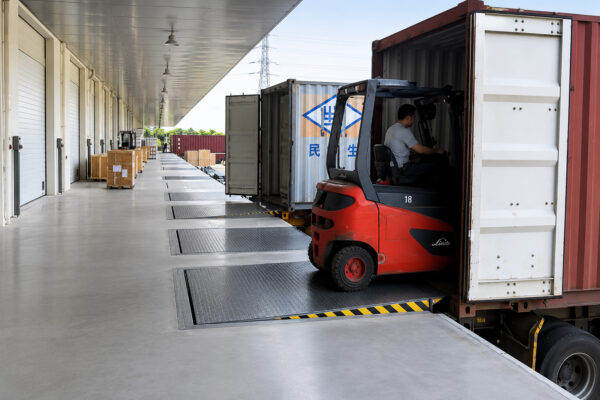
L'automatisation des entrepôts passe rapidement de machines isolées à des systèmes connectés de manutention des matériaux.
Les robots transportent les marchandises. Les convoyeurs automatisés déplacent les cartons entre les postes de travail. Les systèmes de gestion d'entrepôt coordonnent les stocks. Les AGV et les AMR sont de plus en plus utilisés pour déplacer des matériaux sans contrôle humain continu.
Mais un domaine peut facilement être négligé lors d'un projet d'automatisation :
En juin 2026, Amazon a présenté la nouvelle génération de son robot mobile autonome Proteus dans le cadre d'un investissement majeur dans un centre de distribution européen. Le Proteus original est déjà déployé dans 25 centres de distribution aux États-Unis et opère principalement dans les zones de quai, transportant des chariots lourds. La nouvelle génération est conçue pour aller au-delà du quai et fonctionner dans l'ensemble des centres de distribution.
C'est une illustration utile d'un changement plus large.
Lorsque la circulation des matériaux à l'intérieur d'un entrepôt devient plus rapide et plus automatisée, le quai de chargement ne peut plus être traité comme une opération manuelle totalement séparée.
Pour les entrepôts à haut débit, les centres de distribution et les usines de fabrication, l'automatisation du quai de chargement devient une partie importante du flux logistique complet.
À quoi ressemble donc réellement un quai de chargement automatisé, et comment les entreprises doivent-elles le concevoir ?
Table des matières
BasculerPourquoi l'automatisation du quai de chargement est importante en 2026
L'automatisation ne se limite plus à un petit nombre de centres de distribution très avancés.
DHL a rapporté qu'il a investi plus d'un milliard d'euros dans l'automatisation dans sa division de logistique contractuelle sur trois ans. Son réseau utilise plus de 7 500 robots et près de 800 000 capteurs IoT, tandis que plus de 90% des entrepôts DHL dans le monde disposent d'au moins une solution d'automatisation ou de digitalisation.
Les plus récents Logistics Trend Radar Echo, fondé sur les réponses de plus de 2 500 professionnels de la chaîne d'approvisionnement, classe également la robotique parmi les clusters technologiques les plus importants façonnant la logistique, l'efficacité opérationnelle figurant parmi les principales raisons pour lesquelles les entreprises investissent dans ces technologies.
Ces évolutions soulèvent une question opérationnelle simple :
Que se passe-t-il lorsque les marchandises circulent rapidement dans un entrepôt automatisé mais attendent encore à un quai de chargement à commande manuelle ?
Un quai de chargement peut devenir un goulot d'étranglement lorsque :
- les camions attendent trop longtemps un quai disponible ;
- les employés doivent coordonner manuellement les portes et les équipements de quai ;
- les niveleurs de quai ne sont pas intégrés aux autres équipements ;
- les chariots élévateurs ou les AGV attendent la bonne séquence de chargement ;
- les chauffeurs et les opérateurs d'entrepôt ne s'appuient que sur la communication verbale ;
- les équipements peuvent être actionnés dans un ordre incorrect ;
- les informations sur l'occupation des quais ne sont pas disponibles pour le système d'entrepôt.
L'objectif de l'automatisation des quais de chargement n'est donc pas simplement de faire bouger automatiquement un niveleur de quai.
Il est de créer un processus de chargement coordonné.
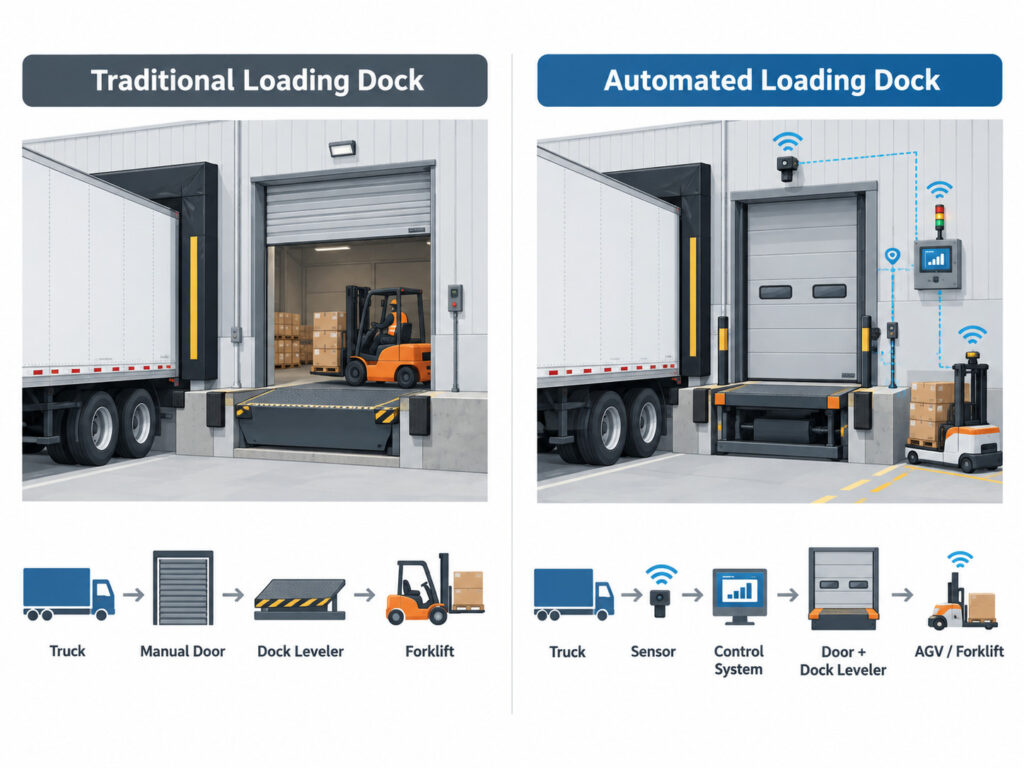
Image suggérée 1 – Insérer ici
Concept de l'image :
Quai de chargement traditionnel vs quai de chargement automatisé.
À gauche :
Camion → Porte manuelle → Niveleur de quai manuel → Chariot élévateur
À droite :
Camion → Capteur → Système de contrôle → Porte industrielle + niveleur de quai + dispositif de retenue → Chariot élévateur / AGV
Garder le graphique épuré avec un texte anglais minimal.
Qu'est-ce que l'automatisation du quai de chargement ?
L'automatisation des quais de chargement désigne l'utilisation d'équipements automatiques, de capteurs, de systèmes de contrôle et d'interfaces de communication pour coordonner les activités entre l'entrepôt et le véhicule au niveau du quai de chargement.
Un quai conventionnel peut comprendre :
- porte industrielle;
- niveleurs de quai;
- de shelters de quai;
- commande par bouton-poussoir ;
- chariot élévateur.
Un quai de chargement plus automatisé peut ajouter :
- capteurs de détection de véhicules ;
- surveillance de l'occupation des quais ;
- commandes automatiques de portes ;
- commandes de niveleurs de quai hydrauliques ;
- dispositifs de retenue de véhicules ;;
- feux de circulation ;
- verrouillages de sécurité ;
- communication PLC ;
- intégration WMS ou de gestion de cour ;
- interfaces AGV ou AMR.
La différence ne réside pas simplement dans le nombre de dispositifs.
La différence essentielle est que les dispositifs communiquent et fonctionnent selon une séquence contrôlée.
De l'équipement autonome à un quai de chargement connecté
Considérons une opération de chargement traditionnelle.
Un camion arrive.
Un employé confirme qu'il est correctement positionné.
La porte industrielle est ouverte.
Le niveleur de quai est activé.
Un chariot élévateur entre dans la remorque.
Une fois le chargement terminé, l'opérateur remet le niveleur de quai en position de rangement et ferme la porte.
Each step depends heavily on people following the correct procedure.
In an automated loading dock, some of these steps can be monitored, controlled or interlocked.
A simplified sequence might look like this:
Truck arrives
↓
Vehicle position detected
↓
Truck secured / loading permission confirmed
↓
Industrial door opens
↓
Dock leveler deploys
↓
Loading authorization activated
↓
Forklift / AGV begins material transfer
↓
Loading completed
↓
Dock leveler returns
↓
Door closes
↓
Vehicle released
Not every warehouse needs every step to be fully automatic.
The important principle is that the equipment should work as one loading bay system rather than several unrelated products.
1. Les niveleurs de quai automatiques font partie de la séquence de contrôle
The dock leveler remains one of the most important components of a loading bay.
Its job is to bridge the height and distance difference between the warehouse floor and truck bed, allowing forklifts and other material-handling equipment to move between them.
Hydraulic dock levelers are particularly suitable for high-frequency loading environments because platform lifting and lip operation can be controlled electrically and hydraulically.
But in a smart loading dock, the question changes from:
“Can the dock leveler operate automatically?”
to:
“Can the dock leveler operate safely as part of the warehouse loading sequence?”
For example, the system may prevent the leveler from deploying before:
- the truck is correctly positioned;
- the industrial door is open;
- the loading area is authorized for operation.
Likewise, the door should not necessarily close while the leveler remains deployed.
This type of interlocking reduces dependence on operator memory and helps create a more controlled workflow.
2. Les portes industrielles et les niveleurs de quai peuvent fonctionner ensemble
The industrial door is another critical part of loading dock automation.
Instead of treating the door and leveler as independent machines, their control logic can be coordinated.
Par exemple :
Step 1
Truck reaches the loading position.
Step 2
The system confirms that loading conditions are ready.
Step 3
The industrial sectional door opens.
Step 4
The hydraulic dock leveler deploys.
Step 5
The loading process begins.
When loading is complete:
Step 6
The dock leveler returns to its stored position.
Step 7
The industrial door closes.
This sequence is particularly useful in warehouses with:
- high truck traffic;
- multiple loading bays;
- strict safety procedures;
- cold-storage requirements;
- automated material-handling systems.
It can also reduce situations where equipment is operated in the wrong order.
3. Les capteurs donnent une conscience au quai de chargement
Automation requires information.
That is why sensors are becoming increasingly important around loading bays.
Depending on the project, sensors may be used to detect:
- vehicle presence;
- truck position;
- door status;
- la position du niveleur de quai ;
- loading area occupancy;
- obstacles;
- vehicle restraint status.
This information can then be sent to a PLC or other control system.
Instead of asking an employee:
“Is the truck ready?”
the system can use defined signals to determine whether the next operation should be permitted.
This becomes increasingly important as warehouses introduce autonomous equipment.
4. Les feux de circulation et les dispositifs de retenue des véhicules améliorent la coordination
A loading dock connects two very different environments:
the warehouse et the truck yard.
That means automation must coordinate not only machines but also people.
Traffic lights can provide clear visual signals to warehouse employees and truck drivers.
Par exemple :
Outside: Red light
The driver should remain stationary while loading is taking place.
Inside: Green light
Warehouse personnel are authorized to begin loading.
Vehicle restraints can provide another layer of protection by helping prevent unexpected trailer movement or premature departure.
This is especially important when forklifts travel between the dock and trailer.
OSHA identifies loading docks as potentially dangerous areas for forklifts and specifically warns about risks including forklifts falling from dock edges or between docks and unsecured trailers. OSHA requirements also address preventing trucks or trailers from moving during loading and unloading operations.
Automation therefore should not be designed only around speed.
Safety logic must remain part of the control strategy.
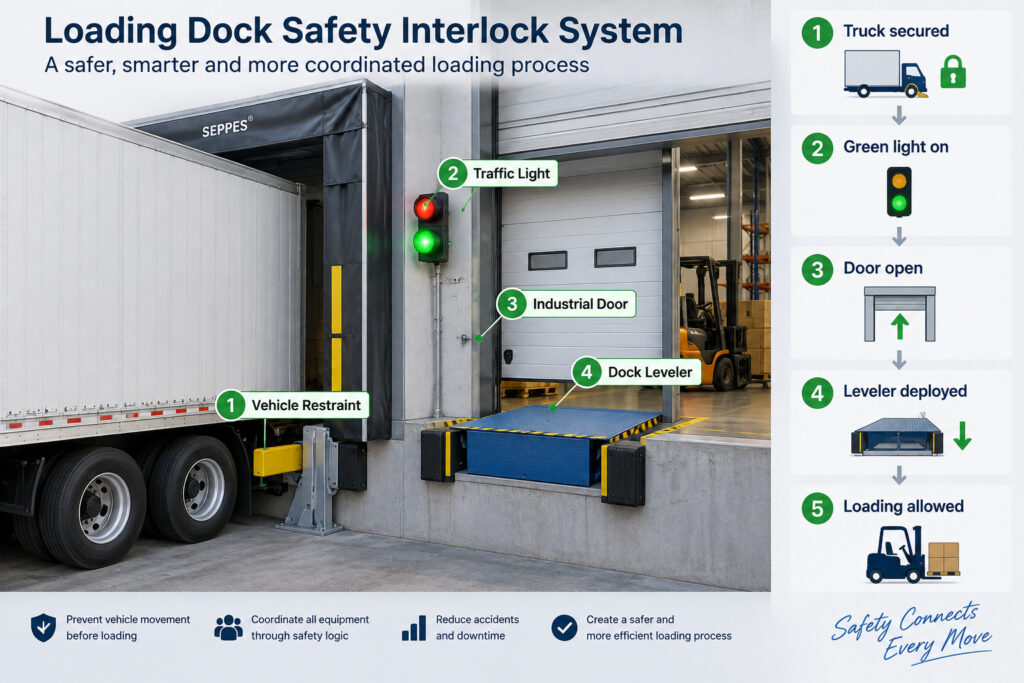
Suggested Image 2 – Insert here
Concept de l'image :
Loading dock safety interlock diagram:
Camion
↓
Vehicle restraint
↓
Traffic light
↓
Équipement de porte
↓
Niveleur de quai
↓
Forklift / AGV
Use arrows to show the operating sequence.
5. Les quais de chargement peuvent se connecter aux systèmes de contrôle d'entrepôt
The next stage of loading dock automation is system integration.
Modern warehouses often use combinations of:
- WMS — Warehouse Management System;
- WCS — Warehouse Control System;
- PLC — Programmable Logic Controller;
- YMS — Yard Management System;
- TMS — Transportation Management System.
The loading dock can provide operational status information to these systems.
Par exemple :
Dock 01 — Available
Dock 02 — Truck detected
Dock 03 — Loading
Dock 04 — Door fault
This information makes dock operations more visible.
Instead of warehouse staff physically checking each loading bay, supervisors can potentially monitor loading status from a central control interface.
Depending on the project architecture, interfaces such as dry contacts or industrial communication protocols can also be considered to exchange status and command signals.
The exact communication method should be confirmed during engineering because it depends on both the loading dock equipment and the customer’s existing automation system.
6. Les AGV et les AMR transforment la conception des quais de chargement
Automated Guided Vehicles and Autonomous Mobile Robots introduce new requirements.
A human forklift driver can visually judge small changes in:
- floor condition;
- dock leveler angle;
- trailer position;
- obstacles;
- available clearance.
An automated vehicle depends much more heavily on predefined operating conditions.
Therefore, when AGVs or AMRs are expected to approach or cross a dock leveler, engineers should evaluate factors such as:
- platform slope;
- transition angle;
- load capacity;
- wheel size;
- ground clearance;
- surface traction;
- position accuracy;
- safety sensor coverage;
- communication signals;
- acceptable trailer movement.
This does not mean every standard dock leveler is automatically suitable for AGV operation.
The dock, vehicle and control system should be evaluated as a complete application.
For highly automated warehouses, this engineering work should ideally happen during the design stage rather than after the equipment has already been installed.
À quoi ressemble un quai de chargement automatisé ?
A typical configuration might include:
Côté entrepôt
- warehouse management system;
- PLC control;
- industrial sectional door;
- les capteurs de sécurité ;
- dock leveler control.
Zone de chargement
- hydraulic dock leveler;
- dock shelter or dock seal;
- vehicle restraint;
- internal traffic light;
- external traffic light.
Manutention des matériaux
- forklift;
- conveyor;
- AGV;
- AMR.
Couche informationnelle
- vehicle detection;
- door status;
- dock leveler status;
- equipment fault signal;
- loading authorization;
- dock occupancy status.
Together, these components turn the loading dock from a passive transfer point into an active part of the warehouse material-flow system.
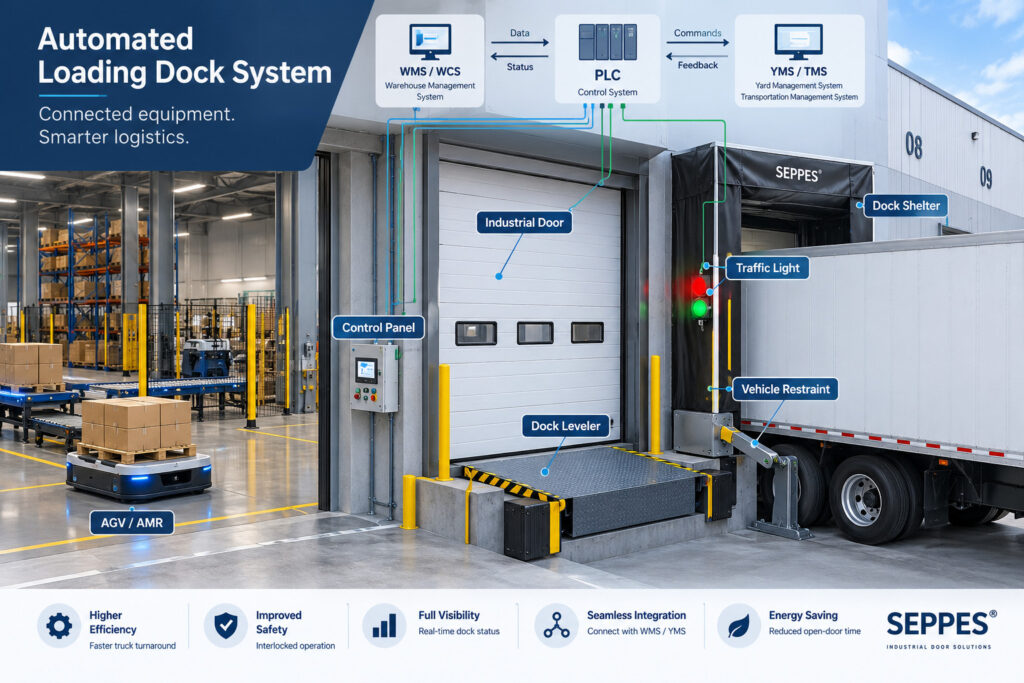
Suggested Image 3 – Insert here
Concept de l'image :
Full automated warehouse loading dock architecture.
WMS / PLC at top → Industrial door / Dock leveler / Vehicle restraint → Truck
AGV or forklift traveling through the door.
This image should be more technical than promotional.
Quai de chargement traditionnel vs quai de chargement automatisé
| Caractéristique | Traditional Loading Dock | Automated Loading Dock |
|---|---|---|
| Fonctionnement de la porte | Independent/manual control | Can be integrated into sequence |
| Niveleur de quai | Standalone operation | Can communicate with control system |
| Truck detection | Visual/manual | Sensors available |
| Vehicle restraint | Manual or separate | Can be interlocked |
| Traffic signals | Optionnel | Integrated into workflow |
| Dock status | Checked manually | Can be monitored centrally |
| AGV compatibility | Not normally considered | Can be designed into the system |
| Data visibility | Limité | Plus élevé |
| Operating sequence | Operator dependent | Logic controlled |
| Scalability | Modéré | Better for high-volume operations |
The automated version is not necessarily the right choice for every warehouse.
A facility handling only a few trucks per day may not need sophisticated integration.
But as truck volume, loading frequency and automation increase, coordinated dock controls become increasingly valuable.
Quels entrepôts bénéficient le plus de l'automatisation du quai de chargement ?
Centres de distribution e-commerce
E-commerce warehouses often handle high shipment volumes and short delivery windows.
Amazon’s 2026 European investment illustrates how fulfillment networks continue to adopt more advanced robotics while simultaneously pursuing faster delivery. The company also announced plans for more than 25 additional sub-same-day delivery sites across Europe during 2026.
For this type of operation, reducing unnecessary waiting at the dock can become increasingly important.
Usines de fabrication automatisées
Factories using:
- production conveyors;
- robotic production lines;
- AGVs;
- automated storage systems
may benefit from extending automation to inbound and outbound logistics.
Centres de distribution et entrepôts 3PL
Facilities operating many loading bays need better visibility over:
- which docks are occupied;
- which trucks are ready;
- which bays are loading;
- which equipment requires attention.
Entrepôts frigorifiques
Cold-storage operations have an additional concern:
temperature loss.
Coordinating the dock leveler, insulated industrial door and dock shelter can reduce unnecessary door-open time and uncontrolled air exchange.
Centres logistiques à haute fréquence
The higher the number of truck movements per day, the more important loading sequence, dock availability and operating efficiency become.
Comment concevoir un quai de chargement pour l'automatisation
Buying an automatic dock leveler alone does not create an automated loading dock.
Before specifying equipment, consider the following factors.
1. Types de camions
Identify the vehicles that will regularly use the loading bay.
Record:
- lowest truck-bed height;
- highest truck-bed height;
- trailer width;
- expected vehicle types.
This determines the working range required from the dock leveler.
2. Poids des chariots élévateurs ou des AGV
The dock leveler’s rated capacity should consider the actual loading operation.
This includes:
- le poids du chariot élévateur ou de l'AGV ;
- cargo weight;
- operating frequency;
- dynamic forces.
Do not select a platform solely according to cargo weight.
3. Hauteur du quai
The relationship between warehouse floor height and truck-bed height affects the operating angle of the dock leveler.
Excessive slopes may create problems for:
- low-clearance forklifts;
- pallet trucks;
- AGVs.
4. Type de porte industrielle
Determine whether the project requires:
- Porte sectionnelle industrielle;
- high-speed door;
- insulated door;
- other industrial door systems.
Space above and beside the opening should also be checked before equipment selection.
5. Logique de contrôle
Decide which devices must communicate.
Par exemple :
Vehicle restraint → Door → Dock leveler → Loading authorization
The control sequence should be defined before production.
6. Exigences de communication
If the loading bay will connect to a PLC, WMS or other system, clarify:
- required signals;
- communication method;
- input/output points;
- fault feedback;
- status feedback;
- remote control requirements.
7. Exigences de sécurité
Automation should include fail-safe thinking.
What happens if:
- a sensor fails?
- the door cannot fully open?
- the dock leveler does not return?
- the vehicle moves unexpectedly?
- communication with the warehouse system is lost?
These situations should be considered during system design.
L'avenir : des entrepôts intelligents aux quais de chargement intelligents
For years, warehouse automation concentrated mainly on what happened inside the building.
Companies automated:
- storage;
- picking;
- sorting;
- conveyors;
- pallet movement;
- inventory management.
The loading dock was often treated as the final manual boundary.
That boundary is starting to change.
Amazon’s development of autonomous robots that began with dock-area material movement provides a visible example of how important this part of the warehouse has become. Meanwhile, DHL’s automation investments and logistics trend research show that robotics, AI and digital systems are moving deeper into everyday logistics operations.
The next generation of loading docks will therefore be less about individual pieces of equipment and more about coordination.
The industrial door knows the status of the dock leveler.
The dock leveler knows whether loading conditions are safe.
The control system knows whether the dock is occupied.
The warehouse system knows whether the truck can be loaded.
AGVs and forklifts receive permission to move only when the loading path is ready.
That is the real direction of loading dock automation.
Construire un quai de chargement intégré avec SEPPES
A modern loading bay should be designed as a system rather than a collection of unrelated products.
SEPPES provides industrial loading solutions that can combine equipment such as:
- des niveaux de quai hydrauliques;
- portes sectionnelles industrielles;
- les portes à grande vitesse,;
- abris de quai;
- loading bay control systems;
- safety and activation devices.
For automated warehouse projects, equipment configuration can be evaluated according to the customer’s loading process, vehicle types, material-handling equipment and control requirements.
Where system integration is required, communication and interlocking requirements should be confirmed during the engineering stage so that the industrial door, dock leveler and other loading equipment work according to the required operating sequence.
If you are planning a new warehouse or upgrading an existing loading bay, provide:
- door opening size;
- loading dock height;
- truck-bed height range;
- forklift or AGV specifications;
- required loading capacity;
- number of loading bays;
- control or communication requirements.
These details allow the loading dock solution to be designed around the actual workflow instead of simply selecting equipment from a catalog.
Foire aux questions
Un niveleur de quai peut-il être intégré à l'automatisation de l'entrepôt ?
Yes. A dock leveler can be incorporated into a wider control system using control signals and interlocking logic. The exact method depends on the dock leveler controller and the customer’s PLC or warehouse automation architecture.
Qu'est-ce qu'un quai de chargement automatisé ?
An automated loading dock uses connected equipment such as dock levelers, industrial doors, vehicle restraints, sensors, traffic lights and control systems to coordinate the loading and unloading process.
Les AGV peuvent-ils utiliser un niveleur de quai ?
Potentially, but the complete application should be evaluated. Important factors include platform slope, transition angle, AGV ground clearance, wheel size, load, surface condition, trailer movement and communication requirements.
Quel niveleur de quai est le meilleur pour un entrepôt automatisé ?
Hydraulic dock levelers are commonly suited to high-frequency loading applications because their platform and lip movements can be electrically controlled. However, the correct model depends on vehicle height, capacity, loading frequency and automation requirements.
L'automatisation du quai de chargement élimine-t-elle le besoin d'opérateurs ?
Not necessarily. The primary goal is usually to coordinate equipment, reduce unnecessary manual steps, improve visibility and create safer operating sequences. Human supervision may still be required depending on the application.
Quel équipement est nécessaire pour un quai de chargement intelligent ?
A smart loading dock may include an industrial door, hydraulic dock leveler, dock shelter, vehicle restraint, sensors, traffic lights, PLC controls and connections to warehouse or yard-management systems. The final configuration depends on the level of automation required.