
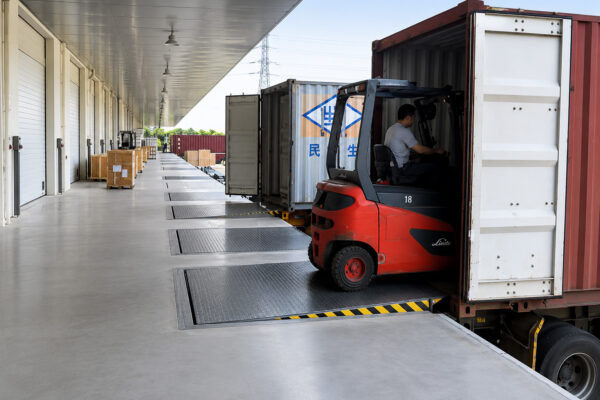
La automatización de almacenes está pasando rápidamente de máquinas aisladas a sistemas conectados de manipulación de materiales.
Los robots transportan mercancías. Los transportadores automatizados mueven cajas entre estaciones de trabajo. Los sistemas de gestión de almacenes coordinan el inventario. Los AGV y AMR se utilizan cada vez más para mover materiales sin control humano continuo.
Pero hay un área que puede pasarse fácilmente por alto durante un proyecto de automatización:
En junio de 2026, Amazon presentó la siguiente generación de su robot móvil autónomo Proteus como parte de una importante inversión europea en centros de cumplimiento. El Proteus original ya está desplegado en 25 centros de cumplimiento en Estados Unidos y opera principalmente en zonas de muelle, transportando carros pesados. La nueva generación está diseñada para ir más allá del muelle y operar en todos los centros de cumplimiento.
Esto es un ejemplo útil de un cambio más amplio.
Cuando el movimiento de materiales dentro de un almacén se vuelve más rápido y más automatizado, la zona de carga ya no puede tratarse como una operación manual completamente separada.
Para almacenes de alto rendimiento, centros de distribución y plantas de fabricación, la automatización del muelle de carga se está convirtiendo en una parte importante del flujo de trabajo logístico completo.
Entonces, ¿cómo es realmente un muelle de carga automatizado y cómo deberían diseñarlo las empresas?
Índice
TogglePor qué importa la automatización del muelle de carga en 2026
La automatización ya no se limita a un pequeño número de centros de cumplimiento altamente avanzados.
DHL informó que ha invertido más de 1.000 millones de euros en automatización en su división de logística contractual durante tres años. Su red utiliza más de 7.500 robots y cerca de 800.000 sensores IoT, mientras que más del 90% de los almacenes de DHL en todo el mundo cuenta con al menos una solución de automatización o digitalización.
El más reciente de DHL Logistics Trend Radar Echo, basado en las respuestas de más de 2.500 profesionales de la cadena de suministro, también clasifica la robótica como uno de los grupos tecnológicos más significativos que configuran la logística, con la eficiencia operativa entre las principales razones por las que las empresas invierten en estas tecnologías.
Estos avances generan una pregunta operativa sencilla:
¿Qué sucede cuando las mercancías se desplazan rápidamente por un almacén automatizado pero aún esperan en un muelle de carga operado manualmente?
Un muelle de carga puede convertirse en un cuello de botella cuando:
- los camiones esperan demasiado tiempo para obtener un muelle disponible;
- los empleados deben coordinar manualmente las puertas y los equipos del muelle;
- los niveladores de muelle no están integrados con otros equipos;
- las carretillas elevadoras o los AGV esperan la secuencia de carga correcta;
- los conductores y los operadores de almacén dependen únicamente de la comunicación verbal;
- los equipos pueden operarse en una secuencia incorrecta;
- la información sobre la ocupación del muelle no está disponible para el sistema de almacén.
El objetivo de la automatización del muelle de carga no es, por tanto, simplemente lograr que un nivelador de muelle se mueva automáticamente.
Es crear un proceso de carga coordinado.
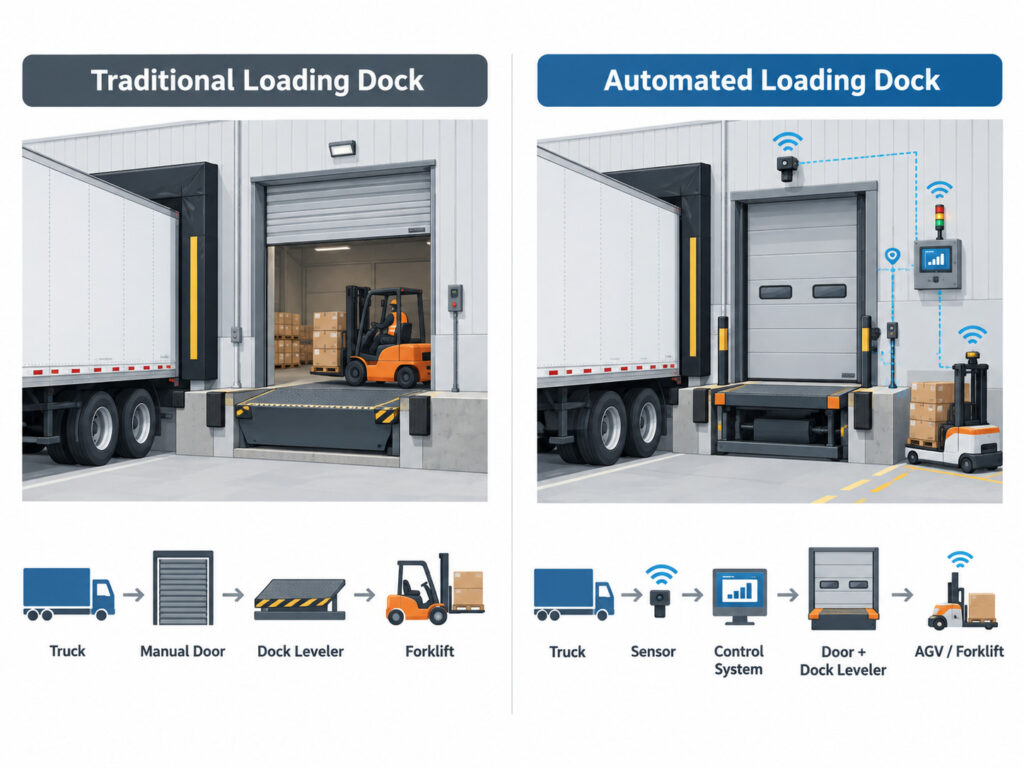
Imagen sugerida 1 – Insertar aquí
Concepto de imagen:
Muelle de carga tradicional vs. muelle de carga automatizado.
Izquierda:
Camión → Puerta manual → Nivelador de muelle manual → Carretilla elevadora
Derecha:
Camión → Sensor → Sistema de control → Puerta industrial + nivelador de muelle + sistema de sujeción → Carretilla elevadora / AGV
Mantener el gráfico limpio con texto en inglés mínimo.
¿Qué es la automatización del muelle de carga?
La automatización del muelle de carga se refiere al uso de equipos automáticos, sensores, sistemas de control e interfaces de comunicación para coordinar las actividades entre el almacén y el vehículo en el muelle de carga.
Un muelle convencional podría consistir en:
- puerta industrial;
- niveladores de muelle;
- refugios de muelle;
- control por botón;
- carretilla elevadora.
Un muelle de carga más automatizado puede añadir:
- sensores de detección de vehículos;
- monitoreo de ocupación del muelle;
- controles automáticos de puertas;
- controles de nivelador de muelle hidráulico;
- sistemas de sujeción de vehículos;
- semáforos;
- enclavamientos de seguridad;
- comunicación PLC;
- integración con WMS o gestión de patio;
- interfaces para AGV o AMR.
La diferencia no es simplemente el número de dispositivos.
La diferencia clave es que los dispositivos se comunican y operan según una secuencia controlada.
Del equipo independiente a una zona de carga conectada
Consideremos una operación de carga tradicional.
Llega un camión.
Un empleado confirma que está correctamente posicionado.
Se abre la puerta industrial.
Se activa el nivelador de muelle.
Una carretilla elevadora entra en el remolque.
Una vez completada la carga, el operador devuelve el nivelador de muelle a su posición de reposo y cierra la puerta.
Each step depends heavily on people following the correct procedure.
In an automated loading dock, some of these steps can be monitored, controlled or interlocked.
A simplified sequence might look like this:
Truck arrives
↓
Vehicle position detected
↓
Truck secured / loading permission confirmed
↓
Industrial door opens
↓
Dock leveler deploys
↓
Loading authorization activated
↓
Forklift / AGV begins material transfer
↓
Loading completed
↓
Dock leveler returns
↓
Door closes
↓
Vehicle released
Not every warehouse needs every step to be fully automatic.
The important principle is that the equipment should work as one loading bay system rather than several unrelated products.
1. Los niveladores automáticos de muelle se convierten en parte de la secuencia de control
The dock leveler remains one of the most important components of a loading bay.
Its job is to bridge the height and distance difference between the warehouse floor and truck bed, allowing forklifts and other material-handling equipment to move between them.
Hydraulic dock levelers are particularly suitable for high-frequency loading environments because platform lifting and lip operation can be controlled electrically and hydraulically.
But in a smart loading dock, the question changes from:
“Can the dock leveler operate automatically?”
to:
“Can the dock leveler operate safely as part of the warehouse loading sequence?”
For example, the system may prevent the leveler from deploying before:
- the truck is correctly positioned;
- the industrial door is open;
- the loading area is authorized for operation.
Likewise, the door should not necessarily close while the leveler remains deployed.
This type of interlocking reduces dependence on operator memory and helps create a more controlled workflow.
2. Las puertas industriales y los niveladores de muelle pueden trabajar juntos
The industrial door is another critical part of loading dock automation.
Instead of treating the door and leveler as independent machines, their control logic can be coordinated.
Por ejemplo:
Step 1
Truck reaches the loading position.
Step 2
The system confirms that loading conditions are ready.
Step 3
The industrial sectional door opens.
Step 4
The hydraulic dock leveler deploys.
Step 5
The loading process begins.
When loading is complete:
Step 6
The dock leveler returns to its stored position.
Step 7
The industrial door closes.
This sequence is particularly useful in warehouses with:
- high truck traffic;
- multiple loading bays;
- strict safety procedures;
- cold-storage requirements;
- automated material-handling systems.
It can also reduce situations where equipment is operated in the wrong order.
3. Los sensores dan conciencia al muelle de carga
Automation requires information.
That is why sensors are becoming increasingly important around loading bays.
Depending on the project, sensors may be used to detect:
- vehicle presence;
- truck position;
- door status;
- la posición del nivelador de muelle;
- loading area occupancy;
- obstacles;
- vehicle restraint status.
This information can then be sent to a PLC or other control system.
Instead of asking an employee:
“Is the truck ready?”
the system can use defined signals to determine whether the next operation should be permitted.
This becomes increasingly important as warehouses introduce autonomous equipment.
4. Los semáforos y los sistemas de sujeción de vehículos mejoran la coordinación
A loading dock connects two very different environments:
the warehouse y the truck yard.
That means automation must coordinate not only machines but also people.
Traffic lights can provide clear visual signals to warehouse employees and truck drivers.
Por ejemplo:
Outside: Red light
The driver should remain stationary while loading is taking place.
Inside: Green light
Warehouse personnel are authorized to begin loading.
Vehicle restraints can provide another layer of protection by helping prevent unexpected trailer movement or premature departure.
This is especially important when forklifts travel between the dock and trailer.
OSHA identifies loading docks as potentially dangerous areas for forklifts and specifically warns about risks including forklifts falling from dock edges or between docks and unsecured trailers. OSHA requirements also address preventing trucks or trailers from moving during loading and unloading operations.
Automation therefore should not be designed only around speed.
Safety logic must remain part of the control strategy.
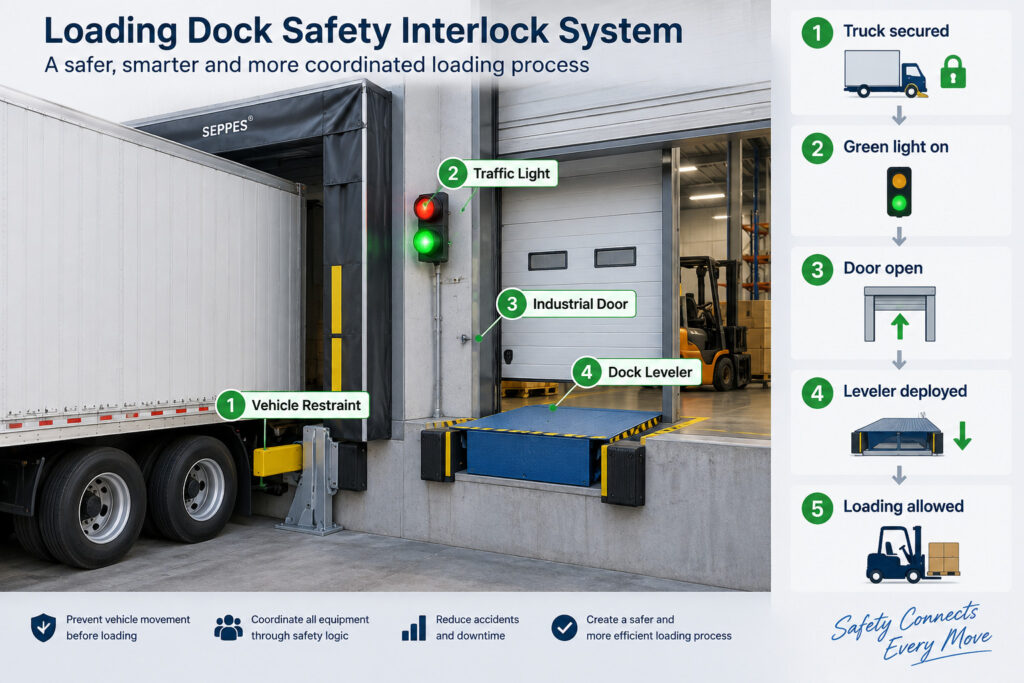
Suggested Image 2 – Insert here
Concepto de imagen:
Loading dock safety interlock diagram:
Camión
↓
Vehicle restraint
↓
Traffic light
↓
Puerta industrial
↓
Dock leveler
↓
Forklift / AGV
Use arrows to show the operating sequence.
5. Los muelles de carga pueden conectarse a los sistemas de control de almacén
The next stage of loading dock automation is system integration.
Modern warehouses often use combinations of:
- WMS — Warehouse Management System;
- WCS — Warehouse Control System;
- PLC — Programmable Logic Controller;
- YMS — Yard Management System;
- TMS — Transportation Management System.
The loading dock can provide operational status information to these systems.
Por ejemplo:
Dock 01 — Available
Dock 02 — Truck detected
Dock 03 — Loading
Dock 04 — Door fault
This information makes dock operations more visible.
Instead of warehouse staff physically checking each loading bay, supervisors can potentially monitor loading status from a central control interface.
Depending on the project architecture, interfaces such as dry contacts or industrial communication protocols can also be considered to exchange status and command signals.
The exact communication method should be confirmed during engineering because it depends on both the loading dock equipment and the customer’s existing automation system.
6. Los AGV y AMR están cambiando el diseño de la zona de carga
Automated Guided Vehicles and Autonomous Mobile Robots introduce new requirements.
A human forklift driver can visually judge small changes in:
- floor condition;
- dock leveler angle;
- trailer position;
- obstacles;
- available clearance.
An automated vehicle depends much more heavily on predefined operating conditions.
Therefore, when AGVs or AMRs are expected to approach or cross a dock leveler, engineers should evaluate factors such as:
- platform slope;
- transition angle;
- load capacity;
- wheel size;
- ground clearance;
- surface traction;
- position accuracy;
- safety sensor coverage;
- communication signals;
- acceptable trailer movement.
This does not mean every standard dock leveler is automatically suitable for AGV operation.
The dock, vehicle and control system should be evaluated as a complete application.
For highly automated warehouses, this engineering work should ideally happen during the design stage rather than after the equipment has already been installed.
¿Cómo es un muelle de carga automatizado?
A typical configuration might include:
Lado del almacén
- warehouse management system;
- PLC control;
- industrial sectional door;
- sensores de seguridad;
- dock leveler control.
Zona de carga
- hydraulic dock leveler;
- dock shelter or dock seal;
- vehicle restraint;
- internal traffic light;
- external traffic light.
Manipulación de materiales
- forklift;
- conveyor;
- AGV;
- AMR.
Capa de información
- vehicle detection;
- door status;
- dock leveler status;
- equipment fault signal;
- loading authorization;
- dock occupancy status.
Together, these components turn the loading dock from a passive transfer point into an active part of the warehouse material-flow system.
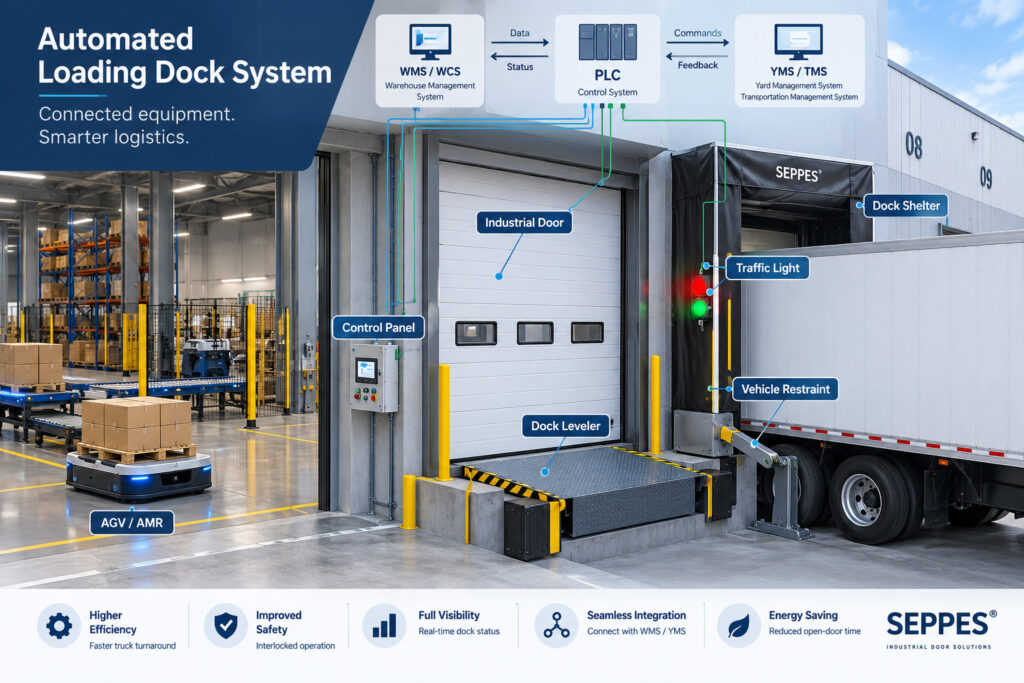
Suggested Image 3 – Insert here
Concepto de imagen:
Full automated warehouse loading dock architecture.
WMS / PLC at top → Industrial door / Dock leveler / Vehicle restraint → Truck
AGV or forklift traveling through the door.
This image should be more technical than promotional.
Muelle de carga tradicional vs. muelle de carga automatizado
| Característica | Traditional Loading Dock | Automated Loading Dock |
|---|---|---|
| Operación de puerta | Independent/manual control | Can be integrated into sequence |
| Dock leveler | Standalone operation | Can communicate with control system |
| Truck detection | Visual/manual | Sensors available |
| Vehicle restraint | Manual or separate | Can be interlocked |
| Traffic signals | Opcional | Integrated into workflow |
| Dock status | Checked manually | Can be monitored centrally |
| AGV compatibility | Not normally considered | Can be designed into the system |
| Data visibility | Limitado | Más alto |
| Operating sequence | Operator dependent | Logic controlled |
| Scalability | Moderado | Better for high-volume operations |
The automated version is not necessarily the right choice for every warehouse.
A facility handling only a few trucks per day may not need sophisticated integration.
But as truck volume, loading frequency and automation increase, coordinated dock controls become increasingly valuable.
¿Qué almacenes se benefician más de la automatización del muelle de carga?
Centros de cumplimiento de comercio electrónico
E-commerce warehouses often handle high shipment volumes and short delivery windows.
Amazon’s 2026 European investment illustrates how fulfillment networks continue to adopt more advanced robotics while simultaneously pursuing faster delivery. The company also announced plans for more than 25 additional sub-same-day delivery sites across Europe during 2026.
For this type of operation, reducing unnecessary waiting at the dock can become increasingly important.
Plantas de fabricación automatizadas
Factories using:
- production conveyors;
- robotic production lines;
- AGVs;
- automated storage systems
may benefit from extending automation to inbound and outbound logistics.
Centros de distribución y almacenes 3PL
Facilities operating many loading bays need better visibility over:
- which docks are occupied;
- which trucks are ready;
- which bays are loading;
- which equipment requires attention.
está protegido de elementos externos durante las transferencias.
Cold-storage operations have an additional concern:
temperature loss.
Coordinating the dock leveler, insulated industrial door and dock shelter can reduce unnecessary door-open time and uncontrolled air exchange.
Centros logísticos de alta frecuencia
The higher the number of truck movements per day, the more important loading sequence, dock availability and operating efficiency become.
Cómo diseñar un muelle de carga para la automatización
Buying an automatic dock leveler alone does not create an automated loading dock.
Before specifying equipment, consider the following factors.
1. Tipos de camiones
Identify the vehicles that will regularly use the loading bay.
Record:
- lowest truck-bed height;
- highest truck-bed height;
- ancho del remolque;
- expected vehicle types.
This determines the working range required from the dock leveler.
2. Peso de la carretilla elevadora o del AGV
The dock leveler’s rated capacity should consider the actual loading operation.
This includes:
- peso de la carretilla elevadora o del AGV;
- cargo weight;
- frecuencia operativa;
- dynamic forces.
Do not select a platform solely according to cargo weight.
3. Altura del muelle
The relationship between warehouse floor height and truck-bed height affects the operating angle of the dock leveler.
Excessive slopes may create problems for:
- low-clearance forklifts;
- pallet trucks;
- AGVs.
4. Tipo de puerta industrial
Determine whether the project requires:
- puerta seccional industrial;
- high-speed door;
- puerta aislada;
- other industrial door systems.
Space above and beside the opening should also be checked before equipment selection.
5. Lógica de control
Decide which devices must communicate.
Por ejemplo:
Vehicle restraint → Door → Dock leveler → Loading authorization
The control sequence should be defined before production.
6. Requisitos de comunicación
If the loading bay will connect to a PLC, WMS or other system, clarify:
- required signals;
- communication method;
- input/output points;
- fault feedback;
- status feedback;
- remote control requirements.
7. Requisitos de seguridad
Automation should include fail-safe thinking.
What happens if:
- a sensor fails?
- the door cannot fully open?
- the dock leveler does not return?
- the vehicle moves unexpectedly?
- communication with the warehouse system is lost?
These situations should be considered during system design.
El futuro: de almacenes inteligentes a zonas de carga inteligentes
For years, warehouse automation concentrated mainly on what happened inside the building.
Companies automated:
- storage;
- picking;
- sorting;
- conveyors;
- pallet movement;
- inventory management.
The loading dock was often treated as the final manual boundary.
That boundary is starting to change.
Amazon’s development of autonomous robots that began with dock-area material movement provides a visible example of how important this part of the warehouse has become. Meanwhile, DHL’s automation investments and logistics trend research show that robotics, AI and digital systems are moving deeper into everyday logistics operations.
The next generation of loading docks will therefore be less about individual pieces of equipment and more about coordination.
The industrial door knows the status of the dock leveler.
The dock leveler knows whether loading conditions are safe.
The control system knows whether the dock is occupied.
The warehouse system knows whether the truck can be loaded.
AGVs and forklifts receive permission to move only when the loading path is ready.
That is the real direction of loading dock automation.
Construir una zona de carga integrada con SEPPES
A modern loading bay should be designed as a system rather than a collection of unrelated products.
SEPPES provides industrial loading solutions that can combine equipment such as:
- niveladores de muelle hidráulicos;
- puertas seccionales industriales;
- puertas rápidas;
- refugios para muelles;
- loading bay control systems;
- safety and activation devices.
For automated warehouse projects, equipment configuration can be evaluated according to the customer’s loading process, vehicle types, material-handling equipment and control requirements.
Where system integration is required, communication and interlocking requirements should be confirmed during the engineering stage so that the industrial door, dock leveler and other loading equipment work according to the required operating sequence.
If you are planning a new warehouse or upgrading an existing loading bay, provide:
- door opening size;
- loading dock height;
- truck-bed height range;
- forklift or AGV specifications;
- required loading capacity;
- number of loading bays;
- control or communication requirements.
These details allow the loading dock solution to be designed around the actual workflow instead of simply selecting equipment from a catalog.
Preguntas frecuentes
¿Se puede integrar un nivelador de muelle con la automatización del almacén?
Yes. A dock leveler can be incorporated into a wider control system using control signals and interlocking logic. The exact method depends on the dock leveler controller and the customer’s PLC or warehouse automation architecture.
¿Qué es un muelle de carga automatizado?
An automated loading dock uses connected equipment such as dock levelers, industrial doors, vehicle restraints, sensors, traffic lights and control systems to coordinate the loading and unloading process.
¿Pueden los AGV utilizar un nivelador de muelle?
Potentially, but the complete application should be evaluated. Important factors include platform slope, transition angle, AGV ground clearance, wheel size, load, surface condition, trailer movement and communication requirements.
¿Qué nivelador de muelle es mejor para un almacén automatizado?
Hydraulic dock levelers are commonly suited to high-frequency loading applications because their platform and lip movements can be electrically controlled. However, the correct model depends on vehicle height, capacity, loading frequency and automation requirements.
¿La automatización del muelle de carga elimina la necesidad de operadores?
Not necessarily. The primary goal is usually to coordinate equipment, reduce unnecessary manual steps, improve visibility and create safer operating sequences. Human supervision may still be required depending on the application.
¿Qué equipo se necesita para un muelle de carga inteligente?
A smart loading dock may include an industrial door, hydraulic dock leveler, dock shelter, vehicle restraint, sensors, traffic lights, PLC controls and connections to warehouse or yard-management systems. The final configuration depends on the level of automation required.