
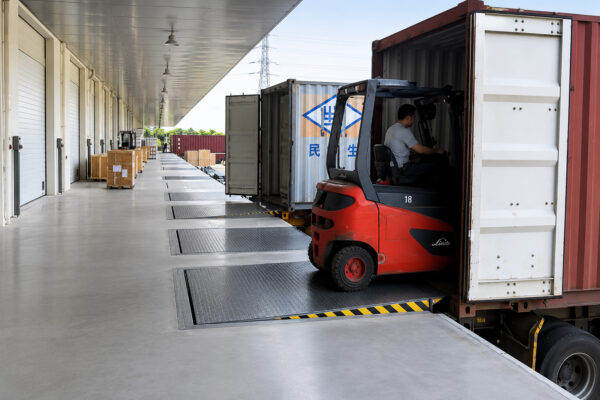
仓库自动化正迅速从孤立设备转向互联的物料搬运系统。.
机器人运输货物。自动化输送机在工作站之间移动纸箱。仓库管理系统协调库存。AGV和AMR越来越多地用于在无需持续人工控制的情况下移动物料。.
但在自动化项目中,有一个领域很容易被忽视:
2026年6月,, 亚马逊推出了其Proteus自主移动机器人的下一代产品, 作为一项重大欧洲履约投资的一部分。初代Proteus已在全美25个履约中心部署,主要在装卸区域运行,运输重型推车。下一代产品旨在突破装卸区域限制,在整个履约中心内运行。.
这是更广泛变革的一个有益例证。.
当仓库内部的物料流动变得更快、更自动化时,装卸区不能再被视为完全独立的人工操作。.
对于高吞吐量仓库、配送中心和制造工厂而言,, 装卸月台自动化正成为完整物流工作流程的重要组成部分。.
那么,自动化装卸月台究竟是什么样的,企业又应如何设计?
目录
切换为什么装卸月台自动化在2026年至关重要
自动化不再局限于少数高度先进的履约中心。.
DHL报告称其已 在自动化方面投资超过10亿欧元 三年内在其合同物流部门。其网络使用了超过7,500台机器人和近80万个物联网传感器,而全球超过90%的DHL仓库至少拥有一项自动化或数字化解决方案。.
DHL最近的 物流趋势雷达回响, 基于超过2,500名供应链专业人士的反馈,也将机器人技术列为塑造物流的最重要技术集群之一,运营效率是企业投资这些技术的主要原因之一。.
这些发展引出了一个简单的运营问题:
当货物快速通过自动化仓库,却仍在人工操作的装卸货位等待时,会发生什么?
装卸货月台在以下情况下可能成为瓶颈:
- 卡车等待可用装卸货位的时间过长;;
- 员工必须手动协调门和装卸货位设备;;
- 装卸货位调平器未与其他设备集成;;
- 叉车或AGV等待正确的装载顺序;;
- 司机和仓库操作员仅依赖口头沟通;;
- 设备可能以错误的顺序被操作;;
- 装卸货位占用信息无法提供给仓库系统。.
因此,装卸货位自动化的目标不仅仅是让调平器自动移动。.
而是创建一个 协调的装载流程.
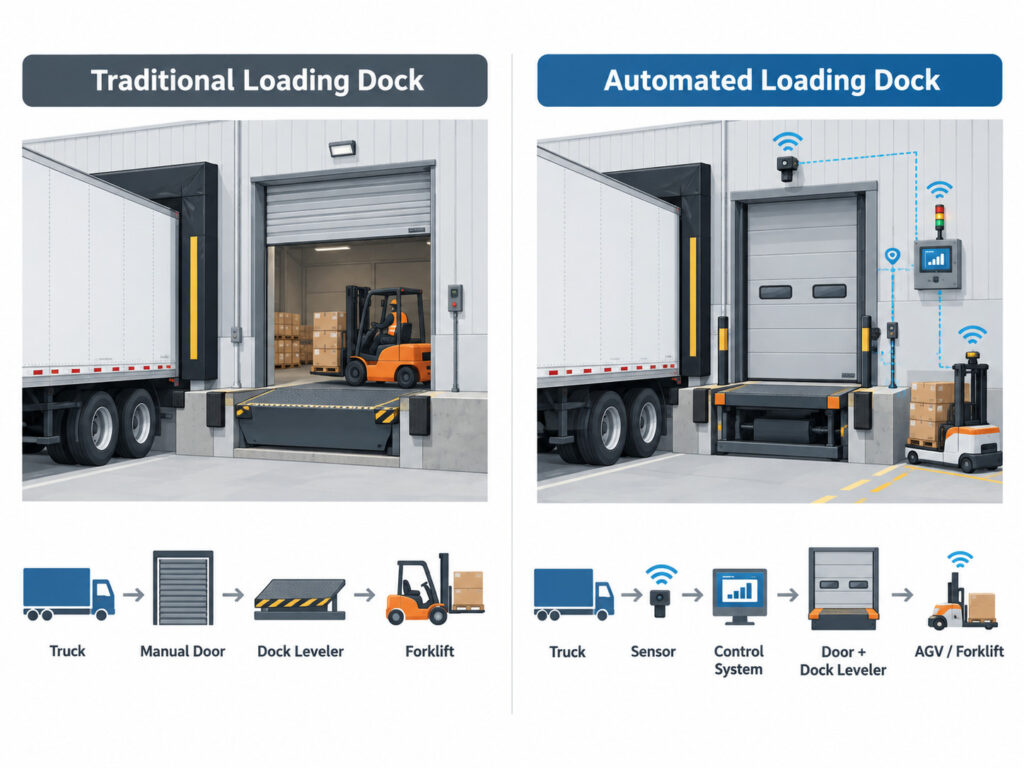
建议图片1 – 在此插入
图片概念:
传统装卸货位 vs 自动化装卸货位。.
左侧:
卡车 → 手动门 → 手动装卸货位调平器 → 叉车
右侧:
卡车 → 传感器 → 控制系统 → 工业门 + 装卸货位调平器 + 约束装置 → 叉车 / AGV
保持图形简洁,尽量减少英文文字。.
从独立设备到互联装卸区
设想一个传统的装载作业。.
一辆卡车到达。.
员工确认其正确定位。.
工业门打开。.
装卸货位调平器启动。.
叉车进入拖车。.
装载完成后,操作员将装卸货位调平器恢复到存放位置并关闭门。.
每个步骤都在很大程度上依赖于人员遵循正确的程序。.
在自动化装卸货台中,其中一些步骤可以被监控、控制或联锁。.
一个简化的流程可能如下所示:
卡车到达
↓
检测车辆位置
↓
卡车固定/装卸许可确认
↓
工业门打开
↓
登车桥展开
↓
装卸授权激活
↓
叉车/AGV开始物料搬运
↓
装卸完成
↓
登车桥收回
↓
门关闭
↓
车辆放行
并非每个仓库都需要每个步骤完全自动化。.
重要的原则是,设备应作为一个 统一的装卸货位系统运行,而非多个互不相关的产品.
1. 自动登车桥成为控制序列的一部分
登车桥仍然是装卸货位最重要的组件之一。.
其作用是弥合仓库地面与卡车车厢之间的高度和距离差,使叉车及其他物料搬运设备能够在两者之间移动。.
液压登车桥特别适用于高频装卸环境,因为平台升降和唇板操作可以通过电气和液压方式进行控制。.
但在智能装卸货台中,问题从:
“登车桥能否自动运行?”
转变为:
“登车桥能否作为仓库装卸流程的一部分安全运行?”
例如,系统可能会在以下条件满足之前阻止登车桥展开:
- 卡车已正确就位;;
- 工业门已打开;;
- 装卸区域已获操作授权。.
同样,在登车桥仍处于展开状态时,门不应随意关闭。.
这种联锁方式减少了对操作人员记忆的依赖,有助于创建更可控的工作流程。.
2. 工业门与登车桥可协同工作
工业门是装卸货台自动化的另一个关键部分。.
与其将门和登车桥视为独立的机器,不如协调它们的控制逻辑。.
例如:
步骤1
卡车到达装卸位置。.
步骤2
系统确认装卸条件已就绪。.
步骤3
工业分节门打开。.
步骤4
液压登车桥展开。.
步骤5
装卸过程开始。.
装卸完成后:
步骤6
登车桥返回其存放位置。.
步骤7
工业门关闭。.
该流程特别适用于以下仓库:
- 卡车流量大;;
- 多个装卸货位;;
- strict safety procedures;
- cold-storage requirements;
- automated material-handling systems.
It can also reduce situations where equipment is operated in the wrong order.
3. 传感器赋予装卸月台感知能力
Automation requires information.
That is why sensors are becoming increasingly important around loading bays.
Depending on the project, sensors may be used to detect:
- vehicle presence;
- truck position;
- door status;
- 装卸货平台门状态;;
- loading area occupancy;
- obstacles;
- vehicle restraint status.
This information can then be sent to a PLC or other control system.
Instead of asking an employee:
“Is the truck ready?”
the system can use defined signals to determine whether the next operation should be permitted.
This becomes increasingly important as warehouses introduce autonomous equipment.
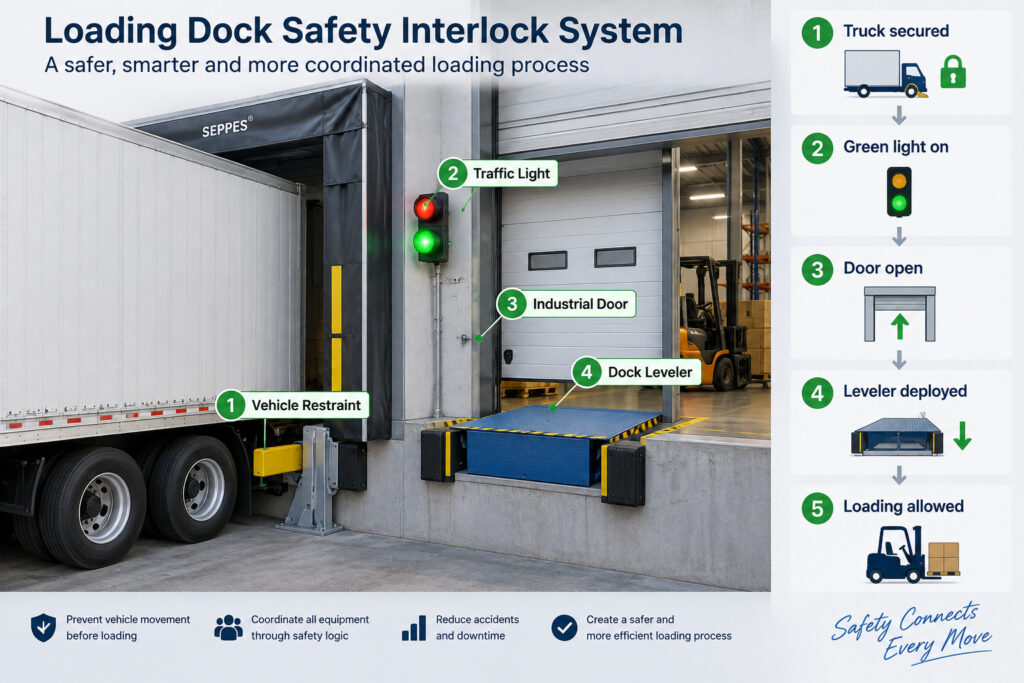
4. 交通信号灯与车辆限位装置改善协调
A loading dock connects two very different environments:
the warehouse 和 the truck yard.
That means automation must coordinate not only machines but also people.
Traffic lights can provide clear visual signals to warehouse employees and truck drivers.
例如:
Outside: Red light
The driver should remain stationary while loading is taking place.
Inside: Green light
Warehouse personnel are authorized to begin loading.
Vehicle restraints can provide another layer of protection by helping prevent unexpected trailer movement or premature departure.
This is especially important when forklifts travel between the dock and trailer.
OSHA identifies loading docks as potentially dangerous areas for forklifts and specifically warns about risks including forklifts falling from dock edges or between docks and unsecured trailers. OSHA requirements also address preventing trucks or trailers from moving during loading and unloading operations.
Automation therefore should not be designed only around speed.
Safety logic must remain part of the control strategy.
Suggested Image 2 – Insert here
图片概念:
Loading dock safety interlock diagram:
卡车
↓
Vehicle restraint
↓
Traffic light
↓
工业门
↓
液压调节板
↓
Forklift / AGV
Use arrows to show the operating sequence.
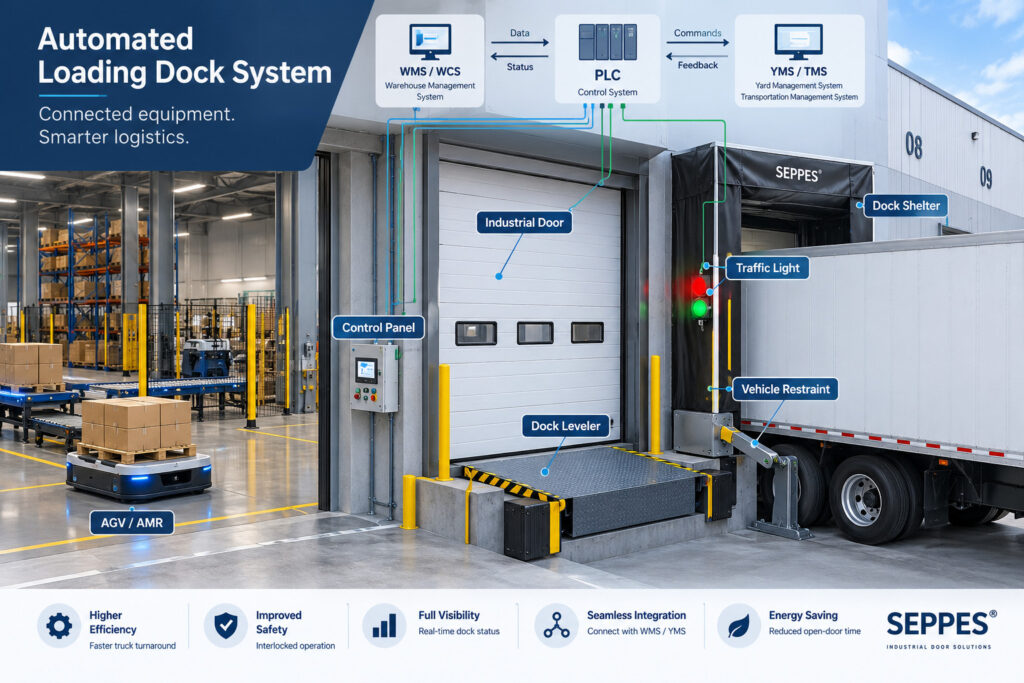
5. 装卸月台可连接仓库控制系统
The next stage of loading dock automation is system integration.
Modern warehouses often use combinations of:
- WMS — Warehouse Management System;
- WCS — Warehouse Control System;
- PLC — Programmable Logic Controller;
- YMS — Yard Management System;
- TMS — Transportation Management System.
The loading dock can provide operational status information to these systems.
例如:
Dock 01 — Available
Dock 02 — Truck detected
Dock 03 — Loading
Dock 04 — Door fault
This information makes dock operations more visible.
Instead of warehouse staff physically checking each loading bay, supervisors can potentially monitor loading status from a central control interface.
Depending on the project architecture, interfaces such as dry contacts or industrial communication protocols can also be considered to exchange status and command signals.
The exact communication method should be confirmed during engineering because it depends on both the loading dock equipment and the customer’s existing automation system.
6. AGV和AMR正在改变装卸区设计
Automated Guided Vehicles and Autonomous Mobile Robots introduce new requirements.
A human forklift driver can visually judge small changes in:
- floor condition;
- dock leveler angle;
- trailer position;
- obstacles;
- available clearance.
An automated vehicle depends much more heavily on predefined operating conditions.
Therefore, when AGVs or AMRs are expected to approach or cross a dock leveler, engineers should evaluate factors such as:
- platform slope;
- transition angle;
- load capacity;
- wheel size;
- ground clearance;
- surface traction;
- position accuracy;
- safety sensor coverage;
- communication signals;
- acceptable trailer movement.
This does not mean every standard dock leveler is automatically suitable for AGV operation.
The dock, vehicle and control system should be evaluated as a complete application.
For highly automated warehouses, this engineering work should ideally happen during the design stage rather than after the equipment has already been installed.
自动化装卸月台是什么样的?
A typical configuration might include:
仓库侧
- warehouse management system;
- PLC control;
- industrial sectional door;
- 卡车或挂车是否存在;;
- dock leveler control.
装卸区
- 控制仓库与挂车间接口之间的通行,但完整的装卸过程还可能需要的设备:;
- 液压登车桥;;
- 装卸月台防撞块;;
- internal traffic light;
- external traffic light.
物料搬运
- forklift;
- conveyor;
- AGV;
- AMR.
信息层
- vehicle detection;
- door status;
- dock leveler status;
- equipment fault signal;
- loading authorization;
- dock occupancy status.
Together, these components turn the loading dock from a passive transfer point into an active part of the warehouse material-flow system.
Suggested Image 3 – Insert here
图片概念:
Full automated warehouse loading dock architecture.
WMS / PLC at top → Industrial door / Dock leveler / Vehicle restraint → Truck
AGV or forklift traveling through the door.
This image should be more technical than promotional.
传统装卸月台与自动化装卸月台对比
| 特点 | Traditional Loading Dock | Automated Loading Dock |
|---|---|---|
| 门操作 | Independent/manual control | Can be integrated into sequence |
| 液压调节板 | Standalone operation | Can communicate with control system |
| Truck detection | Visual/manual | Sensors available |
| Vehicle restraint | Manual or separate | Can be interlocked |
| Traffic signals | 可选 | Integrated into workflow |
| Dock status | Checked manually | Can be monitored centrally |
| AGV compatibility | Not normally considered | Can be designed into the system |
| Data visibility | 有限公司 | 更高 |
| Operating sequence | Operator dependent | Logic controlled |
| Scalability | 中度 | Better for high-volume operations |
The automated version is not necessarily the right choice for every warehouse.
A facility handling only a few trucks per day may not need sophisticated integration.
But as truck volume, loading frequency and automation increase, coordinated dock controls become increasingly valuable.
哪些仓库从装卸月台自动化中受益最大?
电子商务履约中心
E-commerce warehouses often handle high shipment volumes and short delivery windows.
Amazon’s 2026 European investment illustrates how fulfillment networks continue to adopt more advanced robotics while simultaneously pursuing faster delivery. The company also announced plans for more than 25 additional sub-same-day delivery sites across Europe during 2026.
For this type of operation, reducing unnecessary waiting at the dock can become increasingly important.
自动化制造工厂
Factories using:
- production conveyors;
- robotic production lines;
- AGVs;
- automated storage systems
may benefit from extending automation to inbound and outbound logistics.
配送中心和3PL仓库
Facilities operating many loading bays need better visibility over:
- which docks are occupied;
- which trucks are ready;
- which bays are loading;
- which equipment requires attention.
冷藏仓库
Cold-storage operations have an additional concern:
temperature loss.
Coordinating the dock leveler, insulated industrial door and dock shelter can reduce unnecessary door-open time and uncontrolled air exchange.
高频物流中心
The higher the number of truck movements per day, the more important loading sequence, dock availability and operating efficiency become.
如何为自动化设计装卸月台
Buying an automatic dock leveler alone does not create an automated loading dock.
Before specifying equipment, consider the following factors.
1. 卡车类型
Identify the vehicles that will regularly use the loading bay.
Record:
- lowest truck-bed height;
- highest truck-bed height;
- 挂车宽度;;
- expected vehicle types.
This determines the working range required from the dock leveler.
2. 叉车或AGV重量
The dock leveler’s rated capacity should consider the actual loading operation.
This includes:
- 叉车或AGV的重量;;
- 货物重量;;
- operating frequency;
- dynamic forces.
Do not select a platform solely according to cargo weight.
3. 月台高度
The relationship between warehouse floor height and truck-bed height affects the operating angle of the dock leveler.
Excessive slopes may create problems for:
- low-clearance forklifts;
- pallet trucks;
- AGVs.
4. 工业门类型
Determine whether the project requires:
Space above and beside the opening should also be checked before equipment selection.
5. 控制逻辑
Decide which devices must communicate.
例如:
Vehicle restraint → Door → Dock leveler → Loading authorization
The control sequence should be defined before production.
6. 通信要求
If the loading bay will connect to a PLC, WMS or other system, clarify:
- required signals;
- communication method;
- input/output points;
- fault feedback;
- status feedback;
- remote control requirements.
7. 安全要求
Automation should include fail-safe thinking.
What happens if:
- a sensor fails?
- the door cannot fully open?
- the dock leveler does not return?
- the vehicle moves unexpectedly?
- communication with the warehouse system is lost?
These situations should be considered during system design.
未来:从智能仓库到智能装卸区
For years, warehouse automation concentrated mainly on what happened inside the building.
Companies automated:
- storage;
- picking;
- sorting;
- conveyors;
- pallet movement;
- inventory management.
The loading dock was often treated as the final manual boundary.
That boundary is starting to change.
Amazon’s development of autonomous robots that began with dock-area material movement provides a visible example of how important this part of the warehouse has become. Meanwhile, DHL’s automation investments and logistics trend research show that robotics, AI and digital systems are moving deeper into everyday logistics operations.
The next generation of loading docks will therefore be less about individual pieces of equipment and more about coordination.
The industrial door knows the status of the dock leveler.
The dock leveler knows whether loading conditions are safe.
The control system knows whether the dock is occupied.
The warehouse system knows whether the truck can be loaded.
AGVs and forklifts receive permission to move only when the loading path is ready.
That is the real direction of loading dock automation.
与SEPPES共建一体化装卸区
A modern loading bay should be designed as a system rather than a collection of unrelated products.
SEPPES provides industrial loading solutions that can combine equipment such as:
For automated warehouse projects, equipment configuration can be evaluated according to the customer’s loading process, vehicle types, material-handling equipment and control requirements.
Where system integration is required, communication and interlocking requirements should be confirmed during the engineering stage so that the industrial door, dock leveler and other loading equipment work according to the required operating sequence.
If you are planning a new warehouse or upgrading an existing loading bay, provide:
- 门开口尺寸;;
- loading dock height;
- 车厢底板高度范围;;
- forklift or AGV specifications;
- required loading capacity;
- number of loading bays;
- control or communication requirements.
These details allow the loading dock solution to be designed around the actual workflow instead of simply selecting equipment from a catalog.
常见问题
登车桥能否与仓库自动化集成?
Yes. A dock leveler can be incorporated into a wider control system using control signals and interlocking logic. The exact method depends on the dock leveler controller and the customer’s PLC or warehouse automation architecture.
什么是自动化装卸月台?
An automated loading dock uses connected equipment such as dock levelers, industrial doors, vehicle restraints, sensors, traffic lights and control systems to coordinate the loading and unloading process.
AGV能否使用登车桥?
Potentially, but the complete application should be evaluated. Important factors include platform slope, transition angle, AGV ground clearance, wheel size, load, surface condition, trailer movement and communication requirements.
哪种登车桥最适合自动化仓库?
Hydraulic dock levelers are commonly suited to high-frequency loading applications because their platform and lip movements can be electrically controlled. However, the correct model depends on vehicle height, capacity, loading frequency and automation requirements.
装卸月台自动化是否会取代操作人员的需求?
Not necessarily. The primary goal is usually to coordinate equipment, reduce unnecessary manual steps, improve visibility and create safer operating sequences. Human supervision may still be required depending on the application.
智能装卸月台需要哪些设备?
A smart loading dock may include an industrial door, hydraulic dock leveler, dock shelter, vehicle restraint, sensors, traffic lights, PLC controls and connections to warehouse or yard-management systems. The final configuration depends on the level of automation required.