
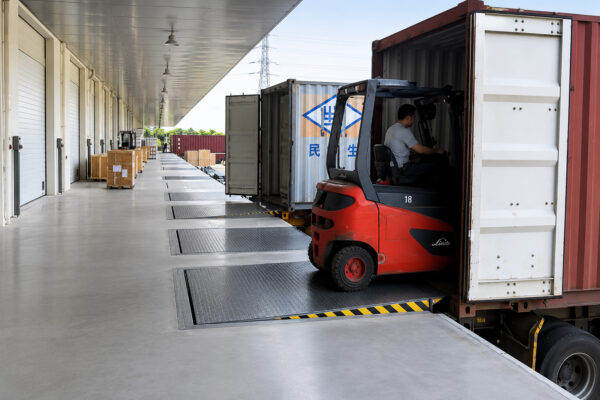
أتمتة المستودعات تنتقل بسرعة من الآلات المعزولة إلى أنظمة مناولة المواد المتصلة.
تنقل الروبوتات البضائع. تنقل السيور الناقلة الآلية الكراتين بين محطات العمل. تنسق أنظمة إدارة المستودعات المخزون. تُستخدم المركبات الموجهة ذاتياً (AGVs) والروبوتات المتنقلة المستقلة (AMRs) بشكل متزايد لنقل المواد دون تحكم بشري مستمر.
لكن هناك مجالاً واحداً يمكن أن يُغفل بسهولة أثناء مشروع الأتمتة:
في يونيو 2026،, أطلقت أمازون الجيل التالي من روبوتها المتنقل المستقل Proteus كجزء من استثمار أوروبي كبير في مراكز التنفيذ. تم نشر Proteus الأصلي بالفعل في 25 مركز تنفيذ في الولايات المتحدة ويعمل بشكل أساسي في مناطق الأرصفة، لنقل العربات الثقيلة. صُمم الجيل التالي ليتجاوز الرصيف ويعمل في جميع أنحاء مراكز التنفيذ.
هذا مثال مفيد على تغيير أوسع.
عندما تصبح حركة المواد داخل المستودع أسرع وأكثر أتمتة، لم يعد من الممكن التعامل مع منطقة التحميل كعملية يدوية منفصلة تماماً.
بالنسبة للمستودعات عالية الإنتاجية ومراكز التوزيع والمصانع،, أصبحت أتمتة رصيف التحميل جزءاً مهماً من سير العمل اللوجستي الكامل.
إذن كيف يبدو رصيف التحميل الآلي فعلياً، وكيف ينبغي للشركات تصميمه؟
جدول المحتويات
تبديللماذا تهم أتمتة رصيف التحميل في 2026
لم تعد الأتمتة محدودة بعدد صغير من مراكز التنفيذ المتقدمة للغاية.
أعلنت DHL أنها استثمرت أكثر من مليار يورو في الأتمتة في قسم الخدمات اللوجستية التعاقدية لديها على مدى ثلاث سنوات. تستخدم شبكتها أكثر من 7,500 روبوت وحوالي 800,000 مستشعر إنترنت الأشياء، في حين أن أكثر من 90% من مستودعات DHL حول العالم لديها على الأقل حل واحد للأتمتة أو الرقمنة.
أحدث إصدار من DHL رادار الاتجاهات اللوجستية Echo, ، بناءً على ردود أكثر من 2,500 متخصص في سلسلة التوريد، يصنف أيضًا الروبوتات كواحدة من أهم مجموعات التكنولوجيا التي تشكل الخدمات اللوجستية، مع الكفاءة التشغيلية من بين الأسباب الرئيسية التي تدفع الشركات للاستثمار في هذه التقنيات.
تخلق هذه التطورات سؤالاً تشغيليًا بسيطًا:
ماذا يحدث عندما تتحرك البضائع بسرعة عبر مستودع آلي ولكنها لا تزال تنتظر في رصيف تحميل يُدار يدويًا؟
يمكن أن يصبح رصيف التحميل عنق زجاجة عندما:
- تنتظر الشاحنات وقتًا طويلاً للحصول على رصيف متاح؛;
- يتعين على الموظفين تنسيق الأبواب ومعدات الرصيف يدويًا؛;
- لا تكون معوّضات ارتفاع الرصيف متكاملة مع المعدات الأخرى؛;
- تنتظر الرافعات الشوكية أو مركبات AGV تسلسل التحميل الصحيح؛;
- يعتمد السائقون ومشغلو المستودعات على التواصل الشفهي فقط؛;
- يمكن تشغيل المعدات بتسلسل خاطئ؛;
- لا تتوفر معلومات عن إشغال الرصيف لنظام المستودع.
لذلك فإن هدف أتمتة رصيف التحميل ليس مجرد جعل معوّض ارتفاع الرصيف يتحرك تلقائيًا.
بل هو إنشاء عملية تحميل منسّقة.
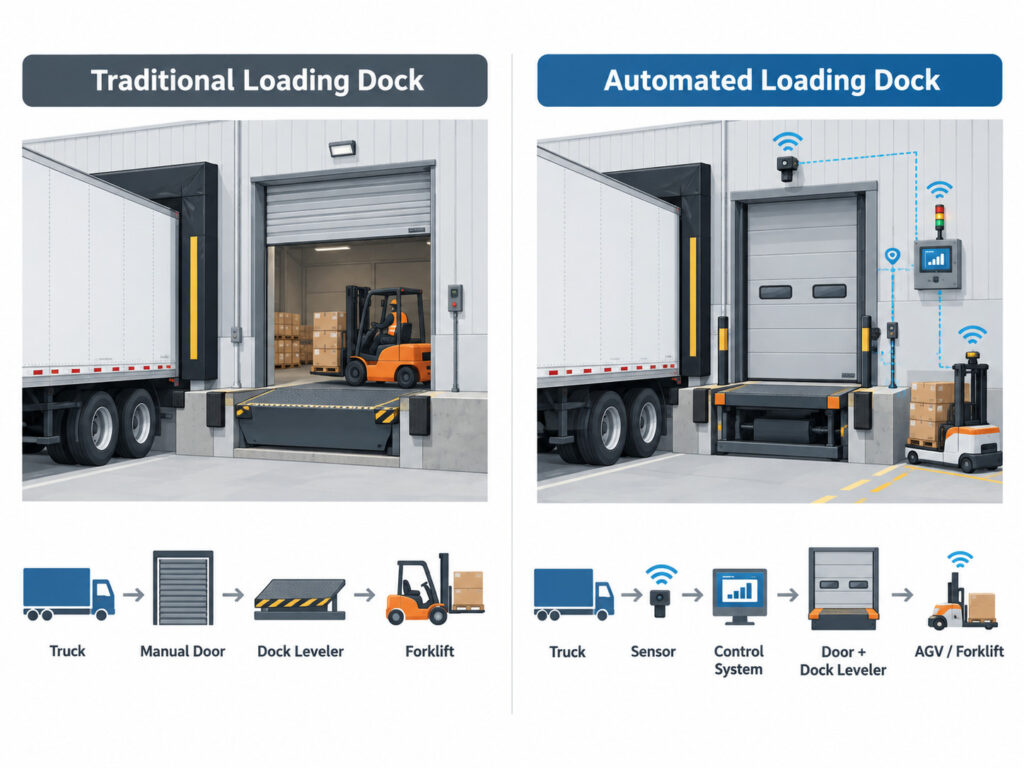
الصورة المقترحة 1 – تُدرج هنا
مفهوم الصورة:
رصيف تحميل تقليدي مقابل رصيف تحميل آلي.
على اليسار:
شاحنة ← باب يدوي ← معوّض ارتفاع رصيف يدوي ← رافعة شوكية
على اليمين:
شاحنة ← مستشعر ← نظام تحكم ← باب صناعي + معوّض ارتفاع رصيف + مثبّت ← رافعة شوكية / AGV
حافظ على الرسم نظيفًا مع الحد الأدنى من النص الإنجليزي.
ما هي أتمتة رصيف التحميل؟
تشير أتمتة رصيف التحميل إلى استخدام المعدات التلقائية والمستشعرات وأنظمة التحكم وواجهات الاتصال لتنسيق الأنشطة بين المستودع والمركبة عند رصيف التحميل.
قد يتكون الرصيف التقليدي من:
- باب صناعي;
- معدات تسوية الرصيف;
- ملجأ الرصيف;
- تحكم بالأزرار؛;
- رافعة شوكية.
قد يضيف رصيف التحميل الأكثر أتمتة:
- مستشعرات كشف المركبات؛;
- مراقبة إشغال الرصيف؛;
- controls الأبواب التلقائية؛;
- controls معوّض ارتفاع الرصيف الهيدروليكي؛;
- مثبّتات المركبات;
- إشارات المرور؛;
- أقفال الأمان التشابكية؛;
- اتصالات PLC؛;
- تكامل مع نظام إدارة المستودعات WMS أو إدارة الساحات؛;
- واجهات AGV أو AMR.
الفرق ليس مجرد عدد الأجهزة.
الفرق الأساسي هو أن الأجهزة تتواصل وتعمل وفقًا لتسلسل محكوم.
من المعدات المستقلة إلى رصيف تحميل متصل
لنأخذ بعين الاعتبار عملية تحميل تقليدية.
تصل شاحنة.
يؤكد موظف أنها في الموضع الصحيح.
يُفتح الباب الصناعي.
يُفعَّل معوّض ارتفاع الرصيف.
تدخل رافعة شوكية إلى المقطورة.
بعد اكتمال التحميل، يعيد المشغل معوّض ارتفاع الرصيف إلى موضعه المخزّن ويغلق الباب.
Each step depends heavily on people following the correct procedure.
In an automated loading dock, some of these steps can be monitored, controlled or interlocked.
A simplified sequence might look like this:
Truck arrives
↓
Vehicle position detected
↓
Truck secured / loading permission confirmed
↓
فتح الباب الصناعي
↓
Dock leveler deploys
↓
Loading authorization activated
↓
Forklift / AGV begins material transfer
↓
Loading completed
↓
Dock leveler returns
↓
Door closes
↓
Vehicle released
Not every warehouse needs every step to be fully automatic.
The important principle is that the equipment should work as one loading bay system rather than several unrelated products.
1. تصبح موازنات الأرصفة الأوتوماتيكية جزءاً من تسلسل التحكم
The dock leveler remains one of the most important components of a loading bay.
Its job is to bridge the height and distance difference between the warehouse floor and truck bed, allowing forklifts and other material-handling equipment to move between them.
Hydraulic dock levelers are particularly suitable for high-frequency loading environments because platform lifting and lip operation can be controlled electrically and hydraulically.
But in a smart loading dock, the question changes from:
“Can the dock leveler operate automatically?”
to:
“Can the dock leveler operate safely as part of the warehouse loading sequence?”
For example, the system may prevent the leveler from deploying before:
- the truck is correctly positioned;
- the industrial door is open;
- the loading area is authorized for operation.
Likewise, the door should not necessarily close while the leveler remains deployed.
This type of interlocking reduces dependence on operator memory and helps create a more controlled workflow.
2. يمكن للأبواب الصناعية وموازنات الأرصفة العمل معاً
The industrial door is another critical part of loading dock automation.
Instead of treating the door and leveler as independent machines, their control logic can be coordinated.
على سبيل المثال:
Step 1
Truck reaches the loading position.
Step 2
The system confirms that loading conditions are ready.
Step 3
The industrial sectional door opens.
Step 4
The hydraulic dock leveler deploys.
Step 5
The loading process begins.
When loading is complete:
Step 6
The dock leveler returns to its stored position.
Step 7
The industrial door closes.
This sequence is particularly useful in warehouses with:
- high truck traffic;
- multiple loading bays;
- strict safety procedures;
- cold-storage requirements;
- automated material-handling systems.
It can also reduce situations where equipment is operated in the wrong order.
3. تمنح أجهزة الاستشعار رصيف التحميل الوعي
Automation requires information.
That is why sensors are becoming increasingly important around loading bays.
Depending on the project, sensors may be used to detect:
- vehicle presence;
- truck position;
- door status;
- موضع معادل الرصيف؛;
- loading area occupancy;
- obstacles;
- vehicle restraint status.
This information can then be sent to a PLC or other control system.
Instead of asking an employee:
“Is the truck ready?”
the system can use defined signals to determine whether the next operation should be permitted.
This becomes increasingly important as warehouses introduce autonomous equipment.
4. تحسّن إشارات المرور ومثبتات المركبات التنسيق
A loading dock connects two very different environments:
the warehouse و the truck yard.
That means automation must coordinate not only machines but also people.
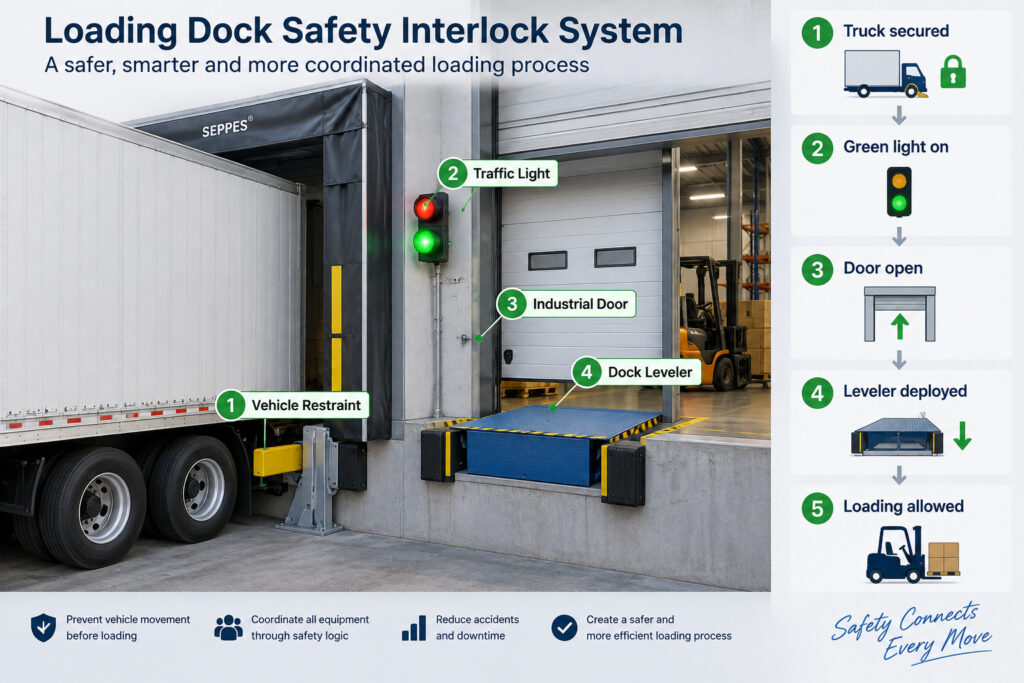
Traffic lights can provide clear visual signals to warehouse employees and truck drivers.
على سبيل المثال:
Outside: Red light
The driver should remain stationary while loading is taking place.
Inside: Green light
Warehouse personnel are authorized to begin loading.
Vehicle restraints can provide another layer of protection by helping prevent unexpected trailer movement or premature departure.
This is especially important when forklifts travel between the dock and trailer.
OSHA identifies loading docks as potentially dangerous areas for forklifts and specifically warns about risks including forklifts falling from dock edges or between docks and unsecured trailers. OSHA requirements also address preventing trucks or trailers from moving during loading and unloading operations.
Automation therefore should not be designed only around speed.
Safety logic must remain part of the control strategy.
Suggested Image 2 – Insert here
مفهوم الصورة:
Loading dock safety interlock diagram:
الشاحنة
↓
Vehicle restraint
↓
Traffic light
↓
باب صناعي
↓
平台高度调节板
↓
Forklift / AGV
Use arrows to show the operating sequence.
5. يمكن لأرصفة التحميل الاتصال بأنظمة التحكم في المستودعات
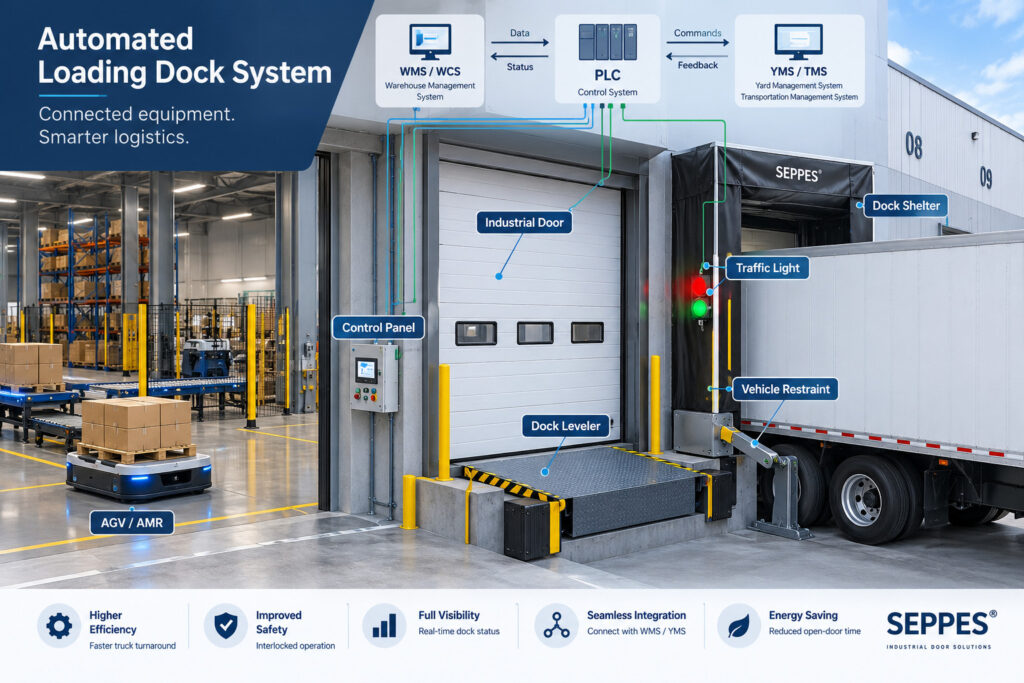
The next stage of loading dock automation is system integration.
Modern warehouses often use combinations of:
- WMS — Warehouse Management System;
- WCS — Warehouse Control System;
- PLC — Programmable Logic Controller;
- YMS — Yard Management System;
- TMS — Transportation Management System.
The loading dock can provide operational status information to these systems.
على سبيل المثال:
Dock 01 — Available
Dock 02 — Truck detected
Dock 03 — Loading
Dock 04 — Door fault
This information makes dock operations more visible.
Instead of warehouse staff physically checking each loading bay, supervisors can potentially monitor loading status from a central control interface.
Depending on the project architecture, interfaces such as dry contacts or industrial communication protocols can also be considered to exchange status and command signals.
The exact communication method should be confirmed during engineering because it depends on both the loading dock equipment and the customer’s existing automation system.
6. تغيّر المركبات الموجهة ذاتياً والروبوتات المتنقلة المستقلة تصميم منطقة التحميل
Automated Guided Vehicles and Autonomous Mobile Robots introduce new requirements.
A human forklift driver can visually judge small changes in:
- floor condition;
- dock leveler angle;
- trailer position;
- obstacles;
- available clearance.
An automated vehicle depends much more heavily on predefined operating conditions.
Therefore, when AGVs or AMRs are expected to approach or cross a dock leveler, engineers should evaluate factors such as:
- platform slope;
- transition angle;
- load capacity;
- wheel size;
- ground clearance;
- surface traction;
- position accuracy;
- safety sensor coverage;
- communication signals;
- acceptable trailer movement.
This does not mean every standard dock leveler is automatically suitable for AGV operation.
The dock, vehicle and control system should be evaluated as a complete application.
For highly automated warehouses, this engineering work should ideally happen during the design stage rather than after the equipment has already been installed.
كيف يبدو رصيف التحميل الآلي؟
A typical configuration might include:
جانب المستودع
- warehouse management system;
- PLC control;
- industrial sectional door;
- أجهزة استشعار السلامة؛;
- dock leveler control.
منطقة التحميل
- hydraulic dock leveler;
- dock shelter or dock seal;
- vehicle restraint;
- internal traffic light;
- external traffic light.
مناولة المواد
- forklift;
- conveyor;
- AGV;
- AMR.
طبقة المعلومات
- vehicle detection;
- door status;
- dock leveler status;
- equipment fault signal;
- loading authorization;
- dock occupancy status.
Together, these components turn the loading dock from a passive transfer point into an active part of the warehouse material-flow system.
Suggested Image 3 – Insert here
مفهوم الصورة:
Full automated warehouse loading dock architecture.
WMS / PLC at top → Industrial door / Dock leveler / Vehicle restraint → Truck
AGV or forklift traveling through the door.
This image should be more technical than promotional.
رصيف التحميل التقليدي مقابل رصيف التحميل الآلي
| الميزة | Traditional Loading Dock | Automated Loading Dock |
|---|---|---|
| تشغيل الباب | Independent/manual control | Can be integrated into sequence |
| 平台高度调节板 | Standalone operation | Can communicate with control system |
| Truck detection | Visual/manual | Sensors available |
| Vehicle restraint | Manual or separate | Can be interlocked |
| Traffic signals | Optional | Integrated into workflow |
| Dock status | Checked manually | Can be monitored centrally |
| AGV compatibility | Not normally considered | Can be designed into the system |
| Data visibility | محدودة | أعلى |
| Operating sequence | Operator dependent | Logic controlled |
| Scalability | معتدل | Better for high-volume operations |
The automated version is not necessarily the right choice for every warehouse.
A facility handling only a few trucks per day may not need sophisticated integration.
But as truck volume, loading frequency and automation increase, coordinated dock controls become increasingly valuable.
أي المستودعات تستفيد أكثر من أتمتة رصيف التحميل؟
مراكز تنفيذ التجارة الإلكترونية
E-commerce warehouses often handle high shipment volumes and short delivery windows.
Amazon’s 2026 European investment illustrates how fulfillment networks continue to adopt more advanced robotics while simultaneously pursuing faster delivery. The company also announced plans for more than 25 additional sub-same-day delivery sites across Europe during 2026.
For this type of operation, reducing unnecessary waiting at the dock can become increasingly important.
المصانع الآلية
Factories using:
- production conveyors;
- robotic production lines;
- AGVs;
- automated storage systems
may benefit from extending automation to inbound and outbound logistics.
مراكز التوزيع ومستودعات الطرف الثالث اللوجستية
Facilities operating many loading bays need better visibility over:
- which docks are occupied;
- which trucks are ready;
- which bays are loading;
- which equipment requires attention.
冷库仓库
Cold-storage operations have an additional concern:
temperature loss.
Coordinating the dock leveler, insulated industrial door and dock shelter can reduce unnecessary door-open time and uncontrolled air exchange.
المراكز اللوجستية عالية التردد
The higher the number of truck movements per day, the more important loading sequence, dock availability and operating efficiency become.
كيفية تصميم رصيف تحميل للأتمتة
Buying an automatic dock leveler alone does not create an automated loading dock.
Before specifying equipment, consider the following factors.
1. أنواع الشاحنات
Identify the vehicles that will regularly use the loading bay.
Record:
- lowest truck-bed height;
- highest truck-bed height;
- trailer width;
- expected vehicle types.
This determines the working range required from the dock leveler.
2. وزن الرافعة الشوكية أو المركبة الموجهة ذاتياً
The dock leveler’s rated capacity should consider the actual loading operation.
This includes:
- وزن الرافعة الشوكية أو مركبة النقل ذاتية القيادة (AGV)؛;
- وزن البضاعة؛;
- operating frequency;
- dynamic forces.
Do not select a platform solely according to cargo weight.
3. ارتفاع الرصيف
The relationship between warehouse floor height and truck-bed height affects the operating angle of the dock leveler.
Excessive slopes may create problems for:
- low-clearance forklifts;
- pallet trucks;
- AGVs.
4. نوع الباب الصناعي
Determine whether the project requires:
- باب قطاعي صناعي;
- باب عالي السرعة;
- باب معزول;
- other industrial door systems.
Space above and beside the opening should also be checked before equipment selection.
5. منطق التحكم
Decide which devices must communicate.
على سبيل المثال:
Vehicle restraint → Door → Dock leveler → Loading authorization
The control sequence should be defined before production.
6. متطلبات الاتصال
If the loading bay will connect to a PLC, WMS or other system, clarify:
- required signals;
- communication method;
- input/output points;
- fault feedback;
- status feedback;
- remote control requirements.
7. متطلبات السلامة
Automation should include fail-safe thinking.
What happens if:
- a sensor fails?
- the door cannot fully open?
- the dock leveler does not return?
- the vehicle moves unexpectedly?
- communication with the warehouse system is lost?
These situations should be considered during system design.
المستقبل: من المستودعات الذكية إلى أرصفة التحميل الذكية
For years, warehouse automation concentrated mainly on what happened inside the building.
Companies automated:
- storage;
- picking;
- sorting;
- conveyors;
- pallet movement;
- inventory management.
The loading dock was often treated as the final manual boundary.
That boundary is starting to change.
Amazon’s development of autonomous robots that began with dock-area material movement provides a visible example of how important this part of the warehouse has become. Meanwhile, DHL’s automation investments and logistics trend research show that robotics, AI and digital systems are moving deeper into everyday logistics operations.
The next generation of loading docks will therefore be less about individual pieces of equipment and more about coordination.
The industrial door knows the status of the dock leveler.
The dock leveler knows whether loading conditions are safe.
The control system knows whether the dock is occupied.
The warehouse system knows whether the truck can be loaded.
AGVs and forklifts receive permission to move only when the loading path is ready.
That is the real direction of loading dock automation.
بناء رصيف تحميل متكامل مع SEPPES
A modern loading bay should be designed as a system rather than a collection of unrelated products.
سيبس provides industrial loading solutions that can combine equipment such as:
- معادلات مستوى الرصيف الهيدروليكية;
- الأبواب المقطعية الصناعية;
- أبواب عالية السرعة;
- ملاجئ الأرصفة;
- loading bay control systems;
- safety and activation devices.
For automated warehouse projects, equipment configuration can be evaluated according to the customer’s loading process, vehicle types, material-handling equipment and control requirements.
Where system integration is required, communication and interlocking requirements should be confirmed during the engineering stage so that the industrial door, dock leveler and other loading equipment work according to the required operating sequence.
If you are planning a new warehouse or upgrading an existing loading bay, provide:
- door opening size;
- loading dock height;
- نطاق ارتفاع سرير الشاحنة؛;
- forklift or AGV specifications;
- required loading capacity;
- number of loading bays;
- control or communication requirements.
These details allow the loading dock solution to be designed around the actual workflow instead of simply selecting equipment from a catalog.
الأسئلة الشائعة
هل يمكن دمج موازن الرصيف مع أتمتة المستودعات؟
Yes. A dock leveler can be incorporated into a wider control system using control signals and interlocking logic. The exact method depends on the dock leveler controller and the customer’s PLC or warehouse automation architecture.
ما هو رصيف التحميل الآلي؟
An automated loading dock uses connected equipment such as dock levelers, industrial doors, vehicle restraints, sensors, traffic lights and control systems to coordinate the loading and unloading process.
هل يمكن للمركبات الموجهة ذاتياً استخدام موازن الرصيف؟
Potentially, but the complete application should be evaluated. Important factors include platform slope, transition angle, AGV ground clearance, wheel size, load, surface condition, trailer movement and communication requirements.
أي موازن رصيف هو الأفضل لمستودع آلي؟
Hydraulic dock levelers are commonly suited to high-frequency loading applications because their platform and lip movements can be electrically controlled. However, the correct model depends on vehicle height, capacity, loading frequency and automation requirements.
هل تلغي أتمتة رصيف التحميل الحاجة إلى المشغلين؟
Not necessarily. The primary goal is usually to coordinate equipment, reduce unnecessary manual steps, improve visibility and create safer operating sequences. Human supervision may still be required depending on the application.
ما المعدات اللازمة لرصيف تحميل ذكي؟
A smart loading dock may include an industrial door, hydraulic dock leveler, dock shelter, vehicle restraint, sensors, traffic lights, PLC controls and connections to warehouse or yard-management systems. The final configuration depends on the level of automation required.