
When choosing an industrial sectional door, many buyers focus on panel thickness, motor brand, or insulation value. However, one of the most important factors is often overlooked: the door lifting method.
Different sectional door lift types directly affect installation space, opening height, workflow efficiency, maintenance convenience, and long-term operating performance. Choosing the right track system can save space, improve safety, and maximize building usability.
SEPPES provides customized industrial lifting door systems with multiple track configurations to match warehouses, factories, logistics centers, workshops, and commercial buildings.
Table of Contents
ToggleWhy the Lift Type Matters for Industrial Sectional Doors
The lifting system determines how the door panels travel when opening. Depending on ceiling height, roof slope, beam obstacles, and required clear opening height, different lift methods are used.
Choosing the wrong configuration may cause:
- Reduced usable headroom
- Lower forklift clearance
- Slower workflow movement
- Difficult installation
- Higher maintenance costs
- Wasted building space
Choosing the correct sectional overhead door lift type improves both daily operation and long-term ROI.
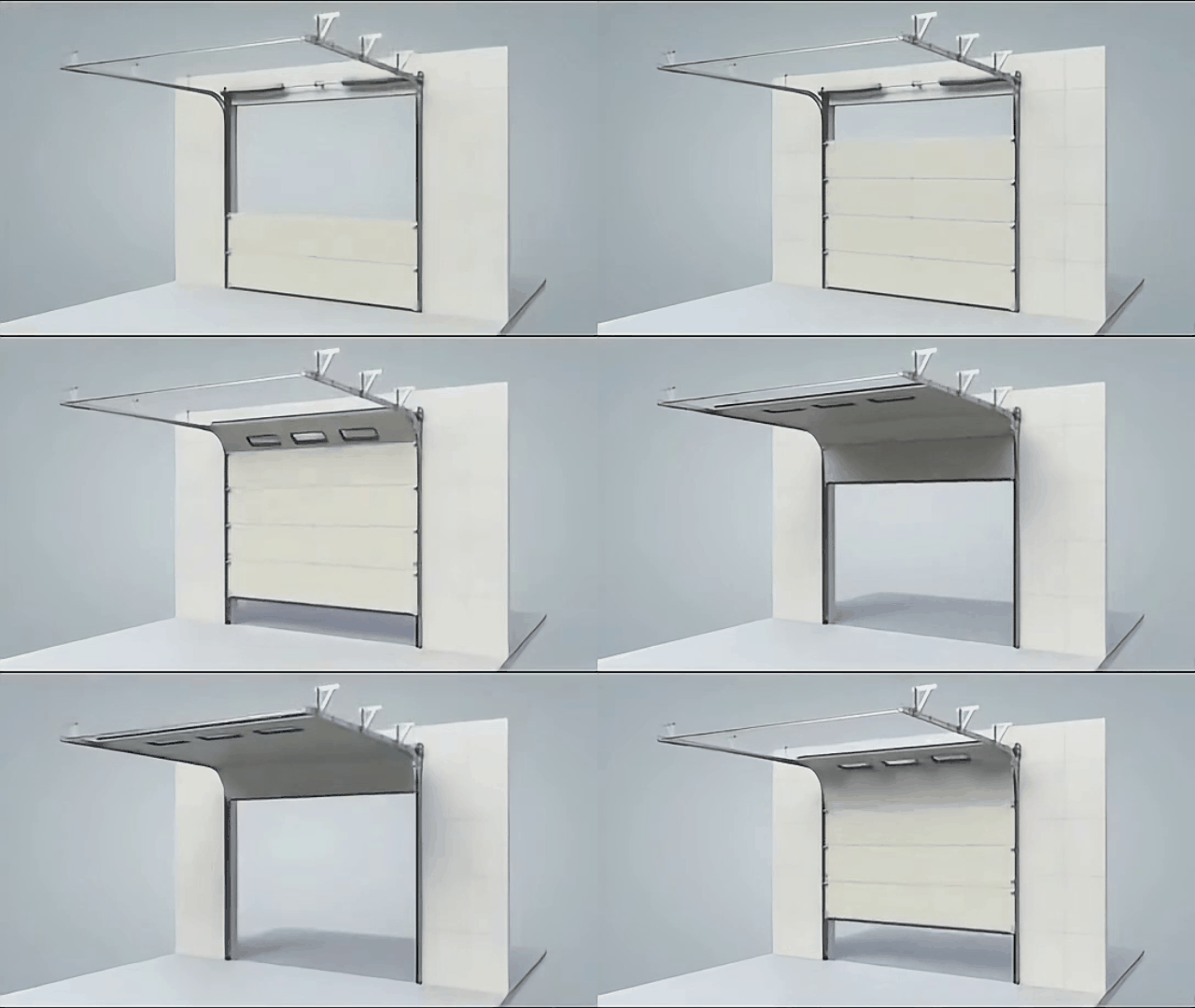
Common Industrial Sectional Door Lift Types
SEPPES mainly offers four common lifting methods:
- Standard Lift
- Low Headroom Lift
- High Lift
- Full Vertical Lift
Each system suits different building structures and applications.
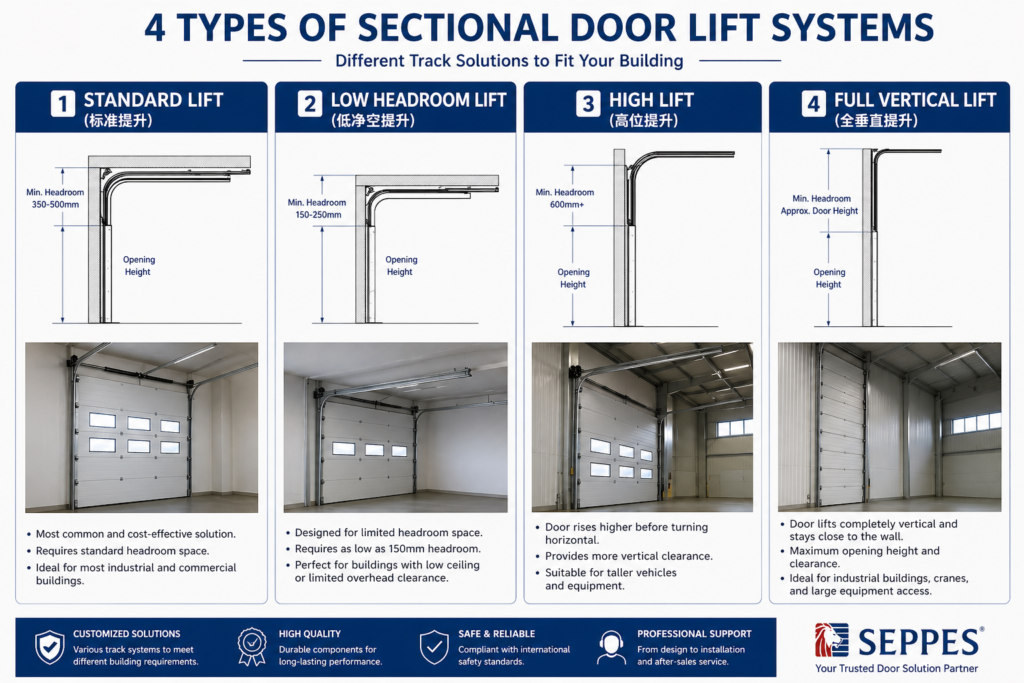
1. Standard Lift Door – Best for Normal Warehouses
A standard lift sectional door uses vertical tracks first, then curves into horizontal ceiling tracks.
Best For:
- Standard warehouses
- Loading bays
- Workshops
- Commercial garages
- Logistics buildings with normal ceiling height
Advantages:
- Most economical option
- Smooth daily operation
- Easy maintenance
- Suitable for common industrial buildings
Considerations:
Requires enough headroom above the opening for curved tracks.
Best Keyword Uses:
- standard lift sectional door
- warehouse overhead door system
- industrial garage door standard lift
If your building has regular headroom, this is often the most cost-effective solution.
2. Low Headroom Lift Door – Best for Limited Space
A low headroom sectional door is designed for buildings with minimal space above the opening.
It uses a compact dual-track or modified spring system to allow installation where ceiling clearance is limited.
Best For:
- Renovated factories
- Underground loading areas
- Parking entrances
- Older warehouses
- Buildings with beams near the opening
Advantages:
- Solves tight headroom issues
- Keeps automatic operation possible
- Maximizes usable opening size
Considerations:
More specialized hardware than standard lift.
Best Keyword Uses:
- low headroom industrial door
- sectional door for low ceiling warehouse
- compact overhead door lift system
If your building has restricted top clearance, this is the ideal option.
3. High Lift Door – Best for Extra Storage Space
A high lift sectional door travels vertically higher before turning horizontal. This creates more open wall space and keeps ceiling tracks higher.
Best For:
- Warehouses with tall ceilings
- Storage facilities
- Manufacturing plants
- Forklift traffic areas
- Buildings using overhead cranes or racking
Advantages:
- Better vertical clearance
- More wall and floor usability
- Tracks stay higher and out of the way
- Better for taller trucks and equipment
Considerations:
Requires more side room and ceiling height.
Best Keyword Uses:
- high lift sectional door
- industrial overhead door high lift track
- warehouse door for tall ceiling
If your warehouse has extra height, high lift often increases efficiency.
4. Full Vertical Lift Door – Best for Maximum Height Access
A full vertical lift door rises straight upward with no horizontal ceiling tracks. Panels stack vertically above the opening.
Best For:
- Aviation hangars
- Large logistics hubs
- Heavy industrial plants
- High-bay warehouses
- Facilities needing full ceiling access
Advantages:
- Maximum clear opening height
- No ceiling track obstruction
- Ideal for cranes, machinery, or high racks
- Premium solution for modern logistics buildings
Considerations:
Requires significant wall height above the opening.
Best Keyword Uses:
- full vertical lift sectional door
- vertical lift warehouse door
- high bay industrial overhead door
For facilities needing the largest clear opening, this is the best solution.
Comparison of Different Sectional Door Lift Types
| Lift Type | Headroom Needed | Ceiling Space Use | Best Application | Cost Level |
|---|---|---|---|---|
| Standard Lift | Normal | Medium | Common warehouses | Low |
| Low Headroom Lift | Minimal | Medium | Tight ceiling spaces | Medium |
| High Lift | High | High tracks | Tall warehouses | Medium |
| Full Vertical Lift | Very High | No horizontal tracks | High-bay facilities | Premium |
How Lift Type Affects Daily Operations
Better Forklift Flow
A properly selected warehouse sectional door lift system gives better clearance for forklifts, pallet trucks, and loading traffic.
More Storage Capacity
High lift and vertical lift systems free wall and ceiling areas for racks, pipes, lighting, and conveyors.
Lower Maintenance Risk
Correct track geometry reduces strain on springs, rollers, and motors.
Improved Safety
Proper lift design avoids collisions with vehicles, equipment, or overhead systems.
Why Choose SEPPES Industrial Sectional Doors?
SEPPES specializes in customized industrial sectional overhead doors for warehouses, factories, and logistics centers.
SEPPES Advantages:
- Custom lift type engineering
- CE certified systems
- Strong insulated door panels
- Smart control systems
- Durable spring balance technology
- Export experience worldwide
- Professional project support
Whether you need a standard lift warehouse door or a full vertical lift industrial door, SEPPES can match your building requirements.
Which Lift Type Is Right for Your Building?
Choose Standard Lift if you have normal ceiling space and want best value.
Choose Low Headroom Lift if top space is limited.
Choose High Lift if you want more vertical storage clearance.
Choose Full Vertical Lift if you need maximum opening height.
Final Thoughts
The right sectional door lifting method improves space efficiency, workflow speed, and long-term durability. Instead of choosing only by price, smart buyers compare how each lift type fits their building structure.
Need help selecting the best lift system? Contact SEPPES for expert advice on customized industrial sectional doors for your project.
FAQ About Sectional Door Lift Types
Which Lift Type Is Best for a Standard Warehouse?
A standard lift industrial sectional door is usually the best option if normal headroom is available.
Which Door Lift Type Saves the Most Space?
A full vertical lift door saves the most ceiling space because it has no horizontal tracks.
Can I Install a Sectional Door in a Low Ceiling Building?
Yes. A low headroom lift sectional door is specifically designed for this situation.
Which Lift Type Is Best for Forklifts?
High lift or full vertical lift systems are often better for tall forklifts and frequent traffic.
Does Lift Type Affect Door Price?
Yes. Standard lift is usually the most economical, while full vertical lift systems cost more due to extra structure and hardware.