
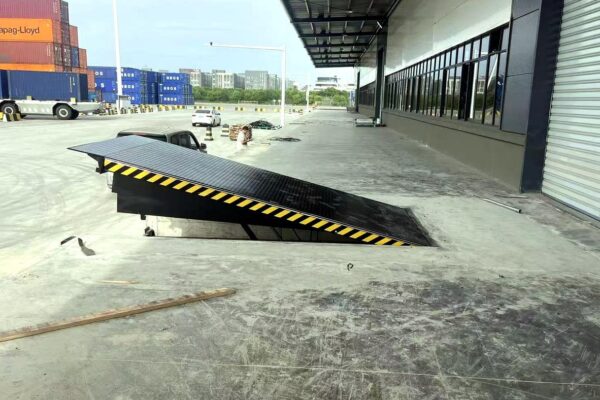
Wie entwickeln sich Laderampen für automatisierte Lagerhäuser im Jahr 2026?
Die Lagerautomatisierung geht über automatisierte Lagerung, robotergestütztes Kommissionieren und Fördersysteme hinaus. Im Jahr 2026 werden Laderampen zunehmend Teil des vernetzten Materialflusssystems, das Lkw, Lagergeräte, Industrietore, Überladebrücken und Software verbindet.
Diese Veränderung ist wichtig, weil ein automatisiertes Lager nur so effizient arbeiten kann wie sein langsamster Übergabepunkt. Waren können schnell durch automatisierte Lager- und Bereitstellungssysteme, Förderer und mobile Roboter transportiert werden, aber wenn Lkw an nicht angebundenen Ladebuchten warten, kann die Laderampe zu einem Engpass werden.
Für Lagereigentümer, Logistikmanager, Automatisierungsintegratoren und Anlagenplaner besteht der nächste Schritt daher nicht einfach darin, mehr Roboter hinzuzufügen. Es geht darum, Laderampen zu konzipieren, die mit dem Rest des Lagers kommunizieren können.
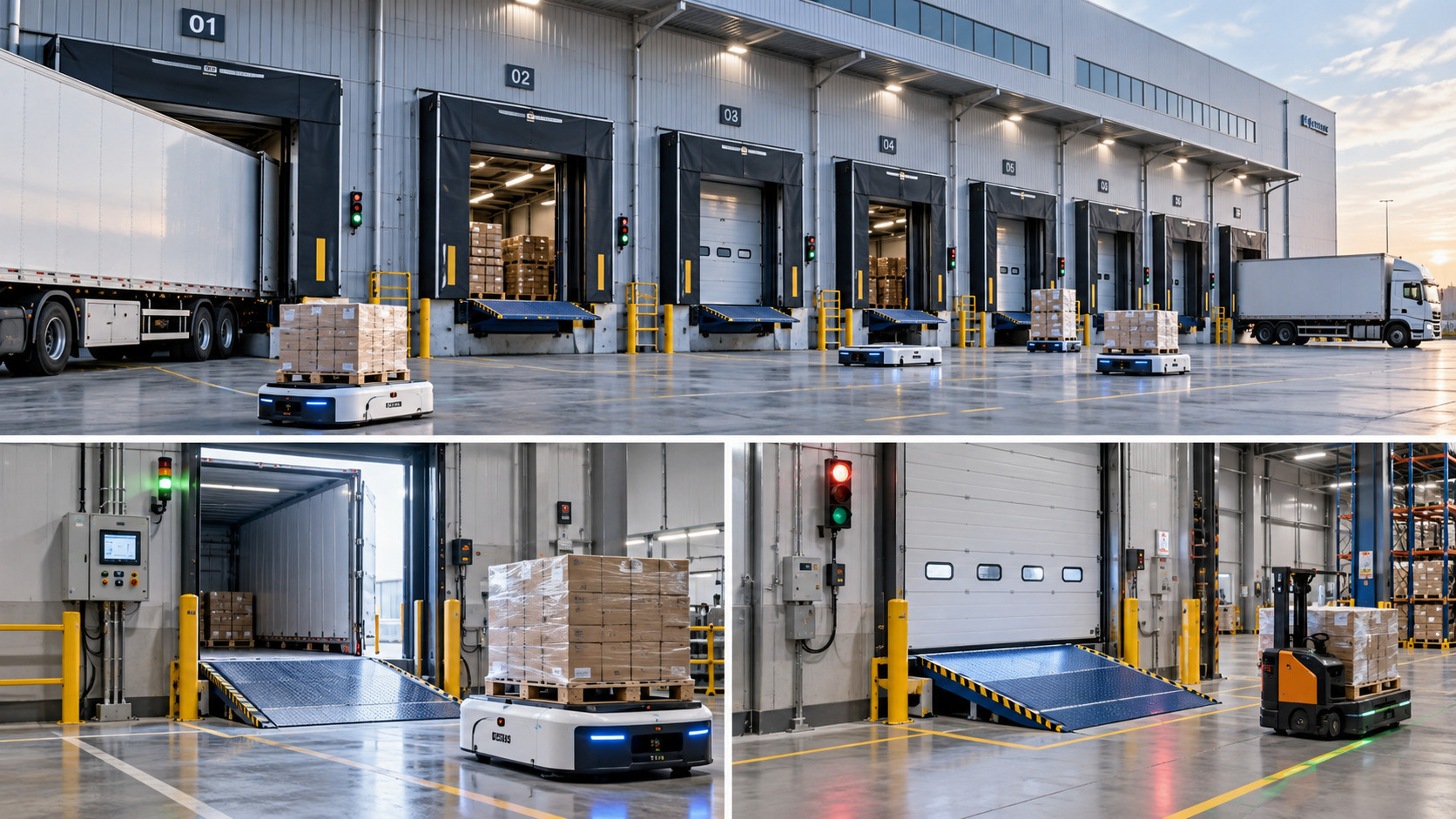
Die Lagerautomatisierung erreicht die Laderampe
Die Lagerautomatisierung hat sich traditionell auf Prozesse innerhalb des Gebäudes konzentriert, einschließlich automatisierter Lager- und Bereitstellungssysteme, Förderer, Roboterarme, fahrerloser Transportfahrzeuge, autonomer mobiler Roboter und Lagerverwaltungssoftware.
Jetzt dehnt sich die Automatisierung näher auf Wareneingang, Warenausgang und Lkw-Beladung aus.
Im März 2026 kündigte DHL Supply Chain die Einführung einer technologieneutralen Integrationsplattform in seinem globalen Lagernetzwerk an. DHL erklärte, dass bereits mehr als 8.000 kollaborative Roboter in seinen Betrieben aktiv seien und dass die neue Plattform die Robotikintegration über verschiedene Technologien hinweg schneller und einfacher machen solle.
Sie können die Ankündigung lesen unter DHL Group .
Die übergeordnete Lehre für die Laderampengestaltung ist wichtig: Automatisierte Ausrüstung funktioniert am besten, wenn einzelne Maschinen nicht isoliert sind.
Eine intelligente Lagerrampe muss möglicherweise koordinieren:
- Lkw-Ankunft und Ladebuchtenzuweisung;
- Status der Laderampentore;
- Position der Überladebrücke;
- Anwesenheit von Lkw oder Aufliegern;
- Ampeln;
- Sicherheitssensoren;
- AGVs und AMRs;
- Gabelstapler;
- Fördersysteme;
- RFID- oder Barcode-Systeme;
- PLC-Steuerungen;
- Lagerverwaltungssysteme;
- Not-Aus- und Verriegelungslogik.
Das Ziel ist nicht Automatisierung um ihrer selbst willen. Es geht darum, unnötiges Warten, wiederholte manuelle Bestätigung und nicht verbundene Betriebsschritte zu reduzieren.
Warum Laderampen zu einem Engpass werden können
Die Laderampe ist die physische Schnittstelle zwischen dem Lager und dem externen Transport. Unabhängig davon, wie fortschrittlich die Automatisierung innerhalb eines Distributionszentrums wird, müssen Paletten und Produkte weiterhin zwischen der Lagerfläche und Lkw-Aufliegern bewegt werden.
Dies führt zu mehreren möglichen Engpässen:
- unterschiedliche Höhen der Ladeflächen;
- langsames Öffnen und Schließen der Tore;
- manuelle Bedienung der Überladebrücke;
- AGVs, die vor geschlossenen Toren warten;
- Gabelstapler, die darauf warten, dass die Torausrüstung positioniert wird;
- schlechte Kommunikation zwischen Fahrern und Lagerpersonal;
- unkoordinierte Tor- und Fördertechniksteuerungen;
- Temperaturverlust durch offene Ladeöffnungen;
- Fahrzeugbewegung vor Abschluss der Beladung;
- Ausrüstungsfehler, die den Materialflussablauf unterbrechen.
In einem konventionellen Lager können Mitarbeiter diese Verzögerungen manuell ausgleichen. In einem automatisierten Lager mit hohem Durchsatz können wiederholte Unterbrechungen an mehreren Laderampen den gesamten Logistikprozess beeinträchtigen.
Was umfasst ein intelligentes Laderampensystem?
Eine intelligente Laderampe kombiniert mechanische Rampenausrüstung, Industrietore, Sensoren, Sicherheitsvorrichtungen und Steuerungsschnittstellen.
Die genaue Konfiguration hängt von den Fahrzeugen, den Waren, der Beladungshäufigkeit, der Umgebung und dem Automatisierungsgrad des Lagers ab.
1. Hydraulische Verladerampe
Eine Überladebrücke schafft eine Verbindung zwischen der Lagerplattform und der Ladefläche des Fahrzeugs und gleicht Höhenunterschiede zwischen den beiden Oberflächen aus.
Für automatisierte oder hochdurchsatzfähige Anlagen sollte die Überladebrücke nach mehr als nur ihren nominalen Plattformabmessungen ausgewählt werden.
Wichtige Faktoren sind:
- Plattformlänge und -breite;
- Rampenhöhe des Lagers;
- minimale Höhe der Ladefläche;
- maximale Höhe der Ladefläche;
- Betriebsgewicht von Gabelstaplern oder AGVs;
- dynamische Last;
- Lippenart und Lippenlänge;
- tägliche Betriebsfrequenz;
- Grubenabmessungen;
- erforderliche Steuersignale.
In einer automatisierten Laderampe kann die Überladebrücke auch Statussignale an das Steuerungssystem liefern, damit andere Geräte erst mit der Bewegung beginnen, wenn sich die Plattform in der erforderlichen Position befindet.
2. Automatisierte Laderampentore
Auch Laderampentore werden zunehmend Teil der Automatisierungssequenz.
In einem konventionellen Lager kann ein Bediener eine Taste drücken, um das Tor zu öffnen. In einem automatisierten Lager kann das Tor einen Befehl von einer SPS, einem AGV-System, einem Fördersystem oder einer anderen Steuerung erhalten.
Die Automatisierung von Industrietoren kann Schnittstellen wie die folgenden umfassen:
- potentialfreie Kontaktsignale;
- RS485;
- SPS-E/A;
- Profinet;
- EtherNet/IP;
- Radarsensoren;
- fotoelektrische Sensoren;
- RFID;
- Fernbedienung;
- AGV-Befehlssignale.
Beispielsweise kann das Automatisierungssystem, anstatt dass ein AGV an einem geschlossenen Industrietor ankommt und anhält, das Öffnen des Tors anfordern, bevor das AGV die Öffnung erreicht. Ein Bestätigungssignal kann dann anzeigen, dass die Öffnung bereit ist, bevor das Fahrzeug weiterfährt.
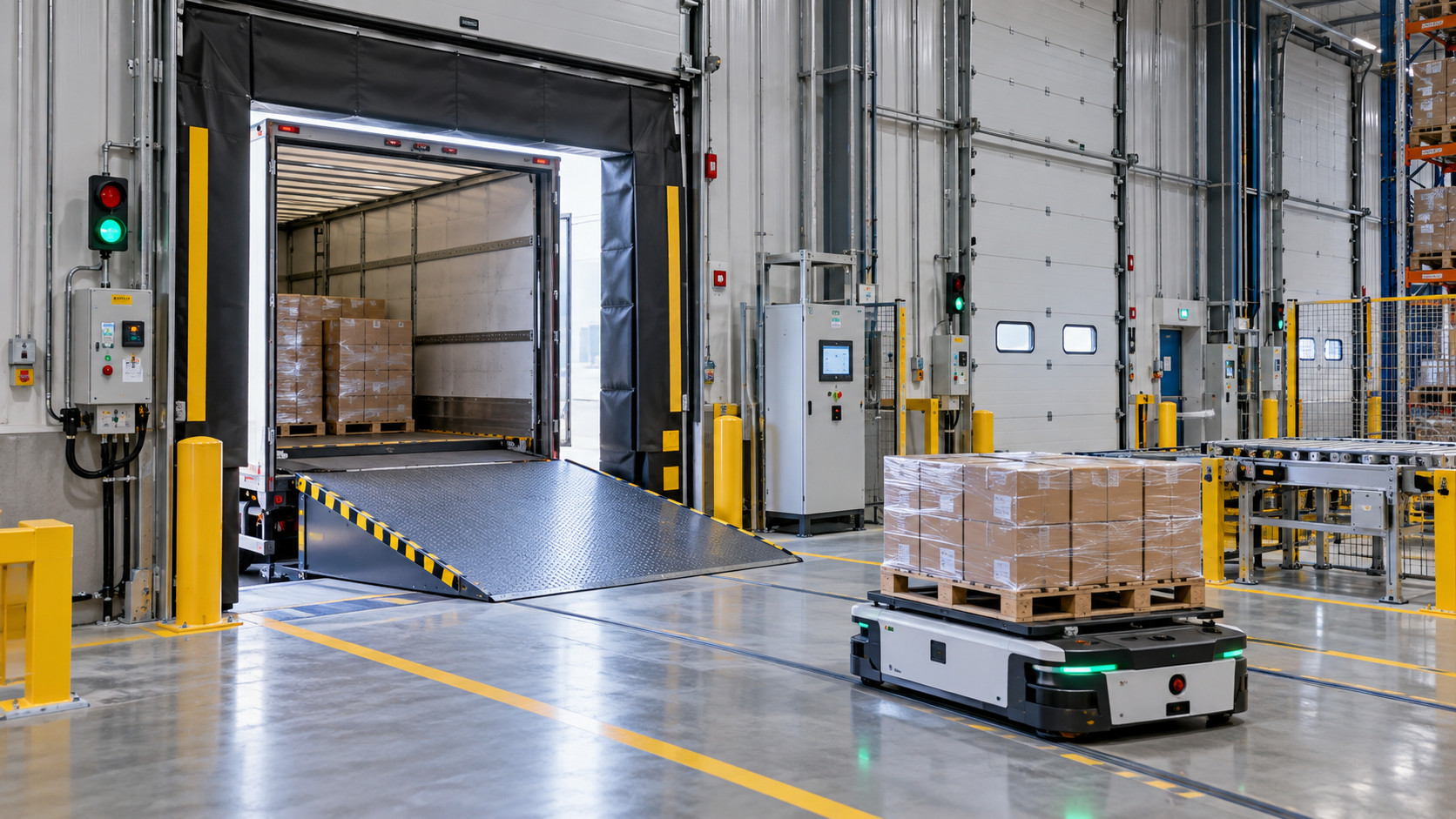
AGVs und AMRs verändern den Materialfluss im Lager
Automatisch geführte Fahrzeuge und autonome mobile Roboter werden zunehmend eingesetzt, um Paletten, Container und andere Lasten innerhalb von Lagern und Produktionsanlagen zu bewegen.
MHI stellt fest, dass AGVs und AMRs weiterhin größere Rollen übernehmen, da sich Sensorik, Navigation und Softwareintegration verbessern. MHI identifiziert auch das automatisierte Be- und Entladen von Lkw als einen wichtigen aufstrebenden Bereich für mobile Robotik.
Siehe die Branchenübersicht von MHI: The Evolution of AGVs and AMRs .
MHI hat auch ein praktisches Problem hervorgehoben, das direkt für Laderampen relevant ist: Das Hinzufügen weiterer Roboter beseitigt nicht automatisch Engpässe. Wenn mobile Roboter wiederholt auf Mitarbeiter, Ausrüstung oder Übergabepunkte warten, kann die Standzeit der Roboter die Effizienz des Gesamtsystems verringern.
Das bedeutet, dass eine AGV-fähige Laderampe mehrere Fragen beantworten muss:
- Kann das AGV die Überladebrücke sicher überqueren?
- Is the dock leveler suitable for the AGV wheel configuration?
- How is the robot prevented from approaching an unprotected dock edge?
- How does the system confirm that a truck is correctly positioned?
- How does the AGV know the loading dock door is fully open?
- How is the leveler position confirmed?
- What happens if a sensor reports a fault?
- What happens if the door stops during an automated sequence?
These conditions need to be defined during system design rather than after all equipment has already been installed.
Von unabhängigen Geräten zu verketteten Laderampen
Traditional loading dock equipment is often operated independently.
An operator opens the industrial door, activates the dock leveler, checks the vehicle and then allows loading to begin.
An automated loading dock can use a more coordinated sequence:
- A truck is assigned to the loading bay.
- A sensor confirms that the vehicle is positioned.
- The vehicle is secured according to the site's operating procedure.
- The control system permits the loading dock door to open.
- The dock leveler is deployed.
- Sensors confirm the required platform position.
- The traffic light changes to the permitted status.
- The AGV, forklift or conveyor receives permission to move.
- Loading or unloading begins.
- After completion, the equipment returns to its safe position before the truck is released.
The exact control sequence will vary between projects. However, the basic principle remains the same: equipment status should be confirmed before the next automated action begins.
Laderampensicherheit wird mit der Automatisierung wichtiger
Automation can reduce certain manual tasks, but it does not remove loading dock hazards.
The loading bay remains an area where trucks, forklifts, AGVs, workers, doors, dock levelers and building edges interact.
The U.S. Occupational Safety and Health Administration identifies loading dock hazards including vehicles falling from dock edges and slipping or skidding on unsafe surfaces. OSHA advises forklift operators to maintain a safe distance from loading dock edges, keep operating surfaces clear and remain aware of surrounding traffic.
Siehe OSHA Loading Dock Safety Guidance .
For automated warehouses, loading dock safety logic may include:
- door-open confirmation;
- door-closed confirmation;
- dock leveler home-position signal;
- dock leveler working-position confirmation;
- truck-present detection;
- vehicle restraint confirmation;
- photoelectric safety sensors;
- safety edges;
- traffic-light interlocking;
- AGV permission signals;
- conveyor stop signals;
- emergency stop circuits;
- fault alarms.
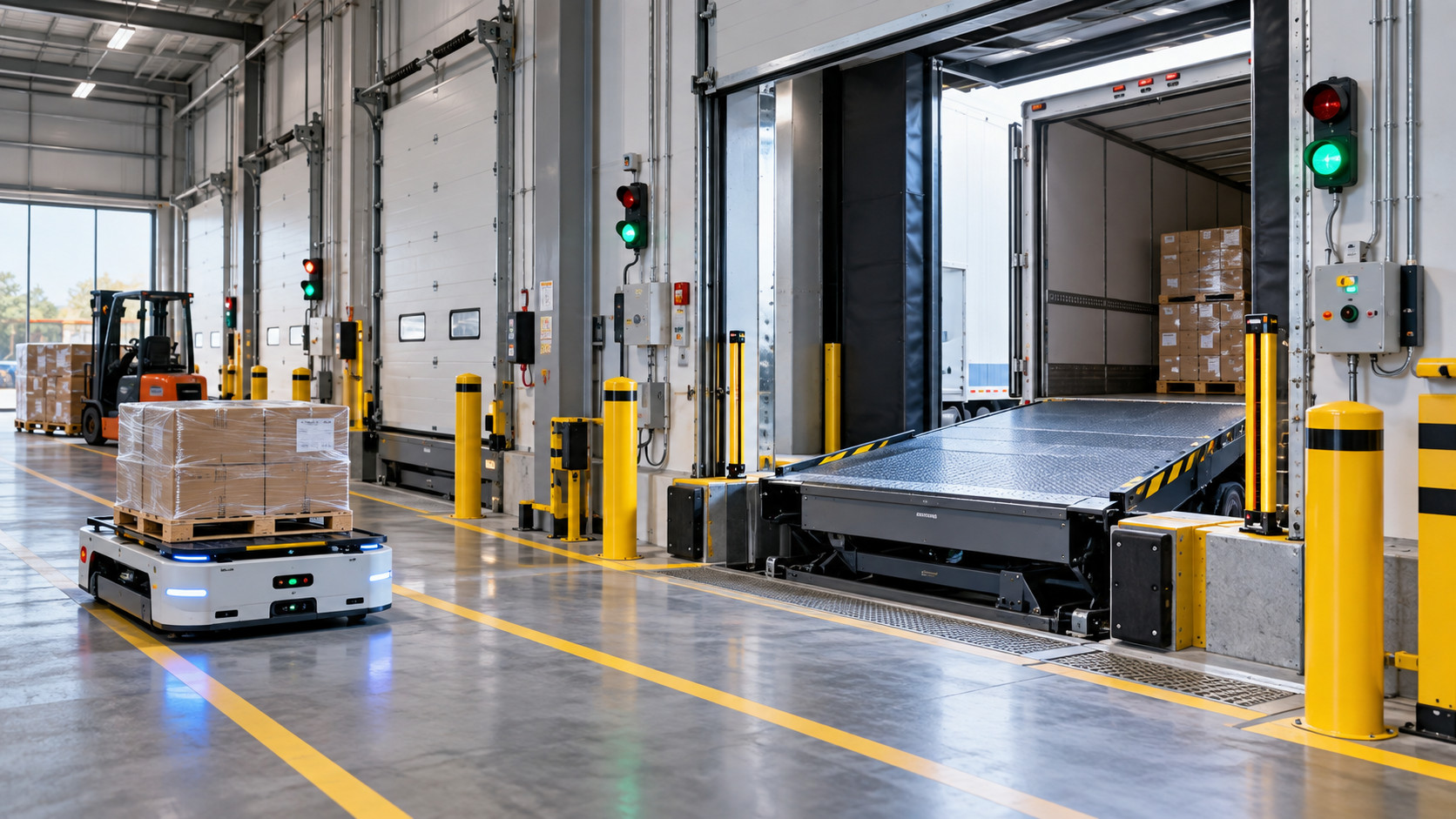
PLC-, WMS- und WES-Integration an der Laderampe
Mechanical equipment alone does not create an automated loading dock. Equipment needs to exchange information with the wider warehouse control architecture.
Different systems may perform different functions:
- PLC controls local equipment, signals and interlocks;
- WMS manages inventory, orders and warehouse tasks;
- WES coordinates the execution of automated material-flow processes;
- RFID identifies pallets, vehicles or loading tasks;
- IoT sensors collect equipment and operating data;
- AGV or AMR fleet software controls mobile robot missions.
MHI's guidance on warehouse software also emphasizes the importance of real-time integration between warehouse management systems and automation equipment, especially when mobile robots are introduced into existing facilities.
For more background, see MHI: How WES Supports Warehouse Automation Goals .
A warehouse does not necessarily need every system listed above. The key is to determine which controller is responsible for each decision and which equipment states need to be communicated.
For example, a WMS may determine which pallet should leave the warehouse, while the PLC confirms that the loading dock door and dock leveler are ready. The AGV controller can then authorize the robot to travel to the loading position.
Wie sich die Laderampengestaltung für automatisierte Lager ändert
Planen Sie um den Materialfluss, nicht nur um die Tortgröße
A conventional industrial door inquiry may begin with width and height. An automated loading dock project requires more information.
The project team should evaluate:
- Toröffnungsbreite und -höhe;
- verfügbare Durchfahrtshöhe und Seitenraum;
- dock platform height;
- truck and trailer dimensions;
- truck bed height range;
- dock leveler dimensions;
- dock pit dimensions;
- forklift or AGV width;
- AGV wheel configuration;
- vehicle operating weight;
- turning radius;
- material-flow direction;
- sensor positions;
- control cabinet position;
- communication interfaces;
- emergency stop locations;
- maintenance clearance;
- pedestrian routes.
Wählen Sie die Überladebrücke für die tatsächliche Betriebslast
Dock leveler capacity should not be selected only according to pallet weight.
The engineering calculation should consider the material-handling vehicle, transported goods, attachments, wheel contact, dynamic movement and daily operating frequency.
This becomes particularly important when AGVs repeatedly cross the dock leveler because vehicle geometry and wheel loads may differ from those of conventional forklifts.
Definieren Sie Automatisierungsschnittstellen vor der Fertigung
Automation interfaces should be confirmed early.
Adding communication requirements after industrial doors, control cabinets or dock equipment have already been manufactured can lead to unnecessary modifications during installation and commissioning.
Before production, define:
- required input signals;
- required output signals;
- communication protocol;
- normal operating sequence;
- fault response;
- emergency stop behavior;
- manual override requirements;
- remote operation requirements.
Welche Laderampentore eignen sich für automatisierte Lager?
Different areas of an automated warehouse may need different industrial door types.
The right choice depends on opening frequency, insulation requirements, wind exposure, traffic type, opening dimensions and the surrounding automation system.
| Anmeldung | Typical Door Type | Main Requirement |
|---|---|---|
| Exterior truck loading dock | Industrie-Sektionaltor | Insulation, security and reliable exterior closure |
| High-frequency internal logistics route | Schnelllauftor | Fast opening and reduced waiting time |
| AGV traffic route | Automated high-speed door | Fast cycles and control-system integration |
| Cold storage loading area | Insulated sectional or insulated high-speed door | Reduced temperature exchange |
| Große industrielle Öffnung | Sectional or stacking door | Large opening dimensions and wind resistance |
Energieeffizienz ist auch Teil der Laderampenautomatisierung
A loading dock is also part of the warehouse building envelope.
Whenever an industrial door stays open longer than necessary, outside air can enter the building. The effect is especially important in cold storage, refrigerated warehouses, food facilities and other temperature-controlled environments.
Automation can help reduce unnecessary opening time by coordinating:
- truck detection;
- industrial door opening;
- dock leveler operation;
- loading or unloading;
- door closing after the operation is complete.
Dock shelters and dock seals can further reduce gaps between the warehouse opening and trailer.
This means industrial doors, dock levelers and dock shelters should be considered together when designing temperature-sensitive loading docks.
Wie Sie Laderampenausrüstung für ein automatisiertes Lager spezifizieren
Before requesting a loading dock quotation, buyers can prepare the following information. Providing these details early can make equipment selection and control-system design much more efficient.
| Projektinformationen | Details to Provide |
|---|---|
| Türöffnung | Breite × Höhe |
| Menge | Number of loading docks |
| Dock platform | Platform height above ground |
| Truck range | Minimale und maximale Höhe der Anhängerladefläche |
| Material-handling equipment | Forklift, pallet truck, AGV or AMR |
| Vehicle weight | Operating weight including goods |
| Ladehäufigkeit | Approximate operating cycles per day |
| Anmeldung | Warehouse, manufacturing, food, cold storage, pharmaceutical, etc. |
| Stromversorgung | Spannung und Frequenz |
| Automation interface | Dry contact, RS485, PLC, Profinet, EtherNet/IP or other interface |
| Drawings | Layout, elevation and dock pit drawings if available |
Laderampenlösungen für automatisierte Lager
For warehouse automation projects, individual components should be selected according to the complete operating sequence rather than treated as unrelated products.
A loading dock solution may combine:
- hydraulic dock levelers;
- industrial sectional doors;
- high-speed doors;
- dock shelters;
- Rammschutzpuffer;
- Sicherheitssensoren;
- Ampeln;
- Fernbedienungen;
- PLC interfaces;
- AGV or conveyor signals;
- customized operating logic.
SEPPES supplies industrial doors and loading dock equipment for warehouse, manufacturing, logistics, cold-chain and automated material-handling applications.
For automation projects, the door and loading dock control requirements can be evaluated according to the customer's warehouse layout, equipment interfaces and operating sequence.
Was wird die Laderampe der Zukunft definieren?
The loading dock of an automated warehouse will not be defined by one individual piece of equipment.
Its performance will depend on how effectively the industrial door, dock leveler, truck, sensors, mobile robots and warehouse software coordinate with one another.
For warehouse buyers, the key question is gradually changing from:
“What dock leveler should I buy?”
zu:
“How should the entire loading dock interact with my warehouse operation?”
This distinction matters. As warehouses become more automated, physical transfer points become more important rather than less important.
The loading dock is one of the most critical of these interfaces because it connects the automated warehouse with the external transportation network.
FAQ zu automatisierten Lagerladerampen
Was ist eine automatisierte Laderampe?
An automated loading dock is a loading area in which equipment such as industrial doors, dock levelers, sensors, traffic lights, safety systems and material-handling equipment exchange control signals to coordinate loading and unloading operations.
Können Überladebrücken mit AGVs zusammenarbeiten?
Yes. However, the dock leveler, AGV weight, wheel configuration, transition surface, trailer position and control system should be evaluated together. The system should confirm that the dock leveler is safely positioned before the AGV is allowed to cross.
Können Laderampentore an eine PLC angeschlossen werden?
Yes. Depending on the project, industrial doors can support control interfaces such as dry contacts, RS485, PLC I/O and industrial communication protocols. The required signals should be confirmed before equipment manufacturing.
Welche Ausrüstung ist normalerweise in einer Laderampe enthalten?
A typical warehouse loading dock may include an industrial door, dock leveler, dock shelter or dock seal, dock bumpers, safety sensors, traffic lights and control equipment.
Wie kann die Laderampensicherheit in einem automatisierten Lager verbessert werden?
Loading dock safety can be improved by combining appropriate operating procedures with equipment status confirmation, vehicle controls, safety sensors, emergency stops, traffic signals, door and dock leveler interlocks and clearly defined pedestrian and vehicle routes.
Welche Informationen werden für ein Angebot für eine automatisierte Laderampe benötigt?
Useful project information includes door opening dimensions, quantity, dock height, truck bed height range, dock leveler dimensions, forklift or AGV specifications, operating frequency, local voltage, application environment and required automation interfaces.
Planen Sie eine automatisierte Lagerladerampe?
If you are planning new loading docks, upgrading an existing warehouse or integrating AGVs, conveyors or other warehouse automation equipment, provide your opening dimensions, number of docks, truck range, dock height, material-handling equipment and required control interfaces.
SEPPES can evaluate the industrial door and loading dock equipment configuration according to the requirements of your project.
Contact SEPPES for a Loading Dock Solution