
How Are Loading Docks Evolving for Automated Warehouses in 2026?
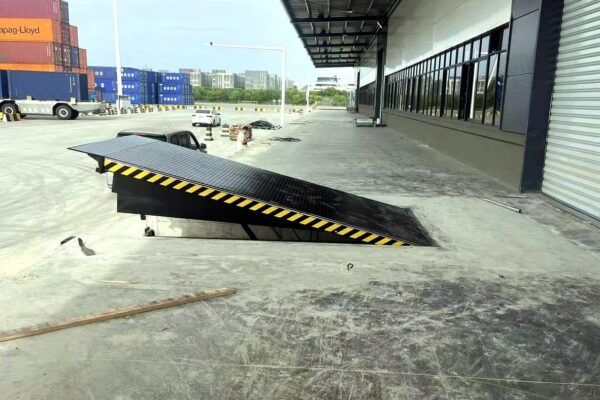
Warehouse automation is moving beyond automated storage, robotic picking and conveyor systems. In 2026, loading docks are increasingly becoming part of the connected material-flow system that links trucks, warehouse equipment, industrial doors, dock levelers and software.
This change matters because an automated warehouse can only move as efficiently as its slowest transfer point. Goods may travel rapidly through automated storage and retrieval systems, conveyors and mobile robots, but if trucks are waiting at disconnected loading bays, the loading dock can become a bottleneck.
For warehouse owners, logistics managers, automation integrators and facility planners, the next step is therefore not simply adding more robots. It is designing loading docks that can communicate with the rest of the warehouse.
Warehouse Automation Is Reaching the Loading Dock
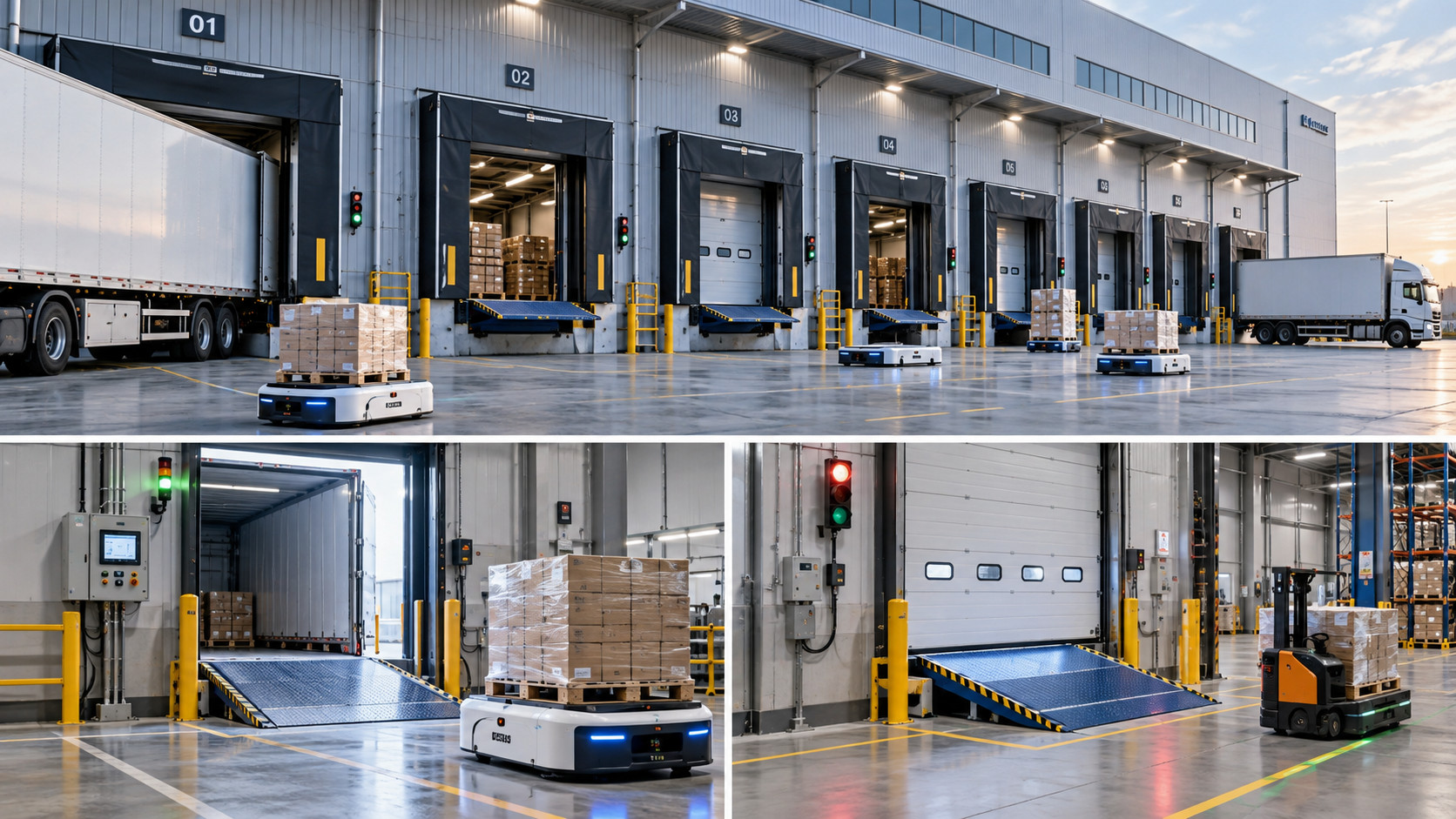
Warehouse automation has traditionally concentrated on processes inside the building, including automated storage and retrieval systems, conveyors, robotic arms, automated guided vehicles, autonomous mobile robots and warehouse management software.
Now, automation is extending closer to receiving, shipping and truck loading operations.
In March 2026, DHL Supply Chain announced the deployment of a technology-neutral integration platform across its global warehouse network. DHL said it already had more than 8,000 collaborative robots active across its operations and that the new platform was designed to make robotics integration faster and easier across different technologies.
You can read the announcement from DHL Group .
The broader lesson for loading dock design is important: automated equipment works best when individual machines are not isolated.
A smart warehouse dock may need to coordinate:
- truck arrival and loading bay assignment;
- loading dock door status;
- dock leveler position;
- truck or trailer presence;
- traffic lights;
- safety sensors;
- AGVs and AMRs;
- forklifts;
- conveyor systems;
- RFID or barcode systems;
- PLC controls;
- warehouse management systems;
- emergency stop and interlocking logic.
The objective is not automation for its own sake. It is to reduce unnecessary waiting, repeated manual confirmation and disconnected operating steps.
Why Loading Docks Can Become a Bottleneck
The loading dock is the physical interface between the warehouse and external transportation. No matter how advanced the automation inside a distribution center becomes, pallets and products still need to move between the warehouse floor and truck trailers.
This creates several potential bottlenecks:
- different truck bed heights;
- slow door opening and closing;
- manual dock leveler operation;
- AGVs waiting in front of closed doors;
- forklifts waiting for dock equipment to be positioned;
- poor communication between drivers and warehouse personnel;
- uncoordinated door and conveyor controls;
- temperature loss through open loading bays;
- truck movement before loading is complete;
- equipment faults that stop the material-flow sequence.
In a conventional warehouse, workers may compensate for these delays manually. In an automated warehouse operating at high throughput, repeated interruptions at multiple loading docks can affect the entire logistics process.
What Does a Smart Loading Dock System Include?
A smart loading dock combines mechanical dock equipment, industrial doors, sensors, safety devices and control interfaces.
The exact configuration depends on the trucks, goods, loading frequency, environment and automation level of the warehouse.
1. Niveau de quai hydraulique
A dock leveler creates a bridge between the warehouse platform and the truck bed, compensating for differences in height between the two surfaces.
For automated or high-throughput facilities, the dock leveler should be selected according to more than its nominal platform dimensions.
Important factors include:
- platform length and width;
- warehouse dock height;
- minimum truck bed height;
- maximum truck bed height;
- forklift or AGV operating weight;
- dynamic load;
- lip type and lip length;
- daily operating frequency;
- pit dimensions;
- required control signals.
In an automated loading dock, the dock leveler can also provide status signals to the control system so that other equipment does not begin moving until the platform is in the required position.
2. Automated Loading Dock Doors
Loading dock doors are also becoming part of the automation sequence.
In a conventional warehouse, an operator may push a button to open the door. In an automated warehouse, the door may receive a command from a PLC, AGV system, conveyor system or other controller.
Industrial door automation can involve interfaces such as:
- dry-contact signals;
- RS485;
- PLC I/O;
- Profinet;
- EtherNet/IP;
- radar sensors;
- photoelectric sensors;
- RFID;
- remote control;
- AGV command signals.
For example, instead of an AGV arriving at a closed industrial door and stopping, the automation system can request the door to open before the AGV reaches the opening. A confirmation signal can then indicate that the opening is ready before the vehicle continues.
AGVs and AMRs Are Changing Warehouse Material Flow
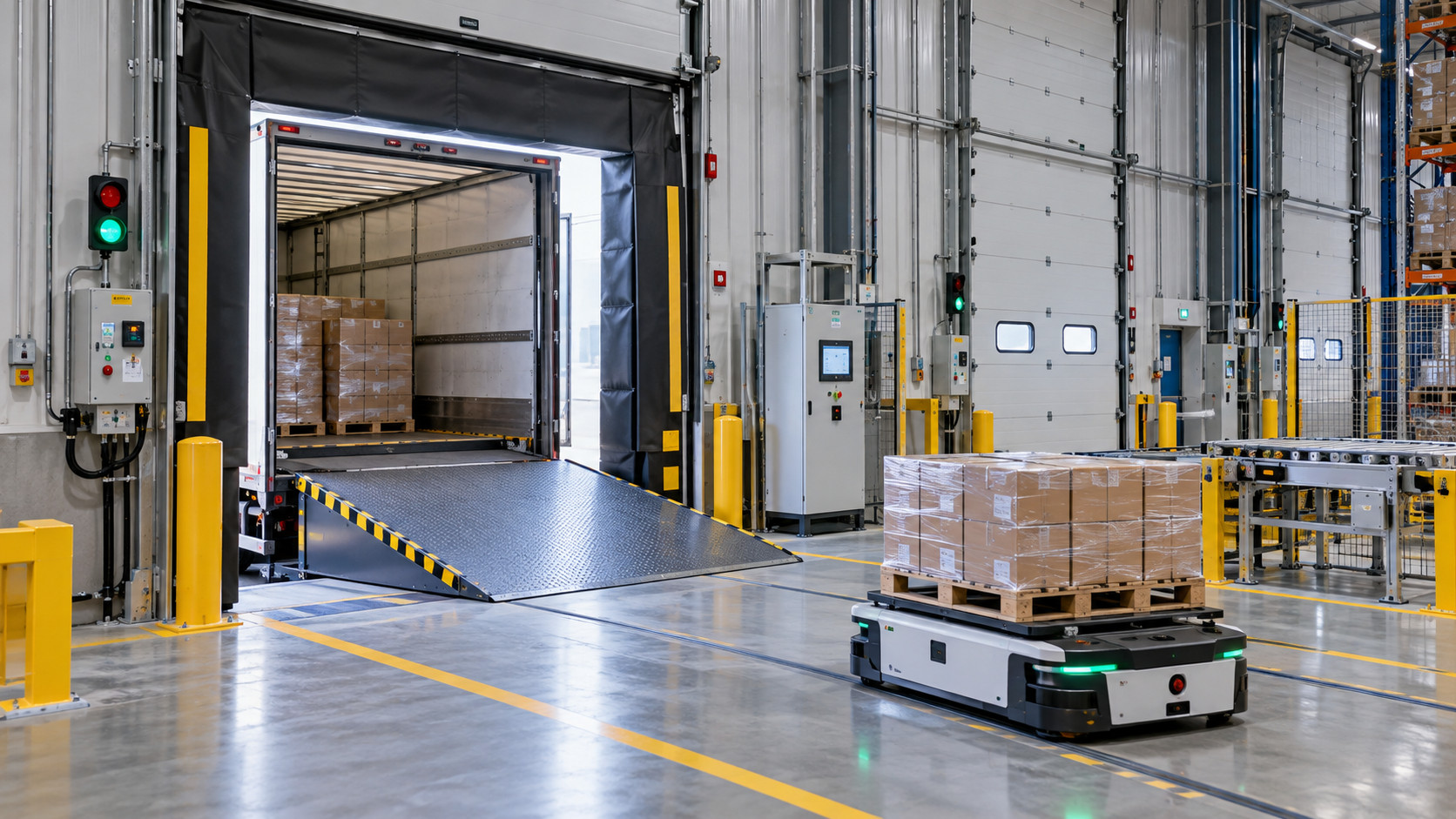
Automated guided vehicles and autonomous mobile robots are increasingly used to move pallets, containers and other loads within warehouses and manufacturing facilities.
MHI notes that AGVs and AMRs continue to take on larger roles as sensing, navigation and software integration improve. It also identifies automated truck loading and unloading as an important emerging area for mobile robotics.
See the industry overview from MHI: The Evolution of AGVs and AMRs .
MHI has also highlighted a practical issue that is directly relevant to loading docks: adding more robots does not automatically eliminate bottlenecks. If mobile robots repeatedly wait for workers, equipment or transfer points, robot dwell time can reduce the efficiency of the overall system.
That means an AGV-enabled loading dock needs to answer several questions:
- Can the AGV safely cross the dock leveler?
- Is the dock leveler suitable for the AGV wheel configuration?
- How is the robot prevented from approaching an unprotected dock edge?
- How does the system confirm that a truck is correctly positioned?
- How does the AGV know the loading dock door is fully open?
- How is the leveler position confirmed?
- What happens if a sensor reports a fault?
- What happens if the door stops during an automated sequence?
These conditions need to be defined during system design rather than after all equipment has already been installed.
From Independent Equipment to Interlocked Loading Docks
Traditional loading dock equipment is often operated independently.
An operator opens the industrial door, activates the dock leveler, checks the vehicle and then allows loading to begin.
An automated loading dock can use a more coordinated sequence:
- A truck is assigned to the loading bay.
- A sensor confirms that the vehicle is positioned.
- The vehicle is secured according to the site's operating procedure.
- The control system permits the loading dock door to open.
- The dock leveler is deployed.
- Sensors confirm the required platform position.
- The traffic light changes to the permitted status.
- The AGV, forklift or conveyor receives permission to move.
- Loading or unloading begins.
- After completion, the equipment returns to its safe position before the truck is released.
The exact control sequence will vary between projects. However, the basic principle remains the same: equipment status should be confirmed before the next automated action begins.
Loading Dock Safety Becomes More Important With Automation
Automation can reduce certain manual tasks, but it does not remove loading dock hazards.
The loading bay remains an area where trucks, forklifts, AGVs, workers, doors, dock levelers and building edges interact.
The U.S. Occupational Safety and Health Administration identifies loading dock hazards including vehicles falling from dock edges and slipping or skidding on unsafe surfaces. OSHA advises forklift operators to maintain a safe distance from loading dock edges, keep operating surfaces clear and remain aware of surrounding traffic.
See OSHA Loading Dock Safety Guidance .
For automated warehouses, loading dock safety logic may include:
- door-open confirmation;
- door-closed confirmation;
- dock leveler home-position signal;
- dock leveler working-position confirmation;
- truck-present detection;
- vehicle restraint confirmation;
- photoelectric safety sensors;
- safety edges;
- traffic-light interlocking;
- AGV permission signals;
- conveyor stop signals;
- emergency stop circuits;
- fault alarms.
PLC, WMS and WES Integration at the Loading Dock
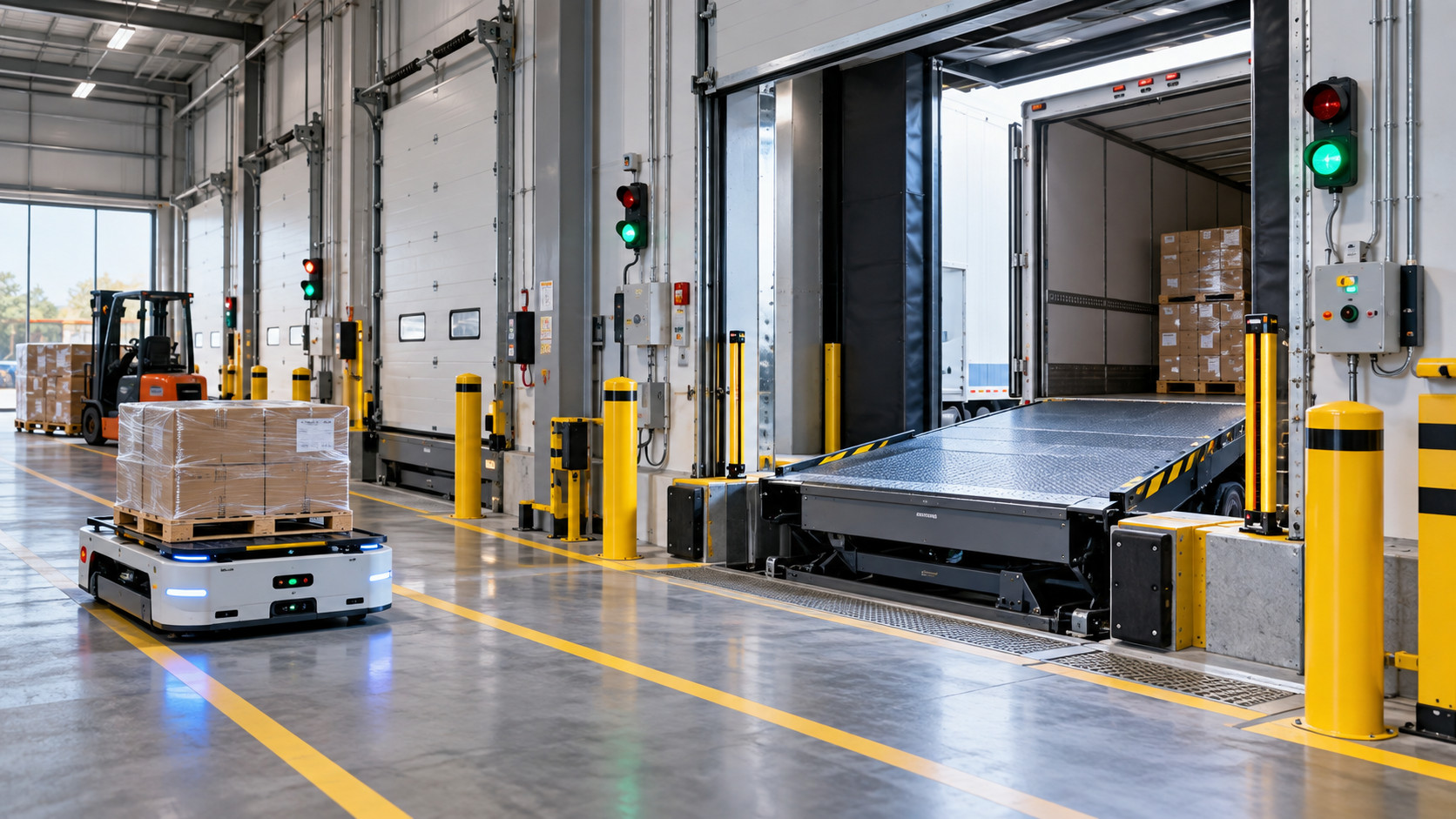
Mechanical equipment alone does not create an automated loading dock. Equipment needs to exchange information with the wider warehouse control architecture.
Different systems may perform different functions:
- PLC controls local equipment, signals and interlocks;
- WMS manages inventory, orders and warehouse tasks;
- WES coordinates the execution of automated material-flow processes;
- RFID identifies pallets, vehicles or loading tasks;
- IoT sensors collect equipment and operating data;
- AGV or AMR fleet software controls mobile robot missions.
MHI's guidance on warehouse software also emphasizes the importance of real-time integration between warehouse management systems and automation equipment, especially when mobile robots are introduced into existing facilities.
For more background, see MHI: How WES Supports Warehouse Automation Goals .
A warehouse does not necessarily need every system listed above. The key is to determine which controller is responsible for each decision and which equipment states need to be communicated.
For example, a WMS may determine which pallet should leave the warehouse, while the PLC confirms that the loading dock door and dock leveler are ready. The AGV controller can then authorize the robot to travel to the loading position.
How Loading Dock Design Changes for Automated Warehouses
Plan Around Material Flow, Not Only Door Size
A conventional industrial door inquiry may begin with width and height. An automated loading dock project requires more information.
The project team should evaluate:
- door opening width and height;
- available headroom and side room;
- dock platform height;
- truck and trailer dimensions;
- truck bed height range;
- dock leveler dimensions;
- dock pit dimensions;
- forklift or AGV width;
- AGV wheel configuration;
- vehicle operating weight;
- turning radius;
- material-flow direction;
- sensor positions;
- control cabinet position;
- communication interfaces;
- emergency stop locations;
- maintenance clearance;
- pedestrian routes.
Select the Dock Leveler for the Actual Operating Load
Dock leveler capacity should not be selected only according to pallet weight.
The engineering calculation should consider the material-handling vehicle, transported goods, attachments, wheel contact, dynamic movement and daily operating frequency.
This becomes particularly important when AGVs repeatedly cross the dock leveler because vehicle geometry and wheel loads may differ from those of conventional forklifts.
Define Automation Interfaces Before Manufacturing
Automation interfaces should be confirmed early.
Adding communication requirements after industrial doors, control cabinets or dock equipment have already been manufactured can lead to unnecessary modifications during installation and commissioning.
Before production, define:
- required input signals;
- required output signals;
- communication protocol;
- normal operating sequence;
- fault response;
- emergency stop behavior;
- manual override requirements;
- remote operation requirements.
Which Loading Dock Doors Work for Automated Warehouses?
Different areas of an automated warehouse may need different industrial door types.
The right choice depends on opening frequency, insulation requirements, wind exposure, traffic type, opening dimensions and the surrounding automation system.
| Scénarios d'application | Typical Door Type | Main Requirement |
|---|---|---|
| Exterior truck loading dock | Les portes sectionnelles industrielles | Insulation, security and reliable exterior closure |
| High-frequency internal logistics route | Porte à grande vitesse | Fast opening and reduced waiting time |
| AGV traffic route | Automated high-speed door | Fast cycles and control-system integration |
| Cold storage loading area | Insulated sectional or insulated high-speed door | Reduced temperature exchange |
| Large industrial opening | Sectional or stacking door | Large opening dimensions and wind resistance |
Energy Efficiency Is Also Part of Loading Dock Automation
A loading dock is also part of the warehouse building envelope.
Whenever an industrial door stays open longer than necessary, outside air can enter the building. The effect is especially important in cold storage, refrigerated warehouses, food facilities and other temperature-controlled environments.
Automation can help reduce unnecessary opening time by coordinating:
- truck detection;
- industrial door opening;
- dock leveler operation;
- loading or unloading;
- door closing after the operation is complete.
Dock shelters and dock seals can further reduce gaps between the warehouse opening and trailer.
This means industrial doors, dock levelers and dock shelters should be considered together when designing temperature-sensitive loading docks.
How to Specify Loading Dock Equipment for an Automated Warehouse
Before requesting a loading dock quotation, buyers can prepare the following information. Providing these details early can make equipment selection and control-system design much more efficient.
| Project Information | Details to Provide |
|---|---|
| Door opening | Width × height |
| Quantité | Number of loading docks |
| Dock platform | Platform height above ground |
| Truck range | Minimum and maximum trailer bed height |
| Material-handling equipment | Forklift, pallet truck, AGV or AMR |
| Vehicle weight | Operating weight including goods |
| Loading frequency | Approximate operating cycles per day |
| Scénarios d'application | Warehouse, manufacturing, food, cold storage, pharmaceutical, etc. |
| Alimentation électrique | Voltage and frequency |
| Automation interface | Dry contact, RS485, PLC, Profinet, EtherNet/IP or other interface |
| Drawings | Layout, elevation and dock pit drawings if available |
Loading Dock Solutions for Automated Warehouses
For warehouse automation projects, individual components should be selected according to the complete operating sequence rather than treated as unrelated products.
A loading dock solution may combine:
- hydraulic dock levelers;
- industrial sectional doors;
- high-speed doors;
- dock shelters;
- dock bumpers;
- safety sensors;
- traffic lights;
- remote controls;
- PLC interfaces;
- AGV or conveyor signals;
- customized operating logic.
SEPPES supplies industrial doors and loading dock equipment for warehouse, manufacturing, logistics, cold-chain and automated material-handling applications.
For automation projects, the door and loading dock control requirements can be evaluated according to the customer's warehouse layout, equipment interfaces and operating sequence.
What Will Define the Loading Dock of the Future?
The loading dock of an automated warehouse will not be defined by one individual piece of equipment.
Its performance will depend on how effectively the industrial door, dock leveler, truck, sensors, mobile robots and warehouse software coordinate with one another.
For warehouse buyers, the key question is gradually changing from:
“What dock leveler should I buy?”
to:
“How should the entire loading dock interact with my warehouse operation?”
This distinction matters. As warehouses become more automated, physical transfer points become more important rather than less important.
The loading dock is one of the most critical of these interfaces because it connects the automated warehouse with the external transportation network.
FAQ About Automated Warehouse Loading Docks
What is an automated loading dock?
An automated loading dock is a loading area in which equipment such as industrial doors, dock levelers, sensors, traffic lights, safety systems and material-handling equipment exchange control signals to coordinate loading and unloading operations.
Can dock levelers work with AGVs?
Yes. However, the dock leveler, AGV weight, wheel configuration, transition surface, trailer position and control system should be evaluated together. The system should confirm that the dock leveler is safely positioned before the AGV is allowed to cross.
Can loading dock doors connect to a PLC?
Yes. Depending on the project, industrial doors can support control interfaces such as dry contacts, RS485, PLC I/O and industrial communication protocols. The required signals should be confirmed before equipment manufacturing.
What equipment is normally included in a loading dock?
A typical warehouse loading dock may include an industrial door, dock leveler, dock shelter or dock seal, dock bumpers, safety sensors, traffic lights and control equipment.
How can loading dock safety be improved in an automated warehouse?
Loading dock safety can be improved by combining appropriate operating procedures with equipment status confirmation, vehicle controls, safety sensors, emergency stops, traffic signals, door and dock leveler interlocks and clearly defined pedestrian and vehicle routes.
What information is needed for an automated loading dock quotation?
Useful project information includes door opening dimensions, quantity, dock height, truck bed height range, dock leveler dimensions, forklift or AGV specifications, operating frequency, local voltage, application environment and required automation interfaces.
Planning an Automated Warehouse Loading Dock?
If you are planning new loading docks, upgrading an existing warehouse or integrating AGVs, conveyors or other warehouse automation equipment, provide your opening dimensions, number of docks, truck range, dock height, material-handling equipment and required control interfaces.
SEPPES can evaluate the industrial door and loading dock equipment configuration according to the requirements of your project.
Contact SEPPES for a Loading Dock Solution