
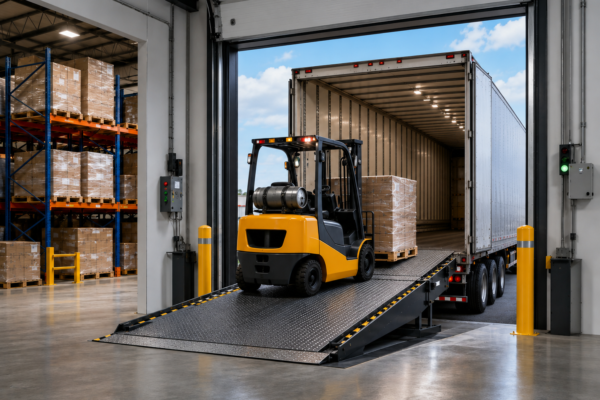
A Laderampenausgleichern verbindet zwei Oberflächen, die grundlegend unterschiedlich sind: einen festen Lagerboden und ein Fahrzeug, das seine Höhe ändern, sich unerwartet bewegen oder die Ladeposition verlassen kann.
Jedes Mal, wenn ein Gabelstapler diesen Übergang überquert, muss die Überladebrücke das Fahrzeug und seine Last tragen und gleichzeitig einen sicheren Weg zwischen dem Gebäude und dem Auflieger gewährleisten.
Aus diesem Grund geht es bei der Sicherheit an der Laderampe nicht nur um die Auswahl einer Plattform mit ausreichender Tragfähigkeit. Käufer müssen auch Plattformbewegungen, Rutschfestigkeit, Quetsch- und Schergefahren, Aufliegerbewegungen, Wartungssicherheit, Steuerungssysteme und die im Zielmarkt geltenden Vorschriften berücksichtigen.
Für internationale Käufer kann dies kompliziert werden.
Europäische Projekte verweisen üblicherweise auf EN 1398, während US-amerikanische Anlagen die OSHA-Anforderungen berücksichtigen müssen. US-Käufer können auch auf ANSI MH30.1 stoßen, eine Konsensnorm, die speziell Überladebrückenvorrichtungen behandelt.
Auch das regulatorische Umfeld befindet sich in einem wichtigen Übergang. EN 1398:2009 wird derzeit von BSI als “Current, Under Review” (aktuell, in Überprüfung) geführt,” während die EU-Maschinenverordnung (EU) 2023/1230 ab dem 20. Januar 2027 gilt.
Was bedeuten diese Normen also tatsächlich, und was sollte ein Käufer prüfen, bevor er eine Überladebrücke bestellt?
Inhaltsübersicht
Umschalten aufWarum die Sicherheit an der Laderampe wichtig ist
Die Laderampe ist eine der am stärksten frequentierten Schnittstellen in vielen Lagerhäusern und Distributionszentren.
Ein typischer Ladezyklus kann Folgendes umfassen:
- ein Lkw, der rückwärts zum Gebäude fährt;
- ein Industrietor, das sich öffnet;
- eine Überladebrücke, die auf den Anhänger ausgefahren wird;
- Gabelstapler, die wiederholt in das Fahrzeug ein- und ausfahren;
- Paletten oder schwere Produkte, die über die Plattform bewegt werden;
- die Überladebrücke, die in ihre Ruheposition zurückkehrt;
- der Lkw, der abfährt.
Während dieses Prozesses kann einiges schiefgehen.
Der Anhänger kann sich von der Rampe wegbewegen. Die Plattform kann rutschig werden. Der Gabelstapler kann sich der Plattformkante unsachgemäß nähern. Eine Überladebrücke kann betätigt werden, bevor ein Fahrzeug ordnungsgemäß positioniert ist. Wartungspersonal kann auch Gefahren unter einer angehobenen Plattform ausgesetzt sein.
Deshalb muss die Sicherheit von Überladebrücken als Teil des gesamten Lagerverladeprozesses betrachtet werden und nicht einfach als Merkmal eines einzelnen Rampengeräts.
Was ist EN 1398?
EN 1398:2009 ist die europäische Norm mit dem Titel:
Überladebrücken — Sicherheitsanforderungen
Sie legt Sicherheitsanforderungen in Bezug auf die Gestaltung, Konstruktion, Installation, Wartung und Prüfung von Überladebrücken und deren Sicherheitskomponenten fest.
Die Norm gilt für Überladebrücken, die als Verkehrswege zwischen Gebäuden und Straßenfahrzeugen oder Eisenbahnwagen verwendet werden, einschließlich Anwendungen mit Fußgängern, manuell betriebenen Transportgeräten und angetriebenen Geräten wie Gabelstaplern.
Laut BSI deckt EN 1398 bestimmte andere Gerätetypen nicht ab, darunter Hubtische, fahrzeugmontierte Ladebordwände oder Überladebrücken, die für marine- und luftfahrttechnische Anwendungen vorgesehen sind.
Diese Unterscheidung ist wichtig, da eine Überladebrücke nicht automatisch als dieselbe Produktkategorie wie ein hydraulischer Hubtisch oder eine andere Art von Ladeplattform behandelt werden sollte.
Welche Sicherheitsprobleme behandelt EN 1398?
EN 1398 deckt eine Reihe von Gefahren ab, die mit Überladebrücken verbunden sind.
BSI identifiziert Bereiche einschließlich:
- Plattformneigungen;
- Rutschfestigkeitseigenschaften;
- Plattformbreite;
- Abstützung in der Ruheposition;
- Stolpergefahren;
- nicht abgestützte Betriebspositionen;
- unbeabsichtigte Bewegung;
- Quetsch- und Schergefahren;
- Wartungsstützvorrichtungen;
- Sichtverhältnisse, wenn die Überladebrücke angehoben oder abgesenkt wird.
Für Käufer lassen sich diese technischen Anforderungen in mehrere praktische Fragen übersetzen.
Ist die Plattform für die vorgesehene Last geeignet?
Eine Überladebrücke trägt nicht nur die zu transportierenden Waren.
Während des Betriebs fahren auch Materialhandhabungsgeräte wie Gabelstapler über die Plattform.
Daher sollten Käufer dem Hersteller Informationen zur Verfügung stellen, einschließlich:
- Gewicht von Gabelstaplern oder AGVs;
- maximales Ladungsgewicht;
- Beladungshäufigkeit;
- Radkonfiguration;
- Betriebsbedingungen.
Die Auswahl der Tragfähigkeit allein anhand des Palettengewichts spiegelt möglicherweise nicht die tatsächlichen Anforderungen wider, die an die Überladebrücke gestellt werden.
Kann sich die Plattform unerwartet bewegen?
Eine Überladebrücke muss sowohl während des Betriebs als auch in der Ruheposition kontrolliert bleiben.
Unerwartete Plattformbewegungen können Bediener, Gabelstaplerfahrer und Wartungspersonal ernsthaften Gefahren aussetzen.
Bei hydraulischen Überladebrücken sollten Käufer verstehen, wie das System auf abnormale Situationen wie Druckverlust oder Stromausfall reagiert.
Das genaue Sicherheitsdesign hängt vom Modell der Überladebrücke und den geltenden Normen ab.
Ist die Wartung unter der Plattform sicher?
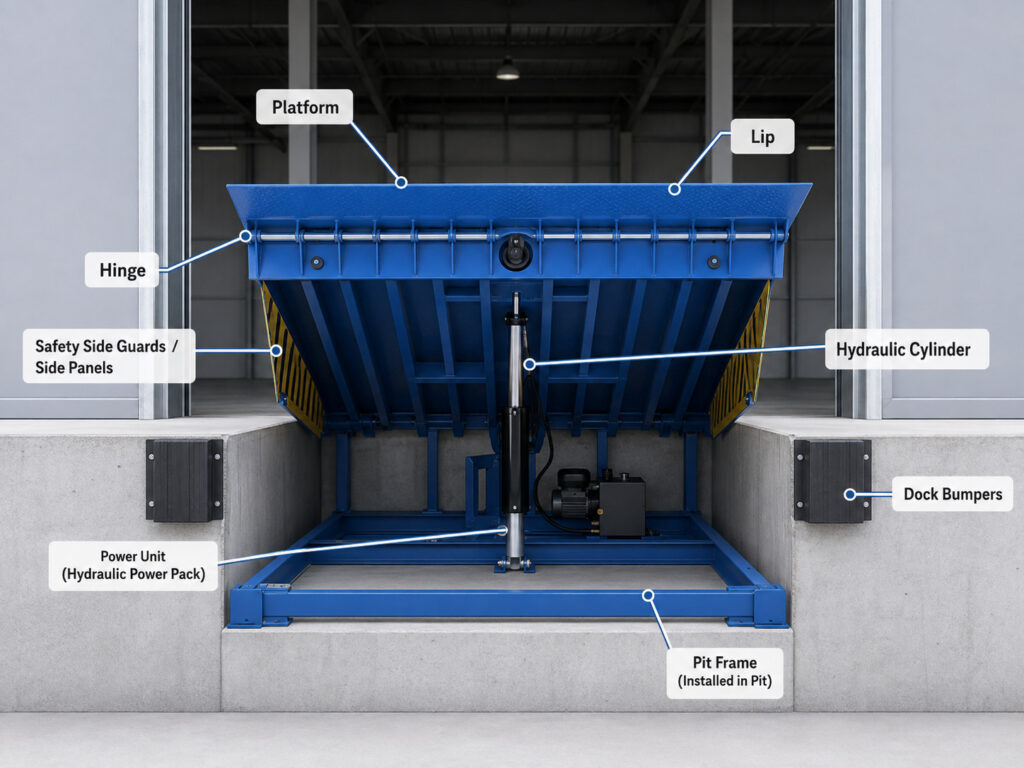
Die Wartung erfordert häufig den Zugang zu Komponenten unterhalb der Plattform.
Eine angehobene Überladebrücke benötigt daher eine geeignete Methode der mechanischen Abstützung während der Inspektion oder Wartung.
EN 1398 behandelt ausdrücklich Stützvorrichtungen für die Wartung.
Dies ist ein wichtiges Merkmal, das Käufer bestätigen sollten, anstatt davon auszugehen, dass der Hydraulikdruck allein ausreicht, um eine Plattform während der Wartung zu halten.
Was verlangt OSHA für Überladebrücken?
Das US-amerikanische Regulierungssystem geht bei der Sicherheit von Überladebrücken anders vor.
OSHA verwendet EN 1398 nicht.
Stattdessen erscheinen Anforderungen für Überladebrücken in den Arbeitsschutzvorschriften von OSHA.
Gemäß OSHA 29 CFR 1910.21, wird ein “Dockboard” als eine feste oder tragbare Vorrichtung definiert, die eine Lücke überspannt oder einen Höhenunterschied zwischen einer Ladeplattform und einem Transportfahrzeug ausgleicht.
OSHA stellt ausdrücklich fest, dass Dockboards Überfahrplatten, Dockplatten und Überladebrücken umfassen.
Dies ist wichtig, da OSHA 1910.26 daher direkt auf Geräte dieser Kategorie anwendbar ist.
OSHA 1910.26: Wichtige Anforderungen, die Käufer verstehen sollten
OSHA 1910.26 enthält mehrere Anforderungen, die für die Sicherheit an Laderampen besonders relevant sind.
Maximale vorgesehene Last
OSHA verlangt, dass Dockboards die maximale vorgesehene Last tragen können.
Dies bekräftigt ein wichtiges Beschaffungsprinzip:
Eine Überladebrücke sollte entsprechend der tatsächlichen Betriebslast und Anwendung ausgewählt werden, nicht einfach nach dem Nenngewicht der transportierten Güter.
Schutz gegen das Herunterfahren von Fahrzeugen über die Kante
Für Dockboards, die am oder nach dem 17. Januar 2017 erstmals in Betrieb genommen werden, verlangt OSHA im Allgemeinen, dass sie so konstruiert, gebaut und gewartet werden, dass Transferfahrzeuge nicht über die Kante des Dockboards hinausfahren können, es sei denn, der Arbeitgeber kann nachweisen, dass keine solche Gefahr besteht.
Dies wird besonders wichtig für Einrichtungen, die häufig Gabelstapler einsetzen.
Verhinderung von Fahrzeugbewegungen
Eines der bedeutendsten Risiken an Laderampen hat wenig mit der Überladebrücke selbst zu tun:
der Lkw kann sich bewegen.
OSHA verlangt Maßnahmen wie Radkeile, Sandschuhe oder andere geeignete Mittel, um zu verhindern, dass ein Lkw, Sattelauflieger, Anhänger oder Eisenbahnwagen sich bewegt, während Mitarbeiter das Dockboard benutzen.
Deshalb sollte die Sicherheit an Lkw-Rampen gemeinsam mit der Sicherheit von Überladebrücken bewertet werden.
Eine korrekt konstruierte Plattform kann keine sichere Brücke schaffen, wenn das Fahrzeug unerwartet von ihr wegfährt.
Tragbare Überladeplatten
OSHA enthält auch spezifische Anforderungen für tragbare Dockboards, einschließlich der Sicherung gegen Bewegung und der Bereitstellung von Handgriffen oder anderen Mitteln zur sicheren Handhabung.
Nicht jede Bestimmung gilt gleichermaßen für eine fest installierte hydraulische Überladebrücke und eine tragbare Dockplatte, daher sollten Käufer bei der Bewertung von OSHA-Anforderungen zwischen den verschiedenen Gerätetypen unterscheiden.
EN 1398 vs. OSHA: Es handelt sich nicht um dieselbe Art von Anforderung
Eines der häufigsten Missverständnisse im internationalen Beschaffungswesen ist die Gleichsetzung von EN 1398 und OSHA als äquivalente Produktnormen.
Sie sind es nicht.
| Thema | EN 1398 | OSHA |
|---|---|---|
| Hauptmarkt | Europa | Vereinigte Staaten |
| Hauptzweck | Sicherheitsstandard für Überladebrücken | Arbeitsschutzvorschrift |
| Konstruktion von Überladebrücken | Hauptschwerpunkt | Bestimmte Anforderungen gelten |
| Installation und Verwendung | Behandelt | Behandelt |
| Maximale vorgesehene Last | Behandelt durch Produktdesignanforderungen | Ausdrückliche Anforderung |
| Fahrzeugbewegung | Teil der umfassenderen Ladesicherheit | Ausdrückliche Arbeitsplatzanforderung |
| Arbeitgeberpflichten | Nicht der primäre Zweck | Hauptschwerpunkt |
| CE-Konformitätsrahmen | Relevant in der EU | Nicht anwendbar |
| Rechtsnatur | Europäische Norm | US-amerikanische Vorschrift |
Die praktische Lehre für Käufer ist einfach:
Die Aussage eines Lieferanten, dass eine Überladebrücke “europäische Normen erfüllt”, beantwortet nicht die Frage, ob sie für ein US-Projekt geeignet ist.
Ebenso zeigt die Einhaltung von OSHA-Arbeitsplatzanforderungen nicht automatisch die Konformität mit EN 1398.
Der Zielmarkt sollte festgelegt werden, bevor die Ausrüstung spezifiziert wird.
Was ist ANSI MH30.1-2022?
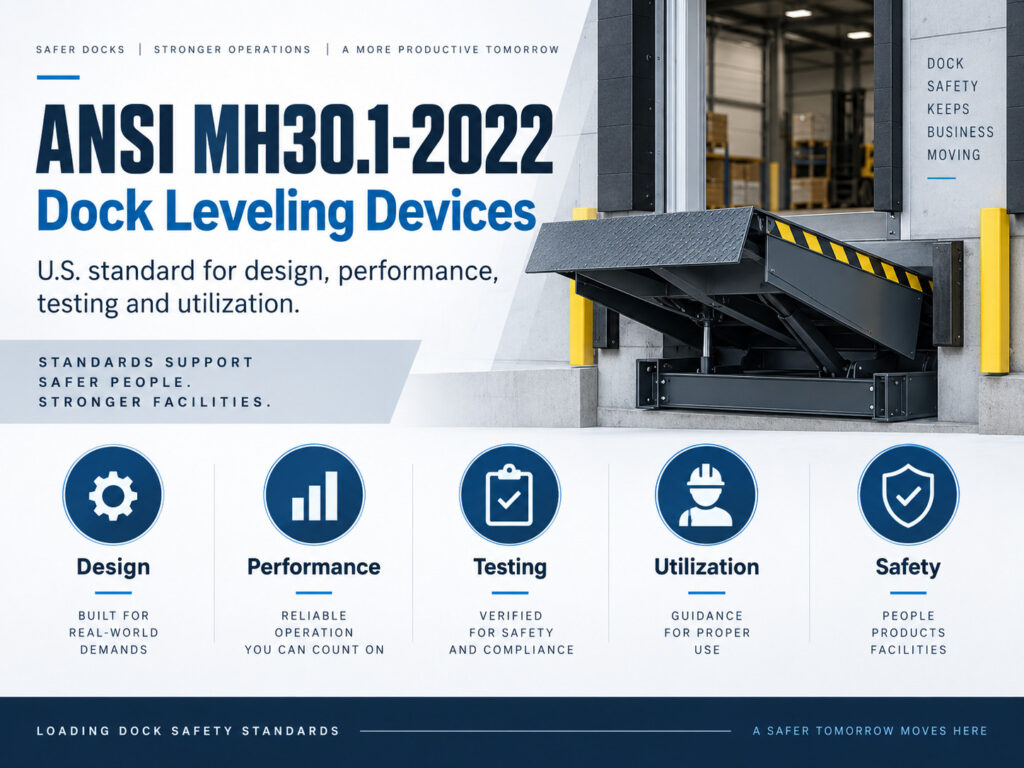
US-amerikanische Käufer können außerdem auf Folgendes stoßen:
ANSI MH30.1-2022 — Leistungs- und Prüfanforderungen für Dock-Nivelliergeräte.
Die Norm wird über die Material Handling Industry veröffentlicht und bietet Leitlinien für Konstrukteure, Hersteller, Verkäufer, Installateure, Eigentümer, Nutzer und Aufsichtsbehörden.
Sie behandelt die Konstruktion und Prüfung von Dock-Nivelliergeräten und bietet eine einheitliche Grundlage für den Vergleich ihrer Leistung. Die Version von 2022 überarbeitet ANSI MH30.1-2015.
Daraus ergibt sich eine wichtige dreiteilige Unterscheidung:
EN 1398
Europäische Sicherheitsnorm für Dock-Nivelliergeräte.
OSHA
US-amerikanische Arbeitsschutzanforderungen.
ANSI MH30.1
US-amerikanische Konsensnorm, die speziell auf Leistung und Prüfung von Dock-Nivelliergeräten ausgerichtet ist.
ANSI MH30.1 kommt daher einer produktspezifischen Dock-Nivelliergeräte-Norm deutlich näher als die OSHA selbst.
Warum 2026–2027 für europäische Käufer wichtig ist
Die europäische Maschinenrechtgebung steht vor einem wichtigen Übergang.
Die Verordnung (EU) 2023/1230 über Maschinen gilt ab dem 20. Januar 2027 und ersetzt die Richtlinie 2006/42/EG.
Dies ist besonders relevant für Käufer, deren Dockausrüstungsprojekte um oder nach diesem Datum hergestellt, importiert oder auf dem EU-Markt bereitgestellt werden.
Es gibt eine weitere wichtige Entwicklung.
Die Seite der Europäischen Kommission zu harmonisierten Normen für Maschinen erklärt derzeit, dass der 20. Januar 2027 als Ende der rechtlichen Geltung von Normen erscheinen kann, die unter der bestehenden Maschinenrichtlinie referenziert sind, da diese Richtlinie an diesem Datum aufgehoben wird.
Die Kommission erklärt außerdem, dass eine neue Liste harmonisierter Normen unter der Maschinenverordnung vorbereitet wird und voraussichtlich vor Ende 2026 vorliegen wird, wobei erwartet wird, dass die überwiegende Mehrheit der derzeit unter der Maschinenrichtlinie zitierten Normen in der neuen Liste enthalten sein wird.
Das macht 2026 zu einem besonders wichtigen Jahr für Beschaffungsteams.
Bei einem für 2027 geplanten Projekt sollten Käufer nicht einfach die Konformitätsanforderungen aus einer älteren Einkaufsspezifikation übernehmen.
Stattdessen sollten sie die anwendbare Gesetzgebung und die aktuellen Referenzen harmonisierter Normen überprüfen, wenn die Ausrüstung auf dem Markt bereitgestellt wird.
Ist EN 1398 noch aktuell?
Stand September 2026 führt BSI BS EN 1398:2009 als:
Aktuell, in Überprüfung.
Die Norm war außerdem in der EU-Liste harmonisierter Maschinennormen enthalten, konsolidiert bis zum 15. Mai 2026.
Da jedoch der europäische Maschinenrahmen zur Verordnung (EU) 2023/1230 übergeht, sollten Käufer, die zukünftige EU-Projekte planen, die neuesten Amtsblatt-Referenzen überprüfen, anstatt davon auszugehen, dass der regulatorische Status unverändert bleibt.
Dies ist besonders wichtig für:
- europäische Importeure;
- Händler;
- Lagerentwickler;
- Logistikdienstleister;
- Hersteller, die Maschinen von außerhalb der EU kaufen.
Bedeutet EN 1398 automatisch CE-Konformität?
Nicht für sich allein.
Europäische harmonisierte Normen sind im Allgemeinen freiwillige technische Mittel zum Nachweis der Konformität mit geltenden rechtlichen Anforderungen.
Die Europäische Kommission erklärt, dass Hersteller eine andere technische Lösung verwenden können, aber dennoch die Einhaltung verbindlicher rechtlicher Anforderungen nachweisen müssen.
Daher ist die Frage:
“Ist das Dock-Nivelliergerät EN 1398?”
nützlich, aber unvollständig.
Eine bessere Beschaffungsfrage ist:
“Welche Gesetzgebung und welche Normen gelten für dieses Dock-Nivelliergerät im Zielmarkt, und welche Konformitätsdokumentation wird bereitgestellt?”
Käufer sollten die vollständige Dokumentation prüfen, die für das Projekt relevant ist, anstatt sich auf eine einzelne Normnummer oder ein CE-Logo zu verlassen.
7 Sicherheitsrisiken an der Laderampe, die Käufer bewerten sollten
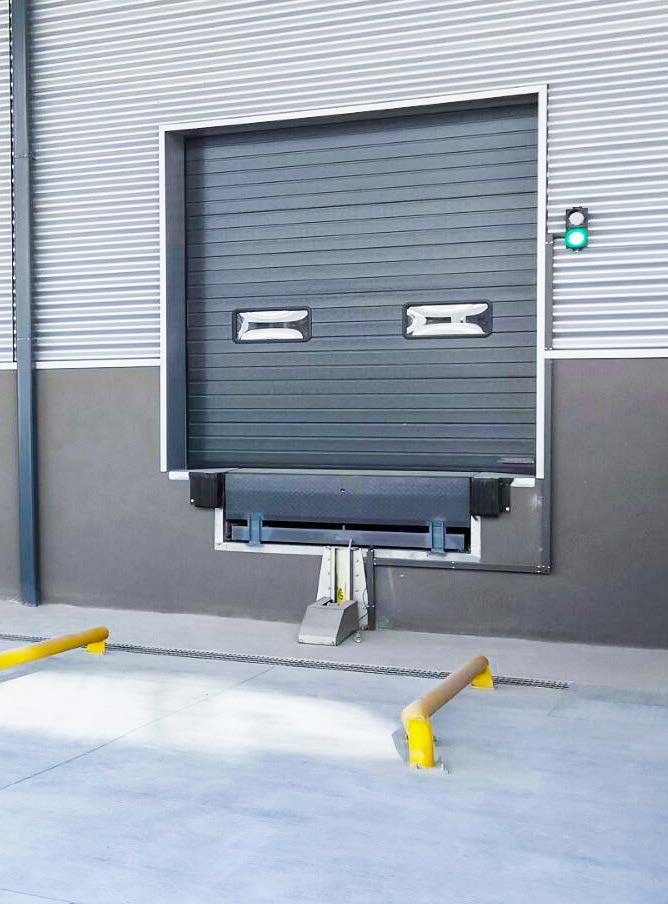
Normen sind leichter zu verstehen, wenn sie mit realen Betriebsrisiken verknüpft werden.
1. Unzureichende Tragfähigkeit
Eine Plattform muss den beabsichtigten Materialumschlagvorgang unterstützen.
Berücksichtigen Sie den Gabelstapler oder AGV, die Ladung, die Betriebsfrequenz und die Belastungsbedingungen bei der Auswahl des Dock-Nivelliergeräts.
2. Aufliegerbewegung
Wenn sich ein Anhänger entfernt, während ein Gabelstapler ein- oder ausfährt, kann sich eine gefährliche Lücke zwischen dem Fahrzeug und der Laderampe bilden.
Fahrzeugrückhaltevorrichtungen, Radkeile und klare Betriebsverfahren können Teil der Sicherheitsstrategie für die Laderampe sein.
3. Übermäßiges Plattformgefälle
Die Höhen von Ladebrücken variieren.
Ein Dock-Nivelliergerät, das in einem übermäßigen Winkel arbeitet, kann Probleme für Gabelstapler, Hubwagen oder AGVs mit geringer Bodenfreiheit verursachen.
Der Höhenbereich der Ladebrücke und die Höhe der Lagerrampe sollten daher bestätigt werden, bevor die Plattformabmessungen ausgewählt werden.
4. Rutschige Oberflächen
Laderampen können Regen, Schnee, Eis, Öl oder anderen Verunreinigungen ausgesetzt sein.
Die Gestaltung der Plattformoberfläche und die Haushaltsführung beeinflussen beide die Rutschfestigkeit.
5. Quetsch- und Scherstellen
Bewegliche Plattformen und Lippen schaffen Bereiche, in denen Hände, Füße oder andere Körperteile Verletzungen ausgesetzt sein können.
Steuerungsposition, Seitenschutz, Warnetiketten und Betriebsverfahren sollten gemeinsam betrachtet werden.
6. Unsichere Wartung
Das Arbeiten unter einer angehobenen Plattform ohne geeignete mechanische Abstützung kann eine ernsthafte Gefahr darstellen.
Wartungsstützen sollten gemäß den Anweisungen des Geräteherstellers verwendet werden.
7. Falsche Bedienungsreihenfolge
Eine Überladebrücke, ein Industrietor und ein Lkw können alle einzeln funktionsfähig sein, während die Gesamtverladereihenfolge unsicher bleibt.
Beispielsweise sollte die Überladebrücke normalerweise nicht gegen ein Fahrzeug verwendet werden, das nicht korrekt positioniert ist.
Hier können Verriegelungen und Laderampenautomatisierung die Prozesskontrolle verbessern.
Wie Fahrzeugrückhaltevorrichtungen und Ampeln die Sicherheit an der Rampe verbessern
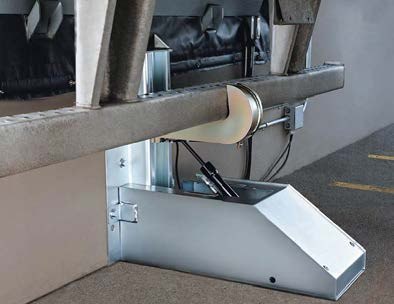
Eine moderne Lagerladerampe kann mehr als eine Überladebrücke enthalten.
Das vollständige System kann umfassen:
Lkw
↓
Fahrzeugrückhaltung
↓
Ampel
↓
Industrielle Toranlagen
↓
Dockleveler
↓
Gabelstapler oder AGV
Beispielsweise kann ein externes rotes Licht dem Fahrer anzeigen, dass er den Lkw nicht bewegen soll, während das Lagerpersonal lädt.
Ein internes Signal kann anzeigen, ob das Laden erlaubt ist.
Gegebenenfalls kann eine Fahrzeugrückhaltung in die Betriebslogik integriert werden.
Eine kontrollierte Sequenz könnte sein:
Lkw korrekt positioniert
↓
Fahrzeug gesichert
↓
Ladeerlaubnis bestätigt
↓
Industrietor öffnet
↓
Überladebrücke fährt aus
↓
Gabelstapler betritt den Auflieger
Diese Art von System ersetzt nicht die Einhaltung von Vorschriften, Schulungen oder ordnungsgemäße Betriebsverfahren.
Es kann jedoch die Abhängigkeit von Bedienern verringern, die sich jeden Schritt manuell merken müssen.
Für automatisierte Lager können das Tor, die Überladebrücke, die Fahrzeugrückhaltung und die SPS auch Statussignale als Teil eines umfassenderen Laderampen-Automatisierungssystems austauschen.
Was Käufer prüfen sollten, bevor sie eine Überladebrücke bestellen
Eine nützliche Einkaufsspezifikation sollte mehr als Breite und Länge enthalten.
Vor der Anforderung eines Angebots sollten die folgenden Informationen gesammelt werden:
| Käufer sollte bereitstellen/prüfen | Warum es wichtig ist |
|---|---|
| Bestimmungsland | Bestimmt anwendbare Vorschriften und Normen |
| Rampenhöhe | Beeinflusst den Arbeitswinkel der Überladebrücke |
| Minimale Lkw-Ladeflächenhöhe | Definiert den unteren Arbeitsbereich |
| Maximale Lkw-Ladeflächenhöhe | Definiert den oberen Arbeitsbereich |
| Gabelstapler- oder AGV-Gewicht | Wichtig für die Kapazitätsauswahl |
| Maximales Frachtgewicht | Teil der vorgesehenen Betriebslast |
| Ladehäufigkeit | Beeinflusst die Geräteauswahl |
| Plattformbreite und -länge | Muss zu Fahrzeugen und Materialhandhabung passen |
| Grubenabmessungen | Entscheidend für die Installation |
| Fahrzeugtypen | Bestimmt den Betriebsbereich |
| Umweltbedingungen | Nasse, kalte oder korrosive Umgebungen können besondere Berücksichtigung erfordern |
| Fahrzeugrückhaltungs-/Unterlegkeil-Strategie | Verringert das Risiko von Aufliegerbewegungen |
| Typ der Tür | Kann die Verladereihenfolge beeinflussen |
| Steuerungsanforderungen | Erforderlich für Verriegelung und Automatisierung |
| Anwendbare Normen | EN 1398, OSHA, ANSI oder lokale Anforderungen |
| Erforderliche Dokumentation | Wichtig für Abnahme und Konformität |
| Anforderungen an die Wartung | Unterstützt den langfristig sicheren Betrieb |
Bei einem neuen Lager sollten diese Fragen idealerweise bereits in der Planungsphase behandelt werden.
Die Korrektur von Dockabmessungen oder Steuerungslogik nach der Bauphase ist in der Regel weitaus schwieriger als die Definition der Anforderungen vor der Bestellung der Ausrüstung.
Sicherheit betrifft das gesamte Laderampensystem, nicht nur die Plattform
Moderne Laderampen kombinieren zunehmend mehrere Ausrüstungskomponenten:
- Überladebrücke;
- industrielles Sektionaltor;
- Dockabdichtung;
- Fahrzeugrückhaltesystem;
- Ampeln;
- Sensoren;
- Steuerungssystem.
Dies verändert die Art und Weise, wie Käufer die Sicherheit bewerten sollten.
Statt nur zu fragen:
“Ist die Überladebrücke sicher?”
sollte man fragen:
“Wie verhält sich die gesamte Ladebucht im Normalbetrieb und unter anormalen Bedingungen?”
Zum Beispiel:
Was passiert, wenn kein Lkw vorhanden ist?
Kann die Überladebrücke betrieben werden, während das Tor geschlossen ist?
Was passiert, wenn das Fahrzeug sich zu bewegen beginnt?
Wie wird eine angehobene Plattform für Wartungsarbeiten gesichert?
Kann das System die Ladeerlaubnis klar an den Fahrer und den Lagerbetreiber kommunizieren?
Was passiert nach einem Strom- oder Steuerungsausfall?
Diese systembezogenen Fragen werden zunehmend wichtiger, da Lagersicherheit und Automatisierung enger miteinander verknüpft werden.
Auswahl von Rampenausrüstung für ein internationales Projekt
Für internationale Käufer wird die richtige Überladebrücke durch drei Anforderungsgruppen bestimmt:
Anwendungsanforderungen
Lkw-Größe, Dockhöhe, Gabelstaplertyp, Ladungsgewicht und Betriebsfrequenz.
Sicherheitsanforderungen
Plattformbewegung, Rutschfestigkeit, Wartungsunterstützung, Anhängerbewegung und der Beladungsablauf.
Marktanforderungen
Die im Bestimmungsland geltenden Vorschriften, Normen und Konformitätsdokumentation.
Ein Käufer, der alle drei Bereiche berücksichtigt, ist deutlich besser positioniert als einer, der Überladebrücken nur nach Nenntragfähigkeit und Preis vergleicht.
Bei der Anfrage einer Laderampenlösung sollten dem Hersteller folgende Angaben bereitgestellt werden:
- Dockabmessungen;
- Höhenbereich der Lkw-Ladefläche;
- Spezifikationen von Gabelstaplern oder AGVs;
- erforderliche Tragfähigkeit;
- Anzahl der Ladebuchten;
- Bestimmungsland;
- Steuerungs- und Automatisierungsanforderungen.
Dies ermöglicht die Bewertung der Laderampenausrüstung anhand der tatsächlichen Anwendung statt einer Auswahl nach einer generischen Spezifikation.
Häufig gestellte Fragen
Wofür gilt EN 1398 bei Überladebrücken?
EN 1398 ist eine europäische Norm, die Sicherheitsanforderungen für die Konstruktion, den Bau, die Installation, die Wartung und die Prüfung von Überladebrücken und deren Sicherheitskomponenten abdeckt. BSI führt derzeit EN 1398:2009 als aktuell und in Überprüfung befindlich.
Gilt OSHA für Überladebrücken?
Ja. OSHA 29 CFR 1910.21 schließt Überladebrücken ausdrücklich in die Definition von Dockboards ein. Die Anforderungen in OSHA 1910.26 behandeln unter anderem die vorgesehene Last, den Kantenabrollschutz, die Bewegung von Transportfahrzeugen und die Sicherheit tragbarer Dockboards.
Ist OSHA das US-amerikanische Äquivalent zu EN 1398?
Nein. OSHA legt gesetzlich durchsetzbare Arbeitssicherheitsanforderungen fest, während EN 1398 eine europäische Produktsicherheitsnorm für Überladebrücken ist. ANSI MH30.1-2022 bietet US-amerikanische Leistungs- und Prüfrichtlinien speziell für Überladebrückenvorrichtungen.
Was ist ANSI MH30.1-2022?
ANSI MH30.1-2022 ist eine Leistungs- und Prüfnorm für Überladebrückenvorrichtungen. Sie bietet Richtlinien für Hersteller, Konstrukteure, Installateure, Eigentümer und Benutzer und schafft eine einheitliche Grundlage für den Vergleich von Überladebrücken.
Ist EN 1398 verbindlich?
Europäische harmonisierte Normen sind im Allgemeinen freiwillige Mittel zum Nachweis der Konformität mit verbindlichen rechtlichen Anforderungen. Hersteller können andere technische Lösungen verwenden, bleiben jedoch dafür verantwortlich, die Einhaltung der geltenden Rechtsvorschriften nachzuweisen.
Welche Änderungen ergeben sich für europäische Maschinen im Jahr 2027?
Die Verordnung (EU) 2023/1230 über Maschinen gilt ab dem 20. Januar 2027 und ersetzt die derzeitige Maschinenrichtlinie. Die Europäische Kommission bereitet eine neue Liste harmonisierter Normen im Rahmen der Verordnung vor, weshalb es für Käufer wichtig ist, die aktuellen Anforderungen für Projekte zu überprüfen, die 2027 in den EU-Markt eintreten.
Welche Informationen sind erforderlich, um eine sichere Überladebrücke auszuwählen?
Geben Sie mindestens die Rampenhöhe, den Höhenbereich der Ladebordwand, das Gewicht des Gabelstaplers oder AGV, die maximale Ladung, die Ladehäufigkeit, die Plattformabmessungen, den Zielmarkt und die erforderlichen Sicherheits- oder Steuerungsfunktionen an.