
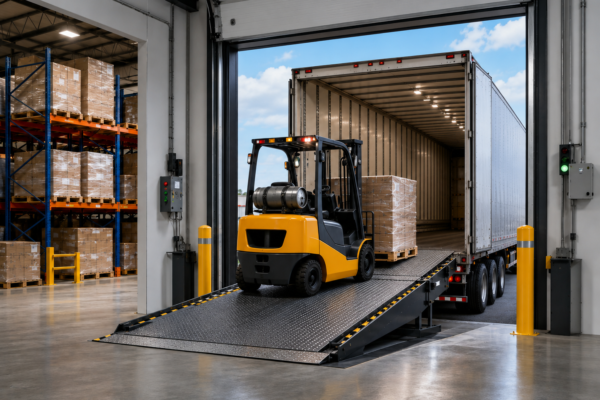
A niveladores de muelle conecta dos superficies que son fundamentalmente diferentes: un suelo de almacén fijo y un vehículo que puede cambiar de altura, moverse inesperadamente o abandonar la posición de carga.
Cada vez que una carretilla elevadora cruza esa transición, el nivelador de muelle debe soportar el vehículo y su carga mientras mantiene una trayectoria segura entre el edificio y el remolque.
Por esta razón, la seguridad en el muelle de carga no se trata solo de elegir una plataforma con capacidad suficiente. Los compradores también deben considerar el movimiento de la plataforma, la resistencia al deslizamiento, los peligros de aplastamiento y cizallamiento, el movimiento del remolque, la seguridad en el mantenimiento, los sistemas de control y las normativas aplicables en el mercado de destino.
Para los compradores internacionales, esto puede resultar complicado.
Los proyectos europeos comúnmente hacen referencia a la EN 1398, mientras que las instalaciones estadounidenses deben considerar los requisitos de OSHA. Los compradores estadounidenses también pueden encontrar la ANSI MH30.1, una norma de consenso que aborda específicamente los dispositivos niveladores de muelle.
El entorno normativo también está entrando en una transición importante. La EN 1398:2009 está actualmente catalogada por BSI como “Vigente, en revisión”,” mientras que el Reglamento de Máquinas de la UE (UE) 2023/1230 se aplicará a partir del 20 de enero de 2027.
Entonces, ¿qué significan realmente estas normas y qué debe verificar un comprador antes de pedir un nivelador de muelle?
Índice
TogglePor qué es importante la seguridad en el muelle de carga
El muelle de carga es una de las interfaces con mayor actividad en muchos almacenes y centros de distribución.
Un ciclo de carga típico puede incluir:
- un camión retrocediendo hacia el edificio;
- la apertura de una puerta industrial;
- el despliegue de un nivelador de muelle sobre el remolque;
- carretillas elevadoras entrando y saliendo repetidamente del vehículo;
- palés o productos pesados moviéndose a través de la plataforma;
- el retorno del nivelador de muelle a su posición de almacenamiento;
- la salida del camión.
Varias cosas pueden salir mal durante este proceso.
El remolque puede alejarse del muelle. La plataforma puede volverse resbaladiza. La carretilla elevadora puede aproximarse incorrectamente al borde de la plataforma. Un nivelador de muelle puede accionarse antes de que un vehículo esté correctamente posicionado. El personal de mantenimiento también puede estar expuesto a peligros bajo una plataforma elevada.
Por esta razón, la seguridad del nivelador de muelle debe considerarse como parte de todo el proceso de carga del almacén, y no simplemente como una característica de un equipo de muelle.
¿Qué es la EN 1398?
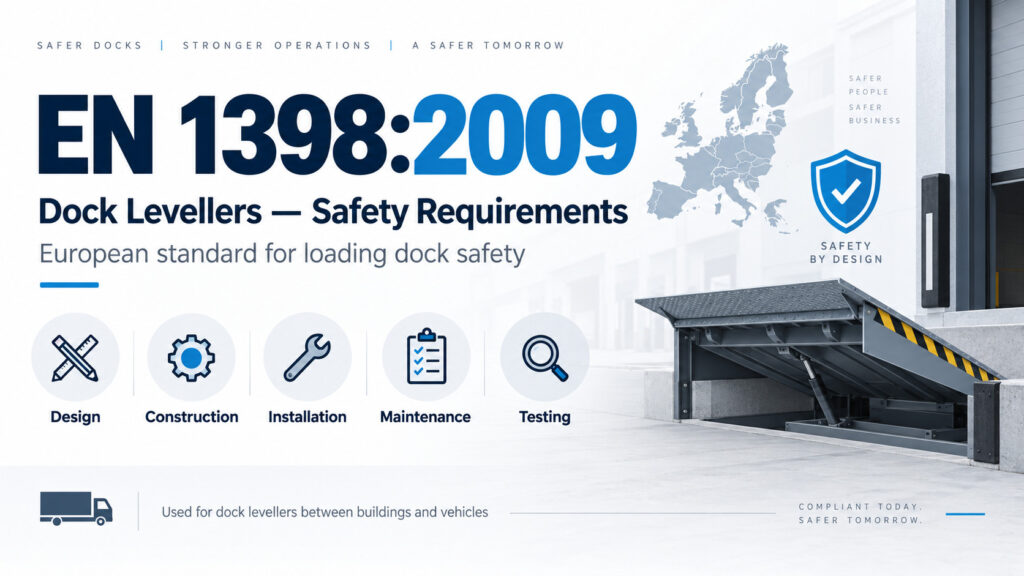
La EN 1398:2009 es la norma europea titulada:
Niveladores de muelle — Requisitos de seguridad
Especifica los requisitos de seguridad relativos al diseño, construcción, instalación, mantenimiento y ensayo de los niveladores de muelle y sus componentes de seguridad.
La norma se aplica a los niveladores de muelle utilizados como vías de tránsito entre edificios y vehículos de carretera o vagones de ferrocarril, incluidas las aplicaciones que implican peatones, equipos de transporte de accionamiento manual y equipos motorizados como carretillas elevadoras.
Según BSI, la EN 1398 no cubre ciertos otros tipos de equipos, incluidos mesas elevadoras, elevadores traseros montados en vehículos o niveladores de muelle destinados a aplicaciones marítimas y aeronáuticas.
Esta distinción es importante porque un nivelador de muelle no debe tratarse automáticamente como la misma categoría de producto que una mesa elevadora hidráulica u otro tipo de plataforma de carga.
¿Qué problemas de seguridad aborda la EN 1398?
La EN 1398 cubre una serie de peligros asociados con los niveladores de muelle.
BSI identifica áreas que incluyen:
- pendientes de la plataforma;
- propiedades antideslizantes;
- anchura de la plataforma;
- soporte en la posición de almacenamiento;
- peligros de tropiezo;
- posiciones de operación no soportadas;
- movimiento involuntario;
- peligros de aplastamiento y cizallamiento;
- dispositivos de soporte para mantenimiento;
- visibilidad cuando el nivelador de muelle se eleva o se baja.
Para los compradores, estos requisitos técnicos pueden traducirse en varias preguntas prácticas.
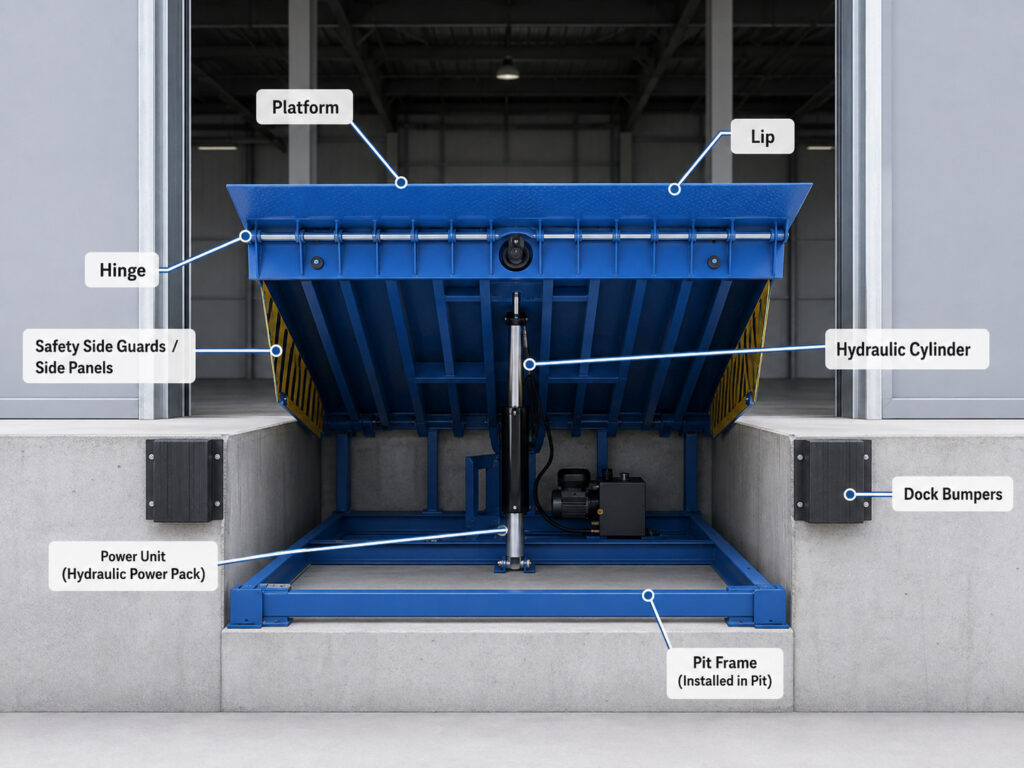
¿Es la plataforma adecuada para la carga prevista?
Un nivelador de muelle no solo soporta las mercancías que se transportan.
Durante la operación, los equipos de manipulación de materiales, como las carretillas elevadoras, también transitan por la plataforma.
Por lo tanto, los compradores deben proporcionar al fabricante información que incluya:
- peso de la carretilla elevadora o del AGV;
- peso máximo de la carga;
- frecuencia de carga;
- configuración de las ruedas;
- condiciones de operación.
Seleccionar la capacidad basándose únicamente en el peso del palé puede no reflejar las demandas reales impuestas al nivelador de muelle.
¿Puede moverse la plataforma de forma inesperada?
Un nivelador de muelle debe permanecer controlado tanto durante la operación como durante el almacenamiento.
El movimiento inesperado de la plataforma puede exponer a los operadores, conductores de carretillas elevadoras y personal de mantenimiento a peligros graves.
Para los niveladores de muelle hidráulicos, los compradores deben comprender cómo responde el sistema a situaciones anormales, como la pérdida de presión hidráulica o de alimentación eléctrica.
El diseño de seguridad exacto dependerá del modelo de nivelador de muelle y de las normas aplicables.
¿Es seguro el mantenimiento bajo la plataforma?
El mantenimiento frecuentemente requiere acceso a componentes situados debajo de la plataforma.
Por lo tanto, un nivelador de muelle elevado necesita un método adecuado de soporte mecánico durante la inspección o el mantenimiento.
La EN 1398 aborda específicamente los dispositivos de soporte para mantenimiento.
Esta es una característica importante que los compradores deben confirmar en lugar de asumir que la presión hidráulica por sí sola es suficiente para sostener una plataforma durante el mantenimiento.
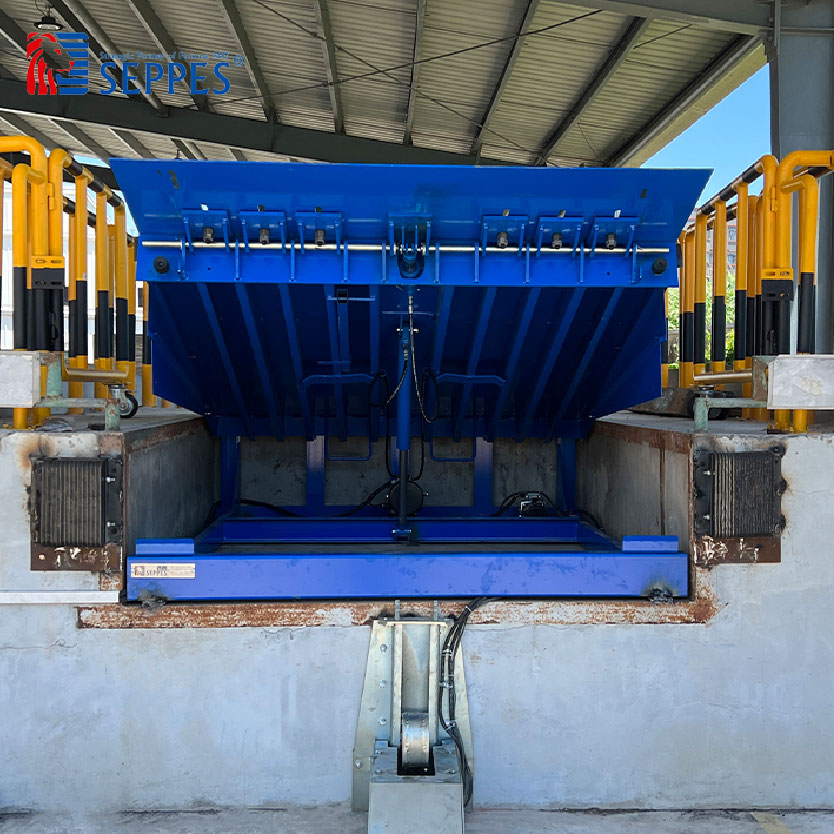
¿Qué exige OSHA para los niveladores de muelle?
The U.S. regulatory system approaches dock leveler safety differently.
OSHA does not use EN 1398.
Instead, requirements relevant to dock levelers appear within OSHA’s workplace safety regulations.
Under OSHA 29 CFR 1910.21, a “dockboard” is defined as a fixed or portable device that spans a gap or compensates for an elevation difference between a loading platform and a transport vehicle.
OSHA explicitly states that dockboards include bridge plates, dock plates and dock levelers.
This is important because OSHA 1910.26 therefore applies directly to equipment in this category.
OSHA 1910.26: Requisitos importantes que los compradores deben conocer
OSHA 1910.26 contains several requirements that are particularly relevant to loading dock safety.
Carga máxima prevista
OSHA requires dockboards to be capable of supporting the maximum intended load.
This reinforces an important procurement principle:
A dock leveler should be selected according to the actual operating load and application, not simply the nominal weight of the goods being transported.
Protección contra la caída de vehículos por el borde
For dockboards initially placed into service on or after January 17, 2017, OSHA generally requires them to be designed, constructed and maintained to prevent transfer vehicles from running off the dockboard edge, unless the employer can demonstrate that there is no such hazard.
This becomes particularly important for facilities using forklifts frequently.
Prevención del movimiento de vehículos
One of the most significant loading dock risks has little to do with the dock leveler itself:
the truck can move.
OSHA requires measures such as wheel chocks, sand shoes or other appropriate means to prevent a truck, semi-trailer, trailer or rail car from moving while employees are using the dockboard.
This is why truck dock safety should be evaluated together with dock leveler safety.
A correctly designed platform cannot create a safe bridge if the vehicle unexpectedly moves away from it.
Rampas portátiles de muelle
OSHA also contains specific requirements for portable dockboards, including securing them against movement and providing handholds or another means for safe handling.
Not every provision applies identically to a permanently installed hydraulic dock leveler and a portable dock plate, so buyers should distinguish between the different equipment types when evaluating OSHA requirements.
EN 1398 vs OSHA: No son el mismo tipo de requisito
One of the most common misunderstandings in international procurement is treating EN 1398 and OSHA as equivalent product standards.
They are not.
| Topic | EN 1398 | OSHA |
|---|---|---|
| Main market | Europa | Estados Unidos |
| Main purpose | Dock leveller safety standard | Workplace safety regulation |
| Dock leveler design | Major focus | Certain requirements apply |
| Installation and use | Addressed | Addressed |
| Carga máxima prevista | Addressed through product design requirements | Explicit requirement |
| Vehicle movement | Part of wider loading safety | Explicit workplace requirement |
| Employer obligations | Not the primary purpose | Major focus |
| CE conformity framework | Relevant in EU | Not applicable |
| Legal nature | European standard | U.S. regulation |
The practical lesson for buyers is simple:
A supplier saying that a dock leveler “meets European standards” does not answer whether it is suitable for a U.S. project.
Likewise, following OSHA workplace requirements does not automatically demonstrate conformity with EN 1398.
The destination market should be identified before the equipment is specified.
¿Qué es la ANSI MH30.1-2022?
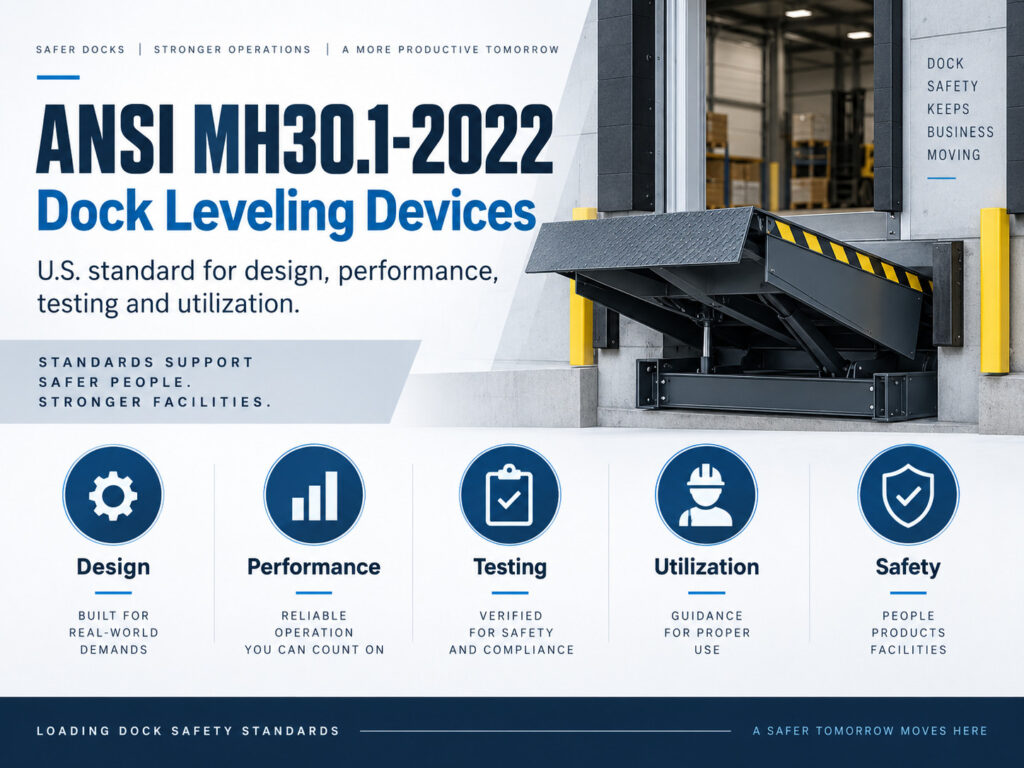
U.S. buyers may also encounter:
ANSI MH30.1-2022 — Performance and Testing Requirements for Dock Leveling Devices.
The standard is published through the Material Handling Industry and provides guidance for designers, manufacturers, sellers, installers, owners, users and governing bodies.
It addresses the design and testing of dock leveling devices and provides a uniform basis for comparing their performance. The 2022 version revises ANSI MH30.1-2015.
This creates an important three-part distinction:
EN 1398
European dock leveler safety standard.
OSHA
U.S. workplace safety requirements.
ANSI MH30.1
U.S. consensus standard specifically addressing dock leveling device performance and testing.
ANSI MH30.1 is therefore much closer to a product-specific dock leveler standard than OSHA itself.
Por qué 2026–2027 es importante para los compradores europeos
European machinery legislation is approaching an important transition.
Regulation (EU) 2023/1230 on machinery will apply from January 20, 2027 and will replace Directive 2006/42/EC.
This is particularly relevant for buyers whose dock equipment projects will be manufactured, imported or placed on the EU market around or after that date.
There is another important development.
The European Commission’s machinery harmonised-standards page currently explains that January 20, 2027 may appear as the end of legal effect for standards referenced under the existing Machinery Directive because that directive will be repealed on that date.
The Commission also says that a new list of harmonised standards under the Machinery Regulation is being prepared and is expected before the end of 2026, with the vast majority of standards currently cited under the Machinery Directive expected to feature in the new list.
That makes 2026 a particularly important year for procurement teams.
For a project scheduled for 2027, buyers should not simply copy the compliance requirements from an older purchase specification.
Instead, verify the applicable legislation and the current harmonised-standard references when the equipment is placed on the market.
¿Sigue vigente la EN 1398?
As of September 2026, BSI lists BS EN 1398:2009 as:
Current, Under Review.
The standard was also included in the EU harmonised machinery standards list consolidated through May 15, 2026.
However, because the European machinery framework is transitioning to Regulation (EU) 2023/1230, buyers planning future EU projects should verify the latest Official Journal references rather than assuming that the regulatory status will remain unchanged.
This is especially important for:
- European importers;
- distributors;
- warehouse developers;
- logistics contractors;
- manufacturers purchasing machinery from outside the EU.
¿La EN 1398 implica automáticamente el cumplimiento de la marca CE?
Not by itself.
European harmonised standards are generally voluntary technical means of demonstrating conformity with applicable legal requirements.
The European Commission explains that manufacturers may use another technical solution, but they must still demonstrate compliance with mandatory legal requirements.
Therefore, asking:
“Is the dock leveler EN 1398?”
is useful, but incomplete.
A better procurement question is:
“Which legislation and standards apply to this dock leveler in the destination market, and what conformity documentation will be supplied?”
Buyers should review the complete documentation relevant to the project rather than relying on a single standard number or a CE logo.
7 riesgos de seguridad en el muelle de carga que los compradores deben evaluar
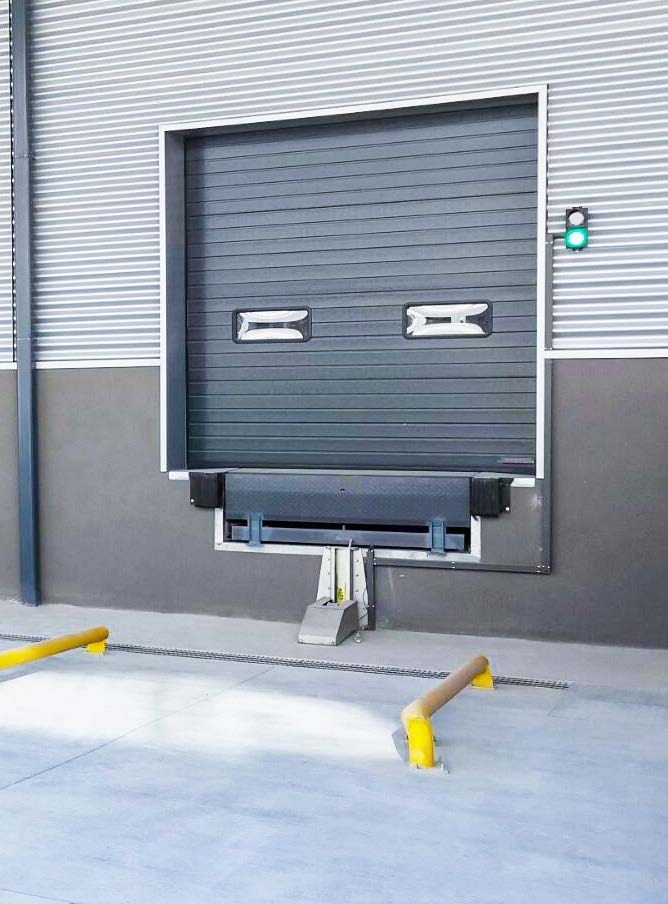
Standards are easier to understand when they are connected to real operating risks.
1. Capacidad de carga insuficiente
A platform must support the intended material-handling operation.
Consider the forklift or AGV, cargo, operating frequency and loading conditions when selecting the dock leveler.
2. Movimiento del remolque
If a trailer moves away while a forklift is entering or leaving, a dangerous gap can develop between the vehicle and the loading dock.
Vehicle restraints, wheel chocks and clear operating procedures may form part of the loading dock safety strategy.
3. Pendiente excesiva de la plataforma
Truck-bed heights vary.
A dock leveler that operates at an excessive angle may create problems for forklifts, pallet trucks or low-clearance AGVs.
Truck-bed height range and warehouse dock height should therefore be confirmed before selecting platform dimensions.
4. Superficies resbaladizas
Loading docks may be exposed to rain, snow, ice, oil or other contaminants.
Platform surface design and housekeeping both influence slip resistance.
5. Puntos de aplastamiento y cizallamiento
Moving platforms and lips create areas where hands, feet or other body parts may be exposed to injury.
Control location, side protection, warning labels and operating procedures should be considered together.
6. Mantenimiento inseguro
Working beneath a raised platform without appropriate mechanical support can create a serious hazard.
Maintenance supports should be used according to the equipment manufacturer’s instructions.
7. Secuencia de operación incorrecta
A dock leveler, industrial door and truck may all be individually functional while the overall loading sequence remains unsafe.
For example, the leveler should not normally be used against a vehicle that is not correctly positioned.
This is where interlocking and loading dock automation can improve process control.
Cómo los sistemas de sujeción de vehículos y los semáforos mejoran la seguridad en el muelle
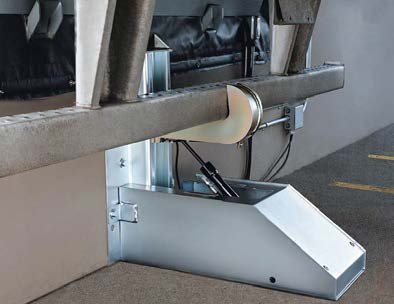
A modern warehouse loading dock may contain more than a dock leveler.
The complete system can include:
Camión
↓
Vehicle restraint
↓
Traffic light
↓
Puerta industrial
↓
Dock leveler
↓
Forklift or AGV
For example, an external red light can tell the driver not to move the truck while warehouse personnel are loading.
An internal signal can indicate whether loading is permitted.
Where appropriate, a vehicle restraint can be integrated into the operating logic.
A controlled sequence might be:
Truck correctly positioned
↓
Vehicle secured
↓
Loading permission confirmed
↓
Industrial door opens
↓
Dock leveler deploys
↓
Forklift enters trailer
This kind of system does not replace compliance, training or proper operating procedures.
It can, however, reduce reliance on operators remembering every step manually.
For automated warehouses, the door, dock leveler, vehicle restraint and PLC may also exchange status signals as part of a wider loading bay automation system.
Qué deben verificar los compradores antes de pedir un nivelador de muelle
A useful purchasing specification should contain more than width and length.
Before requesting a quotation, collect the following information:
| Buyer should provide/check | Why it matters |
|---|---|
| País de destino | Determines applicable regulations and standards |
| Altura del muelle | Influences leveler working angle |
| Altura mínima de la plataforma del camión | Defines lower working range |
| Altura máxima de la plataforma del camión | Defines upper working range |
| Peso de la carretilla elevadora o AGV | Important for capacity selection |
| Peso máximo de la carga | Part of intended operating load |
| Frecuencia de carga | Affects equipment selection |
| Ancho y longitud de la plataforma | Must suit vehicles and material handling |
| Dimensiones del foso | Critical for installation |
| Vehicle types | Determines operating range |
| Condiciones ambientales | Wet, cold or corrosive environments may require special consideration |
| Vehicle restraint/chock strategy | Reduces trailer movement risk |
| Tipo de puerta | May affect loading sequence |
| Control requirements | Needed for interlocking and automation |
| Applicable standards | EN 1398, OSHA, ANSI or local requirements |
| Required documentation | Important for acceptance and compliance |
| Requisitos de mantenimiento | Supports long-term safe operation |
For a new warehouse, these questions should ideally be addressed during the design stage.
Correcting dock dimensions or control logic after construction is usually far more difficult than defining the requirements before equipment is ordered.
La seguridad es cuestión del sistema de muelle de carga, no solo de la plataforma
Modern loading docks increasingly combine several pieces of equipment:
- dock leveler;
- industrial sectional door;
- dock shelter;
- vehicle restraint;
- semáforos;
- sensors;
- control system.
This changes the way buyers should evaluate safety.
Instead of asking only:
“Is the dock leveler safe?”
ask:
“How does the complete loading bay behave during normal operation and abnormal conditions?”
Por ejemplo:
What happens if the truck is not present?
Can the leveler operate while the door is closed?
What happens if the vehicle begins to move?
How is a raised platform secured for maintenance?
Can the system communicate loading permission clearly to the driver and warehouse operator?
What happens after a power or control failure?
These system-level questions are increasingly important as warehouse safety and automation become more closely connected.
Elección de equipos de muelle para un proyecto internacional
For international buyers, the correct dock leveler is determined by three groups of requirements:
Requisitos de aplicación
Truck size, dock height, forklift type, cargo weight and operating frequency.
Requisitos de seguridad
Platform movement, slip resistance, maintenance support, trailer movement and the loading sequence.
Requisitos del mercado
The regulations, standards and conformity documentation applicable in the destination country.
A buyer who considers all three areas is in a much stronger position than one who compares dock levelers only by rated capacity and price.
When requesting a loading dock solution, provide the manufacturer with:
- dock dimensions;
- truck-bed height range;
- forklift or AGV specifications;
- required capacity;
- number of loading bays;
- destination country;
- control and automation requirements.
This allows the warehouse loading dock equipment to be evaluated according to the real application rather than selected from a generic specification.
Preguntas frecuentes
¿Para qué sirve la EN 1398 en los niveladores de muelle?
EN 1398 is a European standard covering safety requirements for the design, construction, installation, maintenance and testing of dock levellers and their safety components. BSI currently lists EN 1398:2009 as current and under review.
Does OSHA apply to dock levelers?
Yes. OSHA 29 CFR 1910.21 specifically includes dock levelers within its definition of dockboards. Requirements in OSHA 1910.26 address matters including intended load, edge run-off protection, movement of transport vehicles and portable dockboard safety.
¿Es OSHA el equivalente estadounidense de la EN 1398?
No. OSHA establishes legally enforceable workplace safety requirements, while EN 1398 is a European product safety standard for dock levellers. ANSI MH30.1-2022 provides U.S. performance and testing guidance specifically for dock leveling devices.
¿Qué es la ANSI MH30.1-2022?
ANSI MH30.1-2022 is a performance and testing standard for dock leveling devices. It provides guidance for manufacturers, designers, installers, owners and users and establishes a uniform basis for comparing dock levelers.
¿Es obligatoria la EN 1398?
European harmonised standards are generally voluntary means of demonstrating conformity with mandatory legal requirements. Manufacturers may use other technical solutions, but they remain responsible for demonstrating compliance with applicable legislation.
¿Qué cambios se aplican a la maquinaria europea en 2027?
Regulation (EU) 2023/1230 on machinery will apply from January 20, 2027 and replace the current Machinery Directive. The European Commission is preparing a new list of harmonised standards under the Regulation, making it important for buyers to verify the current requirements for projects entering the EU market in 2027.
¿Qué información se necesita para seleccionar un nivelador de muelle seguro?
At minimum, provide the dock height, truck-bed height range, forklift or AGV weight, maximum cargo, loading frequency, platform dimensions, destination market and required safety or control functions.