
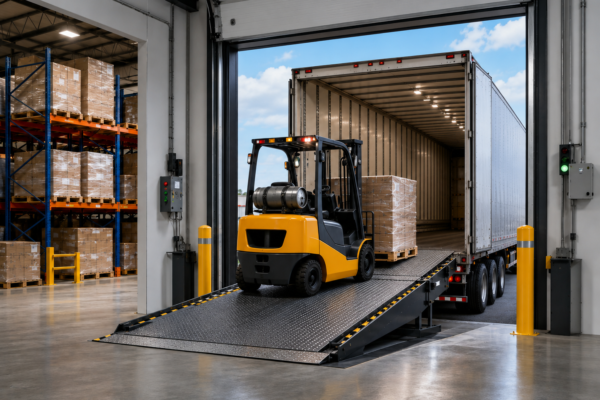
A ドックレベラー 根本的に異なる2つの面、すなわち固定された倉庫の床と、高さが変化し、予期せず移動し、または積載位置から離れる可能性のある車両とを接続する。.
フォークリフトがその移行部を通過するたびに、ドックレベラーは建物とトレーラー間の安全な通路を維持しながら、車両とその積荷を支持しなければならない。.
このため、積載ドックの安全性は十分な容量を持つプラットフォームを選ぶことだけではない。購入者はプラットフォームの移動、滑り抵抗、圧壊およびせん断の危険、トレーラーの移動、メンテナンスの安全性、制御システム、および仕向地市場で適用される規制も考慮する必要がある。.
海外の購入者にとって、これは複雑になることがある。.
欧州のプロジェクトでは一般的にEN 1398が参照されるが、米国の施設ではOSHAの要件を考慮しなければならない。米国の購入者は、ドックレベリング装置に特化したコンセンサス規格であるANSI MH30.1に遭遇することもある。.
規制環境もまた、重要な転換期を迎えている。. EN 1398:2009は現在、BSIにより「Current, Under Review」としてリストされている。“ 一方、EU機械規則 (EU) 2023/1230 は2027年1月20日から適用される。.
では、これらの規格は実際に何を意味し、購入者はドックレベラーを発注する前に何を確認すべきだろうか。
目次
トグル積載ドックの安全性が重要な理由
荷積みドックは、多くの倉庫や配送センターにおいて最も稼働率の高いインターフェースの一つです。.
一般的な荷積みサイクルには、以下が含まれる場合があります:
- トラックが建物に向かって後退する;;
- 産業用ドアが開く;;
- ドックレベラーがトレーラー上に展開する;;
- フォークリフトが車両に繰り返し出入りする;;
- パレットや重量物がプラットフォーム上を移動する;;
- ドックレベラーが格納位置に戻る;;
- トラックが出発する。.
このプロセス中に、いくつかの問題が発生する可能性があります。.
トレーラーがドックから離れる可能性があります。プラットフォームが滑りやすくなる可能性があります。フォークリフトがプラットフォームの端に不適切に接近する可能性があります。車両が適切に配置される前にドックレベラーが操作される可能性があります。保守作業員が上昇したプラットフォームの下で危険にさらされる可能性もあります。.
これが、ドックレベラーの安全性を単に一つのドック機器の機能としてではなく、倉庫の荷積みプロセス全体の一部として考慮する必要がある理由です。.
EN 1398とは何か
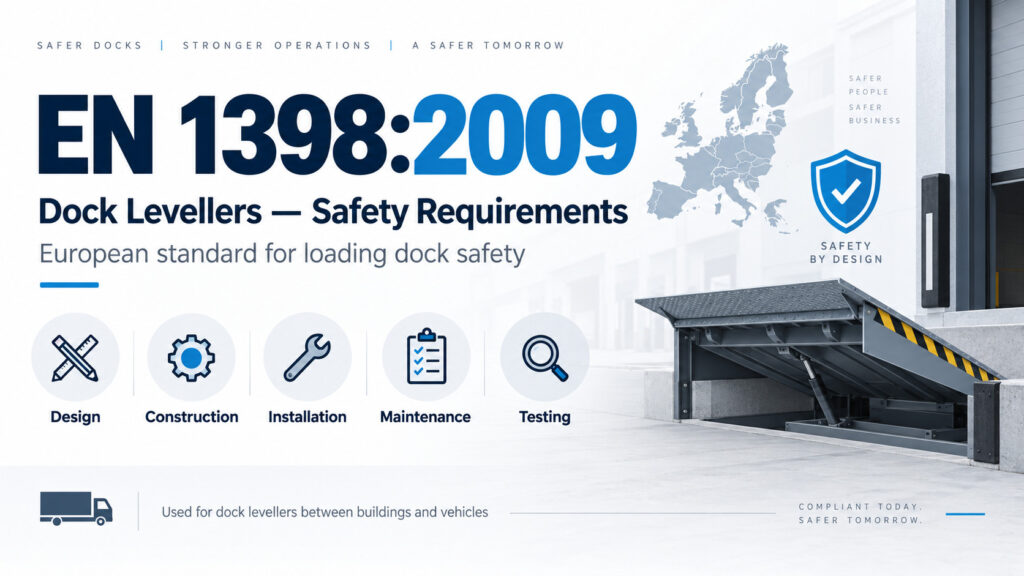
EN 1398:2009は、以下のタイトルの欧州規格です:
ドックレベラー — 安全要件
この規格は、ドックレベラーおよびその安全部品の設計、構造、設置、保守および試験に関する安全要件を規定しています。.
この規格は、建物と道路車両または鉄道車両との間の通行路として使用されるドックレベラーに適用され、歩行者、手動搬送機器およびフォークリフトトラックなどの動力機器を含む用途を含みます。.
BSIによると、EN 1398はリフティングテーブル、車両搭載型テールリフト、または船舶および航空機用途向けのドックレベラーなど、特定の他の種類の機器は対象外です。.
この区別は重要です。なぜなら、ドックレベラーは油圧リフティングテーブルや他の種類の荷積みプラットフォームと同じ製品カテゴリーとして自動的に扱われるべきではないからです。.
EN 1398はどのような安全問題に対処しているか
EN 1398は、ドックレベラーに関連する一連の危険を対象としています。.
BSIは以下を含む領域を特定しています:
- プラットフォームの勾配;;
- 滑り止め特性;;
- プラットフォームの幅;;
- 格納位置での支持;;
- つまずきの危険;;
- 不支持の操作位置;;
- 意図しない移動;;
- 圧壊およびせん断の危険;;
- 保守用支持装置;;
- ドックレベラーの上昇時または下降時の視認性。.
購入者にとって、これらの技術要件はいくつかの実用的な質問に置き換えることができます。.
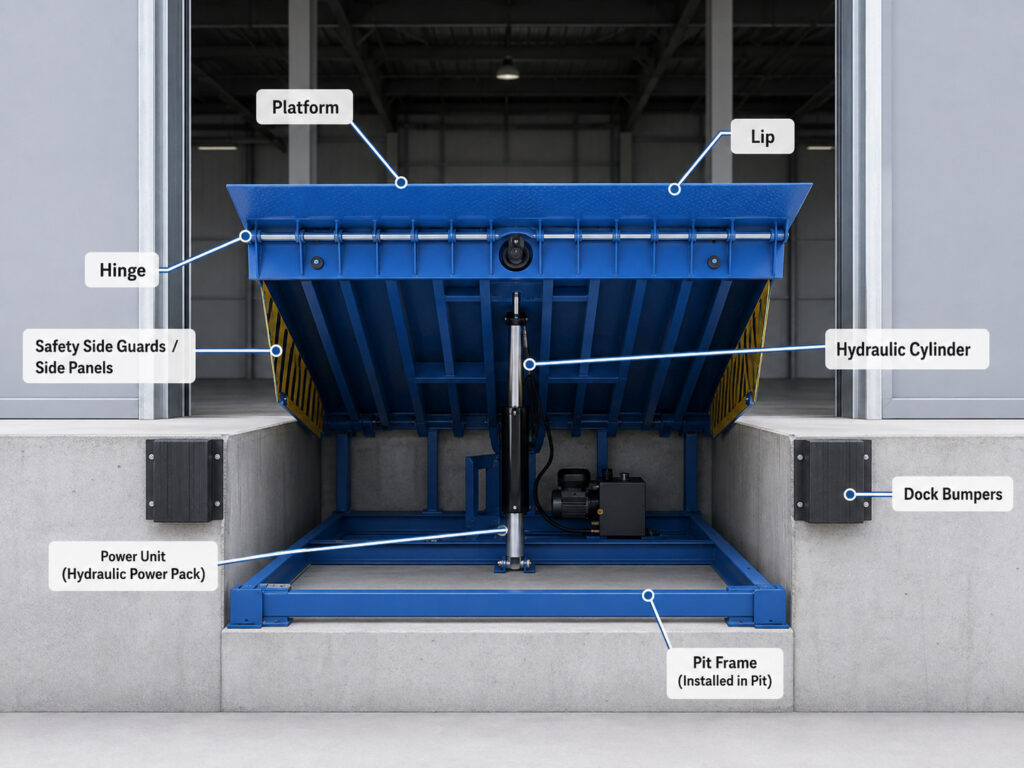
プラットフォームは想定荷重に適しているか
ドックレベラーは、輸送される商品だけを載せているわけではありません。.
操作中、フォークリフトなどのマテリアルハンドリング機器もプラットフォーム上を走行します。.
したがって、購入者はメーカーに以下の情報を提供する必要があります:
- フォークリフトまたはAGVの重量;;
- 最大積載重量;;
- 荷積み頻度;;
- 車輪の構成;;
- 使用条件。.
パレットの重量のみに基づいて容量を選定すると、ドックレベラーに課される実際の要求を反映できない場合があります。.
プラットフォームが予期せず移動する可能性はないか
ドックレベラーは、操作時および格納時の両方において制御された状態を維持する必要があります。.
予期しないプラットフォームの移動は、オペレーター、フォークリフト運転者および保守作業員を重大な危険にさらす可能性があります。.
油圧式ドックレベラーの場合、購入者は油圧圧力の喪失や電源喪失などの異常状況に対してシステムがどのように応答するかを理解する必要があります。.
正確な安全設計は、ドックレベラーのモデルおよび適用規格によって異なります。.
プラットフォーム下でのメンテナンスは安全か
保守では、プラットフォーム下の部品へのアクセスが頻繁に必要となります。.
したがって、上昇したドックレベラーは、検査または整備中に適切な機械的支持方法を必要とします。.
EN 1398は、保守用の支持装置について特に規定しています。.
これは購入者が確認すべき重要な機能であり、保守中に油圧圧力だけでプラットフォームを保持するのに十分であると仮定すべきではありません。.
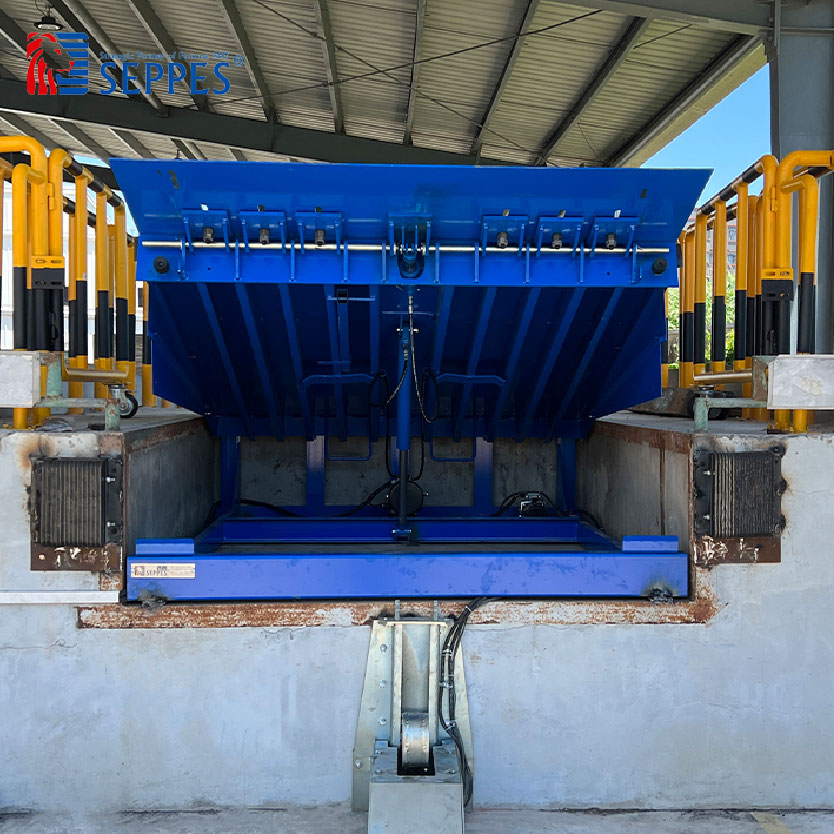
OSHAはドックレベラーに何を要求しているか
米国の規制体系は、ドックレベラーの安全性に対して異なるアプローチを取っています。.
OSHA does not use EN 1398.
Instead, requirements relevant to dock levelers appear within OSHA’s workplace safety regulations.
Under OSHA 29 CFR 1910.21, a “dockboard” is defined as a fixed or portable device that spans a gap or compensates for an elevation difference between a loading platform and a transport vehicle.
OSHA explicitly states that dockboards include bridge plates, dock plates and dock levelers.
This is important because OSHA 1910.26 therefore applies directly to equipment in this category.
OSHA 1910.26:購入者が理解すべき重要な要件
OSHA 1910.26 contains several requirements that are particularly relevant to loading dock safety.
最大想定荷重
OSHA requires dockboards to be capable of supporting the maximum intended load.
This reinforces an important procurement principle:
A dock leveler should be selected according to the actual operating load and application, not simply the nominal weight of the goods being transported.
車両の端からの転落防止
For dockboards initially placed into service on or after January 17, 2017, OSHA generally requires them to be designed, constructed and maintained to prevent transfer vehicles from running off the dockboard edge, unless the employer can demonstrate that there is no such hazard.
This becomes particularly important for facilities using forklifts frequently.
車両の移動防止
One of the most significant loading dock risks has little to do with the dock leveler itself:
the truck can move.
OSHA requires measures such as wheel chocks, sand shoes or other appropriate means to prevent a truck, semi-trailer, trailer or rail car from moving while employees are using the dockboard.
This is why truck dock safety should be evaluated together with dock leveler safety.
A correctly designed platform cannot create a safe bridge if the vehicle unexpectedly moves away from it.
可搬式ドックボード
OSHA also contains specific requirements for portable dockboards, including securing them against movement and providing handholds or another means for safe handling.
Not every provision applies identically to a permanently installed hydraulic dock leveler and a portable dock plate, so buyers should distinguish between the different equipment types when evaluating OSHA requirements.
EN 1398対OSHA:它们是不同类型的要
One of the most common misunderstandings in international procurement is treating EN 1398 and OSHA as equivalent product standards.
They are not.
| Topic | EN 1398 | OSHA |
|---|---|---|
| Main market | ヨーロッパ | 米国 |
| Main purpose | Dock leveller safety standard | Workplace safety regulation |
| Dock leveler design | Major focus | Certain requirements apply |
| Installation and use | Addressed | Addressed |
| 最大想定荷重 | Addressed through product design requirements | Explicit requirement |
| Vehicle movement | Part of wider loading safety | Explicit workplace requirement |
| Employer obligations | Not the primary purpose | Major focus |
| CE conformity framework | Relevant in EU | Not applicable |
| Legal nature | European standard | U.S. regulation |
The practical lesson for buyers is simple:
A supplier saying that a dock leveler “meets European standards” does not answer whether it is suitable for a U.S. project.
Likewise, following OSHA workplace requirements does not automatically demonstrate conformity with EN 1398.
The destination market should be identified before the equipment is specified.
ANSI MH30.1-2022とは何か
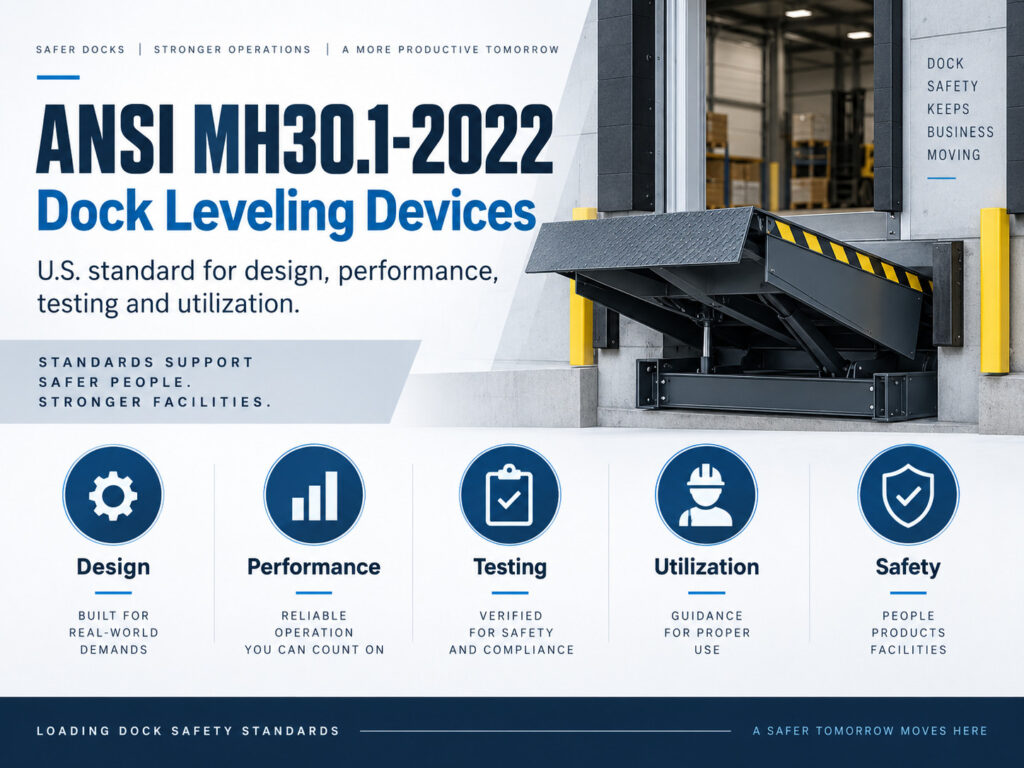
U.S. buyers may also encounter:
ANSI MH30.1-2022 — Performance and Testing Requirements for Dock Leveling Devices.
The standard is published through the Material Handling Industry and provides guidance for designers, manufacturers, sellers, installers, owners, users and governing bodies.
It addresses the design and testing of dock leveling devices and provides a uniform basis for comparing their performance. The 2022 version revises ANSI MH30.1-2015.
This creates an important three-part distinction:
EN 1398
European dock leveler safety standard.
OSHA
U.S. workplace safety requirements.
ANSI MH30.1
U.S. consensus standard specifically addressing dock leveling device performance and testing.
ANSI MH30.1 is therefore much closer to a product-specific dock leveler standard than OSHA itself.
2026~2027年が欧州の購入者にとって重要な理由
European machinery legislation is approaching an important transition.
Regulation (EU) 2023/1230 on machinery will apply from January 20, 2027 and will replace Directive 2006/42/EC.
This is particularly relevant for buyers whose dock equipment projects will be manufactured, imported or placed on the EU market around or after that date.
There is another important development.
The European Commission’s machinery harmonised-standards page currently explains that January 20, 2027 may appear as the end of legal effect for standards referenced under the existing Machinery Directive because that directive will be repealed on that date.
The Commission also says that a new list of harmonised standards under the Machinery Regulation is being prepared and is expected before the end of 2026, with the vast majority of standards currently cited under the Machinery Directive expected to feature in the new list.
That makes 2026 a particularly important year for procurement teams.
For a project scheduled for 2027, buyers should not simply copy the compliance requirements from an older purchase specification.
Instead, verify the applicable legislation and the current harmonised-standard references when the equipment is placed on the market.
EN 1398はまだ現行か
As of September 2026, BSI lists BS EN 1398:2009 as:
Current, Under Review.
The standard was also included in the EU harmonised machinery standards list consolidated through May 15, 2026.
However, because the European machinery framework is transitioning to Regulation (EU) 2023/1230, buyers planning future EU projects should verify the latest Official Journal references rather than assuming that the regulatory status will remain unchanged.
This is especially important for:
- European importers;
- distributors;
- warehouse developers;
- logistics contractors;
- manufacturers purchasing machinery from outside the EU.
EN 1398に準拠していれば自動的にCE適合となるか
それだけでは不十分です。.
European harmonised standards are generally voluntary technical means of demonstrating conformity with applicable legal requirements.
The European Commission explains that manufacturers may use another technical solution, but they must still demonstrate compliance with mandatory legal requirements.
Therefore, asking:
“Is the dock leveler EN 1398?”
is useful, but incomplete.
A better procurement question is:
“Which legislation and standards apply to this dock leveler in the destination market, and what conformity documentation will be supplied?”
Buyers should review the complete documentation relevant to the project rather than relying on a single standard number or a CE logo.
購入者が評価すべき積載ドックの7つの安全リスク
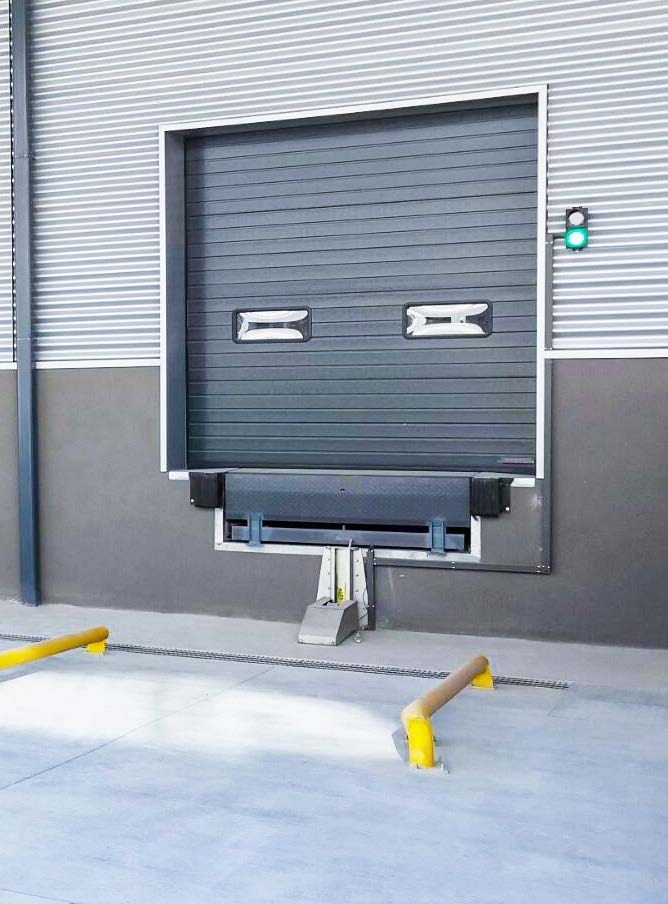
Standards are easier to understand when they are connected to real operating risks.
1. 不十分な耐荷重
A platform must support the intended material-handling operation.
Consider the forklift or AGV, cargo, operating frequency and loading conditions when selecting the dock leveler.
2. トレーラーの移動
If a trailer moves away while a forklift is entering or leaving, a dangerous gap can develop between the vehicle and the loading dock.
Vehicle restraints, wheel chocks and clear operating procedures may form part of the loading dock safety strategy.
3. 過大なプラットフォーム勾配
Truck-bed heights vary.
A dock leveler that operates at an excessive angle may create problems for forklifts, pallet trucks or low-clearance AGVs.
Truck-bed height range and warehouse dock height should therefore be confirmed before selecting platform dimensions.
4. 滑りやすい表面
Loading docks may be exposed to rain, snow, ice, oil or other contaminants.
Platform surface design and housekeeping both influence slip resistance.
5. 圧壊およびせん断ポイント
Moving platforms and lips create areas where hands, feet or other body parts may be exposed to injury.
Control location, side protection, warning labels and operating procedures should be considered together.
6. 不安全なメンテナンス
Working beneath a raised platform without appropriate mechanical support can create a serious hazard.
Maintenance supports should be used according to the equipment manufacturer’s instructions.
7. 誤った操作手順
A dock leveler, industrial door and truck may all be individually functional while the overall loading sequence remains unsafe.
For example, the leveler should not normally be used against a vehicle that is not correctly positioned.
This is where interlocking and loading dock automation can improve process control.
車両拘束装置と信号灯がドックの安全性をどのように向上させるか
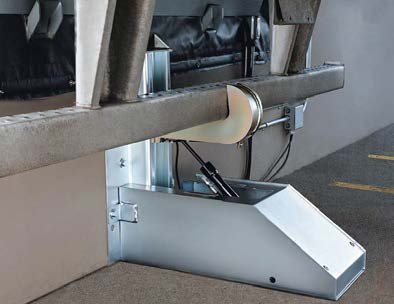
A modern warehouse loading dock may contain more than a dock leveler.
The complete system can include:
トラック
↓
車両拘束装置
↓
信号灯
↓
厳しい物流通路設計に対応する設備です。その開閉速度は通常1.0~2.0メートル/秒に達し、一般的な鋼製シャッター戸を大幅に上回ります。この迅速な開閉機能により、高速ドアは室内環境の恒温・恒湿・清浄度維持に重要な役割を果たします。
↓
ドックレベラー
↓
Forklift or AGV
For example, an external red light can tell the driver not to move the truck while warehouse personnel are loading.
An internal signal can indicate whether loading is permitted.
Where appropriate, a vehicle restraint can be integrated into the operating logic.
A controlled sequence might be:
Truck correctly positioned
↓
Vehicle secured
↓
Loading permission confirmed
↓
産業用ドアが開く
↓
ドックレベラーが展開
↓
Forklift enters trailer
This kind of system does not replace compliance, training or proper operating procedures.
It can, however, reduce reliance on operators remembering every step manually.
For automated warehouses, the door, dock leveler, vehicle restraint and PLC may also exchange status signals as part of a wider loading bay automation system.
購入者がドックレベラーを発注する前に確認すべきこと
A useful purchasing specification should contain more than width and length.
Before requesting a quotation, collect the following information:
| Buyer should provide/check | Why it matters |
|---|---|
| Destination country | Determines applicable regulations and standards |
| ドック高さ | Influences leveler working angle |
| 最小トラックベッド高さ | Defines lower working range |
| 最大トラックベッド高さ | Defines upper working range |
| フォークリフトまたはAGVの重量 | Important for capacity selection |
| 最大貨物重量 | Part of intended operating load |
| 積み下ろし頻度 | Affects equipment selection |
| プラットフォームの幅と長さ | Must suit vehicles and material handling |
| ピット寸法 | Critical for installation |
| Vehicle types | Determines operating range |
| 環境条件 | Wet, cold or corrosive environments may require special consideration |
| Vehicle restraint/chock strategy | Reduces trailer movement risk |
| ドアタイプ | May affect loading sequence |
| Control requirements | Needed for interlocking and automation |
| Applicable standards | EN 1398, OSHA, ANSI or local requirements |
| Required documentation | Important for acceptance and compliance |
| メンテナンス要件 | Supports long-term safe operation |
For a new warehouse, these questions should ideally be addressed during the design stage.
Correcting dock dimensions or control logic after construction is usually far more difficult than defining the requirements before equipment is ordered.
安全性はプラットフォームだけでなく積載ドックシステム全体に関わる
Modern loading docks increasingly combine several pieces of equipment:
- dock leveler;
- 産業用セクショナルドア;;
- dock shelter;
- 車両拘束装置;;
- 信号灯;;
- sensors;
- control system.
This changes the way buyers should evaluate safety.
Instead of asking only:
“Is the dock leveler safe?”
ask:
“How does the complete loading bay behave during normal operation and abnormal conditions?”
例えば:
What happens if the truck is not present?
Can the leveler operate while the door is closed?
What happens if the vehicle begins to move?
How is a raised platform secured for maintenance?
Can the system communicate loading permission clearly to the driver and warehouse operator?
What happens after a power or control failure?
These system-level questions are increasingly important as warehouse safety and automation become more closely connected.
国際プロジェクト向けのドック設備の選定
For international buyers, the correct dock leveler is determined by three groups of requirements:
用途要件
Truck size, dock height, forklift type, cargo weight and operating frequency.
安全要件
Platform movement, slip resistance, maintenance support, trailer movement and the loading sequence.
市場要件
The regulations, standards and conformity documentation applicable in the destination country.
A buyer who considers all three areas is in a much stronger position than one who compares dock levelers only by rated capacity and price.
When requesting a loading dock solution, provide the manufacturer with:
- dock dimensions;
- トラックベッドの高さ範囲;;
- forklift or AGV specifications;
- required capacity;
- number of loading bays;
- destination country;
- control and automation requirements.
This allows the warehouse loading dock equipment to be evaluated according to the real application rather than selected from a generic specification.
よくある質問
ドックレベラーにおけるEN 1398とは何か
EN 1398 is a European standard covering safety requirements for the design, construction, installation, maintenance and testing of dock levellers and their safety components. BSI currently lists EN 1398:2009 as current and under review.
Does OSHA apply to dock levelers?
Yes. OSHA 29 CFR 1910.21 specifically includes dock levelers within its definition of dockboards. Requirements in OSHA 1910.26 address matters including intended load, edge run-off protection, movement of transport vehicles and portable dockboard safety.
OSHAはEN 1398の米国版に相当するか
No. OSHA establishes legally enforceable workplace safety requirements, while EN 1398 is a European product safety standard for dock levellers. ANSI MH30.1-2022 provides U.S. performance and testing guidance specifically for dock leveling devices.
ANSI MH30.1-2022とは何か
ANSI MH30.1-2022 is a performance and testing standard for dock leveling devices. It provides guidance for manufacturers, designers, installers, owners and users and establishes a uniform basis for comparing dock levelers.
EN 1398は義務か
European harmonised standards are generally voluntary means of demonstrating conformity with mandatory legal requirements. Manufacturers may use other technical solutions, but they remain responsible for demonstrating compliance with applicable legislation.
2027年に欧州の機械に何が変わるか
Regulation (EU) 2023/1230 on machinery will apply from January 20, 2027 and replace the current Machinery Directive. The European Commission is preparing a new list of harmonised standards under the Regulation, making it important for buyers to verify the current requirements for projects entering the EU market in 2027.
安全なドックレベラーを選定するには、どのような情報が必要ですか?
At minimum, provide the dock height, truck-bed height range, forklift or AGV weight, maximum cargo, loading frequency, platform dimensions, destination market and required safety or control functions.