
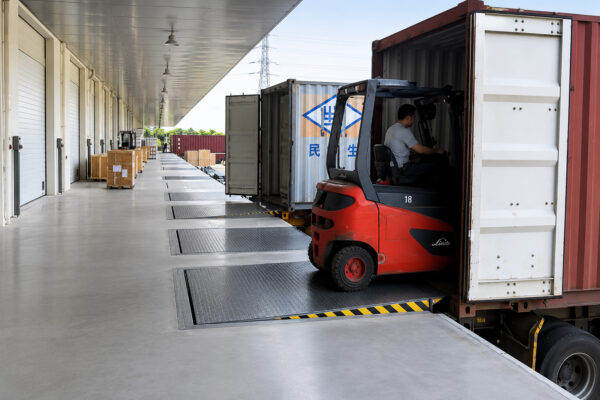
A automação de armazéns está a passar rapidamente de máquinas isoladas para sistemas conectados de movimentação de materiais.
Robôs transportam mercadorias. Transportadores automatizados movem caixas entre postos de trabalho. Sistemas de gestão de armazém coordenam o inventário. AGVs e AMRs são cada vez mais utilizados para mover materiais sem controlo humano contínuo.
Mas há uma área que pode facilmente ser negligenciada durante um projeto de automação:
Em junho de 2026, a Amazon apresentou a próxima geração do seu robô móvel autónomo Proteus como parte de um importante investimento europeu em fulfillment. O Proteus original já está implementado em 25 centros de fulfillment nos Estados Unidos e opera principalmente em áreas de doca, transportando carrinhos pesados. A próxima geração foi concebida para ir além da doca e operar em todos os centros de fulfillment.
Esta é uma ilustração útil de uma mudança mais ampla.
Quando a movimentação de materiais dentro de um armazém se torna mais rápida e mais automatizada, a doca de carregamento já não pode ser tratada como uma operação manual completamente separada.
Para armazéns de alto rendimento, centros de distribuição e unidades fabris, a automação da doca de carregamento está a tornar-se uma parte importante do fluxo de trabalho logístico completo.
Então, como é realmente uma doca de carregamento automatizada e como devem as empresas concebê-la?
Índice
AlternarPor que a Automação da Doca de Carregamento é Importante em 2026
A automação já não está limitada a um pequeno número de centros de fulfillment altamente avançados.
A DHL reportou que investiu mais de 1 mil milhões de euros em automação na sua divisão de logística contratual ao longo de três anos. A sua rede utiliza mais de 7.500 robôs e cerca de 800.000 sensores IoT, enquanto mais de 90% dos armazéns da DHL em todo o mundo possuem pelo menos uma solução de automação ou digitalização.
O mais recente da DHL Logistics Trend Radar Echo, baseado nas respostas de mais de 2.500 profissionais da cadeia de abastecimento, também classifica a robótica como um dos clusters tecnológicos mais significativos que moldam a logística, com a eficiência operacional entre as principais razões pelas quais as empresas investem nestas tecnologias.
Estes desenvolvimentos criam uma questão operacional simples:
O que acontece quando as mercadorias se movem rapidamente através de um armazém automatizado, mas ainda esperam numa doca de carregamento operada manualmente?
Uma doca de carregamento pode tornar-se um gargalo quando:
- os camiões esperam demasiado tempo por uma doca disponível;
- os colaboradores têm de coordenar manualmente as portas e os equipamentos da doca;
- os niveladores de doca não estão integrados com outros equipamentos;
- os empilhadores ou AGVs aguardam a sequência de carregamento correta;
- os motoristas e os operadores de armazém dependem apenas da comunicação verbal;
- o equipamento pode ser operado numa sequência incorreta;
- a informação sobre a ocupação da doca não está disponível para o sistema de armazém.
O objetivo da automação da doca de carregamento não é, portanto, simplesmente fazer com que um nivelador de doca se mova automaticamente.
É criar um processo de carregamento coordenado.
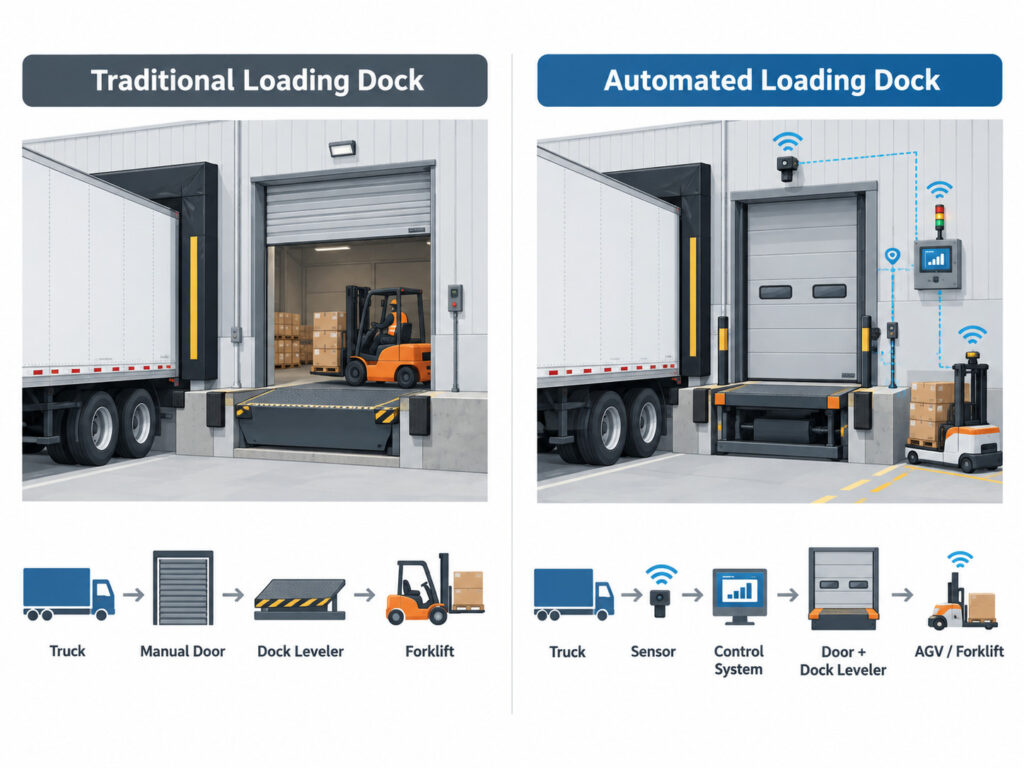
Imagem Sugerida 1 – Inserir aqui
Conceito da imagem:
Doca de carregamento tradicional vs doca de carregamento automatizada.
Esquerda:
Camião → Porta manual → Nivelador de doca manual → Empilhador
Direita:
Camião → Sensor → Sistema de controlo → Porta industrial + nivelador de doca + sistema de retenção → Empilhador / AGV
Manter o gráfico limpo com texto em inglês mínimo.
O Que É a Automação da Doca de Carregamento?
A automação da doca de carregamento refere-se à utilização de equipamentos automáticos, sensores, sistemas de controlo e interfaces de comunicação para coordenar as atividades entre o armazém e o veículo na doca de carregamento.
Uma doca convencional pode consistir em:
- porta industrial;
- nivelador de doca;
- abrigos de doca;
- controlo por botão;
- empilhador.
Uma doca de carregamento mais automatizada pode adicionar:
- sensores de deteção de veículos;
- monitorização da ocupação da doca;
- controlos automáticos de portas;
- controlos de niveladores de doca hidráulicos;
- sistemas de retenção de veículos;
- semáforos;
- interbloqueios de segurança;
- comunicação PLC;
- integração com WMS ou gestão de pátio;
- interfaces AGV ou AMR.
A diferença não é simplesmente o número de dispositivos.
A principal diferença é que os dispositivos comunicam e operam de acordo com uma sequência controlada.
De Equipamentos Autónomos a uma Doca de Carregamento Conectada
Considere uma operação de carregamento tradicional.
Um camião chega.
Um colaborador confirma que está corretamente posicionado.
A porta industrial é aberta.
O nivelador de doca é ativado.
Um empilhador entra no reboque.
Após a conclusão do carregamento, o operador devolve o nivelador de doca à sua posição de repouso e fecha a porta.
Cada etapa depende fortemente de as pessoas seguirem o procedimento correto.
In an automated loading dock, some of these steps can be monitored, controlled or interlocked.
A simplified sequence might look like this:
Truck arrives
↓
Vehicle position detected
↓
Truck secured / loading permission confirmed
↓
Porta industrial abre
↓
Nivelador de doca acionado
↓
Loading authorization activated
↓
Forklift / AGV begins material transfer
↓
Carregamento concluído
↓
Dock leveler returns
↓
Door closes
↓
Vehicle released
Not every warehouse needs every step to be fully automatic.
The important principle is that the equipment should work as one loading bay system rather than several unrelated products.
1. Niveladores de Doca Automáticos Tornam-se Parte da Sequência de Controlo
The dock leveler remains one of the most important components of a loading bay.
Its job is to bridge the height and distance difference between the warehouse floor and truck bed, allowing forklifts and other material-handling equipment to move between them.
Hydraulic dock levelers are particularly suitable for high-frequency loading environments because platform lifting and lip operation can be controlled electrically and hydraulically.
But in a smart loading dock, the question changes from:
“Can the dock leveler operate automatically?”
para:
“Can the dock leveler operate safely as part of the warehouse loading sequence?”
For example, the system may prevent the leveler from deploying before:
- o caminhão está posicionado corretamente;
- the industrial door is open;
- the loading area is authorized for operation.
Likewise, the door should not necessarily close while the leveler remains deployed.
This type of interlocking reduces dependence on operator memory and helps create a more controlled workflow.
2. Portas Industriais e Niveladores de Doca Podem Funcionar em Conjunto
The industrial door is another critical part of loading dock automation.
Instead of treating the door and leveler as independent machines, their control logic can be coordinated.
Por exemplo:
Step 1
Truck reaches the loading position.
Step 2
The system confirms that loading conditions are ready.
Step 3
The industrial sectional door opens.
Step 4
O nivelador hidráulico de doca é acionado.
Step 5
The loading process begins.
When loading is complete:
Step 6
O nivelador de doca retorna à sua posição de armazenamento.
Step 7
The industrial door closes.
This sequence is particularly useful in warehouses with:
- high truck traffic;
- multiple loading bays;
- strict safety procedures;
- cold-storage requirements;
- automated material-handling systems.
It can also reduce situations where equipment is operated in the wrong order.
3. Sensores Dão Consciência à Doca de Carregamento
Automation requires information.
That is why sensors are becoming increasingly important around loading bays.
Depending on the project, sensors may be used to detect:
- vehicle presence;
- truck position;
- door status;
- posição do nivelador de doca;
- loading area occupancy;
- obstacles;
- vehicle restraint status.
This information can then be sent to a PLC or other control system.
Instead of asking an employee:
“Is the truck ready?”
the system can use defined signals to determine whether the next operation should be permitted.
This becomes increasingly important as warehouses introduce autonomous equipment.
4. Semáforos e Sistemas de Retenção de Veículos Melhoram a Coordenação
A loading dock connects two very different environments:
the warehouse e the truck yard.
That means automation must coordinate not only machines but also people.
Traffic lights can provide clear visual signals to warehouse employees and truck drivers.
Por exemplo:
Outside: Red light
The driver should remain stationary while loading is taking place.
Inside: Green light
Warehouse personnel are authorized to begin loading.
Vehicle restraints can provide another layer of protection by helping prevent unexpected trailer movement or premature departure.
This is especially important when forklifts travel between the dock and trailer.
OSHA identifies loading docks as potentially dangerous areas for forklifts and specifically warns about risks including forklifts falling from dock edges or between docks and unsecured trailers. OSHA requirements also address preventing trucks or trailers from moving during loading and unloading operations.
Automation therefore should not be designed only around speed.
Safety logic must remain part of the control strategy.
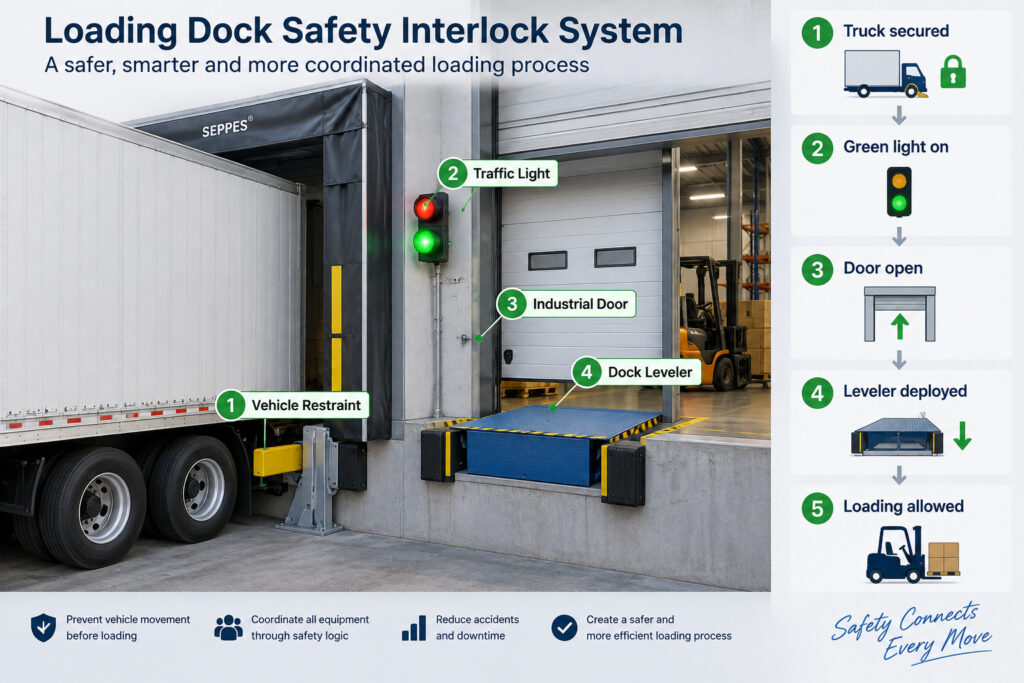
Suggested Image 2 – Insert here
Conceito da imagem:
Loading dock safety interlock diagram:
Caminhão
↓
Dispositivo de retenção de veículos
↓
Semáforo
↓
工业门
↓
Nivelador de docas
↓
Empilhadeira / AGV
Use arrows to show the operating sequence.
5. As Docas de Carregamento Podem Ligar-se a Sistemas de Controlo de Armazém
The next stage of loading dock automation is system integration.
Modern warehouses often use combinations of:
- WMS — Warehouse Management System;
- WCS — Warehouse Control System;
- PLC — Programmable Logic Controller;
- YMS — Yard Management System;
- TMS — Transportation Management System.
The loading dock can provide operational status information to these systems.
Por exemplo:
Dock 01 — Available
Dock 02 — Truck detected
Dock 03 — Loading
Dock 04 — Door fault
This information makes dock operations more visible.
Instead of warehouse staff physically checking each loading bay, supervisors can potentially monitor loading status from a central control interface.
Depending on the project architecture, interfaces such as dry contacts or industrial communication protocols can also be considered to exchange status and command signals.
The exact communication method should be confirmed during engineering because it depends on both the loading dock equipment and the customer’s existing automation system.
6. AGVs e AMRs Estão a Mudar o Design da Doca de Carregamento
Automated Guided Vehicles and Autonomous Mobile Robots introduce new requirements.
A human forklift driver can visually judge small changes in:
- floor condition;
- dock leveler angle;
- trailer position;
- obstacles;
- available clearance.
An automated vehicle depends much more heavily on predefined operating conditions.
Therefore, when AGVs or AMRs are expected to approach or cross a dock leveler, engineers should evaluate factors such as:
- platform slope;
- transition angle;
- load capacity;
- wheel size;
- distância ao solo;
- surface traction;
- position accuracy;
- safety sensor coverage;
- communication signals;
- acceptable trailer movement.
This does não mean every standard dock leveler is automatically suitable for AGV operation.
The dock, vehicle and control system should be evaluated as a complete application.
For highly automated warehouses, this engineering work should ideally happen during the design stage rather than after the equipment has already been installed.
Como É uma Doca de Carregamento Automatizada?
A typical configuration might include:
Lado do Armazém
- warehouse management system;
- PLC control;
- porta seccional industrial;
- sensores de segurança;
- dock leveler control.
Doca de Carregamento
- hydraulic dock leveler;
- abrigo de doca ou vedação de doca;
- restritor de veículos;
- internal traffic light;
- external traffic light.
Movimentação de Materiais
- empilhadeira;
- conveyor;
- AGV;
- AMR.
Camada de Informação
- vehicle detection;
- door status;
- dock leveler status;
- equipment fault signal;
- loading authorization;
- dock occupancy status.
Together, these components turn the loading dock from a passive transfer point into an active part of the warehouse material-flow system.
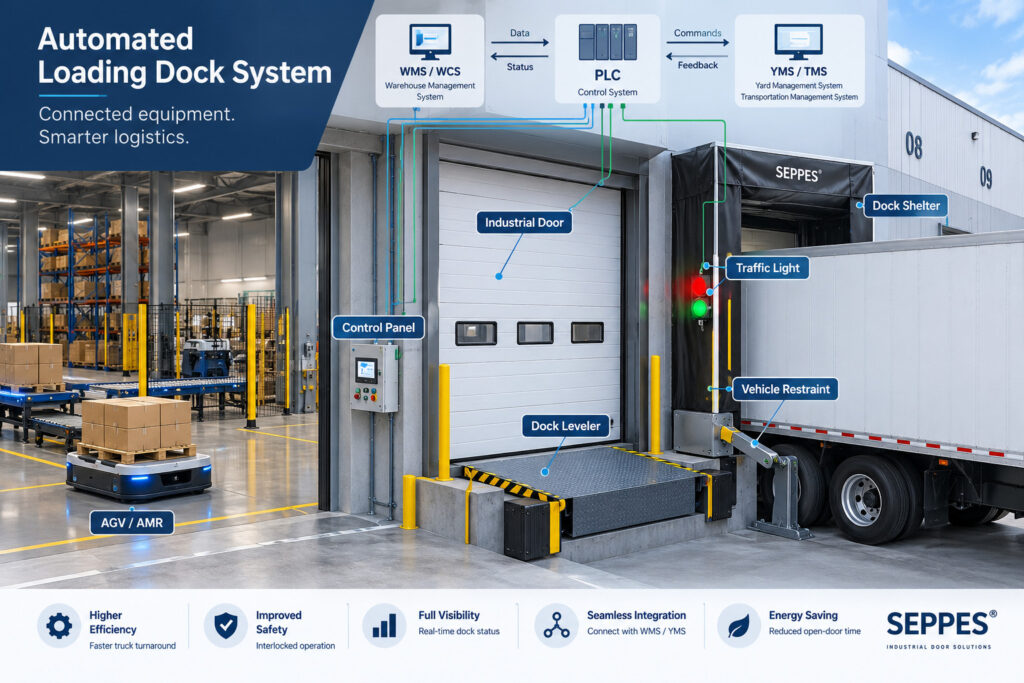
Suggested Image 3 – Insert here
Conceito da imagem:
Full automated warehouse loading dock architecture.
WMS / PLC at top → Industrial door / Dock leveler / Vehicle restraint → Truck
AGV or forklift traveling through the door.
This image should be more technical than promotional.
Doca de Carregamento Tradicional vs Doca de Carregamento Automatizada
| Característica | Traditional Loading Dock | Automated Loading Dock |
|---|---|---|
| Operação da porta | Independent/manual control | Can be integrated into sequence |
| Nivelador de docas | Standalone operation | Can communicate with control system |
| Truck detection | Visual/manual | Sensors available |
| Dispositivo de retenção de veículos | Manual or separate | Can be interlocked |
| Traffic signals | Optional | Integrated into workflow |
| Dock status | Checked manually | Can be monitored centrally |
| AGV compatibility | Not normally considered | Can be designed into the system |
| Data visibility | Limitada | Maior |
| Operating sequence | Operator dependent | Logic controlled |
| Scalability | Moderada | Better for high-volume operations |
The automated version is not necessarily the right choice for every warehouse.
A facility handling only a few trucks per day may not need sophisticated integration.
But as truck volume, loading frequency and automation increase, coordinated dock controls become increasingly valuable.
Quais Armazéns Beneficiam Mais da Automação da Doca de Carregamento?
Centros de Fulfillment de Comércio Eletrónico
E-commerce warehouses often handle high shipment volumes and short delivery windows.
Amazon’s 2026 European investment illustrates how fulfillment networks continue to adopt more advanced robotics while simultaneously pursuing faster delivery. The company also announced plans for more than 25 additional sub-same-day delivery sites across Europe during 2026.
For this type of operation, reducing unnecessary waiting at the dock can become increasingly important.
Unidades Fabris Automatizadas
Factories using:
- production conveyors;
- robotic production lines;
- AGVs;
- automated storage systems
may benefit from extending automation to inbound and outbound logistics.
Centros de Distribuição e Armazéns 3PL
Facilities operating many loading bays need better visibility over:
- which docks are occupied;
- which trucks are ready;
- which bays are loading;
- which equipment requires attention.
Armazéns de Armazenamento a Frio
Cold-storage operations have an additional concern:
temperature loss.
Coordinating the dock leveler, insulated industrial door and dock shelter can reduce unnecessary door-open time and uncontrolled air exchange.
Centros Logísticos de Alta Frequência
The higher the number of truck movements per day, the more important loading sequence, dock availability and operating efficiency become.
Como Conceber uma Doca de Carregamento para Automação
Buying an automatic dock leveler alone does not create an automated loading dock.
Before specifying equipment, consider the following factors.
1. Tipos de Camião
Identify the vehicles that will regularly use the loading bay.
Record:
- lowest truck-bed height;
- highest truck-bed height;
- largura do reboque;
- expected vehicle types.
This determines the working range required from the dock leveler.
2. Peso de Empilhadores ou AGVs
The dock leveler’s rated capacity should consider the actual loading operation.
This includes:
- peso da empilhadeira ou AGV;
- peso da carga;
- frequência operacional;
- dynamic forces.
Do not select a platform solely according to cargo weight.
3. Altura da Doca
The relationship between warehouse floor height and truck-bed height affects the operating angle of the dock leveler.
Excessive slopes may create problems for:
- low-clearance forklifts;
- pallet trucks;
- AGVs.
4. Tipo de Porta Industrial
Determine whether the project requires:
- Porta seccional industrial;
- high-speed door;
- Porta Isolada;
- other industrial door systems.
Space above and beside the opening should also be checked before equipment selection.
5. Lógica de Controlo
Decide which devices must communicate.
Por exemplo:
Vehicle restraint → Door → Dock leveler → Loading authorization
The control sequence should be defined before production.
6. Requisitos de Comunicação
If the loading bay will connect to a PLC, WMS or other system, clarify:
- required signals;
- communication method;
- input/output points;
- fault feedback;
- status feedback;
- remote control requirements.
7. Requisitos de Segurança
Automation should include fail-safe thinking.
What happens if:
- a sensor fails?
- the door cannot fully open?
- the dock leveler does not return?
- the vehicle moves unexpectedly?
- communication with the warehouse system is lost?
These situations should be considered during system design.
O Futuro: De Armazéns Inteligentes a Docas de Carregamento Inteligentes
For years, warehouse automation concentrated mainly on what happened inside the building.
Companies automated:
- storage;
- picking;
- sorting;
- conveyors;
- pallet movement;
- inventory management.
The loading dock was often treated as the final manual boundary.
That boundary is starting to change.
Amazon’s development of autonomous robots that began with dock-area material movement provides a visible example of how important this part of the warehouse has become. Meanwhile, DHL’s automation investments and logistics trend research show that robotics, AI and digital systems are moving deeper into everyday logistics operations.
The next generation of loading docks will therefore be less about individual pieces of equipment and more about coordination.
The industrial door knows the status of the dock leveler.
The dock leveler knows whether loading conditions are safe.
The control system knows whether the dock is occupied.
The warehouse system knows whether the truck can be loaded.
AGVs and forklifts receive permission to move only when the loading path is ready.
That is the real direction of loading dock automation.
Construir uma Doca de Carregamento Integrada com a SEPPES
A modern loading bay should be designed as a system rather than a collection of unrelated products.
SEPPES provides industrial loading solutions that can combine equipment such as:
- niveladores de doca hidráulicos;
- portas seccionais industriais;
- As portas rápidas;
- abrigos para docas;
- loading bay control systems;
- safety and activation devices.
For automated warehouse projects, equipment configuration can be evaluated according to the customer’s loading process, vehicle types, material-handling equipment and control requirements.
Where system integration is required, communication and interlocking requirements should be confirmed during the engineering stage so that the industrial door, dock leveler and other loading equipment work according to the required operating sequence.
If you are planning a new warehouse or upgrading an existing loading bay, provide:
- door opening size;
- loading dock height;
- intervalo de altura da caixa do caminhão;
- especificações do empilhador ou AGV;
- required loading capacity;
- número de baias de carregamento;
- control or communication requirements.
These details allow the loading dock solution to be designed around the actual workflow instead of simply selecting equipment from a catalog.
Perguntas Frequentes
Um Nivelador de Doca Pode Ser Integrado com a Automação do Armazém?
Yes. A dock leveler can be incorporated into a wider control system using control signals and interlocking logic. The exact method depends on the dock leveler controller and the customer’s PLC or warehouse automation architecture.
O Que É uma Doca de Carregamento Automatizada?
An automated loading dock uses connected equipment such as dock levelers, industrial doors, vehicle restraints, sensors, traffic lights and control systems to coordinate the loading and unloading process.
Os AGVs Podem Utilizar um Nivelador de Doca?
Potentially, but the complete application should be evaluated. Important factors include platform slope, transition angle, AGV ground clearance, wheel size, load, surface condition, trailer movement and communication requirements.
Qual Nivelador de Doca É Melhor para um Armazém Automatizado?
Hydraulic dock levelers are commonly suited to high-frequency loading applications because their platform and lip movements can be electrically controlled. However, the correct model depends on vehicle height, capacity, loading frequency and automation requirements.
A Automação da Doca de Carregamento Elimina a Necessidade de Operadores?
Not necessarily. The primary goal is usually to coordinate equipment, reduce unnecessary manual steps, improve visibility and create safer operating sequences. Human supervision may still be required depending on the application.
Que Equipamentos São Necessários para uma Doca de Carregamento Inteligente?
A smart loading dock may include an industrial door, hydraulic dock leveler, dock shelter, vehicle restraint, sensors, traffic lights, PLC controls and connections to warehouse or yard-management systems. The final configuration depends on the level of automation required.