
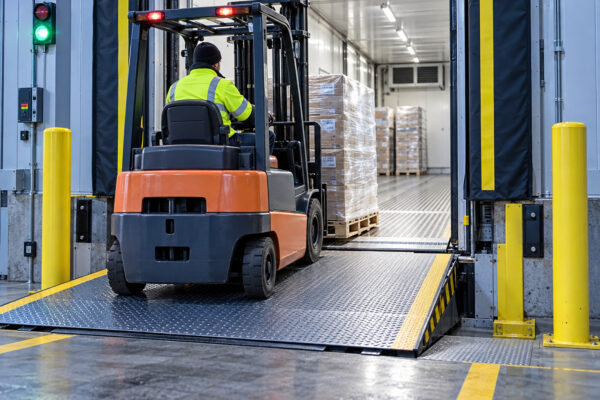
Los muelles de carga son uno de los puntos operativos más importantes en un centro de distribución de cadena de frío. Cada camión entrante, transferencia de palés y entrega regional saliente debe pasar por el área del muelle, a menudo mientras los productos refrigerados se reciben, clasifican, preparan y despachan al mismo tiempo.
Por esta razón, un muelle de carga de cadena de frío no debe diseñarse como una fila de puertas idénticas. El número de bahías, el tráfico entrante y saliente, el rango de altura de la plataforma del camión, el tipo de puerta, el nivelador de muelle, el sistema de sellado y el espacio de preparación temporal afectan todos la eficiencia con la que puede operar el centro de distribución.
Un sistema multi-bahía bien planificado conecta el flujo de trabajo completo:
Para una visión más amplia de los sistemas de acceso refrigerado, consulte el solución de puertas de almacenamiento en frío y equipo de muelle de carga de SEPPES .
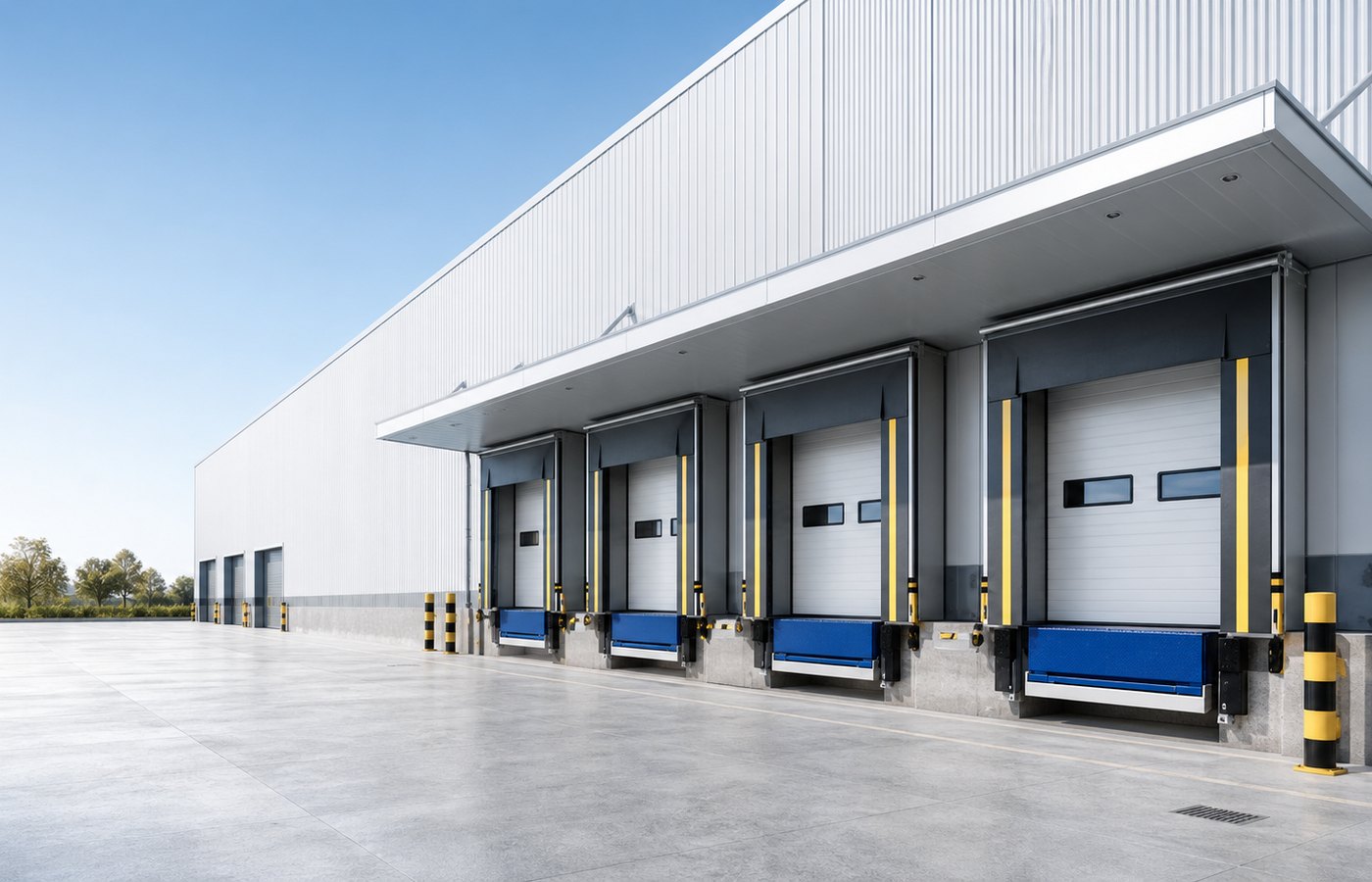
Por qué los centros de distribución de cadena de frío necesitan planificación de muelles de carga multi-bahía
Un almacén convencional puede tener un tráfico entrante y saliente relativamente predecible. Un centro de distribución de cadena de frío puede ser más complejo porque los productos a menudo se mueven rápidamente a través de la recepción, inspección, clasificación, almacenamiento refrigerado temporal y despacho regional.
Varios camiones pueden llegar dentro del mismo período, mientras que los vehículos salientes ya están esperando la carga de ruta. Si cada bahía de carga se trata como intercambiable, el tráfico de montacargas, las colas de remolques y la congestión de preparación pueden comenzar a superponerse.
El objetivo de la planificación multi-bahía, por lo tanto, no es simplemente instalar más muelles de carga. Es asignar a cada bahía un rol práctico y asegurar que la distribución del almacén circundante apoye ese rol.
Los factores de planificación importantes incluyen:
- llegadas máximas de camiones por hora;
- tiempo promedio de carga y descarga;
- volumen entrante versus saliente;
- variación de tamaño de camiones y remolques;
- zonas de temperatura;
- capacidad de preparación de palés;
- conflictos de rutas de montacargas;
- frecuencia de apertura de puertas;
- rango operativo del nivelador de muelle;
- requisitos de sellado de camiones.
Separar los muelles de recepción de los muelles de carga salientes
One of the most useful layout decisions is to distinguish between inbound receiving and outbound dispatch instead of allowing every bay to perform every task.
| Dock function | Main activity | Important design considerations |
|---|---|---|
| Inbound receiving dock | Unload refrigerated trailers and receive pallets | Fast inspection access, forklift circulation and staging space |
| Inspection or exception bay | Handle delayed, damaged or special shipments | Avoid blocking normal receiving bays |
| Cross-dock bay | Move goods rapidly from inbound to outbound routes | Short travel distance between receiving and dispatch |
| Outbound loading dock | Load regional delivery vehicles | Route staging, vehicle scheduling and efficient pallet sequencing |
| Overflow bay | Support peak periods and mixed operations | Flexible equipment and broad truck compatibility |
Separating these functions can reduce conflicts between inbound products and outbound route staging, especially during morning receiving peaks or afternoon distribution waves.
¿Cuántos muelles de carga necesita un centro de distribución?
There is no universal number of loading docks that works for every cold chain facility. The correct bay count depends more on peak operating conditions than on total daily truck volume.
For an early planning study, ask:
- How many trucks can arrive during the busiest hour?
- How long does one truck normally occupy a bay?
- Do receiving and outbound dispatch occur at the same time?
- How often are trucks delayed because pallets are not ready?
- Does the facility handle several vehicle sizes?
- Is one bay needed for returns, rejected loads or maintenance?
- How much staging space is available behind each dock?
A facility processing moderate daily volume can still experience serious congestion if most vehicles arrive during two short peak windows.
Distribución del muelle de carga multi-bahía para la distribución de cadena de frío
The physical arrangement of loading docks should support the internal product route. Ideally, a pallet should not travel through unnecessary cross traffic after it leaves the trailer.
A typical workflow may be:
Inbound truck → receiving dock → inspection → sorting → refrigerated staging → outbound staging → loading dock → regional delivery truck
Where possible, the forklift route should remain simple and directional. Crossings between inbound forklifts, outbound pallets and pedestrian routes should be minimized through warehouse layout and operating procedures.
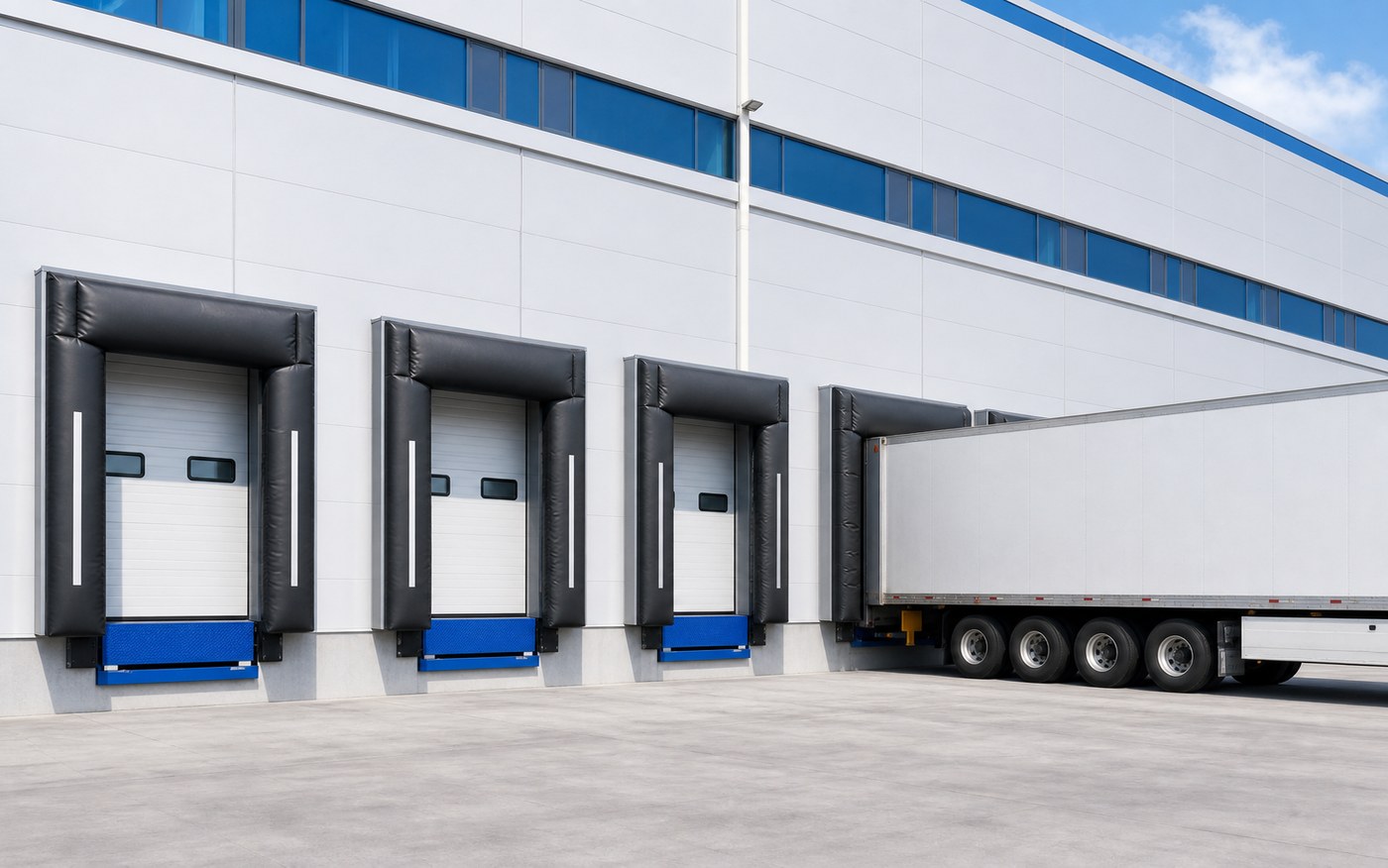
Elegir el nivelador de muelle de carga adecuado para alturas de camión mixtas
Cold chain distribution centers often receive vehicles from different carriers, suppliers and regional fleets. Their trailer floors may not all be at the same height.
A rampa niveladora hidráulica bridges the height difference between the warehouse platform and truck bed so forklifts can move between both surfaces.
SEPPES hydraulic dock levelers are available with reference rated-load options of 6T, 8T, 10T and 12T. Final capacity should be selected according to the complete operating condition rather than pallet weight alone.
Revise:
- peso del montacargas;
- peso máximo de la carga;
- altura mínima del lecho del camión;
- altura máxima del lecho del camión;
- platform height;
- dimensiones del foso;
- daily loading cycles;
- truck type;
- dynamic loading during forklift crossing.
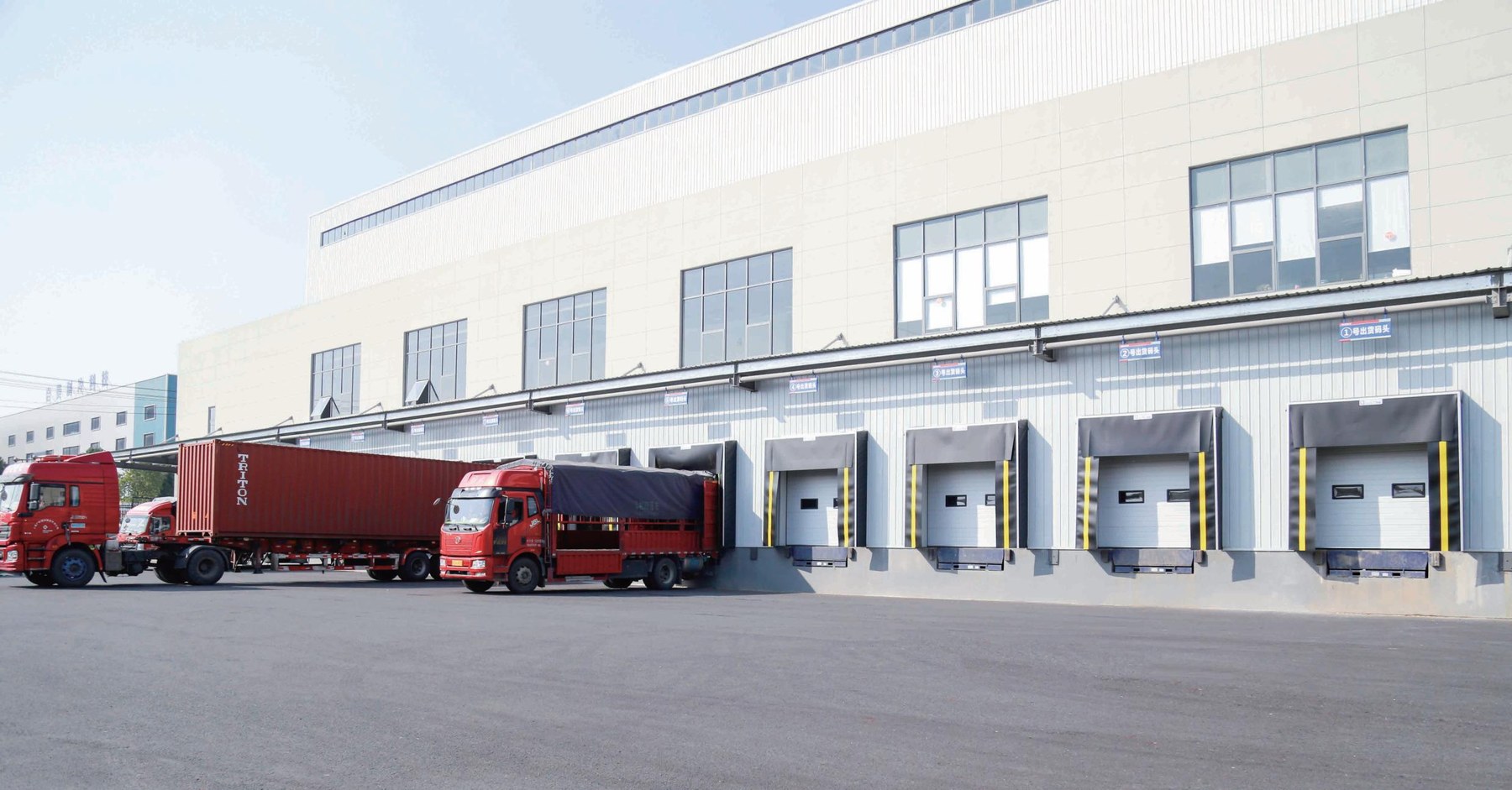
Capacidad del nivelador de muelle de almacén: no utilizar solo el peso de la carga
A common purchasing mistake is assuming that a six-ton cargo load automatically requires a six-ton dock leveler. The forklift itself also moves across the platform, and dynamic forces occur as its wheels enter and leave the leveler.
For example, project engineers should review the combined operating conditions of:
- la carretilla elevadora;
- cargo;
- driver or operator;
- crossing speed;
- frequency of operation;
- dynamic impact;
- required safety margin.
En SEPPES loading dock equipment range includes dock levelers, dock shelters, dock seals and other loading bay equipment for warehouse and logistics applications.
Los refugios de muelle ayudan a mantener el límite de la cadena de frío
The truck-to-building interface is another important part of refrigerated distribution. Even when the loading door itself is insulated, a large gap can remain around the trailer while the vehicle is positioned at the dock.
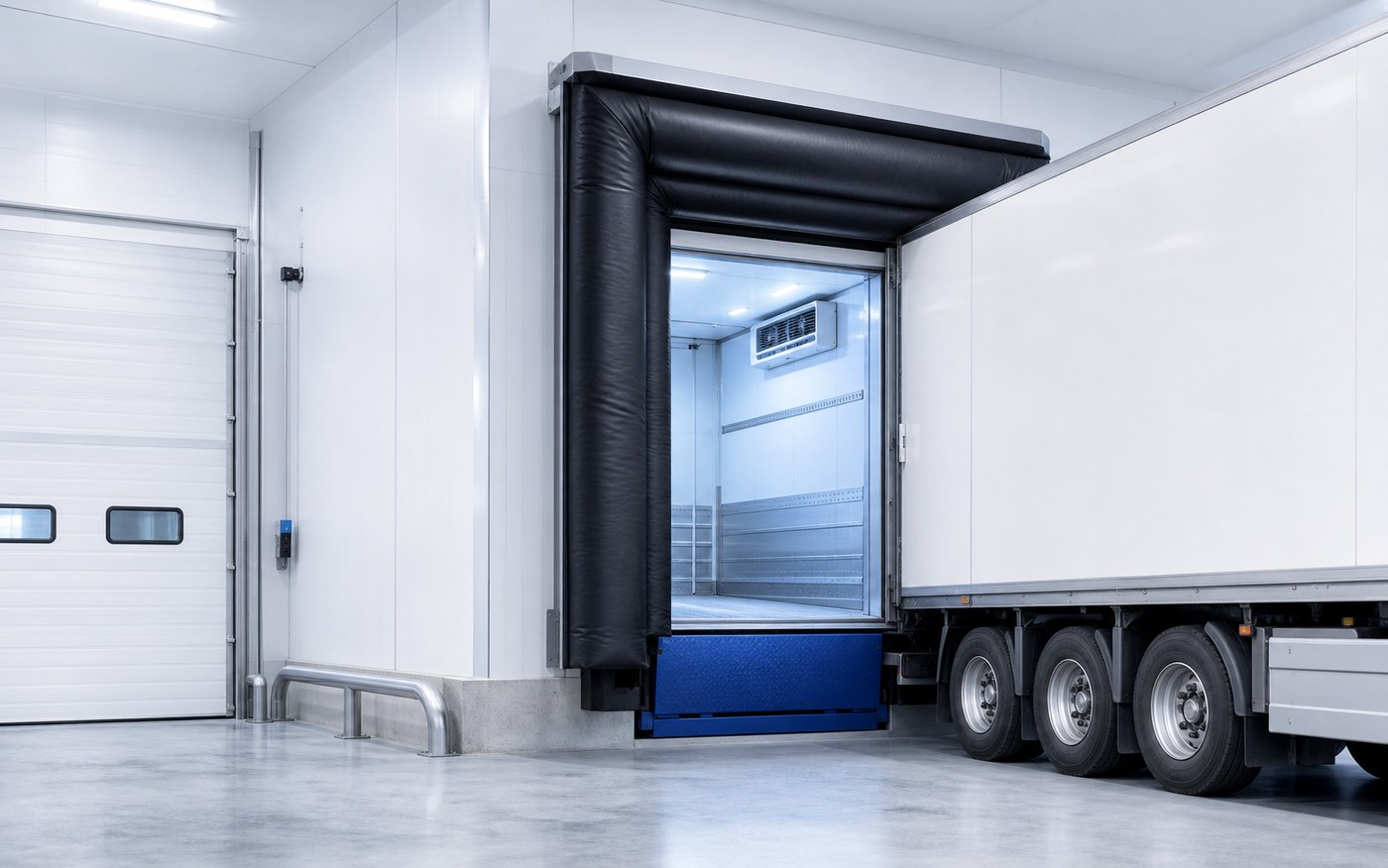
For higher sealing requirements, an abrigo inflable para muelles uses side and top airbags to close much of this gap.
The shelter can help reduce:
- outside air entering the loading area;
- wind and rain exposure;
- dust and insects;
- uncontrolled air exchange around the trailer.
This can be particularly useful where trucks are loading products from refrigerated or temperature-controlled staging areas.
¿Refugio de muelle mecánico o refugio de muelle inflable?
Not every loading bay requires the same sealing system. Vehicle variation, loading frequency and temperature-control requirements should guide the choice.
| Sistema | Main characteristic | Uso típico |
|---|---|---|
| Abrigo mecánico para muelles | Flexible side and top curtains around the truck body | Frequent logistics traffic and broader truck-size variation |
| Foam dock seal | Compressed pads contact the trailer body | More consistent truck dimensions |
| Abrigo inflable para muelles | Powered airbags inflate around the parked trailer | Cold-chain and controlled loading requiring stronger sealing |
For facilities with broad vehicle variation, you can also review the abrigo de muelle mecánico configuración.
Puertas seccionales elevables para centros de distribución refrigerados
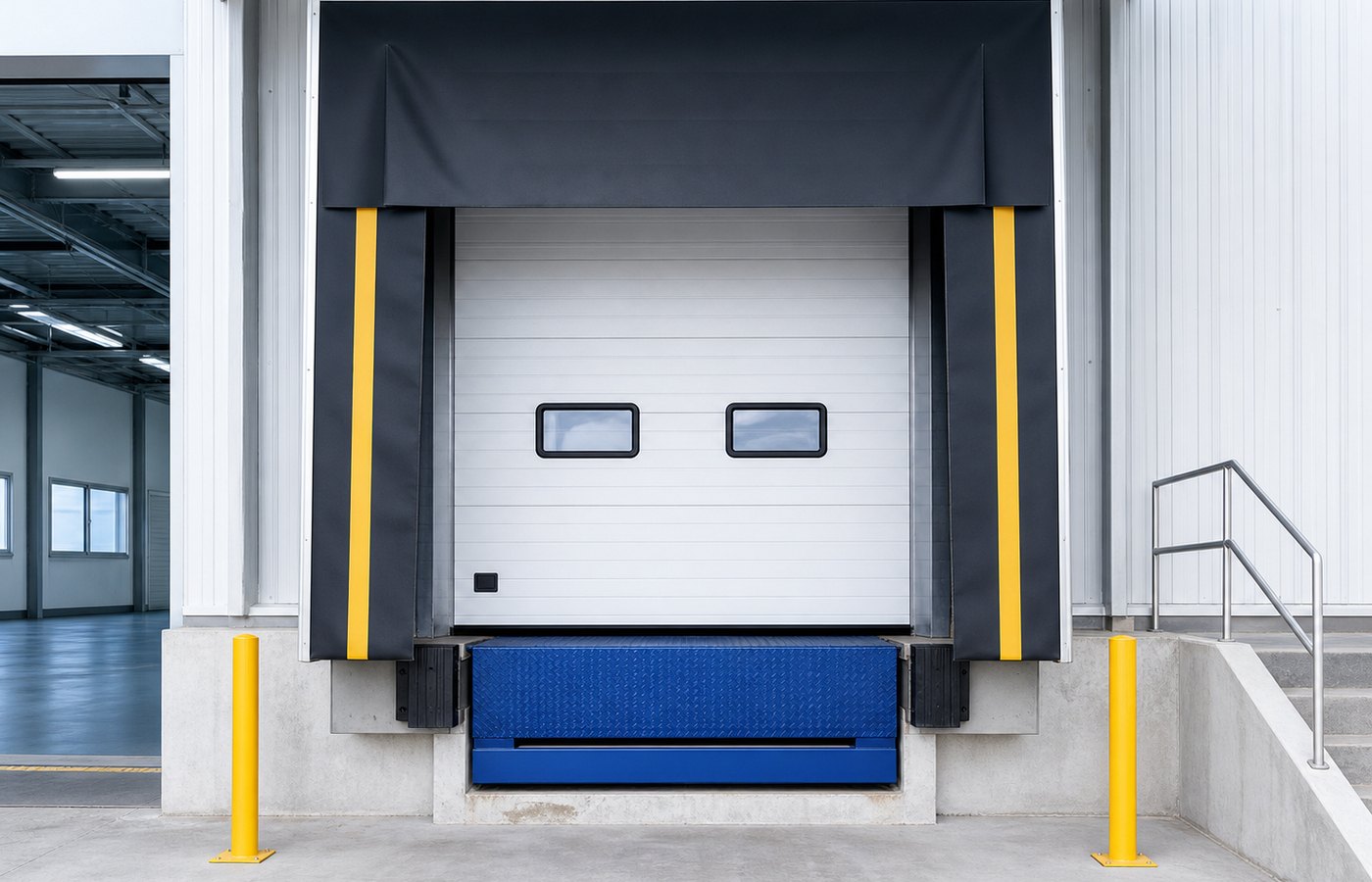
The loading dock door controls access between the warehouse and trailer interface. For refrigerated distribution areas, an insulated sectional overhead door can provide structural closure and thermal separation while keeping floor space around the loading position clear.
En Puerta seccional aislada SEPPES uses 40 mm or 50 mm polyurethane-filled panels with EPDM sealing around the opening.
When designing several loading docks side by side, confirm:
- door opening width and height;
- headroom;
- side room;
- track arrangement;
- motor position;
- dock shelter frame location;
- leveler pit position;
- maintenance access.
La recepción, clasificación y almacenamiento temporal deben estar conectados
The dock is only one part of the distribution process. Poor staging design behind the dock can create congestion even when the loading equipment is correctly selected.
Receiving areas should have enough temporary space for pallets to be inspected and sorted without blocking active dock doors. Outbound areas should allow complete delivery routes to be staged before the assigned truck arrives where possible.
A practical multi-bay design often separates:
- receiving staging;
- quality inspection;
- temporary cold storage;
- cross-dock transfer;
- outbound route staging;
- returns or rejected products.
This becomes increasingly important as the number of loading docks grows because internal forklift traffic can become the true bottleneck even when enough truck positions are available.
Planificar el tráfico de camiones entrantes y salientes por separado
Multi-bay distribution centers should also review vehicle movement outside the building.
Where site space allows, inbound and outbound trucks should have a clearly defined approach, waiting and departure process. This reduces unnecessary reversing, queue interference and congestion in front of active loading docks.
Verifique:
- truck turning radius;
- yard depth;
- trailer waiting positions;
- dock numbering;
- driver check-in process;
- pedestrian routes;
- one-way versus two-way traffic;
- emergency access.
Seguridad del muelle de carga para montacargas y remolques
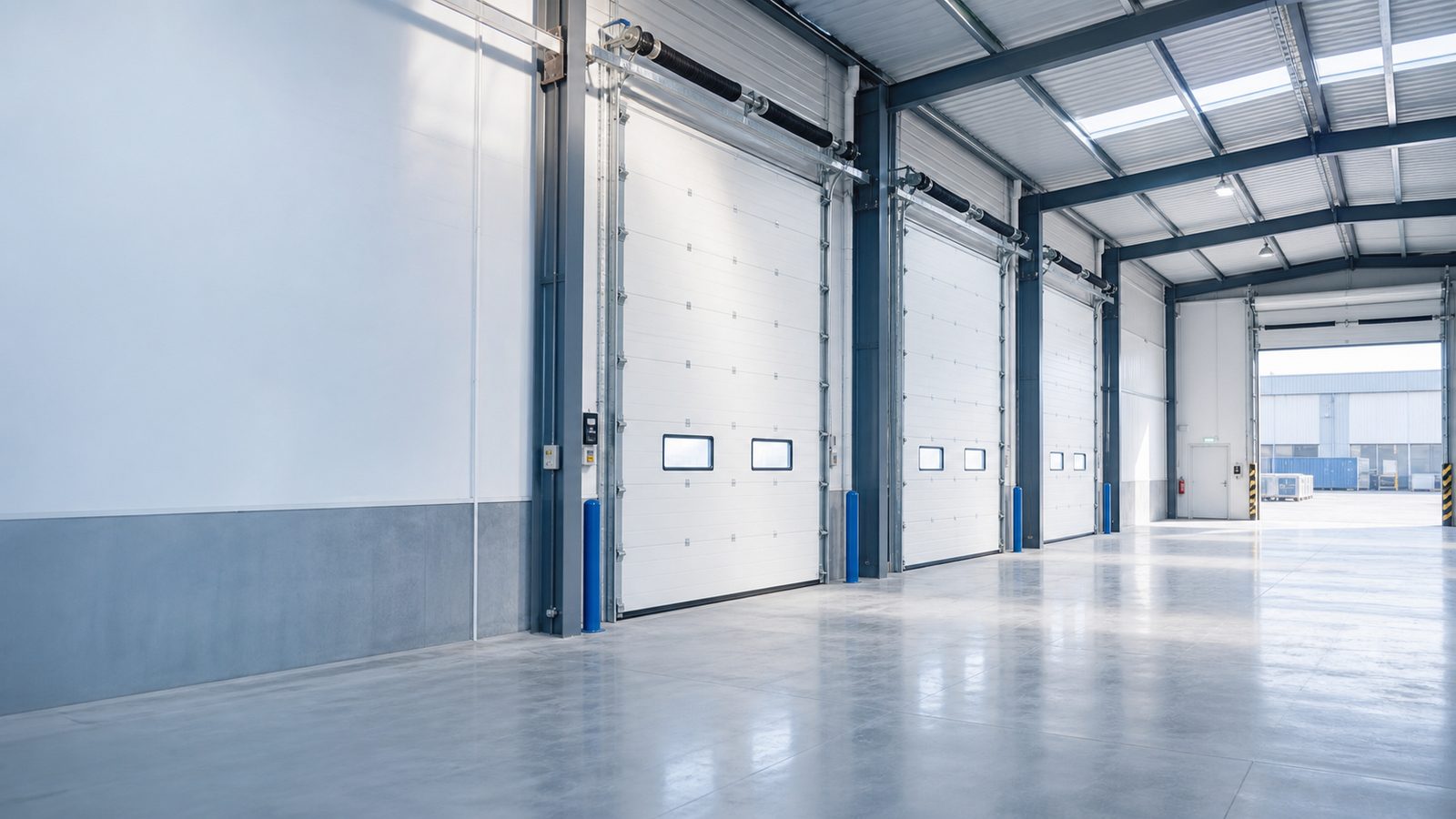
Multi-bay facilities create several areas where forklifts, trailers and employees interact. Loading dock safety therefore needs to be part of the layout rather than added after equipment is installed.
The U.S. Occupational Safety and Health Administration identifies risks such as forklifts falling from dock edges and skidding or slipping on wet or icy loading surfaces.
See: Guía de seguridad para muelles de carga de OSHA .
Depending on local requirements and the site risk assessment, loading bays may use:
- topes de muelle;
- wheel chocks;
- truck restraint systems;
- red/green traffic lights;
- dock edge markings;
- pedestrian separation;
- interlocked door and dock controls.
For vehicle control equipment, see the SEPPES truck restraint system .
You can also review the detailed loading dock safety checklist y dock leveler safety standards guide .
El control de temperatura también continúa durante el transporte
Cold chain distribution does not end when the trailer leaves the warehouse. The transition from refrigerated storage to the transport vehicle is part of the complete temperature-controlled logistics process.
The U.S. Food and Drug Administration's sanitary transportation guidance identifies inadequate refrigeration or temperature control, improper loading and unloading practices, sanitation and poor holding practices among potential food-transport concerns.
Referencia oficial: FDA sanitary transportation of food guidance .
The purpose of the loading dock system is not to replace the facility's food-safety or temperature-control procedures. Instead, the door, shelter and leveler should support the operating environment required by the facility.
Ejemplo de distribución de cadena de frío multi-bahía
The following example shows how six loading docks could be assigned. It is a planning example rather than a fixed engineering standard.
| Bay | Función | Possible equipment |
|---|---|---|
| Bay 1 | Inbound refrigerated receiving | Insulated sectional door + hydraulic dock leveler + dock shelter |
| Bay 2 | Inbound refrigerated receiving | Insulated sectional door + hydraulic dock leveler + dock shelter |
| Bay 3 | Cross-dock / priority transfer | Sectional door + flexible dock shelter + leveler |
| Bay 4 | Outbound regional delivery | Insulated sectional door + leveler + shelter |
| Bay 5 | Outbound regional delivery | Insulated sectional door + leveler + shelter |
| Bay 6 | Overflow / returns / exception loads | Flexible loading bay configuration |
The exact ratio between receiving and outbound docks should be determined by truck schedules, pallet flow and peak-hour requirements.
Errores comunes de diseño de muelles de carga multi-bahía
Utilizar bahías idénticas sin verificar su función real
A receiving dock handling large supplier trailers may need a different operating range from a regional dispatch bay serving smaller vehicles.
Elegir el nivelador de muelle antes de verificar la flota de camiones
Platform dimensions and working range should be selected after the minimum and maximum expected truck-bed heights are known.
Ignorar el área de preparación detrás del muelle
Adding more truck positions does not solve congestion if pallets cannot be staged behind those positions.
Mezclar las rutas de montacargas entrantes y salientes
Repeated crossing between receiving and dispatch flows can reduce efficiency and create additional traffic conflicts.
Utilizar un refugio que no coincida con el rango de vehículos
Dock shelter dimensions should be selected according to actual trailer width and height variation, bumper projection and loading dock geometry.
Tratar la puerta, el refugio y el nivelador como proyectos separados
All three products occupy the same opening and need to be coordinated before production or pit construction begins.
¿Qué información se necesita para diseñar muelles de carga de cadena de frío?
For a multi-bay distribution center project, prepare the following information where available:
- número de bahías de carga;
- receiving versus outbound bay allocation;
- ancho × altura de la abertura de la puerta;
- platform height;
- dock leveler pit dimensions;
- altura mínima del lecho del camión;
- altura máxima del lecho del camión;
- minimum and maximum trailer width and height;
- peso del montacargas;
- peso máximo de la carga;
- expected loading cycles per day;
- temperatura operativa interior;
- outdoor climate conditions;
- required dock sealing level;
- truck restraint requirements;
- architectural drawings;
- site photos;
- país o puerto de destino.
If the warehouse is still in the design stage, sharing drawings before the dock pits and door openings are finalized can make it easier to coordinate the door tracks, levelers, shelters and truck approach dimensions.
Preguntas frecuentes
¿Cuántos muelles de carga debería tener un centro de distribución de cadena de frío?
No existe un número fijo. La cantidad de bahías debe calcularse a partir de la llegada máxima de camiones, el tiempo promedio de carga o descarga, la superposición entre recepción y despacho, la variación de camiones, la capacidad de staging y la cantidad de margen operativo requerido.
¿Deben separarse los muelles de recepción y los muelles de salida?
Where the operating volume justifies it, separating inbound receiving and outbound dispatch can simplify pallet flow, reduce forklift conflicts and make truck scheduling easier to manage.
¿Qué tipo de nivelador de muelle es adecuado para un centro de distribución?
Los niveladores de muelle hidráulicos se utilizan ampliamente en entornos de almacén de alta frecuencia. La selección debe considerar el rango de altura de la plataforma del camión, las dimensiones del foso, el peso de la carretilla elevadora y la carga, la frecuencia de carga y la capacidad requerida.
¿Por qué son importantes los abrigos de muelle en la distribución de cadena de frío?
A dock shelter reduces the exposed gap around a trailer when it is positioned at the warehouse. This can help reduce outside air, weather, dust and moisture entering the loading interface.
¿Debería cada muelle de carga utilizar el mismo abrigo de muelle?
No necesariamente. Las dársenas que manipulan camiones similares pueden utilizar equipos estandarizados, mientras que las posiciones de recepción especial, de vehículos pequeños o de alto sellado pueden requerir dimensiones o diseños de refugio diferentes.
¿Qué puerta se utiliza normalmente con los muelles de carga?
Insulated sectional overhead doors are commonly used because they open vertically, leave the dock floor clear and can be integrated with dock shelters and levelers. The required panel, lift type and sealing system depend on the warehouse environment.
¿Se pueden planificar juntos la puerta, el abrigo de muelle y el nivelador?
Yes. Planning them as one loading bay system allows the opening dimensions, track arrangement, pit, bumper position, truck interface and sealing system to be coordinated before production.
¿Planificando muelles de carga para un centro de distribución de cadena de frío?
Send us your number of loading bays, platform height, pit dimensions, truck-bed range, vehicle sizes, door openings, forklift loads and warehouse drawings. SEPPES can help coordinate the doors, dock levelers and dock shelters for your multi-bay distribution project.
Request a project quote View loading dock equipment