
Choosing the right commercial garage doors is an important decision for warehouses, factories, workshops, logistics centers, automotive facilities, and other industrial buildings. The right door should not only fit the opening but also meet requirements for insulation, operating frequency, available installation space, safety, and automation.
For many industrial facilities, sectional garage doors are a practical choice because they open vertically, provide good thermal insulation, and can be configured for different ceiling conditions.
This buying guide explains the main factors to consider before purchasing a commercial garage door.
Table of Contents
ToggleWhat Are Commercial Garage Doors?
Commercial garage doors are designed for larger openings and more demanding operating environments than typical residential garage doors.
They are commonly installed in:
- Warehouses
- Manufacturing plants
- Logistics centers
- Loading areas
- Automotive workshops
- Equipment storage buildings
- Agricultural facilities
- Distribution centers
Depending on the application, buyers may choose sectional doors, rolling doors, high-speed doors, or other industrial door systems.
Among these options, the commercial sectional garage door is widely used where insulation, durability, and efficient use of space are important.
1. Choose the Right Commercial Garage Door Type
The first step is deciding which door structure best suits the building.
Sectional Garage Doors
A sectional garage door consists of horizontal door panels connected by hinges. The door moves upward along tracks and normally turns underneath the ceiling.
Its main advantages include:
- Good thermal insulation
- Strong panel construction
- Vertical opening
- Multiple track configurations
- Customizable dimensions
- Optional windows and pedestrian doors
Sectional doors are especially suitable for warehouses, factories, workshops, and logistics buildings.
Roll-Up Doors
Roll-up doors use metal slats or a curtain that rolls around a shaft above the opening.
They require less ceiling track space and are often used for storage areas, commercial buildings, and industrial entrances.
However, insulation and sealing performance can differ significantly depending on the curtain structure.

High-Speed Doors
High-speed doors are designed for frequent opening and closing.
They are better suited to internal logistics passages, cleanrooms, temperature-controlled areas, and production lines where opening speed is more important than heavy insulated panel construction.
For an exterior warehouse entrance, a sectional door is often more appropriate when insulation and structural strength are the main priorities.

2. Measure the Door Opening Correctly
Accurate measurements are essential before ordering commercial garage doors.
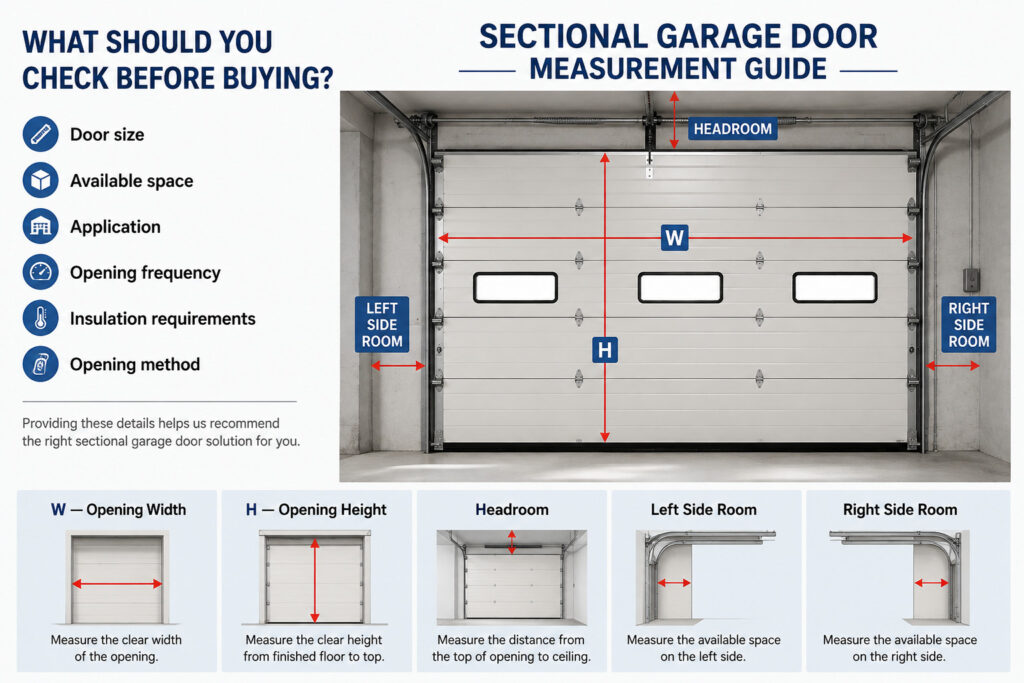
Do not provide only the width and height of the opening. The installation space around the doorway also affects the track system and motor position.
The following dimensions should normally be checked:
| Measurement | What to Measure |
|---|---|
| Opening Width | Clear width from left to right |
| Opening Height | Clear height from floor to top |
| Headroom | Space above the door opening |
| Left Side Room | Space beside the opening |
| Right Side Room | Space beside the opening |
| Backroom | Available ceiling depth behind the opening |
The manufacturer uses these dimensions to determine whether the project requires a standard lift, high lift, or vertical lift configuration.
Accurate measurements also help prevent installation problems after the door arrives.
3. Check the Available Headroom
The space above the opening is particularly important for sectional garage doors.
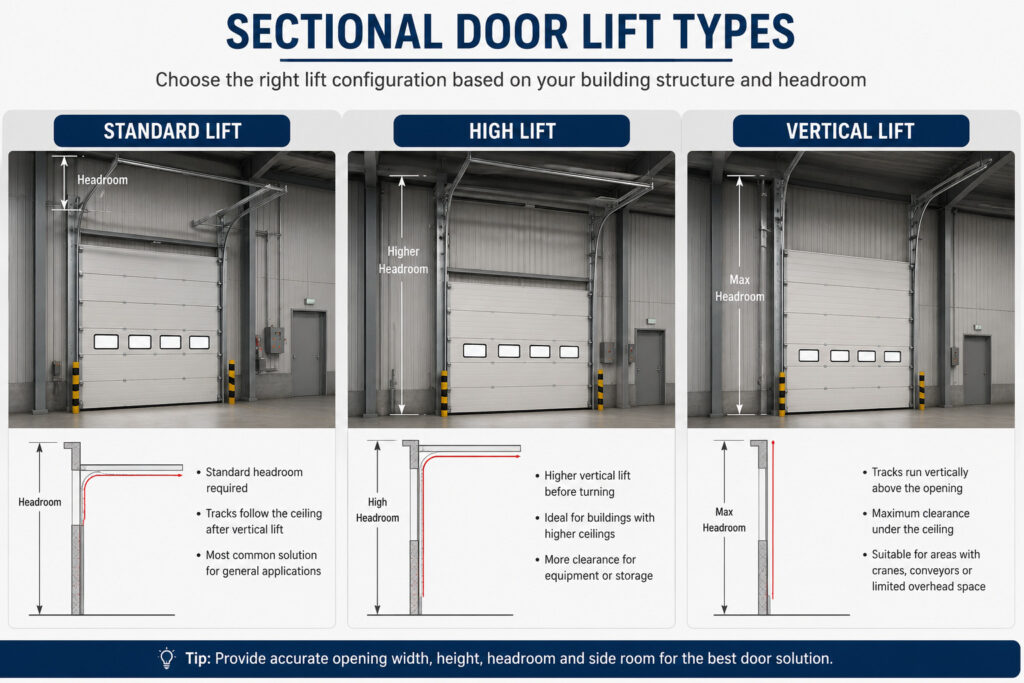
Different buildings require different track systems.
Standard Lift
A standard lift door travels vertically for a short distance before turning horizontally under the ceiling.
It is commonly used in warehouses and workshops with normal ceiling conditions.
High Lift
A high lift sectional door travels farther upward before turning toward the ceiling.
This configuration is useful when the building has a high ceiling and you want to keep the horizontal tracks away from equipment, cranes, vehicle lifts, or other obstacles.
Vertical Lift
A vertical lift door moves almost entirely upward along the wall.
It is suitable for buildings with substantial space above the opening.
This configuration can maximize usable ceiling space but requires sufficient wall height.
The correct lift type should therefore be selected according to the actual building structure rather than simply choosing the cheapest option.
4. Consider Insulation Requirements
For temperature-controlled warehouses and industrial buildings, insulation is an important purchasing factor.
An insulated sectional garage door normally uses sandwich panels filled with polyurethane foam.
Compared with single-layer metal doors, insulated panels can provide:
- Better temperature stability
- Reduced heat transfer
- Improved energy efficiency
- Greater panel rigidity
- Better sound insulation
Insulated commercial doors are commonly used in warehouses, workshops, food facilities, manufacturing plants, and buildings with heating or air-conditioning systems.
For simple storage buildings where temperature control is not important, a less insulated configuration may be sufficient.
5. Choose the Right Door Panel Material
Commercial garage door panels are available in several materials.
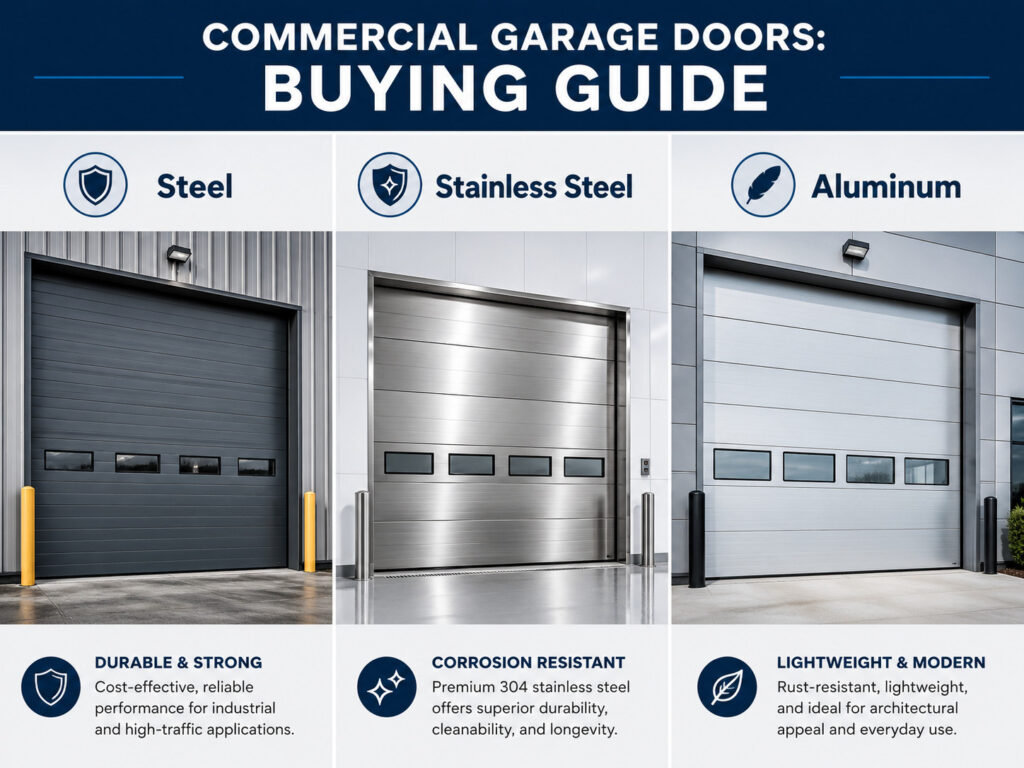
Steel
Steel is one of the most common materials for commercial sectional doors.
A steel garage door provides good structural strength and is suitable for most warehouses and industrial buildings.
It also offers a practical balance between durability, insulation, and cost.
Stainless Steel
Stainless steel is more suitable for environments where corrosion resistance or hygiene is important.
Typical applications include:
- Food processing facilities
- Pharmaceutical plants
- Humid environments
- Wash-down areas
- Coastal facilities
Aluminum
Aluminum sectional doors are lightweight and corrosion-resistant.
They are often selected for commercial buildings where appearance is important or where large transparent panels are required.
Automotive showrooms and service centers, for example, may use aluminum frames combined with glass panels.
6. Determine the Required Operating Frequency
Not every commercial garage door operates at the same frequency.
A warehouse door that opens five times per day has different requirements from a logistics entrance operating dozens of times every hour.
Before selecting a door, consider:
- Number of opening cycles per day
- Vehicle traffic
- Forklift traffic
- Operating hours
- Required opening speed
- Indoor temperature control
If the doorway has extremely frequent traffic, a standard sectional door may not always be the best solution.
A high-speed door may be more suitable for high-cycle applications.
For moderate-frequency exterior entrances requiring insulation and security, a commercial sectional door is usually a strong option.
7. Select the Right Opening Method
Commercial doors can use different activation methods depending on the workflow.
Common options include:
- Wall-mounted push buttons
- Remote control
- Pull cord
- Radar sensor
- Vehicle loop detector
- Access control
- Card reader
- PLC signal
In automated factories, doors may also need to communicate with:
- AGVs
- Conveyors
- Robots
- Warehouse management systems
- Production equipment
If automation is required, confirm the control interface with the manufacturer before production.
8. Review Safety Features
Safety should be considered whenever people, forklifts, or vehicles pass through the doorway.
Typical safety devices for industrial sectional doors may include:
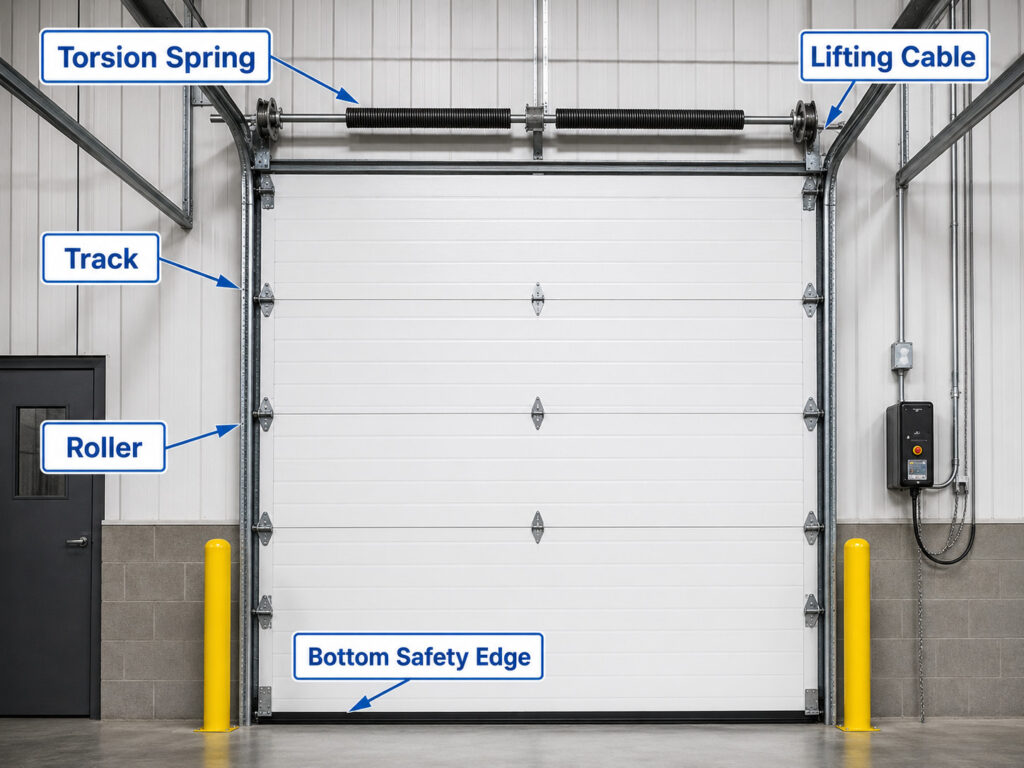
Bottom Safety Edge
The bottom safety edge detects contact with an obstacle while the door is closing and can trigger the door to stop or reverse.
Cable Break Protection
This device helps prevent uncontrolled door movement if a lifting cable fails.
Spring Break Protection
A spring break protection system helps secure the door if a torsion spring fails.
Photoelectric Sensors
Photoelectric sensors detect people or objects in the doorway and can prevent the door from closing.
Safety requirements should be selected according to the operating environment and local project requirements.
9. Consider Wind Resistance
Large exterior doors are directly exposed to wind pressure.
This becomes particularly important for:
- Large warehouse openings
- Coastal areas
- Open industrial sites
- Buildings in high-wind regions
Larger doors generally experience greater wind loads.
When requesting a quotation, tell the supplier if the project is located in a high-wind environment so that the panel structure, reinforcement, tracks, and hardware can be properly evaluated.
10. Decide Whether Windows or a Pedestrian Door Are Needed
Commercial sectional doors can often be customized with additional features.
Vision Windows
Windows allow natural light into the building and help employees see whether people or vehicles are located on the opposite side of the door.
They are commonly used in workshops and logistics buildings.
Pedestrian Door
A pedestrian door, also called a wicket door, can be integrated into some sectional doors.
This allows personnel to enter without opening the entire industrial door.
It can be useful when the main door is large and pedestrian access is frequent.
However, the availability of a wicket door depends on the door dimensions and panel structure.
11. Compare Sectional Doors and Roll-Up Doors
Buyers often compare commercial sectional garage doors with rolling doors.
| Feature | Sectional Door | Roll-Up Door |
| Door Construction | Insulated panels | Slats or curtain |
| Insulation | Generally good | Depends on design |
| Opening | Travels along tracks | Rolls above opening |
| Ceiling Space | Track space required | More compact |
| Windows | Easy to integrate | More limited |
| Appearance | Clean panel design | Industrial style |
| Typical Application | Warehouses, factories | Storage, shops, industrial openings |
Neither design is universally better.
The correct choice depends on available space, insulation requirements, operating frequency, and building use.
12. What Information Should You Send to the Manufacturer?
Providing complete project information makes it easier to receive an accurate quotation.
Before contacting a supplier, prepare:
- Door width
- Door height
- Quantity
- Available headroom
- Available side room
- Building application
- Indoor and outdoor environment
- Preferred door material
- Required insulation
- Opening frequency
- Preferred control method
- Required safety devices
- Project location
Photos of the doorway or architectural drawings can also help the manufacturer understand the installation conditions.
Commercial Garage Door Buying Checklist
Before placing an order, confirm the following:
Opening width and height are accurate
Headroom and side room have been measured
Correct lift type has been selected
Door panel material is suitable
Insulation requirements are confirmed
Operating frequency has been evaluated
Motor and control method are selected
Safety devices are confirmed
Wind conditions have been considered
Installation conditions have been reviewed
Frequently Asked Questions
What is the best commercial garage door for a warehouse?
For many warehouses, an insulated sectional garage door is a practical option because it combines insulation, durability, vertical opening, and multiple track configurations.
Are commercial garage doors available in custom sizes?
Yes. Industrial and commercial doors are commonly manufactured according to the actual opening width and height.
What is the difference between a commercial garage door and a residential garage door?
Commercial doors are generally designed for larger openings, heavier operation, stronger hardware, and more demanding industrial environments.
What is a high lift commercial garage door?
A high lift sectional door travels farther vertically before turning horizontally. It is commonly used in buildings with high ceilings or where overhead equipment limits the available track position.
Should I choose an insulated commercial garage door?
If the building is heated, cooled, or temperature-sensitive, an insulated door can help reduce heat transfer and improve indoor temperature stability.
What measurements are needed before ordering?
At minimum, provide the opening width, opening height, headroom, left and right side room, and available space behind the opening.
The right commercial garage doors should be selected according to the building structure and daily operating requirements rather than price alone.
For warehouses, factories, workshops, and logistics facilities, sectional doors are a popular solution because they combine strong insulated panels, flexible lift configurations, automatic operation, and customizable dimensions.
Before requesting a quotation, measure the opening carefully and confirm the required insulation, operating frequency, available headroom, safety requirements, and control method.
Providing this information from the beginning makes it easier to select a commercial garage door that fits the building and performs reliably over the long term.