

High Speed Door Sensors: Radar vs Photoelectric Sensors

High speed door sensors are essential for reliable automatic activation, obstacle detection, and industrial door safety. In warehouses, manufacturing facilities, cleanrooms, and automated production lines, selecting the right sensor can improve traffic efficiency and help reduce unwanted door movements.
Two widely used technologies are radar door sensors and photoelectric door sensors. Although both detect activity around industrial doors, their typical functions are different. Conventional radar sensors primarily detect approaching movement to activate a door, while photoelectric sensors detect objects interrupting a defined light beam.
So, which technology is better for industrial high-speed doors?
In most applications, the best solution is not choosing radar instead of photoelectric protection. These technologies often work together, supported by a compatible controller and other protective devices.
This guide explains 7 key differences between radar and photoelectric sensors, how each technology works, where they are used, and how to choose an appropriate configuration for industrial door systems.
What Are High Speed Door Sensors?
High speed door sensors are detection devices connected to industrial door control systems. Depending on the sensor design, they can provide opening requests, detect obstructions, monitor presence, or support automated traffic management.
Common sensor technologies include:
- Radar motion sensors: Detect approaching movement for automatic door activation.
- Photoelectric sensors: Detect interruptions of a defined optical beam.
- Safety light curtains: Use multiple beams to monitor a protected area.
- Inductive loop detectors: Detect suitable vehicles near an industrial entrance.
- Specialized presence sensors: Detect people or objects within a specified monitoring zone.
- Safety radar systems: Provide specified protective functions when designed and validated for the application.
These devices are not interchangeable. A sensor suitable for opening activation may not provide the monitoring capabilities required for closing protection.
For example, a busy warehouse entrance may require automatic forklift detection, obstacle detection, and a suitable safety system. In automated production, additional PLC communication and door-position feedback may also be necessary.
How Do Radar Door Sensors Work?
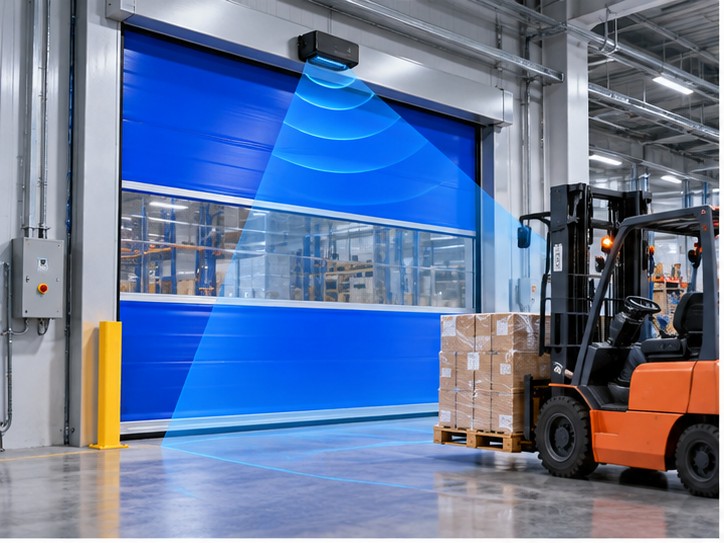
A radar door sensor uses radio-frequency electromagnetic waves to detect movement or, in certain sensor designs, presence within a defined area.
Many conventional automatic door radar sensors use the Doppler effect. They transmit microwave signals and analyze reflected signals to identify moving objects.
When an approaching forklift or pedestrian enters the configured detection zone, the radar generates an activation signal. The door controller then determines whether opening is permitted.
Key Benefits of Radar Door Sensors
1. Hands-free door activation
Forklift operators can approach an entrance without stopping to press a wall-mounted button.
2. Early detection of approaching traffic
Properly configured radar systems can initiate opening before a vehicle reaches the doorway.
3. Adjustable detection zones
Depending on the model, technicians may be able to adjust the coverage area, sensitivity, or directional settings.
4. Suitable for busy industrial applications
Automatic radar activation is commonly used at warehouse entrances, logistics facilities, and factory passages.
Limitations of Conventional Radar Sensors
Conventional motion radar primarily detects moving targets and may not reliably recognize stationary objects.
If the detection area overlaps a nearby forklift lane, it may also trigger unwanted openings.
Some advanced radar systems offer presence detection, but these functions must be verified from the specific sensor's technical documentation.
Important: A standard radar activation sensor should not be assumed to be a safety-rated protective device.
Learn more about the SEPPES Radar Door Sensor for industrial automatic activation applications.
How Do Photoelectric Door Sensors Work?
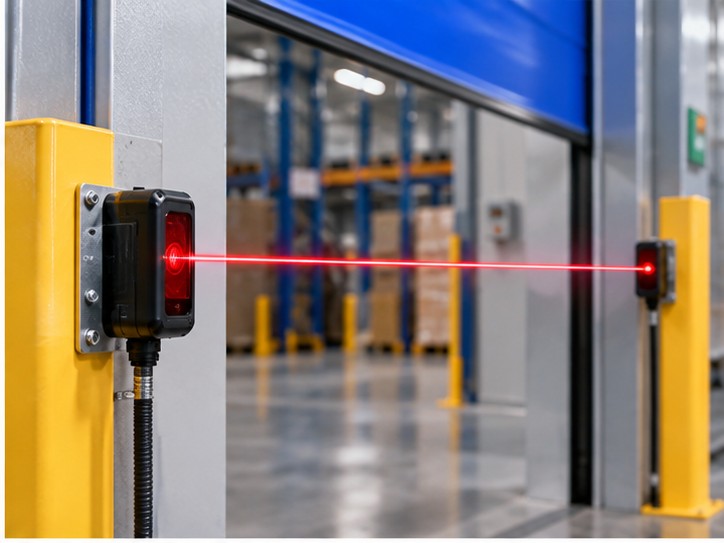
A photoelectric door sensor uses light, commonly infrared, to detect an object within its sensing path.
A typical industrial door arrangement uses a transmitter installed on one side of the opening and a receiver on the opposite side.
When an object interrupts the light beam, the sensor changes its output state. The door controller can use this signal to inhibit closing, stop movement, or initiate reopening according to its approved control logic.
Key Benefits of Photoelectric Sensors
1. Reliable detection within a defined beam path
Photoelectric sensors can detect objects that interrupt the monitored beam.
2. Stationary-object detection
An object remaining inside the monitored beam can continue to be detected even when it is no longer moving.
3. Support for protective closing functions
Suitable monitored photoelectric systems can provide important information to the controller's protective logic.
4. Compatibility with many industrial applications
Correctly selected and installed photoelectric sensors can be used in warehouses, production facilities, and other industrial environments.
Limitations of Photoelectric Sensors
A single photoelectric beam monitors only a defined sensing path. It cannot detect every object throughout an entire doorway.
Potential limitations include:
- Limited coverage from a single beam
- Misalignment between transmitter and receiver
- Dust or condensation on optical surfaces
- Damage to mounting brackets or wiring
- Environmental conditions outside sensor ratings
Where broader coverage is required, suitable safety light curtains or other protective devices may be necessary.
Radar vs Photoelectric Sensors: 7 Key Differences
Understanding the differences between radar and photoelectric sensors helps industrial buyers choose equipment for the correct application.
1. Detection Technology
Radar sensors use radio-frequency signals to detect movement or other specified target characteristics. Photoelectric sensors use light to detect objects through beam interruption or other optical sensing methods.
2. Primary Function
Conventional radar is typically used for automatic door activation. Photoelectric sensors are commonly used for obstruction detection within a designated sensing path.
3. Detection of Stationary Objects
Conventional motion radar may not reliably detect stationary objects. Photoelectric beam sensors can detect an object that remains within the beam.
4. Detection Coverage
Radar can monitor a configured approach zone. A single photoelectric sensor typically monitors one optical beam, while multi-beam protective systems can cover larger areas.
5. Installation Position
Radar sensors are commonly mounted above or near the opening. Through-beam photoelectric sensors are usually installed on opposite sides of the doorway.
6. Typical Industrial Applications
Radar is commonly used for forklift approach detection and hands-free access. Photoelectric sensors are frequently incorporated into closing protection systems.
7. Safety and Control Requirements
Neither technology should automatically be treated as sufficient for every safety function. Protective suitability depends on the sensor model, controller, system design, and applicable requirements.
Radar vs Photoelectric Sensor Comparison Chart
| Feature | Radar Sensor | Photoelectric Sensor |
|---|---|---|
| Detection principle | Radio-frequency electromagnetic waves | Optical light detection |
| Typical function | Automatic activation | Obstruction detection |
| Stationary-object detection | Model-dependent; limited for motion-only radar | Possible when object interrupts beam |
| Detection coverage | Configured detection zone | Defined beam path |
| Common mounting | Above or near doorway | Across doorway |
| Typical application | Forklift and pedestrian activation | Protective closing logic |
| Main consideration | Detection coverage and unwanted activation | Beam coverage and protective suitability |
Key takeaway: Radar and photoelectric sensors are often complementary. Their functions should be selected according to the required activation, detection, and protective performance.
Which High Speed Door Sensor Is Best for Your Application?
The best high-speed door sensor configuration depends on traffic conditions, operating environment, and the safety functions needed.
Radar Sensors for Automatic Forklift Activation
Radar is often suitable when forklifts, pallet trucks, or pedestrians require hands-free activation.
Common applications include:
- Warehouse entrances
- Logistics distribution centers
- Forklift traffic routes
- Manufacturing plant access points
The radar detection zone must be configured according to actual vehicle movement to reduce unintended activation.
Photoelectric Sensors for Obstruction Detection
Photoelectric sensors are useful when the control system needs to detect whether an object interrupts a defined beam path.
For example, when a pallet remains in the monitored doorway, a suitable protective photoelectric system can signal the controller to prevent or interrupt closing.
However, a single beam does not provide complete monitoring of the entire opening. Additional protective devices may be needed.
Combining Radar and Photoelectric Sensors
For many high-speed door applications, combining the two technologies provides a practical arrangement:
- Radar requests automatic opening.
- Photoelectric sensors detect obstructions within their monitored paths.
- The controller coordinates opening and closing.
- Other protective devices address additional identified hazards.
All components must be compatible and correctly integrated into the overall door system.
How Radar and Photoelectric Sensors Work Together
Consider a forklift approaching an industrial high-speed door.
- Approach: The forklift enters the radar detection zone.
- Activation: The radar sends an opening request to the door controller.
- Opening: The controller checks applicable conditions and opens the door.
- Passage: The forklift travels through the doorway.
- Obstruction monitoring: Photoelectric sensors monitor their defined beam paths.
- Closing: The door closes when the activation, protection, and control conditions allow it.
This illustrates a typical arrangement rather than a universal control sequence. Actual operation depends on the installed equipment.
Correct sensor coordination can support efficient traffic flow, but the complete system still requires appropriate protective design and commissioning.
Best Sensor Configurations for Industrial High Speed Doors
Warehouse and Distribution Centers
Warehouses often require frequent opening cycles and automatic forklift access.
Radar activation can reduce the need for manual controls, while suitable photoelectric sensors and other protective devices support safer closing operation.
Selection factors include:
- Vehicle approach speed
- Traffic direction
- Adjacent forklift lanes
- Door opening dimensions
- Required protective coverage
- Controller compatibility
In environments with frequent accidental impact, a self-repairing high-speed zipper door may also be worth considering.
Cold Storage and Freezer Facilities
Cold storage environments introduce challenges such as condensation, frost, and temperature-related equipment limitations.
Sensor selection should account for:
- Low-temperature operating ratings
- Condensation exposure
- Suitable enclosure protection
- Traffic frequency
- Unnecessary door opening cycles
- Required protective functions
A properly configured activation system may help reduce unnecessary openings, while protective devices support controlled door operation.
Cleanrooms and Pharmaceutical Facilities
Cleanrooms may require contactless activation combined with airlock or access-control functions.
Sensor systems should be selected according to the facility's hygiene, sealing, interlocking, and safety requirements.
Conventional radar activation may be appropriate for hands-free access, while photoelectric sensors can provide obstruction information to the controller.
AGV and Automated Production Systems
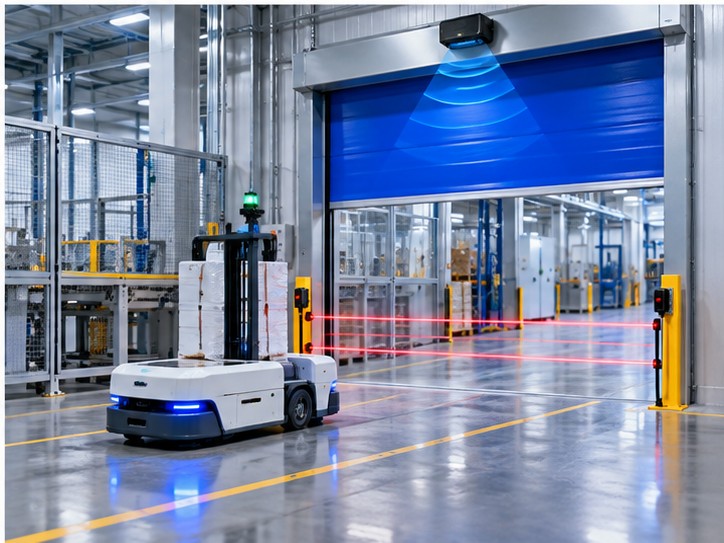
Automated guided vehicles (AGVs), autonomous mobile robots (AMRs), and conveyors often use PLC or dedicated controller signals to request door opening.
Radar and photoelectric sensors may complement these controls, but do not replace the required automation and safety architecture.
A typical integration sequence may include:
- The external automation system requests opening.
- The door controller checks relevant interlocks and safety conditions.
- The door opens.
- Door-position feedback confirms an appropriate state.
- The AGV proceeds according to the validated traffic sequence.
- The door closes when permitted by all applicable conditions.
Depending on the equipment, integration interfaces may include dry contacts, PLC I/O, RS485, or compatible industrial communication modules.
Qualified automation personnel must verify the complete system before commissioning.
Common High Speed Door Sensor Installation Mistakes
Incorrect Radar Detection Range
A radar sensor with an excessively wide detection zone may activate the door whenever traffic passes nearby.
The coverage should be adjusted to match the intended approach area.
Incorrect Photoelectric Sensor Position
A poorly positioned photoelectric beam may fail to monitor the intended obstruction path.
Mounting positions must follow the sensor documentation and the door system's protective design.
Ignoring Environmental Conditions
Dust, moisture, frost, vibration, and physical impacts may affect sensor performance.
Choose devices with suitable environmental ratings and protection for the installation.
Using an Activation Sensor as a Safety Device
A conventional radar opening sensor should not be assumed to meet protective safety requirements.
Where safety-related sensing is required, use devices and control interfaces suitable for the intended protective function.
Skipping Commissioning and Functional Tests
After installation, sensor coverage, controller response, and required protective functions should be tested according to the manufacturer instructions and applicable requirements.
For European industrial door applications, EN 12453 is a relevant standard addressing the safety in use of power-operated doors. Its applicability must be evaluated for the installation and market.
For worker safety during covered servicing activities in the United States, refer to OSHA 29 CFR 1910.147.
High Speed Door Sensor Maintenance Tips
Regular inspection helps identify contamination, mounting damage, and changes in sensor performance.
Radar Sensor Maintenance
- Inspect the mounting bracket for visible damage.
- Check for unwanted door activation.
- Review whether the detection area matches the traffic pattern.
- Observe controller activation indications.
- Arrange qualified inspection of damaged connections.
Photoelectric Sensor Maintenance
- Clean accessible optical surfaces according to the manufacturer's instructions.
- Inspect mounting brackets and visible wiring.
- Observe sensor indicators where safely accessible.
- Investigate repeated obstruction warnings.
- Verify protective operation through approved testing procedures.
Safety warning: Never bypass protective sensors to keep a high-speed door operating. An unresolved protective-device fault must be corrected and verified before normal use resumes.
How to Select the Right Sensor System for a New High Speed Door
Before purchasing equipment, identify the intended application and operating conditions.
| Selection Question | Why It Matters |
|---|---|
| What traffic uses the opening? | Determines vehicle, pedestrian, or automation requirements. |
| Is hands-free activation required? | Identifies suitable activation methods. |
| What closing hazards must be addressed? | Determines protective device requirements. |
| Are there nearby traffic lanes? | Affects detection coverage and unwanted activation. |
| Will the door integrate with PLC or AGV systems? | Determines interface and feedback requirements. |
| What environmental conditions apply? | Influences sensor ratings and mounting requirements. |
| Which standards apply? | Guides compliance and system validation. |
SEPPES offers customizable industrial high-speed door systems and compatible industrial door accessories for warehouses and manufacturing applications.
For new projects, share the opening dimensions, traffic conditions, environmental requirements, and control-system specifications with the manufacturer.
Frequently Asked Questions About High Speed Door Sensors
What is the difference between radar and photoelectric door sensors?
Conventional radar sensors commonly detect approaching movement and activate the door. Photoelectric sensors detect objects interrupting a defined optical path and are often used as part of closing protection systems.
Which sensor is best for an industrial high-speed door?
The best configuration depends on the function required. Radar may be suitable for automatic opening, while appropriate photoelectric sensors can support obstruction detection. Many installations benefit from a combination.
Can radar sensors detect stationary objects?
Conventional motion radar may not reliably detect stationary objects. Certain advanced radar systems provide presence-detection functions, depending on their design and specifications.
Can radar and photoelectric sensors work together?
Yes. They can provide complementary activation and detection functions when properly integrated with the door controller and other required protective devices.
Are photoelectric sensors enough for high-speed door safety?
Not necessarily. A single photoelectric beam only monitors a defined path. Additional protective devices and safety-related controls may be required depending on the application and risk assessment.
Can high speed door sensors work with AGV systems?
Yes. Sensors may complement PLC- or AGV-controlled door systems. Automated traffic management and required safety interlocks must be designed and validated as part of the complete installation.
Why does my radar sensor keep opening the door unnecessarily?
The detection zone may include adjacent vehicle movement or unintended targets. An authorized technician should review sensor positioning and coverage settings.
Why does a photoelectric sensor prevent my door from closing?
A blocked beam, contamination, misalignment, damaged wiring, or a sensor fault may keep the related protective input active. The cause should be investigated without bypassing the sensor.
Conclusion: Choose the Best High Speed Door Sensor Configuration
Radar and photoelectric sensors are both important technologies for industrial high-speed door applications, but they typically perform different functions.
Conventional radar sensors are commonly used for contactless opening activation, particularly in warehouses and forklift traffic areas. Photoelectric sensors are frequently used to detect obstacles within defined sensing paths and support protective door operation.
The best sensor configuration depends on the opening dimensions, vehicle traffic, operating environment, controller compatibility, and required protective functions.
For many industrial facilities, a properly engineered combination of activation sensors, obstruction detection, and compatible door controls provides a more complete solution than selecting one sensor technology alone.
Need Help Selecting High Speed Door Sensors?
SEPPES is an industrial door manufacturer based in Suzhou, China, providing customized high-speed door solutions for warehouses, manufacturing plants, cold storage facilities, cleanrooms, and automated production lines.
Whether you need radar activation for forklift access, photoelectric obstruction detection, or high-speed doors compatible with factory automation, our team can help review your project requirements and discuss suitable configurations.
For a product recommendation or quotation, please provide your door width and height, operating environment, traffic requirements, and control-system specifications.