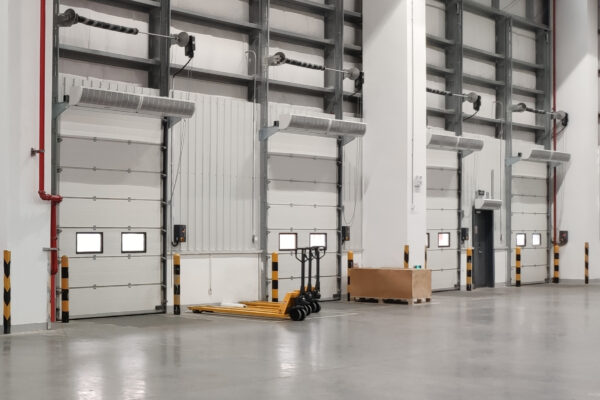
If you’re planning to buy sectional doors for industrial or commercial use, balancing functionality, durability, and Industrial sectional door cost is crucial. For busy warehouses, commercial garages, or retail facilities, proper planning ensures smooth operations. This blog breaks down costs by size, material, insulation, and additional features, helping you budget effectively and make a smart investment for your operational needs. Let’s explore the basics!
What Factors Affect the Cost of Industrial Sectional Doors?
Industrial sectional doors have a varied price range depending on the following considerations:
Size: Depending on the measurements, larger doors would translate to adding to the price, as they would require additional materials.
Materials: Steel, aluminum, and composite materials impact the doors and price. For example. Steel and aluminum are composite materials that would make the doors, and impact the price positively.
Insulation: The doors, as well as adding additional energy efficiency, add to the price of the doors. This is a given for climate-controlled facilities.
Custom Features: Severely impact the price, and add additional features, including windows, automated locks, models, advanced locks, and automation
Custom features are also a severe price impact, including windows, automated models, advanced locks, and automation.
These custom features are also a severe price impact.
These considerations for doors outlines price and features вмеш are thr price and the adjustment for the features, impact.
Overview of Industrial Sectional Doors
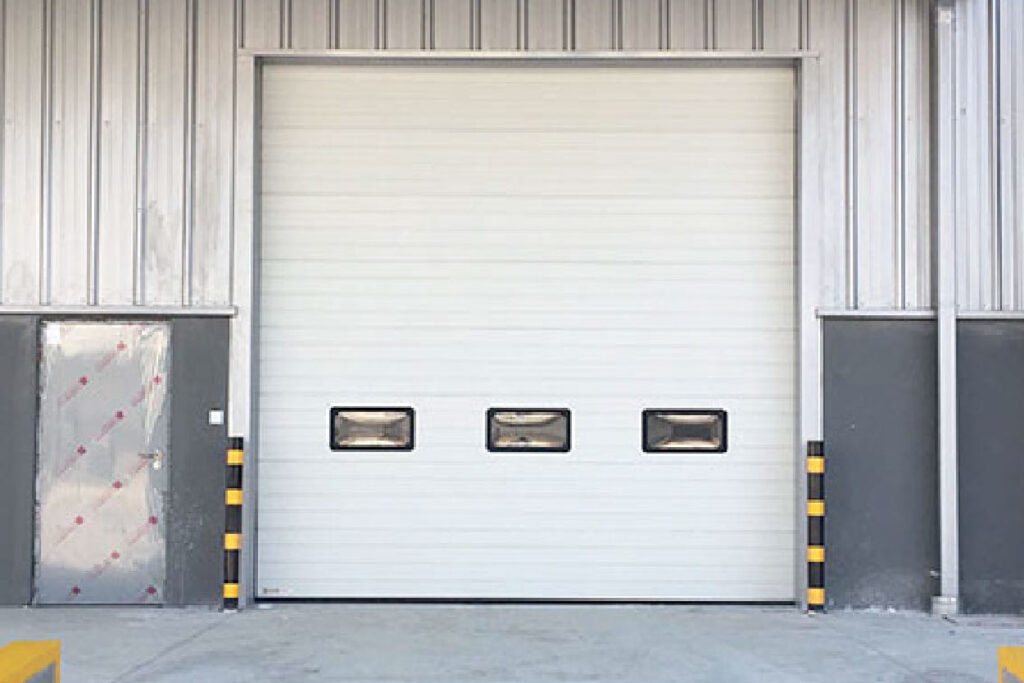
Industrial sectional doors are perfect for meeting the demands of commercial and industrial environments. They are practical, versatile, and the doors are space efficient. The doors have several horizontal panels that open vertically which allows them to fit into limited headroom spaces. They are commonly found in warehouses and manufacturing and distribution centers.
Industrial sectional doors have modern galvanized steel, aluminum, or insulated panels. These materials provide a better indoor temperature control and protects them from harsh weather. The doors have good seals with improved insulation which makes them energy efficient. These features are perfect for climate controlled facilities.
Modern sectional doors are also equipped with the latest smart control and safety features to enhance efficiency and safety with minimal labor. Fully automated doors will also reduce the amount of manual effort required.
Businesses have the additional option to customize panel finishes, add glass light inserts, and better locks and security options. Modern features, sturdy construction, and flexibility makes industrial sectional doors the best option for improving your business operations.
Importance of Industrial Sectional Door Cost Transparency
When purchasing industrial sectional doors, you need clear and upfront pricing. This allows you to gauge what budget you have to work with and schedule an installation. You will also have to consider how much maintenance and customization will cost. Recently, customers have been demanding more breakdowns on costs and the resulting materials. Additionally, customers want to know how much labor, insulation, and security features will add to the cost of a door designed for durability and energy efficiency.
When manufacturers and suppliers communicate openly with their customers, trust is built, which can make pricing and cost forecasting much easier. Additionally, clear pricing documenting how long the energy will last, how much you will spend to maintain the door, and how long the door will last will save your customers a lot. Long-term value is a major result of cost transparency, especially when customers want to know how much energy will be saved. Cost transparency saves your customers the hassle of forecasting costs on a budget that will keep the operation running. These are the costs that will be hidden from you, and you can lose a lot of money using your budget to cover them.
What is an Industrial Sectional Door?
Definition and Core Features
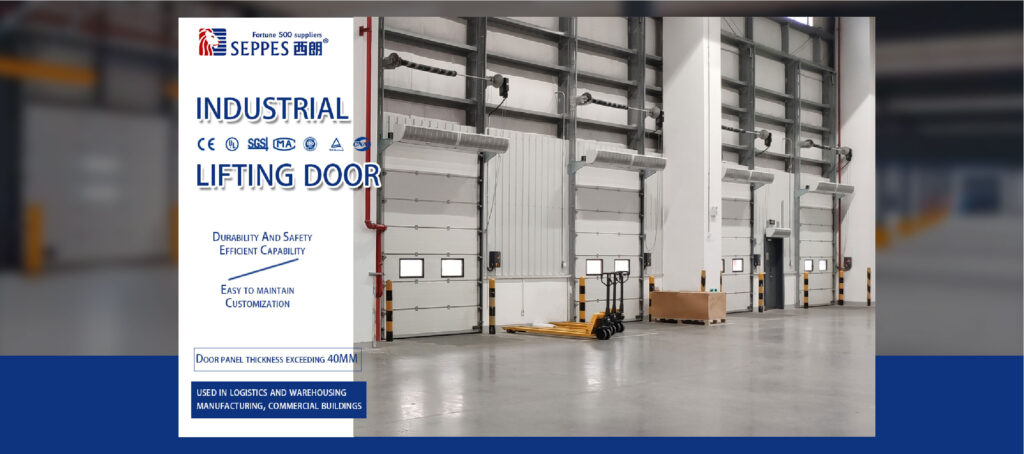
Modular sectional doors have a diverse range of applications. Industrial sectional doors are an example of this type of door. Industrial sectional doors are specifically designed for commercial use. An example of a modular sectional door is an industrial sectional door. These doors are industrial and commercial because of the materials used to construct their individual compartments. These compartments can be made of steel and aluminum or even of insulated panels. The compartments are designed to optimize space. The doors slide vertically along a space-efficient track and can be customized to fit any rugged industrial or commercial applications.
Core Features of Industrial Sectional Doors
Durability and Strength
Industrial sectional doors are built with high-quality materials like galvanized steel or insulated aluminum, which endure rough conditions and repetitive use.
Thermal Insulation
Industrial sectional doors with insulated panels keep the temperature in a facility at a desired level and help lower energy costs by increasing the facility’s energy efficiency.
Space Optimization
The vertical opening design means the door won’t take up any extra space when opening, maximizing the floor and ceiling space.
Customizable Options
The doors come in a variety of sizes, finishes, and colors, and can include vision panels and extra safety features to meet operational requirements.
Enhanced Security
Industrial sectional doors provide high levels of security with strong locking systems and robust construction to keep a facility safe and secure against intruders and other dangers.
Common Applications in Various Industries
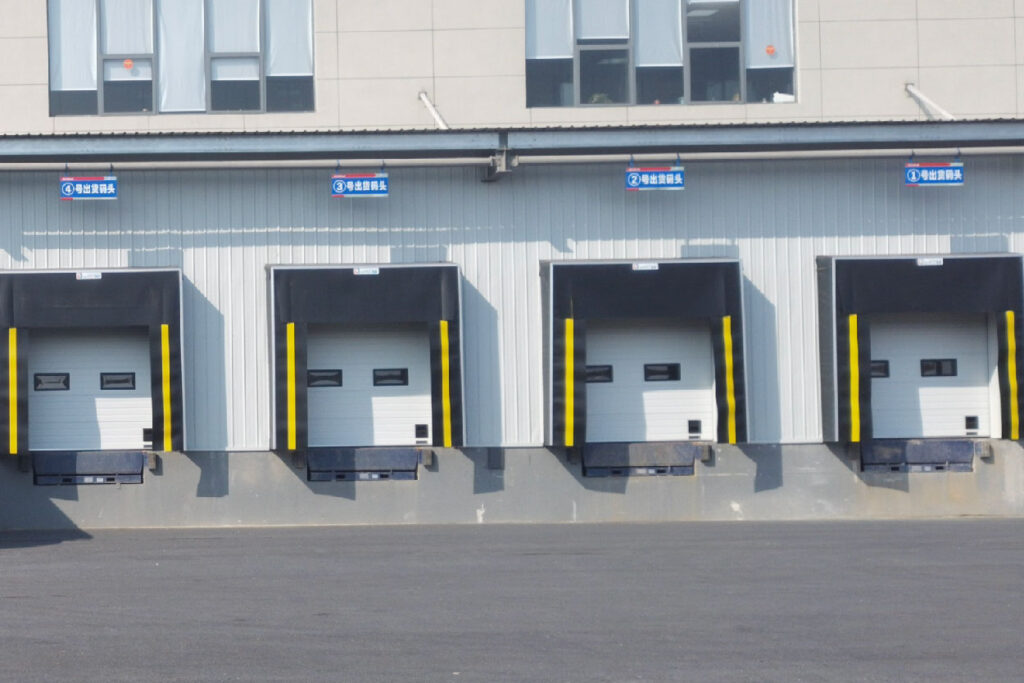
Sectional doors for industries have important developments for different industries and niches. These doors prove important for operational setups. Here are important applications for these doors.
Warehousing and Logistics
The distribution centers and warehousing industries need these doors most. These industries rely on these doors for the efficient and timely movement of goods for loading and unloading. These doors help foster seamless movement in and out of the centers.
Manufacturing Facilities
These doors help maintain controlled environments within factories by providing insulation against heat, cold, and noise while allowing seamless operations. They are essential for ensuring safety and compliance with industry standards.
Automotive Service Centers
Sectional doors are perfect for small repair garages and larger automotive service centers, courtesy of their robust construction and customizable features.
Food Processing and Cold Storage
The hinges and cold storage doors maintain the essential and safe standards for food processing industrial sectionals.
Airports and Transportation Hubs
These doors ensure rapid and temporary security control on a needed basis to close off and open access to transport security zones.
Overview of Industrial Sectional Door Costs in 2025-2026
Typical Price Ranges
Aspects like insulation, material, size, and customization will impact industrial sectional door pricing in 2025-2026. Generally, standard sectional doors cost somewhere between 1,500 and 5,000 dollars. A door with advanced thermal insulation that has special coatings for the cold storage or the food industry will cost between 7,000 and 10,000 dollars. Heavy-duty, fully customized doors for transport hubs or large warehouses can cost more than 12,000 dollars.
There will also be other costs like maintenance, installation, and customization, which can include automated doors, security systems, and more. When making budget plans, industry insulation standards, and the amount of customization should be considered, as they can significantly impact pricing.
Example Cost Brackets
As of now, I have the following cost ranges for industrial sectional doors based on examples in the market, the standard options, and possible customizations.
Standard Industrial Sectional Doors
These are the most common and range between $3,000 and $5,500. The doors have basic insulation and are manual. Dimensions are standard for smaller warehouses or workshops.
Mid-Range Industrial Sectional Doors
These range from $6,000 to $9,000. They usually have better thermal insulation, semi-automated door functions, and more durable materials for mid-sized door facilities or those that require some customization.
High-End or Customized Industrial Sectional Doors
The lowest prices in this category are $10,000 and can go up to $15,000. The prices depend on what is needed. This can include a heavy-duty component that is fully automated, weatherproof, and has extra security features for high-traffic businesses.
Note: Potential add-ons can significantly change the cost as they often include smart controls, extreme weatherproofing, and extreme maintenance and installation packages. Multiple quotes are always recommended to get the best quality combo for the best price.
Factors Influencing Industrial Sectional Door Costs
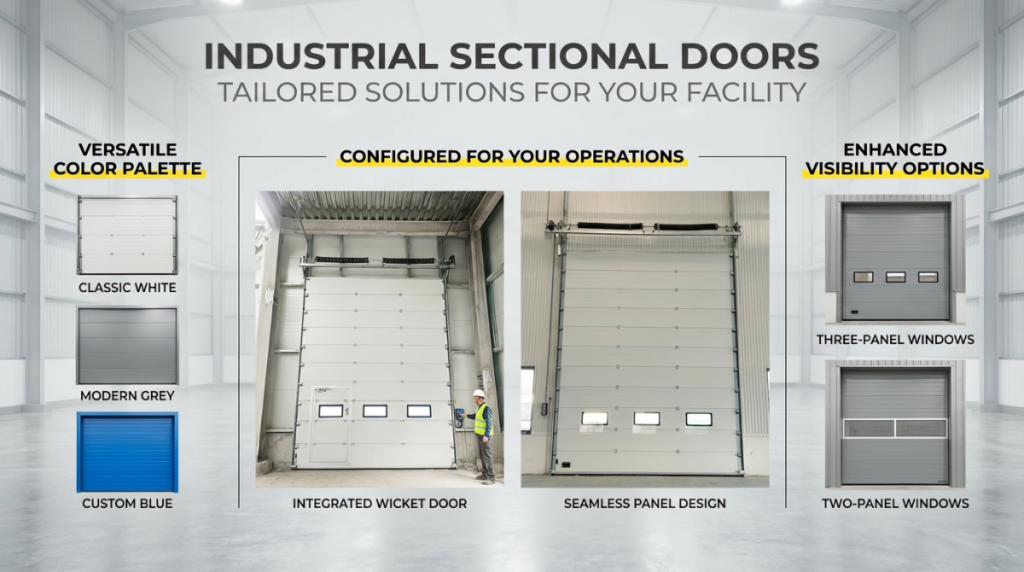
Material Selection: Steel, Aluminum, and Insulated Panels
Materials determine the cost, functionality, and durability of industrial sectional doors. The most commonly used material is steel, which is cheap and is also long-lasting. For frequent industrials, galvanized steel is ideal. It is highly resistant to wear and corrosion. For industries that need operational ease and prioritize aesthetics, aluminum is ideal. Aluminum is lightweight and does not rust. It also comes with a higher price tag. For industries that need a modern touch and operational longevity, aluminum is an excellent long-term investment.
Another vital option to consider is the use of insulative panel. For businesses that are focused on energy efficiency and needing temperature control, insulated panels are vital. The panels are usually constructed using filled cores of either polyurethane or polystyrene insulation, which are then sandwiched between layers of steel or aluminum. The panels help maintain consistent indoor temperatures in the climate-sensitive operations and refrigerated warehouses. The insulating to custom pay off to energy savings over time. The selection of material should align closely with the operational needs, environment, and long-term goals of the facility.
Door Size and Customizations
One of the main aspects of the cost of a sectional door is the size of the door itself. Larger doors use more materials, therefore increasing the cost to the business. Not all businesses have this problem, but some have size requirements for their sectional door, especially businesses that have a lot of vertical movement, like warehouses, loading docks, or manufacturing facilities.
Custom doors are usually more expensive than other doors because of the additional costs of adding features like window panels, enhanced insulation, and extra finishes. More automation and advanced systems, for example, remote control or sensor-activated mechanisms, further increase costs but optimize workflow of the business.
Choosing to build the door out of more expensive materials like galvanized steel or aluminum is an extra cost, but it adds to the lifespan of the door. Additional costs also go to added color choices the company may want, and added logos or branding on the door. In the end, businesses have to justify the costs of the different customizations with their operational needs.
Operation Types: Manual vs. Motorized
How your industrial sectional doors operate can greatly impact your manual vs motorized door options. Manually operated doors are less costly because they are less complex. Cost savings can be passed on providing doors with manual handles or counterbalancing systems to support operation. However, for facilities that have high traffic door operation or larger, heavier doors, manual operation can become impractical due to high labor demands.
In contrast, motorized sectional doors are even more costly. These doors add electric motors and sophisticated door controls. Overall, they provide greater convenience and safety. These systems can be complemented with remotes, keypads, or smart operation, allowing for seamless touchless activation. While motorized roll up doors cost a lot more, they are more cost-effective because they require less work, and thus save a lot of time, particularly in busy, fast work environments. Also, motorized doors provide leave time fast access point. Motorized doors come equipped with enhanced safety systems, including obstacle detectors, to protect everyone in the workspace.
This decision also needs to be weighed against the door’s size, weight, and operational frequency, and the organization’s available budget and operational goals to determine the best cost options for your organization.
Cost Breakdown: Direct and Indirect Expenses
Upfront Purchase Price
The price of industrial sectional doors can change quite a bit based on the size, materials, and any extra features like insulation and automation systems. For the standard industrial sectional doors, the average cost is about $2,000 to $7,000. Some custom doors and heavy-duty models can cost over $10,000. Doors with additional features like high-speed functions, insulation, and safety sensors can also cost extra. Consulting with suppliers and manufacturers will help you get the best estimate for your operational needs. While the doors may be expensive, focusing on quality will pay for itself in the long run with less maintenance and replacements.
Delivery and Installation Charges
While buying an industrial sectional door, you need to keep in mind how much you’ll have to pay for delivery and installation. These costs depend on how big the door is, how far the installation site is, how heavy the door is, and how difficult the installation process will be. Some suppliers will give you free delivery if you’re within a certain distance, but others will deliver only if you meet a minimum order value or pay a distance fee. Also, for the door to function safely and adequately, you will need professional installation, which will increase your costs. If the ceiling needs to be modified or if any special tools or equipment are necessary, installation costs will be higher. Before buying, you should ask your supplier to explain each of these installation costs. Bundling is offered by many suppliers and manufacturers. In these options, delivery and installation are included in the total price. This makes cost control easier.
Optional Add-ons and Integrated Systems
Industrial sectional doors offer customization options for enhanced functionality, long-term durability, and operational efficiency. One of these options is insulating systems, which creates a barrier to heat transfer, making these doors ideal for temperature-controlled environments like refrigerated shipping and cold storage warehouses. Vision panels can also be added for visibility and security, with the added benefit of natural light.
Integrating systems for automated control is a popular option that comes with a remote to minimize operational effort. Additional security features like access control with keycard readers, keypads, and biometric scanners can be added to limit who can access or control the doors.
Industrial sectional doors keep the weather out and the internal environment safe with options like reinforced panels and corrosion-resistant coatings for added durability. High-quality weather seals also create an internal barrier to extreme temperatures. Safety systems like photocell sensors and emergency stop buttons protect employees and valuable equipment from collisions and drops.
Cost-effective long-term solutions, sectional doors can be tailored with different combinations of integrations and add-ons to meet specific industry performance and functionality needs.
Installation Costs and Process
Typical Professional Installation Cost Ranges
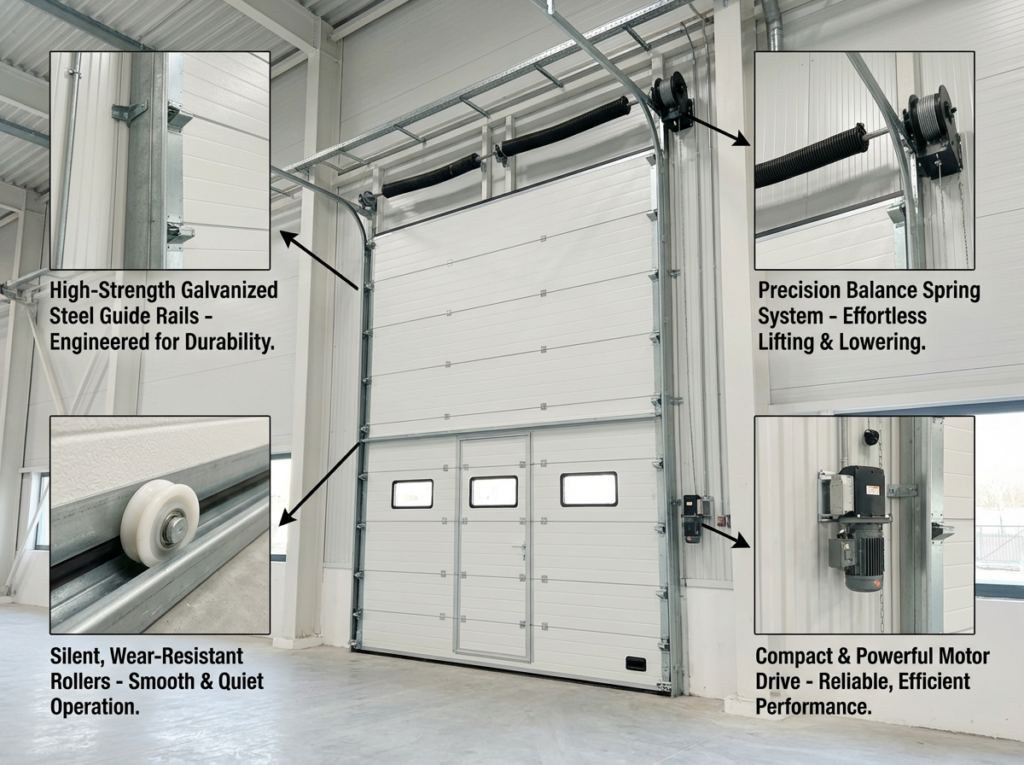
The price of professionally fitting industrial sectional doors can differ from door to door because of the size, materials used, and the complexity of the actual installation. Normally, the costs of installing such doors range between 1500 and 7000. If you need smaller-sized doors made out of galvanized steel, then you will definitely fall on the lower side of that price range. However, if you need bigger-sized doors made out of aluminum steel, then you will definitely end up on the upper side, so keep that in mind.
Other costs that you may need to consider are things like customization and top-of-the-range automation systems. Where you live can also affect the price, so if you are from a high-cost area, you may need to pay a little more to have the doors installed. To make sure the doors are installed in a safe and highly functional way, make sure you get a quote from a professional installer.
Factors Affecting Installation Pricing
Door Size and Specifications
When it comes to customized doors, their size can affect the total cost required for their installation. Take, for example, a door that is 12 feet wide. Its price will likely be less than that of a 20-foot-wide one. Furthermore, that 20-foot model can even be designed to be heavily insulated for industrial use. Now that the model will surely be more expensive to install.
Material and Design
Certain materials can affect the price of a door. Steel, composite, and aluminum are examples of materials that will impact the price of any given door. Insulated steel doors are designed to be more energy-efficient than standard aluminum doors and will cost more.
Automation and Technology
Adding smart features like a remote control, an automatic door opener, or a means to connect it to a building management system can add a lot more to the installation and equipment expenses. You may also need to hire additional tech staff to wire and program the system.
Facility Requirements and Modifications
Some installation procedures, like frame reinforcements, are put in place to help the system function safely. They may, however, increase the total cost of the installation.
Geographic Location and Labor Expenses
The rates of transportation of materials needed for the installation and of local labor can affect the total cost of the services. Cities and areas with high living costs tend to have more expensive rates compared to rural areas.
DIY vs. Professional Installation
DIY installation offers cost savings and flexibility but risks safety, quality, and warranty voids, while professional installation ensures expertise, safety, and warranties but comes at a higher cost and less scheduling flexibility.
Tabular Summary:
| Parameter | DIY Installation | Professional Installation |
| Cost | Low | High |
| Flexibility | High | Low |
| Expertise | Limited | High |
| Safety | Risky | Assured |
| Warranty | Voidable | Included |
| Time | High | Low |
| Quality | Variable | Consistent |
| Tools | Required | Provided |
| Convenience | Low | High |
| Long-Term Value | Uncertain | Reliable |
Ongoing Maintenance and Lifetime Value
Maintenance Frequency and Costs of Industrial Sectional Doors
To ensure long-lasting performance, industrial sectional doors require proper servicing. Businesses should maintain rollers, tracks, and hinges every 3–6 months. Inspect these components regularly and replace them as needed to maintain efficiency and safety, with a full service conducted once per year.
The price for maintenance can be different per door depending on how often it is used, how big it is, and what the service is. Basic maintenance is cheap, like lubrication and cleaning. If the motor or spring is broken, that is expensive. Preventative maintenance is always better than correcting something after it breaks. Doing this will add to how long the industrial sectional doors are able to be used. Reliable maintenance will add to how long the doors can be used and how long until new doors must be purchased.
Impact of Proactive Maintenance
Industrial sectional doors are important because they help in the smooth running of an industry. Maintaining these doors is important because of the benefits that come with them. We will discuss five of these benefits below.
Less Downtime
If an industry is productive, they do not want frequent disruptions. Studies show that industries that maintain their work equipment reduce unproductive downtime by 30%. Regular maintenance ensures door dependability, allows businesses to predict and plan for breakdowns, and minimizes disruptions so work continues smoothly.
Longer Lifespan
Sectional doors are a little expensive. Their operational life can be increased by 20 to 25%. This is done by adjusting, checking, and replacing the parts of the doors, as well as with the practice of lubrication.
Greater Safety
Doors are often damaged. If doors are not taken care of, they can be dangerous. The balance between the care of the doors and the care of the people in the industry is maintained, and compliance with safety is ensured.
Energy Savings
Energy cut costs often come from a balance of being too hot or too cold, and it is an inefficient practice. Doors that are not maintained cost more money and compromise their dependability. The savings that come from the maintenance are usually seen in the range of 15%.
Saving Money
Neglecting maintenance wastes money. In the industry, companies spend heavily on repairs, which directly affects the bottom line. By practicing regular maintenance, businesses save money and reduce repair costs.
Collectively, these influences result in dependable and efficient function of industrial sectional doors; thus making proactive maintenance an important part of any facility management strategy for rolling doors.
Benefits and Cost-Saving Opportunities
Return on Investment of Premium Features
Investing in premium features for industrial sectional doors has a number of long-term advantages and possible cost cuts. For example, extra insulation helps facilities become more energy efficient by reducing heat transfer and reducing overall heating and cooling expenditures. Also, high-quality materials and premium parts increase the longevity of the product and reduce the frequency of replacements. Also, high-performance materials and sealing technologies improve the protection of your inventory by reducing air and moisture infiltration and help to control the climate.
Fully automated operation systems also feature premium features. Programmable control and remote access smart operations reduce labor and improve efficiency. Improved security features like access control systems and reinforced locking mechanisms help reduce the risk of loss and damage, providing a greater sense of security.
Although the added features may come with a higher price tag, studies show that the energy savings, decreased maintenance, and improved efficiency make them pay for themselves in 2 years in savings. Adding premium features that align with operational needs is a great way for facility managers to maximize lifecycle value.
Tips for Optimizing Value
Install Quality Insulation
Choose sectional doors made with insulation that helps prevent heat loss and saves energy. Well-insulated doors can help reduce energy consumption by 20% in energy-controlled environments.
Choose Quality Build
Select doors made with tough galvanized steel or aluminum. These will help endure the tough industrial surroundings and save costs on repairs and replacements.
Integrate Smart Technology
Incorporate sectional doors with smart control systems for remote access, real-time monitoring, and maintenance notifications. Smart technology helps increase operational efficiency by 15%-20%.
Prioritize Regular Maintenance to ensure the durability and energy efficiency of your doors.
Make sure to set routine inspections and maintenance to ensure that there’s no risk of wear and tear from becoming costly repairs. Facilities with proactive maintenance usually fall short of 25% of routine breakdowns.
Select Customizable Options that enhance the durability and energy efficiency of your doors.
Opt for doors that can be customized with specific operational features, like rapid opening and closing, vision panels, and others. Additional features will help provide long term value by increasing efficiency and safety.
Current Market and Brand Comparisons
Price Comparison of Leading Brands
Several factors can cause variations in pricing for industrial sectional doors, including the brand, size, materials, insulation, and customization. Leading brands have different price ranges for their sectional doors. Here is some data regarding brands and the price ranges they sit in for their sectional doors:
Hormann
Hormann makes high-quality industrial sectional doors with advanced thermal insulation. Prices start around $1,500 and can exceed $6,000 based on size and features.
Clopay
Clopay sectional doors are versatile and can be customized. Basic models start around $1,200. These can go up to $5,000 and more for premium insulated models.
Raynor Garage Doors
Raynor focuses on energy-efficient sectional doors. These have a steel construction and are very durable, making them a solid investment for long-term use. Generally, prices for these sectional doors go from $1,800 up to $6,500 based on specific needs.
Overhead Door
Overhead Door has a wide range of industrial-grade sectional doors. These start around $1,000 and go up to $7,000 for sectional doors with higher insulation and more features.
C.H.I. Overhead Doors
C.H.I. doors are reliable and can be customized. Prices go from $1,500 to $5,500 based on the specifications and custom features.
Request a quote from your local distributors or manufacturers to factor in prices based on geographic region, installation costs, and added options. Although expensive, quality investing in industrial sectional doors makes a strong business case, especially for facilities with a high operational load, as they provide durability and performance over the long run.
SEPPES is a prominent Chinese manufacturer in the industrial sectional door industry. They use industry-leading technology and construction methods at a lower cost than the competition. SEPPES earns a lot of business for producing high-quality sectional doors with smooth operation, energy savings, and good security. SEPPES is a technology leader in the industry, providing automated and smart access solutions for sectional doors using updated technology and proprietary systems. Due to varying prices for SEPPES industrial sectional doors, it is important to reach out to certified distributors to receive customized quotes based on your needs, location, and local market. SEPPES offers dependable solutions for businesses in need of high-quality contemporary industrial doors.
Key Differentiators in Product Quality
There are a few reasons you can tell SEPPES manufactures high-quality sectional industrial doors. One way is to look at the construction materials. SEPPES doors are made from high-quality materials such as galvanized steel and industry-proven insulation. It is these construction materials that give the doors their strength and thermal retention. Furthermore, SEPPES doors have advanced, precision seals that greatly increase their weather resistance. This means that they keep external noise out, as well as the damaging elements. It also means they conserve energy by keeping the conditioned air in.
When it comes to high-quality doors, SEPPES should be at the top of a customer’s list, thanks to more of their advanced technologies, integrated smart sensors, and automated operation mechanisms. These are also a great way to improve safety and, with automation, improve ease of use. SEPPES also provides a great amount of customization in door size, as well as door finish. Additional options also include fireproofing and anti-corrosion coatings.
Despite SEPPES high quality standards, they extend to regulating their in-house automation. SEPPES also goes above standard by ensuring their doors present the qualities in high demand from industry customers. SEPPES presents the industry with high-quality doors that are made to last. These doors are also automated and energy efficient, providing industry customers with high-quality doors that are sure to last.
Latest Trends Shaping Industrial Sectional Door Costs
Technological Innovations Impacting Industrial Sectional Door Costs
Many of the advancements in technology also affect the factors that go into pricing industrial sectional doors, especially for those designed for low maintenance. Smarter automation, IoT systems, and remote operation features are becoming integrated more frequently and are in demand. There are efficiencies and operational conveniences that get unlocked, although the costs on the more integrated systems can be higher in the short term. On the other hand, advancements and prioritization of raw materials, like composites that are both lightweight and highly durable, and fresh technological insulation improvements, are more and more commonly focused on to meet energy efficiency. The demand for energy assigned to a space seems to be driving more innovations to address the thermal insulation of door systems, as well as the sealing systems, ultimately affecting pricing. In addition, features like laser design, which are often commercially/industrially tailored and performance-specific, are priced and added. The technological advancements often meet, or exceed, the pricing expectations of industrial consumers, providing a balance of upfront costs to performance and costs over the lifetime of the product.
Market Trends Impacting Pricing of Industrial Sectional Doors
Sectional doors for industrial use can have a variety of different price points depending on the market conditions. With high inflation making the prices of raw materials soar, specifically steel and aluminum, the prices of sectional doors will continue to rise. Then you have to consider the global situation with the pandemic. It brought about supply chain issues, raw material price inflation, and increased construction and industrial material prices. All of this has brought about an increased sectional door price.
Next is the smart and automation technology segment. With doors acting like devices, people will expect them to have smart automation, like integrated closers and the ability to control them through connected devices, enhancing their high performance. With technology like this, you can expect sectional door prices to rise.
Lastly, energy-efficient doors are increasing in sectional door prices. With more used materials like high R-value insulation, weathertight sealed, and thermal breaks, the prices of sectional doors will stay on the rise. Doors are also custom-made to the client’s specifications, which will also lead to an increased sectional door price.
Lastly, sustainability concerns influence changing market trends. Companies are setting sustainability goals and using eco-friendly materials and methods. While this change addresses the long-term goals of the environment, it often requires new technologies, thus raising prices. These trends of industrial sectional doors show how quickly innovation, customer expectations, and overall economy change the prices.
Conclusion and Expert Recommendations
Checklist for Cost Benchmarking of Industrial Sectional Doors
Material Quality and Durability
Consider what type of materials are used, like steel, aluminum, or insulated panels. What are the expected lives of those materials? Do the products hold up against wear and tear, corrosion, and damage from the environment?
Energy Efficiency
What are the insulation R-value, the energy-saving features, and the durability and energy efficiency of the products? How do they meet energy standards, and how do savings on heating and cooling compare?
Maintenance and Service Costs
What are maintenance costs and how often are they done? What are post-sale service agreements and how much do they cost? How much do replacement parts cost and how available are they?
Technological features
What advanced features do the products have? Do they have features such as remote control, automation, and integrated safety? What are the costs compared to other products with smart features or custom technological integrations?
Warranty and After-Sales Support
What is the length of the warranty? How reliable are the responses to customer support after the sales are made?
Using this checklist helps stakeholders align product choices with operational objectives and available budget.
Steps for Accurate Quotes of SEPPES Industrial Sectional Doors
To get the best price quote from SEPPES for their industrial sectional doors, it’s important to give their team as many details as possible from the point of view of SEPPES, as well as your own point of view from being in the market. Steps to formulate your needs include the following.
Define Specific Requirements
Make sure to determine the size, type, and operational needs of the sectional doors—things like insulation, wind resistance, usage, and so on.
Double-check if there are any other needs like windows, preferred colors, automation, and so on.
Site Measurements
Do on-site measuring yourself. It’s important to get the exact measurements of the space. Your calculations must be precise so the doors will properly install and function as high-performance rolling doors.
Verify Compliance with Standards
Make sure the model you’re purchasing complies with the safety and performance measures to ensure certification of fire resistance and insulation.
Review Customization Options
If your doors will have any smart integrations for automated systems, or if they’ll have any special finishes to meet brand or other aesthetic requirements, be sure to let SEPPES know.
Compare Material Choices for high performance and low maintenance options.
SEPPES offers doors made from a variety of materials, such as galvanized steel and aluminum. Let them know which materials will best apply to your usage.
Assess Installation Conditions
Make sure any structure will be ready to go for the install, and that there’s a place where a motor to drive the doors will be plugged in. Then check for any other potential problems.
Request Detailed Quotes
Contact SEPPES or an authorized distributor for quotes regarding project specifics. Make sure the quote outlines the costs of materials, delivery, installation, and add-on options.
Understand Lead Times and Logistics
Clarify production and delivery timelines in accordance with deadlines for the project. Confirm that the quote accounts for shipping and handling.
Analyze Warranty and Support Services
Check SEPPES’ warranty terms to understand coverage for possible defects. Evaluate the availability of after-sales services, including maintenance and repairs.
Following these steps helps to avoid unplanned costs, ensure the operability of the doors, and achieve the optimal value of the investment. A combination of these steps with current research on SEPPES’ products will yield better results when purchasing.
Frequently Asked Questions (FAQs)
What affects industrial sectional garage door prices and overall door prices?
Countless components affect the cost of industrial sectional doors. These include the door size, materials (steel, insulated, or non-insulated materials), model types, insulation types (polyurethane vs. polystyrene), wind load ratings, heavy-duty hardware, sectional doors vs. full-view doors, base doors vs. custom doors vs. warehouse doors vs. garage doors, additional accessories (operators, safety gear), custom coatings, and (solid) panel configurations. Additionally, labor and installation requirements and local code requirements can affect the garage door prices. Because of these variances, obtaining a free quote will give you a better idea of the total cost of your garage doors.
How do steel doors and insulated steel options influence the cost and energy efficiency?
Opting for insulated steel garage doors or insulated sandwich doors will drive the starting cost of your project up. However, these doors will improve energy efficiency and temperature regulation of the spaces they enclose. The additional energy savings and the improved cost and time savings during the driving of the R-value of the insulation will offset the additional costs of the insulation (polyurethane vs. polystyrene) higher valued insulated doors. In areas with extreme temperatures, insulated doors become a long-term cost savings measure for your energy and a help with the cooling and heating loads.
Are commercial sectional overhead doors more expensive than roll-up doors or rolling steel doors?
There could be various reasons why commercial sectional overhead doors cost more than simple roll-up doors. Sectional doors have complex panels and may have more expensive hardware; they’re designed for heavy-duty and high-traffic use. On the other hand, rolling steel doors and steel curtains could be less expensive; however, they may not be as insulated and could have other durability problems. Ultimately, either choice depends on how much energy efficiency, how high the performance, and how heavy-duty solutions are required.
What is the difference in cost between full-view overhead door models and solid insulated doors?
When using alternative materials, full-view overhead doors usually cost more. Expensive materials used on full-view overhead doors include tempered glass, polycarbonate, and aluminum framing. These more expensive materials do usually provide natural light and visibility, which can reduce the need for expensive lighting added after construction. The use of solid insulated doors can also add to the cost of full-view doors; however, the energy savings and better thermal performance may justify the cost. When operational needs are defined, the trade-offs associated with insulation and natural light can help determine which doors can best fit.
How do warranty, spring life, and heavy-duty hardware impact the long-term value of commercial garage doors?
Quality and heavy-duty hardware provide longer warranties and generally raise the upfront cost of the garage doors; however, over time, the total cost of ownership goes down due to less maintenance and lower downtime on soft-close systems. For high-traffic industrial doors, the added heavy-duty tracks, reinforced hinges, and extended life of the springs improve reliability. For busy warehouses, the soft close systems make the purchase of the doors dependent and provide other service calls, offering long-lasting value.
Can you explain how door size, width, and custom garage requirements change the industrial sectional door cost?
Higher widths and bespoke garage openings lead to escalated expenses. Non-standard widths can mean bespoke door construction or composite sections for added costs. A particular width can lead to additional costs due to increased heavy-duty wind load and added insulation. In instances where openings are different, manufacturers like Clopay and Amarr can sometimes provide commercial sectional or bespoke garage door options—request a quote to obtain details on pricing for your door size.
Do insulated sandwich doors and insulated doors provide better temperature control for warehouses?
Of course, controlled temperatures of greater insulated doors with additional R-value and polyurethane insulation, and double sandwich insulated doors are optimal for temperature control in any commercial or industrial setting. They control temp differentials, minimize wandering temperatures, and even reduce energy costs. They are also durable and require very little maintenance, which makes them great for cool-down or temp-sensitive storage areas.
How does choosing a high-performance or heavy-duty commercial door affect maintenance and emergency service needs?
Heavy-duty and high-performance ventilation doors reduce operational wear and maintenance because they are built for high traffic or cyclical operations. They are also built with silent spring operation, robust operational components, and noise suppression. However, because these doors are pivotal to operations, having local technicians for critical repairs is important. Many providers keep emergency services for extended downtimes.
Are there cost differences between residential garage doors and commercial garage doors, and when should I choose commercial overhead vs. residential models?
Residential garage doors are usually cheaper and built for less use and more looks. On the other hand, commercial garage doors and commercial overhead doors are built for more durability, heavy use, and higher wind loads, which adds more costs. For warehouses, retail loading areas, or other areas with a lot of traffic, choose commercial sectional or high-performance models. For attached residential garage spaces that are used occasionally, insulated residential garage doors can provide good value and energy efficiency without the extra costs of commercial garage doors.
Reference Sources
- United States Government Department of Energy
https://www.osti.gov/biblio/1206624
This source provides insights into cost-effectiveness and materials programs within the industry. - National Cost-Effectiveness of ANSI/ASHRAE/IES Standard
http://www.pnl.gov/main/publications/external/technical_reports/PNNL-28206.pdf
This report discusses construction material and labor cost adjustments, relevant to industrial applications. - Economic Modelling of Multi-Sequential Manufacturing Processes
https://dspace.mit.edu/bitstream/handle/1721.1/14196/22212208-MIT.pdf
A case study analysis focusing on cost impacts in manufacturing processes, including doors.