
Choosing the right dock leveler capacity is not as simple as matching the rated tonnage to the weight of the cargo. A loading dock leveler carries the forklift, the load being transported and the forces created as the forklift moves across the platform.
This means a 6-ton combined load does not automatically mean that a 6-ton dock leveler is the correct choice.
Buyers should consider forklift operating weight, cargo weight, wheel loading, dynamic impact, crossing frequency, truck-bed height range and the dock leveler manufacturer's rating method before confirming the final specification.
For current product configurations, see the SEPPES hydraulic dock leveler or browse the complete loading dock equipment range .
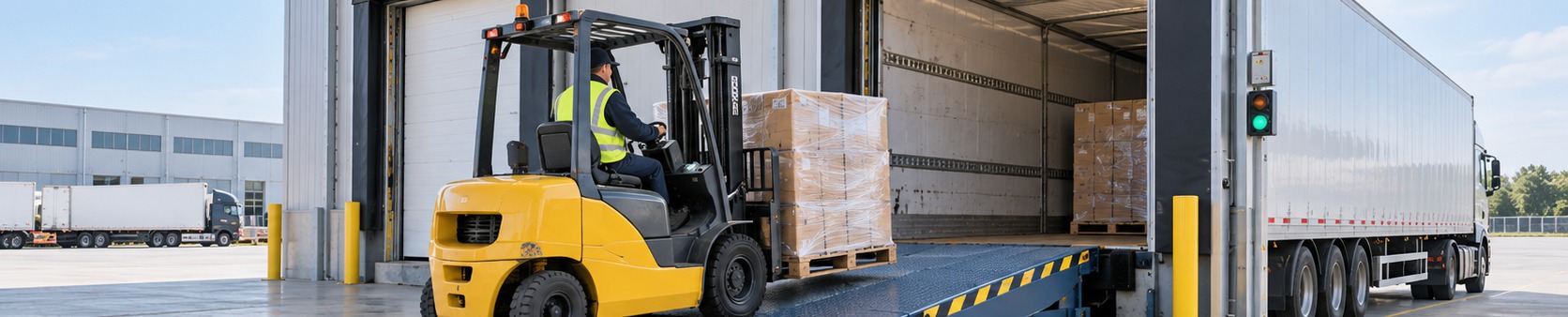
What does dock leveler capacity actually mean?
Dock leveler capacity describes the load the equipment is designed and rated to handle under the manufacturer's specified design, testing and operating conditions.
For the buyer, the important point is that rated capacity should not be interpreted as the maximum cargo weight.
During normal operation, the dock leveler may be exposed to:
- forklift operating weight;
- cargo weight;
- forklift attachments;
- concentrated wheel loads;
- dynamic impact as the forklift enters and exits the platform;
- repeated crossings throughout the working day;
- different trailer heights and leveler angles.
The correct dock leveler specification therefore depends on the entire operating condition, not a single weight figure.
Rated capacity is not the same as cargo weight
One of the most common purchasing mistakes is selecting a loading dock leveler based only on pallet or cargo weight.
If a warehouse handles a 2,000 kg pallet, the dock leveler does not support only that 2,000 kg. The forklift carrying the pallet also travels onto the platform.
The basic static load starts with:
Forklift operating weight + cargo weight + relevant attachments
However, even this combined figure is only the starting point.
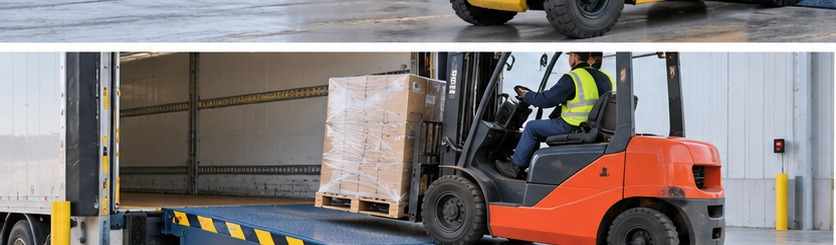
Example: 4,000 kg forklift plus 2,000 kg cargo
Consider the following warehouse application:
- Forklift operating weight: 4,000 kg
- Maximum cargo weight: 2,000 kg
- Combined static weight: 6,000 kg
A simple calculation might suggest:
4,000 kg + 2,000 kg = 6,000 kg → choose a 6-ton dock leveler.
That conclusion is incomplete.
The forklift does not remain stationary in the center of the dock leveler. It drives onto the deck, passes across the hinge and lip area and continues into the trailer.
During this movement, the structure experiences concentrated wheel loads and dynamic forces that are different from placing a stationary six-ton load evenly across the platform.
The correct capacity therefore still depends on forklift configuration, wheel loads, crossing frequency, operating geometry and the manufacturer's rating method.
Use the forklift's actual operating weight
When selecting dock leveler capacity, buyers should use the forklift's actual operating weight rather than a rough estimate.
Depending on forklift type and configuration, operating weight may include:
- battery or fuel system;
- fork carriage;
- attachments;
- standard operating equipment;
- other permanently installed accessories.
Why dynamic loading matters
A moving forklift creates a different loading condition from a stationary object.
As the wheels enter the dock leveler, travel across the deck and transition onto the trailer, force is transferred through relatively small tire contact areas.
Acceleration, braking, uneven transitions and repeated crossings can also affect the load applied to the dock leveler structure.
This is why:
Forklift weight + cargo weight ≠ final dock leveler capacity selection.
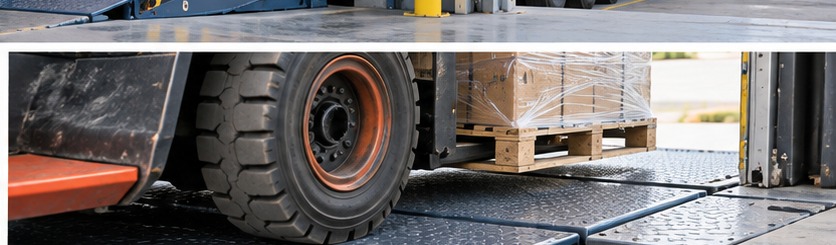
Wheel loads are concentrated, not evenly distributed
The forklift load is transferred to the dock leveler through its tires rather than being evenly distributed across the entire deck.
Axle configuration, wheel spacing, tire type and the position of the cargo can therefore affect how force is transmitted into the leveler.
This is particularly important for:
- heavy forklifts;
- compact wheel arrangements;
- high-density loads;
- specialized industrial vehicles;
- high-capacity dock applications.
How crossing frequency changes capacity requirements
Two warehouses may use exactly the same forklift and cargo but place very different demands on their dock levelers.
| Anmeldung | Example crossing frequency | Operating condition |
|---|---|---|
| Low-frequency warehouse | Approximately 10 crossings per day | Relatively light duty cycle |
| Busy distribution warehouse | 100–200 crossings per day | Repeated loading throughout the shift |
| High-volume logistics center | Continuous multi-shift operation | High duty-cycle demand |
The static weight may be identical, but the long-term loading pattern is not.
Crossing frequency affects the working demands placed on the deck, hinges, lip mechanism, hydraulic system and structural components.
6 ton vs 8 ton vs 10 ton dock leveler capacity
SEPPES hydraulic dock levelers can be configured with reference rated capacities including 6T, 8T, 10T and 12T.
These ratings should not be treated as simple categories such as “small warehouse,” “medium warehouse” and “large warehouse.”
| Rated capacity | Possible application context | What must still be confirmed |
|---|---|---|
| 6T | Lighter forklift and cargo combinations | Forklift operating weight, cargo, wheel loading, traffic frequency and manufacturer criteria |
| 8T | Higher combined loads or more demanding warehouse use | Forklift specification, daily cycles, truck fleet and operating conditions |
| 10T | Heavier industrial forklift operations | Wheel concentration, duty cycle, structural requirements and project conditions |
| 12T or higher | Heavy industrial or specialized loading | Detailed engineering review of vehicle, cargo, platform and loading pattern |
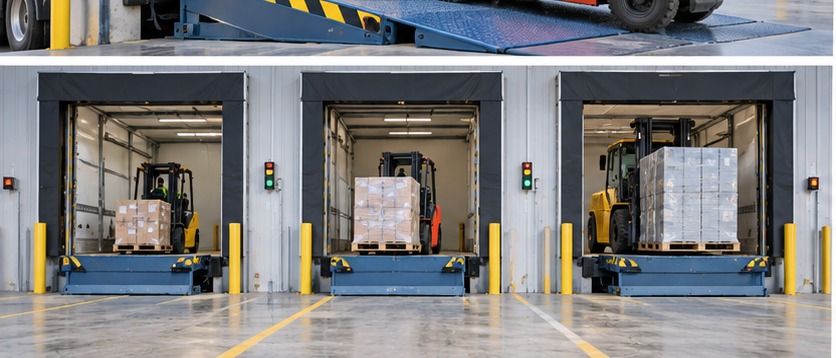
Is an 8-ton dock leveler automatically safer than a 6-ton model?
Not necessarily.
Choosing a higher capacity does not replace correct engineering selection.
The dock leveler still needs to match:
- the actual forklift;
- the truck fleet;
- the loading platform;
- the pit dimensions;
- the required working range;
- the operating frequency.
Capacity should be selected correctly rather than increased arbitrarily.
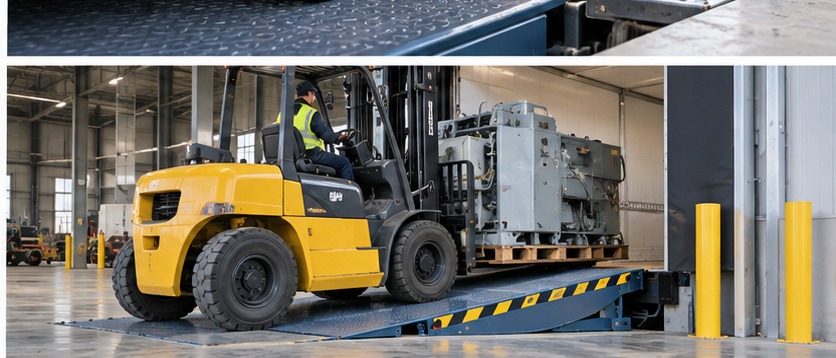
When do you need a heavy capacity dock leveler?
A heavy capacity dock leveler may be required when the warehouse uses heavier material-handling equipment or handles demanding industrial loads.
Typical applications can include:
- heavy forklifts;
- large machinery components;
- steel or metal products;
- dense manufacturing cargo;
- high-frequency logistics terminals;
- multi-shift industrial operations;
- specialized material-handling equipment.
The exact capacity should still be confirmed through project-specific engineering review.
Dock leveler dimensions and capacity should be selected together
Capacity is only one part of dock leveler specification.
The platform dimensions and operating geometry also need to match the loading dock and truck fleet.
Important measurements include:
- pit width;
- pit length;
- pit depth;
- warehouse platform height;
- minimum truck-bed height;
- maximum truck-bed height;
- truck type;
- required lip length;
- forklift travel direction.
You can review current reference specifications on the SEPPES hydraulic dock leveler product page .
Truck-bed height also affects dock leveler selection
Even when the rated capacity is correct, the leveler still needs to operate within a suitable vertical range.
If the truck floor is significantly above or below the warehouse platform, the dock leveler works at a greater angle.
This can affect:
- forklift approach angle;
- ground clearance;
- load stability;
- lip contact with the trailer;
- overall loading efficiency.
For this reason, always provide both the minimum and maximum truck-bed height during selection.
Check manufacturer specifications and applicable standards
Dock leveler capacity terminology should always be checked against the manufacturer's technical documentation because rating methods and design assumptions can vary.
In the United States, OSHA requires dockboards to be capable of supporting the maximum intended load.
Official reference: OSHA 1910.26 – Dockboards .
For built-in dock leveling devices, the Material Handling Industry LODEM group publishes ANSI MH30.1 guidance covering design, testing and utilization.
Industry reference: MHI / LODEM – Dock Leveling Devices .
The applicable standard should always be confirmed according to the destination country, installation and project requirements.
Do not add a random safety factor yourself
Another common purchasing shortcut is:
Forklift + cargo = total weight, then add an arbitrary percentage.
While dock leveler design includes safety considerations, buyers should not invent a universal multiplier and assume it applies to every product.
The better approach is to provide complete operating data and ask the manufacturer to confirm the suitable rated capacity according to its engineering standard and design method.
What information should you send to the dock leveler manufacturer?
- Forklift manufacturer and model
- Forklift operating weight
- Maximum cargo weight
- Forklift attachments
- Wheel or axle information if required
- Daily crossing frequency
- Number of operating shifts
- Minimum truck-bed height
- Maximum truck-bed height
- Warehouse platform height
- Dock pit width × length × depth
- Required platform dimensions
- Truck type
- Operating environment
- Quantity of dock levelers
- Site drawings or photos
- Destination country or port
Providing this information is much more useful than simply asking for “an 8-ton dock leveler.”
Dock leveler capacity selection checklist
- Identify the heaviest forklift that will use the loading dock.
- Confirm its actual operating weight.
- Confirm the maximum cargo weight.
- Include relevant forklift attachments.
- Provide wheel or axle information when requested.
- Estimate normal and peak crossing frequency.
- Confirm minimum and maximum truck-bed heights.
- Measure platform height and dock pit dimensions.
- Confirm the required platform size.
- Describe the operating environment.
- Check the manufacturer's capacity definition.
- Review applicable standards and project requirements.
- Ask the manufacturer to confirm the final rated capacity.
Frequently asked questions
Is dock leveler capacity the same as cargo weight?
No. The dock leveler supports the forklift and cargo while the forklift moves across the platform. Dynamic loading, concentrated wheel loads, crossing frequency and manufacturer rating criteria must also be considered.
If my forklift and cargo weigh 6 tons, can I use a 6-ton dock leveler?
Not automatically. Six tons is only the combined static weight. Forklift configuration, wheel loading, frequency, working geometry and the manufacturer's rating method should also be reviewed.
What dock leveler capacity is suitable for a 4,000 kg forklift carrying 2,000 kg?
The combined static weight is 6,000 kg, but this number alone is not sufficient to select the leveler. Send the forklift model, cargo, crossing frequency and loading conditions to the manufacturer for confirmation.
Is an 8-ton dock leveler always safer than a 6-ton dock leveler?
No. A higher rated capacity does not replace correct product selection. The leveler should be matched to the actual forklift, cargo, truck range, dimensions and operating conditions.
When should I consider a 10-ton or heavy capacity dock leveler?
Higher-capacity configurations may be appropriate for heavy forklifts, dense industrial cargo, high-frequency operations or specialized material handling. Final selection should be confirmed through engineering review.
Does forklift crossing frequency affect dock leveler selection?
Yes. A dock leveler used ten times per day has a different duty cycle from one used continuously across multiple warehouse shifts.
What dimensions are required for a dock leveler quotation?
Provide pit width, pit length, pit depth, warehouse platform height, minimum and maximum truck-bed height and the required platform size.
Need help selecting your dock leveler capacity?
Send us your forklift model and operating weight, maximum cargo weight, daily crossing frequency, truck-bed height range, platform height and dock pit dimensions. SEPPES can review the loading conditions and recommend a suitable dock leveler configuration.
Request a dock leveler quote View hydraulic dock levelers