

This guide explains how to select flexible forklift safety barriers, compare guardrail configurations, interpret impact-test conditions, plan concrete anchoring and prepare a project quotation.
First identify the hazard and required protection zone. Next determine the forklift's loaded operating weight, typical travel speed and potential impact angle. Select the appropriate guardrail height, rail configuration and span; review documented impact conditions; then verify floor strength and anchor requirements. Finally, ensure that the barrier layout preserves pedestrian access, emergency routes and required vehicle clearance.
1. What Are Forklift Protection Barriers?
Forklift protection barriers are physical protective systems positioned between powered industrial trucks and areas where collisions could injure people or damage equipment. They may be installed along pedestrian walkways, beside material-handling equipment, at rack ends, around structural columns or close to industrial door openings.
Their primary purpose is to help manage vehicle impact risk and guide movement through the facility. However, the barrier must be designed for the expected exposure. A lightweight visual divider should not be treated as an impact-rated protective guardrail without supporting test data.
The U.S. Occupational Safety and Health Administration (OSHA) recommends separating forklift traffic from pedestrians wherever possible. It also identifies permanent railings, protective barriers and clearly marked walkways as possible workplace controls. See the OSHA guidance on forklift pedestrian traffic .
Where Are Forklift Safety Barriers Commonly Used?
- Pedestrian walkways: Separate people from regular forklift routes.
- Warehouse racks: Reduce exposure of vulnerable rack ends to vehicle contact.
- Production machinery: Protect exposed machine frames, cabinets and equipment.
- Industrial doorways: Help shield door frames, tracks and adjacent structures.
- Loading and dispatch areas: Define boundaries between material-handling and pedestrian activity.
- Structural columns: Provide localized protection near turning and reversing zones.
For a broader overview of fixed, retractable and point-protection options, explore SEPPES industrial safety barriers for warehouses and factories .
2. Flexible Guardrails vs Traditional Rigid Barriers
Traditional steel guardrails resist vehicle contact through relatively rigid metal members and their supporting anchors. Flexible polymer-based guardrails are designed to undergo controlled deformation when subjected to an impact, helping absorb and redistribute part of the collision energy.
This difference can influence how impact forces are transferred through the system, but actual performance depends on the complete barrier assembly. Polymer material alone does not establish a particular impact rating.
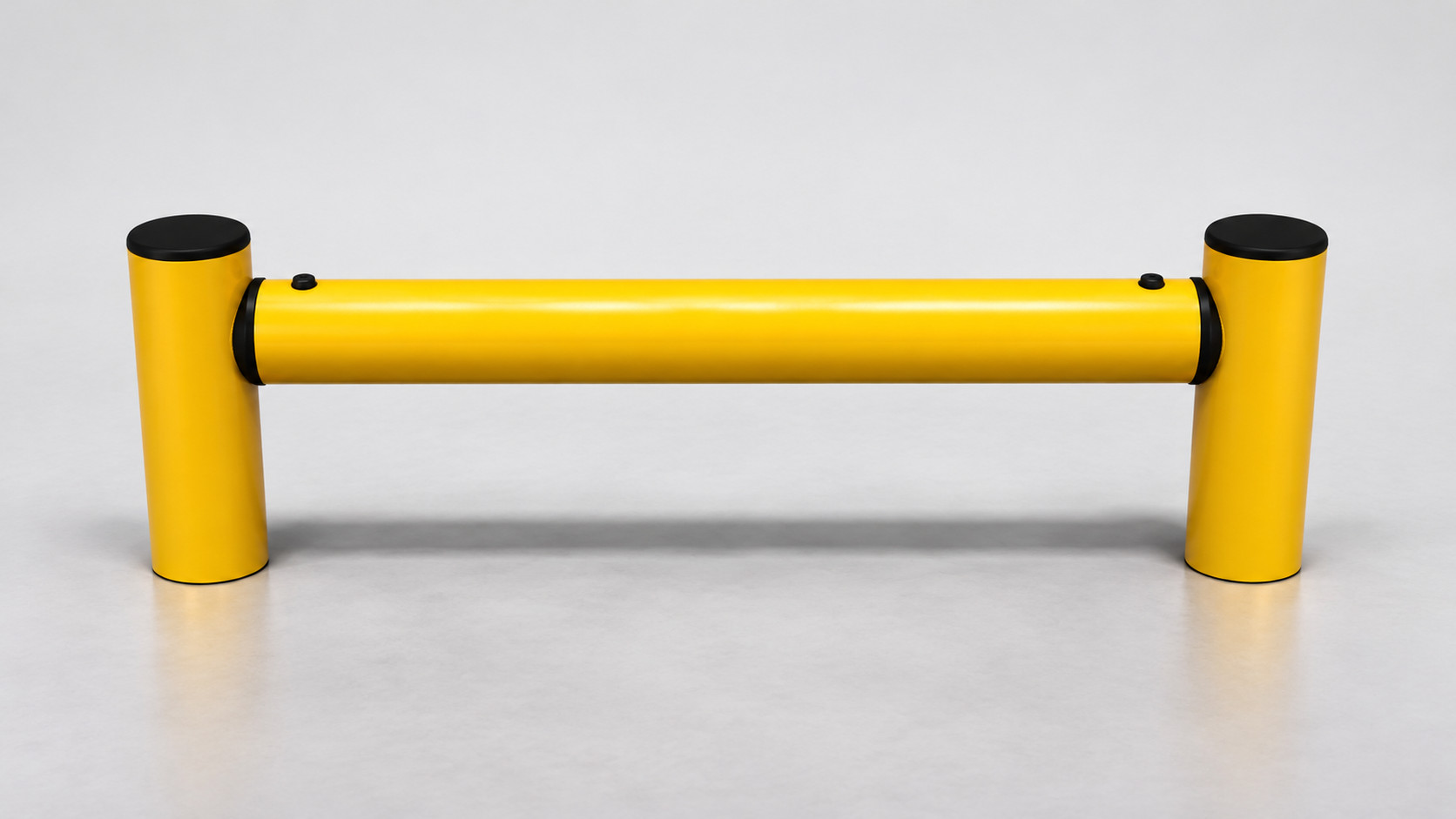
| Auswahlfaktor | Flexible Polymer Guardrail | Conventional Steel Guardrail |
|---|---|---|
| Behavior during impact | Designed to deflect under specified conditions. | Generally resists impact through comparatively rigid metal members. |
| Post-impact assessment | Inspect rails, connectors, posts and anchors for residual damage. | Inspect for permanent bending, joint damage and anchor displacement. |
| Available configurations | Single, multiple and other model-dependent rail arrangements. | Various fixed steel rail and post arrangements. |
| Impact performance | Must be verified using model-specific test conditions. | Must also be verified using model-specific structural or test data. |
| Einrichtung | Requires a suitable supporting surface and specified anchors. | Requires a suitable supporting surface and specified anchors. |
Neither material is automatically safer for every application. The correct decision depends on the impact exposure, available deflection clearance, protection objective, installation method and documented system performance.
Single-Rail vs Multi-Rail Flexible Guardrails
A single-rail barrier provides one horizontal impact member. It may be suitable where the expected contact height and tested protection conditions match that configuration. Multi-rail systems provide additional horizontal members at different heights and may help address different contact geometries or protection requirements.
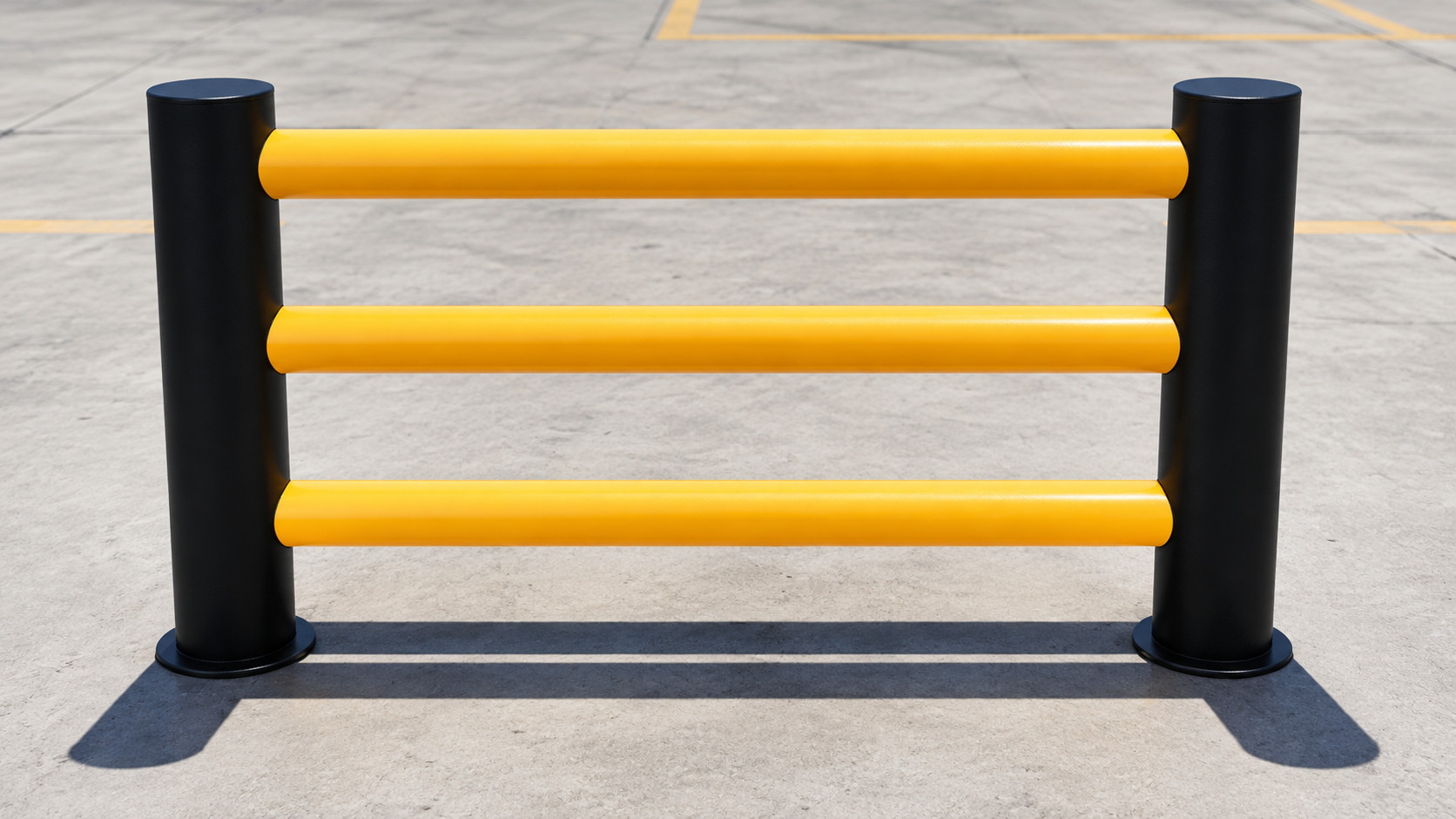
A three-rail system should not automatically be assumed to have three times the impact capacity of a single-rail design. Rail geometry, material dimensions, joint construction, post spacing and the tested collision scenario all affect performance.
3. Understanding Forklift Impact Ratings: Weight, Speed and Angle
Forklift barrier selection must account for the energy and direction of a potential collision. Vehicle mass alone is insufficient because the kinetic energy of a moving vehicle also depends on its speed.
Why Forklift Speed Is So Important
A basic engineering estimate of translational kinetic energy is:
Where E is kinetic energy in joules, m is mass in kilograms and v is velocity in metres per second.
Consider an illustrative vehicle mass of 2,000 kg travelling at 6 km/h. Converting 6 km/h to approximately 1.667 m/s produces a kinetic energy of about 2,778 J, or 2.78 kJ.
Increasing speed to 9 km/h with the same vehicle mass raises the calculated kinetic energy to approximately 6.25 kJ. This is 2.25 times the original energy.
What Happens When a Flexible Guardrail Is Hit?
During a collision, the rail may bend as energy is transferred through the polymer structure, connections, support posts and anchoring assembly. Depending on the collision conditions and the design of the barrier, the system may recover toward its original shape after unloading.

A visible bend is not a substitute for verified test performance. Engineers should request evidence addressing the relevant loading conditions, including vehicle mass, velocity, angle, contact point and the condition of the barrier and anchors after testing.
45° vs 90° Forklift Impact
Impact direction changes how a vehicle interacts with a guardrail. A collision at 90° is generally a more direct perpendicular approach to the barrier, whereas a 45° approach may involve additional sliding or deflection along the rail.
The impact angle should always be considered alongside the test speed and vehicle mass. A barrier performance statement at one angle cannot automatically be applied to a different collision scenario.
4. SEPPES Flexible Guardrail Models and Selection Considerations
SEPPES flexible guardrail options include single-round-rail models, three-rail configurations and a rectangular-rail alternative. The appropriate configuration depends on the required protection height, impact conditions, span length and installation layout.
| Model / Series | Known Specification | Selection Consideration |
|---|---|---|
| SP-90C | Single-round-rail range | Verify the listed impact conditions and dimensions for the model. |
| SP-125C | Single-round-rail range | Match the required impact scenario and post spacing. |
| SP-160C | Single-round-rail range | Review project-specific structural and installation requirements. |
| SP-180C | Single-round-rail range | Confirm the tested system configuration before selection. |
| SP-90 / SP-125 / SP-160 / SP-180 | Three-rail model range; SP-180 includes two 90 mm rails and one 125 mm rail. | Review rail heights and the relevant impact-test results. |
| SP-80-180C | Rectangular rail 180 × 80 mm, 10–11 mm wall; steel post diameter 114 mm, 5 mm wall. | Confirm clearances, anchor design and impact conditions for the complete assembly. |
The single-round-rail range uses post outer diameters spanning approximately 90–180 mm across the listed models. Rail diameters and wall thicknesses differ between configurations. Final dimensions should be confirmed against the current model-specific drawings and product documentation.
Example of Different Listed Impact Conditions
The supplied SP-125 model information describes a 2.0-tonne vehicle travelling at 6 km/h for a 45° impact, or 5 km/h for a 90° impact.
The supplied SP-180 model information describes a 3.0-tonne vehicle travelling at 9 km/h for a 45° impact, or 8 km/h for a 90° impact.
Can Guardrail Dimensions Be Customized?
Guardrail height, rail length, tube dimensions, number of rails and corner arrangements can be reviewed for customization. However, modifying a tested configuration may change its impact performance.
Engineers should therefore obtain confirmation of the applicable specifications for the customized assembly rather than automatically applying impact data from an existing standard model.
5. Concrete Anchoring and Flexible Guardrail Installation
The performance of a floor-mounted forklift protection barrier depends on more than the rail itself. Forces are transferred through the posts and base plates into the anchors and concrete substrate. Poor anchoring conditions can compromise the behavior of the entire installation.

Five Installation Factors to Verify
- Concrete condition: Confirm the substrate type, concrete strength and existing slab condition.
- Slab geometry: Check slab thickness, cracks, joints, edges and nearby embedded services.
- Anchor specification: Verify the permitted anchor type, grade, diameter, embedment, spacing and installation method.
- Barrier position: Confirm the post layout, required deflection clearance and separation from protected equipment or pedestrians.
- Inspection requirements: Inspect the base, connections and rail after any meaningful collision.
The supplied SEPPES guardrail information references floor-mounted bases, anchoring adhesive and customized anchoring hardware. A specified 10.9-grade anchor hardware option lists a maximum tensile-load figure of 16 kN.
That 16 kN figure describes the stated anchor-related data and does not represent the impact rating of the assembled barrier. Actual anchor resistance in concrete depends on the specified hardware, embedment, edge distances, concrete condition and installation design.
6. Planning a Warehouse Guardrail Layout
Effective industrial guardrail systems should be planned around actual forklift routes and pedestrian movement rather than placed only where empty floor space is available.
A practical planning sequence begins with a traffic survey. Identify the vehicle types, load handling patterns, turning zones, reversing areas, intersections and pedestrian access points.
Pedestrian Routes
Use continuous protective boundaries where necessary and provide clearly identified crossing points at suitable locations. Avoid creating narrow or inaccessible pedestrian routes.
Warehouse Racks
Review exposed rack ends and forklift turning patterns. Account for the space needed for pallet handling and the barrier's expected deflection.
Equipment Zones
Position barriers to reduce vehicle contact with machinery, cabinets and conveyors while retaining maintenance access.
Verladebereiche
Distinguish forklift circulation routes from loading-bay edges, trailer interfaces and dock equipment that may require different specialized protection.
The UK Health and Safety Executive recommends separating pedestrians and vehicle routes wherever possible, providing suitable protective barriers and keeping pedestrian routes away from vehicle entrances and other collision risks. Read the HSE guidance on separating pedestrians and vehicles .
Protecting High-Speed Industrial Doorways
Industrial door openings can be vulnerable to collisions because forklifts frequently travel through them, sometimes while turning, accelerating or carrying loads that reduce visibility.
A localized guardrail or bollard arrangement may help protect door tracks, frames, control panels and adjacent wall structures.
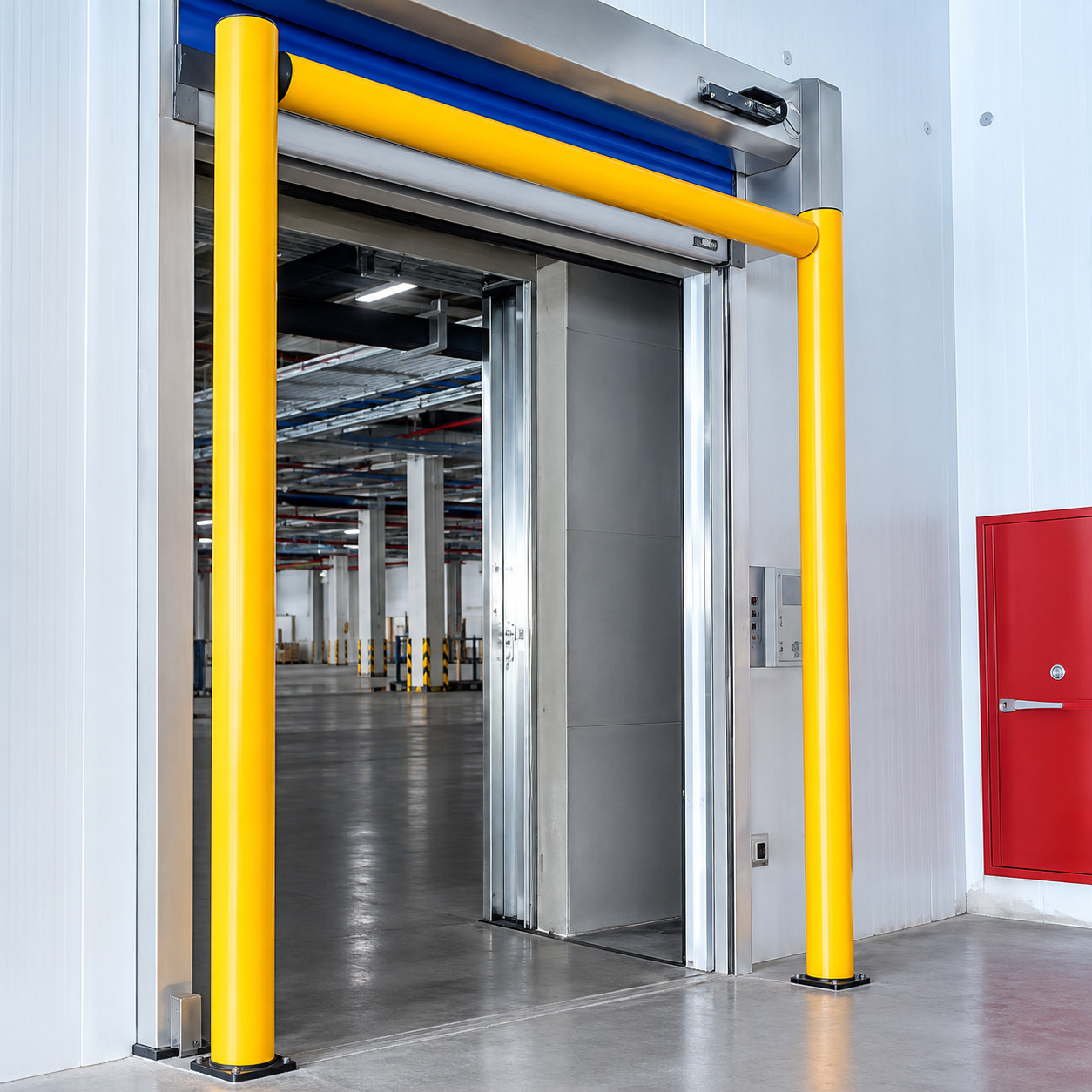
Doorway protection must preserve the door's clear opening, sensor detection area, emergency access and maintenance space. Barriers should not interfere with the operation of the door or introduce a new collision hazard.
Learn more about the surrounding equipment in our high speed roll up door product guide .
What About Automated Warehouses?
In facilities using automated guided vehicles or autonomous mobile robots, fixed physical boundaries may be part of a broader traffic management system.
However, guardrails must not replace the vehicle's required sensing, stopping, safeguarding or control functions. The barrier selection and traffic plan should consider the operating environment, potential human interaction and applicable safety requirements.
7. What Affects Forklift Protection Barrier Cost?
The purchase price of a flexible guardrail depends on the selected model, required height, installation length, number of posts and rails, corner geometry, anchoring configuration and project customization.
Buyers should compare the complete installed system rather than a price for an individual rail alone.
| Cost Factor | Zu bestätigende Informationen |
|---|---|
| Barrier model | Single-rail, multi-rail or rectangular-rail configuration |
| Abmessungen | Overall protection length, height and individual spans |
| Einrichtung | Base plates, anchors, concrete condition and labor |
| Personalisierung | Special corners, rail arrangements and colors |
| Dokumentation | Drawings, test information and installation instructions |
| Logistik | Packaging, delivery location and commercial terms |
| Wartung | Inspection procedures and replacement component availability |
Flexible guardrail tubing in the supplied product information uses a modified polymer blend. The listed round-post models incorporate internal steel reinforcement, while the base assemblies use metal, rubber and other components.
Specified colors include yellow RAL 1003 and black RAL 9017. Confirm the color arrangement for rails, posts and base components when requesting a quotation.
Procurement Checklist
For an accurate project review, prepare the following information:
- Company name, project country and contact information
- Preferred barrier model, if already known
- Protection area, required length and height
- Number of straight sections, corners and openings
- Forklift type and loaded operating weight
- Typical vehicle speed and traffic frequency
- Potential collision direction and impact location
- Concrete slab information and installation conditions
- Site drawings, traffic routes and photographs
- Project delivery location and required schedule
Providing these details helps the manufacturer review the engineering requirements and prepare a more relevant quotation. It also reduces the risk of selecting a system solely on nominal size or appearance.
8. Frequently Asked Questions About Flexible Forklift Guardrails
How do I choose the right flexible warehouse guardrail system?
Start with the protected area, required guardrail height and length, available installation space and expected forklift impact conditions. Then compare rail configurations, post dimensions and model-specific test data. Provide the vehicle's operating weight, speed, impact direction and traffic layout for a project-specific assessment.
Welche Spezifikationen sind für SEPPES SP-Leitplankenmodelle verfügbar?
The listed single-round-rail models include SP-90C, SP-125C, SP-160C and SP-180C, with post outer diameters across the range of approximately 90–180 mm. Three-rail options include SP-90, SP-125, SP-160 and SP-180. The rectangular-rail SP-80-180C uses a 180 × 80 mm rail with a stated 10–11 mm wall thickness and a 114 mm steel post with a 5 mm wall thickness.
Können Höhe, Länge und Anordnung flexibler Schutzplanken individuell angepasst werden?
Yes. Height, rail length, tube dimensions, number of rails and corner configurations can be reviewed for customization. The final design and applicable impact performance must be confirmed for the actual custom arrangement rather than assumed from a standard model.
Wie vergleiche ich die Aufprallbewertungen von Gabelstaplern über verschiedene Schutzgeländermodelle hinweg?
Compare the complete test conditions, including vehicle mass, speed, impact angle, contact location and barrier configuration. The supplied SP-125 information lists a 2.0-tonne vehicle at 6 km/h for 45° or 5 km/h for 90°. SP-180 lists a 3.0-tonne vehicle at 9 km/h for 45° or 8 km/h for 90°. These are stated model-test conditions, not universal collision capacities or independently verified certifications.
What should be checked before installing flexible guardrails?
Confirm the barrier layout, floor condition, concrete strength, slab thickness, base locations and anchoring requirements. Supplied 10.9-grade anchor hardware information references a maximum tensile-load figure of 16 kN, which is not a complete guardrail impact rating. Actual anchor design must be verified for the project.
What materials and colors are available for industrial guardrails?
The supplied guardrail information describes modified polymer tubing, internal steel reinforcement in listed round-post models and base assemblies incorporating metal and other components. Specified colors include yellow RAL 1003 and black RAL 9017. Confirm the final color configuration and materials for the selected model.
What information is needed for a warehouse guardrail quotation?
Provide the preferred model, protection length, height, quantity, site layout, forklift type, loaded operating weight, travel speed, impact direction and installation conditions. Include company details, destination country and target schedule so the supplier can prepare a project-specific quotation.
Plan Your Forklift Protection Barrier System
Need flexible warehouse guardrails for pedestrian routes, industrial doorways or machinery protection? Share your layout, forklift operating conditions and required dimensions with SEPPES.
Our team can review the available guardrail configurations and provide a project-specific recommendation and quotation.
Request a Guardrail QuoteReferences and Further Reading
- OSHA — Powered Industrial Trucks: Pedestrian Traffic . Workplace recommendations on forklift-pedestrian separation and protective barriers.
- OSHA — 29 CFR 1910.178: Powered Industrial Trucks . U.S. regulatory requirements for powered industrial trucks.
- UK HSE — Separating Pedestrians and Vehicles . Guidance covering traffic routes, barriers and crossing points.
- UK HSE — Site Layout and Internal Traffic Routes . Risk-assessment considerations for workplace traffic planning.
Product data note: Model descriptions and stated impact scenarios in this guide are based on the supplied SEPPES guardrail information. Confirm current model drawings, test reports, installation instructions and project-specific requirements before purchase.