
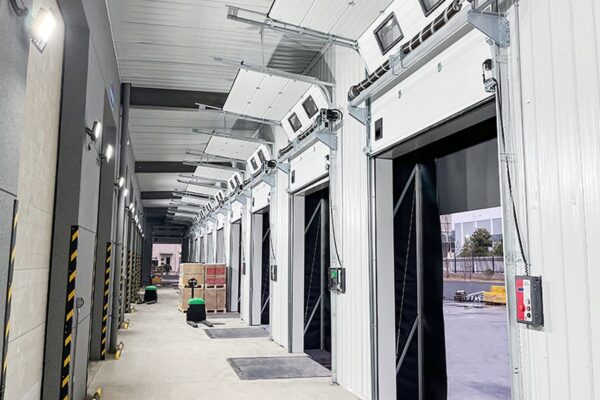
A dock leveler creates a safe transition between the loading dock and the truck, allowing forklifts and pallet trucks to move goods more efficiently.
For warehouses, factories, and logistics centers, choosing the right niveladores de muelle de carga is not only about platform size. You also need to consider truck height differences, loading frequency, rated capacity, operating method, and site conditions.
Índice
ToggleWhat Is a Loading Dock Leveler?
A dock leveler is a piece of equipo portuario installed between the warehouse floor and the truck bed.
When a truck arrives at the loading bay, the platform adjusts to the height of the truck and bridges the gap between the building and the vehicle.
A typical loading dock system may include:
- Dock leveler
- Puerta seccional industrial
- Dock shelter or dock seal
- Vehicle restraint or wheel guide
- Safety accessories
These components work together to improve loading efficiency and safety.
1. Choose the Right Type of Dock Leveler
Different niveladores de muelles are suitable for different loading conditions.
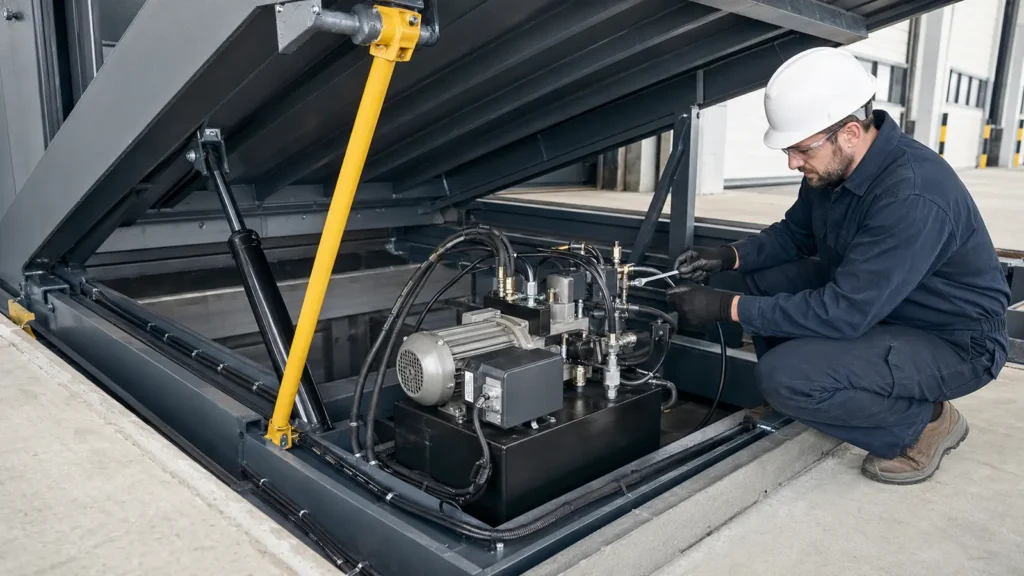
Rampa niveladora hidráulica
A rampa niveladora hidráulica uses a hydraulic system to raise and lower the platform.
It is widely used in warehouses, logistics centers, manufacturing plants, and distribution facilities.
Main advantages include:
- Easy operation
- Stable platform movement
- Suitable for frequent loading
- Lower manual effort
- Suitable for forklift traffic
For high-frequency loading docks, a hydraulic model is usually the preferred option.
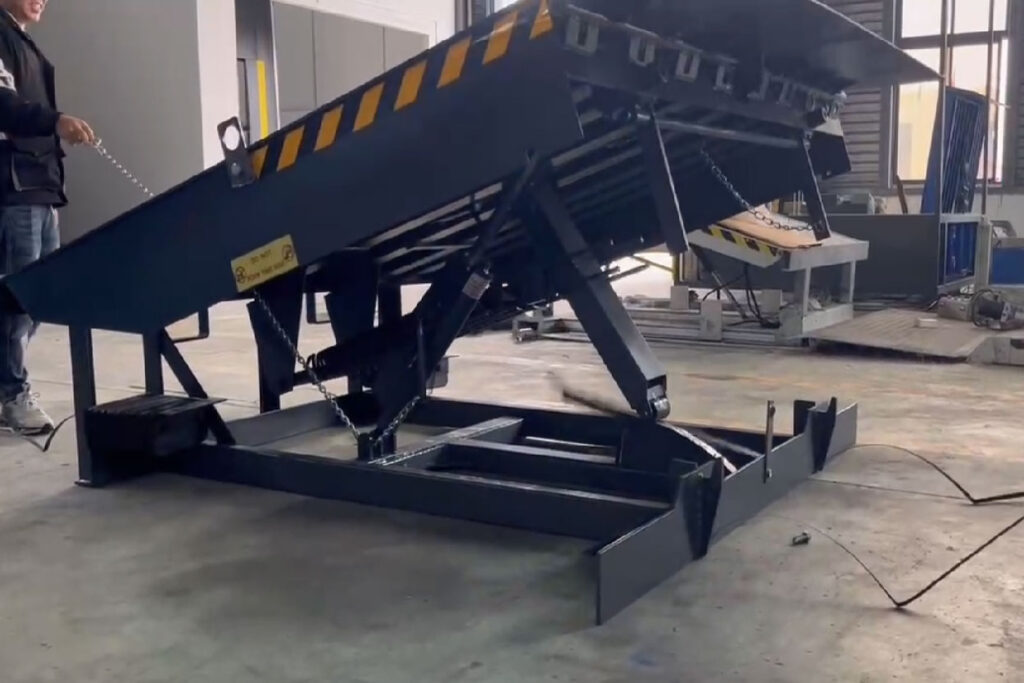
Nivelador de Muelle Mecánico
Mechanical dock levelers operate through a spring-assisted mechanism.
They normally have a simpler structure and can be suitable for loading areas with lower operating frequency.
However, more manual operation is generally required compared with a hydraulic dock leveler.
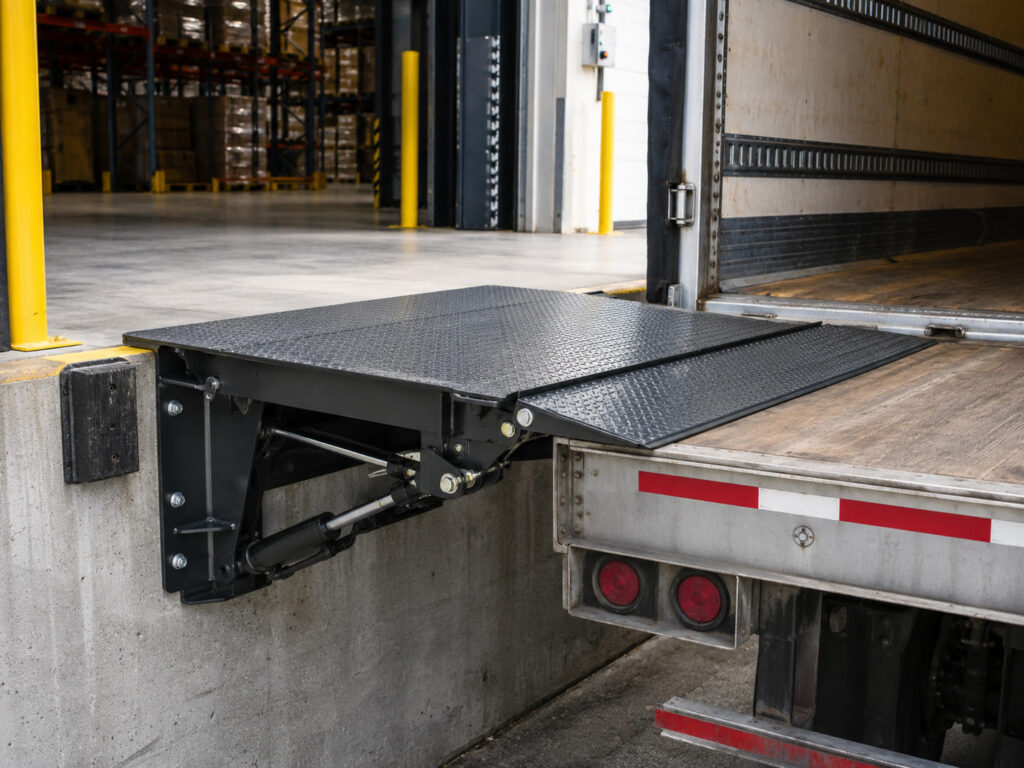
Edge-of-Dock Leveler
An edge-of-dock leveler is installed at the front edge of the loading dock.
It has a shorter working range than a standard pit-mounted dock leveler, but can be suitable where:
- Truck height differences are relatively small
- Installation space is limited
- A pit cannot be constructed
- Loading frequency is moderate
2. Check the Loading Capacity
| Load Capacity | Main Platform Thickness | Lip Plate Thickness | Configuration Notes |
|---|---|---|---|
| 6T | 6 mm | 12 mm | Suitable for standard loading applications |
| 8T | 8 mm | 14 mm | Common configuration for hinged-lip dock levelers |
| 10T | 8 mm | 16 mm | Suitable for heavier loading requirements |
| 15T / 20T | Customized | Customized | Available for heavy-duty applications |
Para hydrauli telescopic dock levelers, the standard dynamic load is 8T, with an 8 mm main platform y 16 mm lip plate. The telescopic lip can extend approximately 1,000 mm, making it suitable for applications requiring more precise positioning between the loading dock and truck bed.
When selecting capacity, consider the total working load:
Forklift + Operator + Cargo + Dynamic Impact
For high-frequency or heavy-duty loading, selecting a suitable safety margin can improve reliability and extend the service life of the dock leveler.
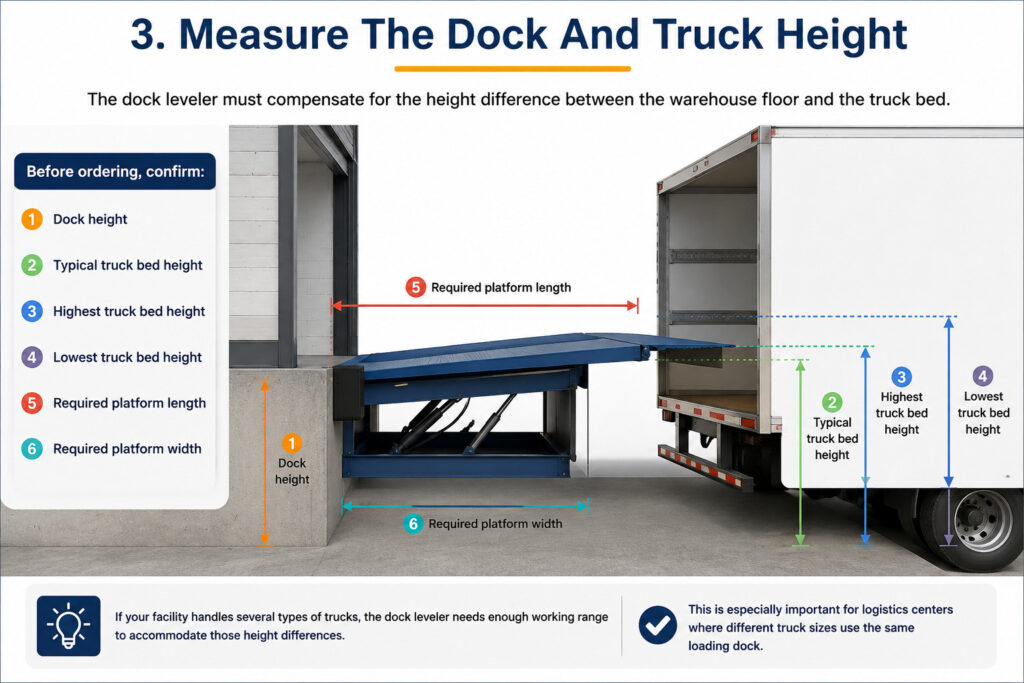
3. Measure the Dock and Truck Height
The dock leveler must compensate for the height difference between the warehouse floor and the truck bed.
Before ordering, confirm:
- Dock height
- Typical truck bed height
- Highest truck bed height
- Lowest truck bed height
- Required platform length
- Required platform width
If your facility handles several types of trucks, the dock leveler needs enough working range to accommodate those height differences.
This is especially important for logistics centers where different truck sizes use the same Muelle de carga.
4. Consider Loading Frequency
Loading frequency directly affects which type of dock leveler you should choose.
| Loading Frequency | Recommended Option |
|---|---|
| Occasional loading | Mechanical or basic hydraulic leveler |
| Daily loading | Rampa niveladora hidráulica |
| High-frequency logistics | Heavy-duty hydraulic dock leveler |
| Large forklift traffic | Higher-capacity hydraulic model |
For a busy distribution center, reducing loading time and operator effort can make a significant difference over hundreds of loading cycles.
5. Consider the Type of Vehicle and Forklift
Different loading operations place different demands on the platform.
Before selecting a dock leveler, consider:
- Forklift type
- Forklift wheel size
- Maximum loaded weight
- Pallet truck use
- Truck type
- Frequency of vehicle changes
Small hard wheels can create higher point loads on the platform than larger pneumatic forklift tires.
The dock leveler structure should therefore match the actual material-handling equipment used in the facility.
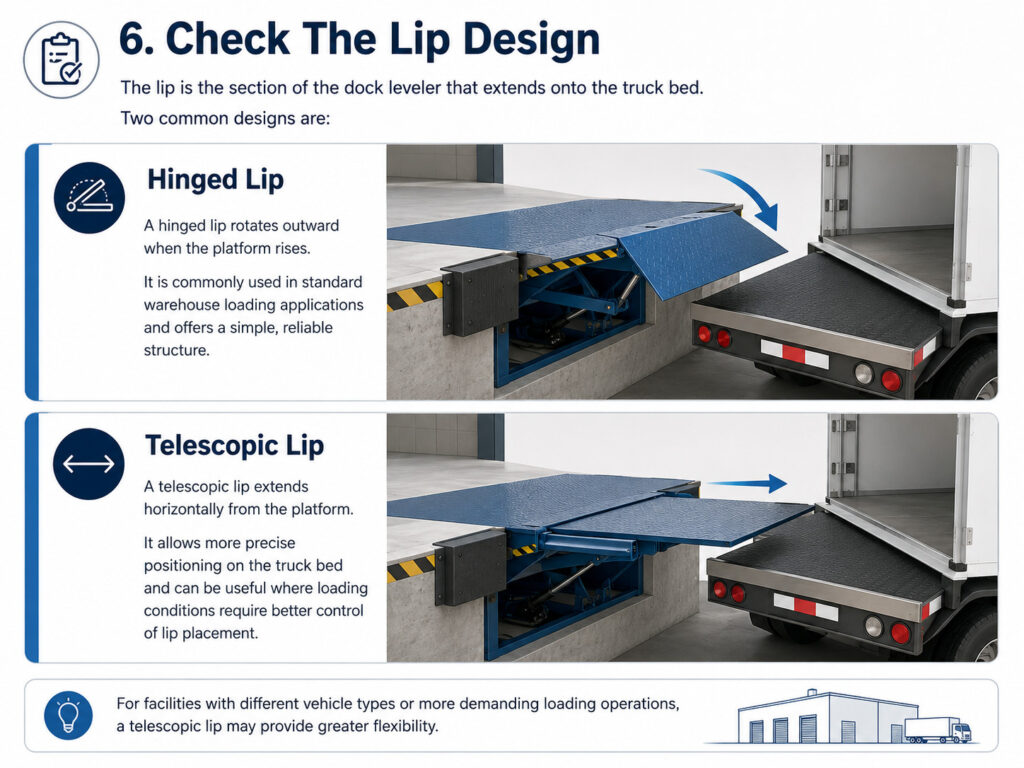
6. Check the Lip Design
The lip is the section of the dock leveler that extends onto the truck bed.
Two common designs are:
Hinged Lip
A hinged lip rotates outward when the platform rises.
It is commonly used in standard warehouse loading applications and offers a simple, reliable structure.
Telescopic Lip
A telescopic lip extends horizontally from the platform.
It allows more precise positioning on the truck bed and can be useful where loading conditions require better control of lip placement.
For facilities with different vehicle types or more demanding loading operations, a telescopic lip may provide greater flexibility.
7. Consider Safety Features
Safety should be a major factor when choosing equipo portuario.
Depending on the design, important safety features may include:
- Emergency stop
- Safety support bar
- Anti-fall protection
- Hydraulic safety system
- Toe guards
- Warning markings
- Non-slip platform surface
The loading dock should also be designed to reduce the risk of forklift movement while the platform is not properly positioned.
8. Consider the Complete Loading Dock System
A dock leveler should not be selected independently from the rest of the loading bay.
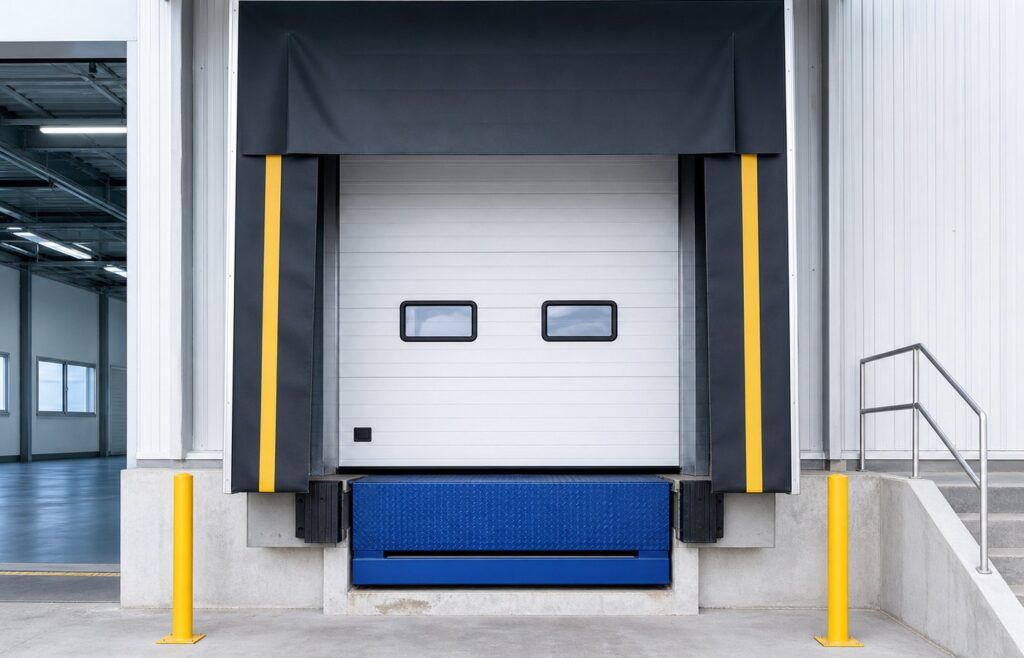
A complete system commonly consists of:
Industrial Sectional Door + Dock Shelter + Dock Leveler
The sectional door closes the building opening.
The dock shelter helps seal the gap between the truck and building.
The dock leveler connects the warehouse floor to the truck bed.
Together, these components can improve:
- Loading efficiency
- Weather protection
- Eficiencia energética
- Worker safety
- Building sealing
For temperature-controlled warehouses, proper coordination between the door, shelter, and leveler becomes even more important.
Nivelador de muelle vs Rampa de muelle
Although the terms dock ramp and dock leveler are sometimes used together, they are not always the same product.
A dock leveler is normally integrated into a fixed loading dock.
A truck loading ramp or yard ramp is usually used where goods must be loaded without a permanent raised dock.
Choose a dock leveler when you have a fixed loading bay.
Choose a mobile or fixed loading ramp when trucks need to be accessed directly from ground level.
What Information Is Needed for a Dock Leveler Quotation?
To receive an accurate quotation, prepare the following information:
- Pit width × length × depth
- Loading dock height
- Truck bed height range
- Required platform size
- Maximum loading capacity
- Forklift type and weight
- Loading frequency
- Cantidad
- Entorno de instalación
- Alimentación
Providing these details helps the manufacturer select the correct dock leveler configuration.
How to Choose the Right Loading Dock Leveler
For most modern warehouses and logistics centers, a rampa niveladora hidráulica provides a good balance of operating efficiency, reliability, and ease of use.
When selecting a model, focus on five factors:
- Loading capacity
- Truck height range
- Loading frequency
- Platform dimensions
- Safety requirements
The best dock leveler is not simply the largest or highest-capacity model. It is the one properly matched to your trucks, forklifts, loading volume, and building conditions.
PREGUNTAS FRECUENTES
What is a dock leveler used for?
A dock leveler bridges the gap and height difference between a loading dock and a truck, allowing forklifts and other material-handling equipment to move safely between them.
What type of dock leveler is best for a warehouse?
For warehouses with frequent loading operations, a hydraulic dock leveler is often the most practical choice because it offers convenient operation and stable performance.
How do I choose the capacity of a dock leveler?
Consider the combined weight of the forklift, operator, goods, and dynamic loads created during movement. Do not select capacity based only on cargo weight.
What is the difference between a dock leveler and a dock ramp?
A dock leveler is usually installed in a fixed loading dock, while a dock ramp is commonly used to connect ground level directly to a truck or container.
What equipment is normally used with a dock leveler?
A complete loading dock system can include an industrial sectional door, dock shelter, dock leveler, vehicle restraint, and other safety accessories.