
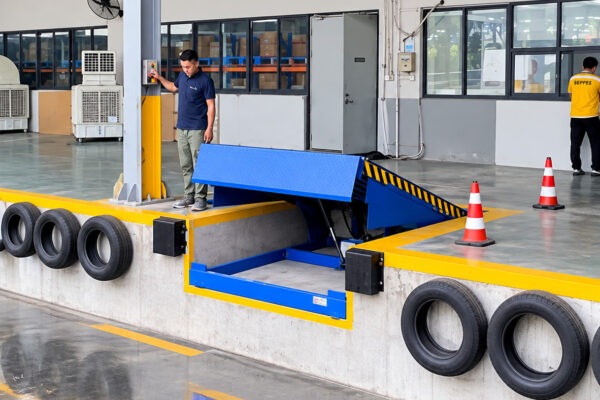
Hinged Lip vs Telescopic Lip Dock Leveler: Which Is Better?
Choosing the right dock leveler is essential for safe, efficient loading and unloading operations. Whether you operate a busy distribution center, manufacturing plant, cold storage warehouse, or logistics facility, the lip mechanism affects how effectively forklifts move between the loading dock and truck bed.
The hinged lip vs telescopic lip dock leveler comparison is particularly important for warehouse operators and procurement managers evaluating different loading bay configurations.
Both types of hydraulic dock levelers bridge the gap between a warehouse platform and a vehicle. However, they use different lip mechanisms, which affect extension control, truck compatibility, installation requirements, maintenance, and overall cost.
A hinged lip dock leveler is often suitable for conventional loading bays with predictable truck positioning. A telescopic lip dock leveler may offer additional flexibility when precise lip placement or adjustable reach is required.
This guide examines seven key differences, explains how each mechanism works, and provides practical recommendations for selecting the right dock leveler for your facility.
What Is a Hinged Lip Dock Leveler?
A hinged lip dock leveler, sometimes called a swing lip dock leveler, is a hydraulic loading platform equipped with a lip plate connected to the front edge of the deck through a hinge mechanism.
During a typical operating cycle, the hydraulic system raises the platform while the lip rotates outward. The platform then lowers until the lip rests securely on the truck bed, creating a transition for forklifts and material-handling equipment.

Main Advantages of Hinged Lip Dock Levelers
Simple mechanical design: The rotating lip mechanism is relatively straightforward compared with telescopic extension systems.
Cost-effective solution: Hinged lip models often have a lower initial purchase cost than comparable telescopic models.
Suitable for standard loading bays: They work well where truck positioning is relatively consistent.
Multiple capacity options: Different models are available for various forklift and cargo loads.
Industrial compatibility: They can be integrated with dock shelters, industrial doors, vehicle restraints, and other loading dock equipment.
Potential Limitations
A hinged lip follows a rotating movement rather than an independently controlled horizontal extension.
Its effective reach is determined by the lip geometry, platform position, and operating sequence.
Where truck positions vary significantly or precise placement is necessary, a telescopic lip mechanism may offer greater flexibility.
For conventional warehouse applications, explore SEPPES Hydraulic Dock Levelers.
What Is a Telescopic Lip Dock Leveler?
A telescopic lip dock leveler, also known as an extendable lip dock leveler, uses a lip that extends outward through a guided mechanism.
Unlike a conventional hinged lip, the telescopic lip can be extended to a controlled position before being placed onto the vehicle bed.
This enables more adjustable reach within the equipment’s specified operating range.

Main Advantages of Telescopic Lip Dock Levelers
Adjustable lip extension: Allows more controlled placement onto the vehicle bed.
Flexible truck compatibility: Can accommodate certain variations in truck positioning and available overlap.
Precise loading transitions: Useful where the lip must be positioned carefully.
Industrial automation: Available with hydraulic controls and compatible loading dock equipment.
Suitable for demanding loading applications: Can be valuable in facilities handling different vehicle types.
Potential Limitations
Telescopic lip dock levelers usually incorporate additional moving components, guides, and extension mechanisms.
This may increase the initial purchase cost and require additional maintenance attention.
However, the operational benefits may justify the investment where adjustable lip placement improves loading efficiency.
Explore the SEPPES Hydraulic Dock Leveler Range for available configurations.
Hinged Lip vs Telescopic Lip Dock Leveler: 7 Key Differences
1. Lip Operating Mechanism
The fundamental difference lies in how the lip moves.
A hinged lip rotates outward around a hinge connection, while a telescopic lip extends horizontally through a guided mechanism.
Both mechanisms create a bridge between the loading platform and the vehicle, but their movement characteristics differ.
2. Lip Reach and Positioning Control
A hinged lip has a defined deployment movement based on its geometry.
A telescopic lip allows its extension to be controlled within the manufacturer’s specified travel range.
This adjustable reach may be particularly useful when trucks do not always park at exactly the same position.
However, longer extension does not automatically mean that a leveler can safely accommodate every truck.
The minimum required lip overlap, support conditions, and operating limits must always be respected.
3. Truck Compatibility
Both hinged and telescopic lip dock levelers can accommodate differences in truck bed heights through movement of the main platform, provided the truck remains within the leveler’s approved working range.
Hinged lip systems are commonly suitable for standard warehouse loading bays with predictable vehicle positioning.
Telescopic lip systems may offer advantages where truck positions, available overlap, or loading surface arrangements vary.
4. Loading Efficiency
Loading efficiency depends on the complete loading process, not only the lip mechanism.
Important factors include:
Truck positioning
Forklift traffic frequency
Loading dock layout
Vehicle restraints
Dock door operation
Operator procedures
Hinged lip designs provide a straightforward operating sequence for routine loading operations.
Telescopic lip designs allow more controlled lip positioning, which can be helpful in demanding applications.
Neither type is universally faster in every loading situation.
5. Installation and Pit Requirements
Dock leveler installation requirements depend on the manufacturer, equipment model, capacity, and frame construction.
Hinged and telescopic lip models may have different:
Pit dimensions
Structural support requirements
Hydraulic configurations
Electrical requirements
Service clearances
A telescopic lip dock leveler cannot automatically be installed in a pit originally designed for a hinged lip unit, even when the nominal platform dimensions appear identical.
For additional guidance, read Dock Leveler Installation: The Ultimate Safe Guide.
6. Maintenance Requirements
Both dock leveler types require regular inspections and preventive maintenance.
For hinged lip systems, maintenance typically includes checking the hinges, hydraulic system, frame, platform deck, and controls.
For telescopic lip systems, additional attention may be required for the extension guides, sliding components, and associated hydraulic mechanisms.
Actual maintenance frequency should follow the manufacturer’s instructions and reflect the facility’s operating conditions.
7. Initial Cost and Long-Term Value
Hinged lip dock levelers often have a lower initial purchase price than comparable telescopic systems.
Telescopic designs may involve higher upfront costs due to their more complex mechanisms.
However, where adjustable reach provides meaningful operational benefits, the additional investment may be justified.
The total cost of ownership should consider equipment price, installation, spare parts, maintenance, loading frequency, and downtime.
Hinged Lip vs Telescopic Lip Dock Leveler Comparison Chart
Vergleich | Hinged Lip Dock Leveler | Telescopic Lip Dock Leveler |
|---|---|---|
Lip movement | Rotates outward | Extends horizontally |
Extension control | Defined by hinge geometry | Adjustable within extension range |
Mechanism | Relatively simple | Komplexer |
Truck positioning | Best for predictable conditions | Useful for variable positioning |
Initial cost | Often lower | Often higher |
Maintenance focus | Hinges, hydraulics, frame | Extension guides, hydraulics, frame |
Pit requirements | Model-specific | Model-specific |
Typical application | Standard warehouse loading | Controlled or adjustable lip placement |
Key takeaway: Hinged lip dock levelers are generally practical for conventional loading operations, while telescopic lip models may provide additional flexibility when precise lip placement is important.
SEPPES Hydraulic Dock Leveler Specifications
SEPPES provides customizable hydraulic dock levelers for warehouses, distribution centers, manufacturing plants, and industrial loading bays.
The following figures illustrate reference configurations discussed in SEPPES technical materials. Final product specifications should be confirmed for the selected model.
Spezifikation | Hinged Lip Reference | Telescopic Lip Reference |
|---|---|---|
Reference dimensions | W1600 × L2000 × H600 mm | W1600 × L2000 × H600 mm |
Rated load | 6T reference | 8T reference |
Main deck plate | 8 mm reference | 8 mm reference |
Lip type | Hinged rotating lip | Extendable telescopic lip |
Lip dimensions | 400 mm sample lip length | Up to approximately 1000 mm extension in referenced configuration |
Power reference | 380V / 1.1 kW | 380V / 1.5 kW |
Personalisierung | Size, capacity, controls | Size, extension, capacity, controls |
Technical note: These values are configuration references, not universal specifications. Final load ratings, extension range, electrical parameters, and pit dimensions must be verified against approved model-specific drawings.
Which Dock Leveler Is Better for Forklift Loading?
Both hinged lip and telescopic lip dock levelers can be suitable for forklift operations when correctly selected for the required capacity and loading conditions.

Choose a Hinged Lip for Standard Warehouse Operations
A hinged lip dock leveler is often a practical option when:
Trucks have relatively consistent bed heights and parking positions.
Loading operations follow a predictable routine.
Operators require a straightforward hydraulic platform.
Initial equipment cost is an important consideration.
Additional telescopic reach is unnecessary.
For general distribution centers and manufacturing warehouses, hinged lip systems may offer a suitable balance of performance and cost.
Choose a Telescopic Lip for More Demanding Loading Conditions
A telescopic lip dock leveler may be preferable when:
Different types of vehicles use the same loading bay.
Truck positioning varies.
More precise lip placement is required.
The available overlap changes between vehicles.
The facility benefits from adjustable lip reach.
The selection should always be verified against actual truck dimensions, forklift loads, dock height, and manufacturer operating limits.
Hinged vs Telescopic Lip Dock Levelers for Different Industries
Lagerhäuser und Vertriebszentren
Standard warehouses often prioritize reliable loading performance, simple operation, and efficient forklift traffic.
For consistent truck positioning, hinged lip dock levelers may be sufficient.
Telescopic lip levelers become particularly relevant where different truck configurations or loading conditions require additional lip placement control.
Cold Storage and Refrigerated Warehouses
Cold-chain facilities face additional requirements related to temperature control, moisture, and loading bay sealing.
The choice between hinged and telescopic lips should be evaluated alongside the complete loading dock system.
Important equipment may include:
Insulated industrial doors
Dock shelters and seals
Vehicle restraints
Hydraulische Laderampen
Loading dock control systems
Where precise truck positioning and effective dock sealing are priorities, telescopic lip operation may provide useful placement flexibility.
For temperature-controlled loading bays, explore SEPPES Inflatable Dock Shelters.
Fertigungseinrichtungen
Manufacturing plants may receive raw materials and dispatch finished products using different vehicle types.
Dock leveler selection should consider load capacity, forklift dimensions, daily loading frequency, and vehicle positioning.
Hinged lip levelers may suit routine operations, while telescopic lip levelers may be more appropriate where additional positioning flexibility is needed.
Food and Pharmaceutical Logistics
These applications may require coordinated dock sealing, controlled vehicle movement, reliable cargo transfer, and suitable cleaning procedures.
Neither lip mechanism alone provides temperature-control or food-safety compliance. The complete loading bay configuration must be assessed.
Installation and Pit Requirements
Before purchasing a hydraulic dock leveler, confirm the existing or planned loading dock pit dimensions.
Important measurements include:
Installation Requirement | Information Needed |
|---|---|
Pit width | Clear width in mm |
Pit length | Front-to-back length in mm |
Pit depth | Vertical depth in mm |
Dock height | Finished loading platform height |
Truck heights | Minimum and maximum bed heights |
Loading capacity | Forklift and cargo operating loads |
Electrical supply | Voltage and frequency |
Installation conditions | Concrete structure and available clearance |
The selected model must match the loading dock structure and intended operating conditions.
Never construct or modify a dock leveler pit based solely on nominal platform dimensions. Use the approved manufacturer’s installation drawing.
Safety Considerations for Both Lip Types
Loading dock safety depends on more than the lip mechanism.
A safe loading operation requires proper vehicle positioning, adequate lip support, suitable load capacity, operator training, and appropriate equipment inspection.
Key considerations include vehicle movement prevention, correct lip placement, safe forklift traffic, and regular servicing.
Relevant U.S. workplace safety guidance includes OSHA 29 CFR 1910.26 — Dockboards und OSHA 29 CFR 1910.147 — Control of Hazardous Energy.
For busy industrial loading bays, an appropriate SEPPES Truck Restraint System may also be considered.
Maintenance and Lifecycle Costs
Preventive maintenance plays an important role in reliable dock leveler operation.
Hinged lip and telescopic lip systems should both be inspected according to the manufacturer’s maintenance schedule.
Common inspection areas include:
Platform structure
Hydraulic components
Lip movement
Mechanical joints
Electrical controls
Safety-related components
Visible wear or deformation
For telescopic systems, the extension and guide mechanisms may require additional inspection attention.
A more complex mechanism is not automatically less reliable. Maintenance outcomes depend on product quality, installation, operating frequency, environmental conditions, and servicing.
How to Choose the Right Hydraulic Dock Leveler
Before requesting a quotation, warehouse operators and procurement managers should collect the following information:
Project Requirement | Information to Provide |
|---|---|
Dock leveler size | Required platform width and length |
Pit dimensions | W × L × D in mm |
Dock height | Finished platform height |
Truck specifications | Bed height range and vehicle types |
Forklift loading | Maximum forklift and cargo weight |
Betriebsfrequenz | Estimated cycles per day |
Lip requirements | Required reach and overlap |
Stromversorgung | Voltage and frequency |
Anmeldung | Warehouse, factory, cold storage, logistics |
Project location | Country, city, or nearest shipping port |
Providing accurate project information helps the manufacturer recommend a suitable hinged lip or telescopic lip hydraulic dock leveler.
Häufig gestellte Fragen
What is the difference between a hinged lip and telescopic lip dock leveler?
A hinged lip rotates outward around a hinge connection after the platform rises. A telescopic lip extends horizontally, allowing more controlled reach and placement within its operating range.
Which dock leveler is better for a standard warehouse?
For conventional loading bays with predictable truck positioning, a hinged lip dock leveler may offer a practical combination of reliability, operational simplicity, and cost.
When should I choose a telescopic lip dock leveler?
A telescopic lip model may be suitable when truck parking positions vary, available overlap differs between vehicles, or precise lip placement is required.
Are telescopic lip dock levelers safer than hinged lip models?
Neither mechanism is automatically safer in every situation. Safety depends on equipment design, correct selection, installation, operating procedures, and maintenance.
Is a telescopic lip dock leveler more expensive?
Telescopic models often cost more initially because of their additional extension mechanism. Actual pricing depends on dimensions, capacity, controls, and manufacturer specifications.
Can both types handle forklift traffic?
Yes. Both designs can support forklift loading when their rated capacity, working range, lip support, and platform dimensions match the application.
Do hinged and telescopic lip dock levelers require the same pit dimensions?
Not necessarily. Installation and pit dimensions vary by manufacturer and model. Always obtain an approved technical drawing before construction or replacement.
Which dock leveler is better for cold storage?
Both types may be suitable for cold-chain facilities. The choice depends on truck positioning, loading requirements, environmental conditions, and the complete loading dock sealing arrangement.
Conclusion: Which Dock Leveler Should You Choose?
Choosing between a hinged lip and telescopic lip dock leveler depends on the actual loading conditions of your facility.
A hinged lip dock leveler is often a cost-effective and practical solution for conventional warehouse loading bays with predictable truck positioning.
A telescopic lip dock leveler provides more adjustable reach and controlled lip positioning, making it worth considering for facilities with varying vehicle configurations or more demanding loading requirements.
Neither design is universally better. The right choice depends on truck compatibility, loading capacity, lip overlap, installation conditions, operating frequency, and lifecycle costs.
By evaluating these factors before purchasing, warehouse operators can select equipment that supports reliable cargo handling and efficient daily operations.
Get a Customized Dock Leveler Solution from SEPPES
SEPPES manufactures customizable hydraulic dock levelers for industrial warehouses, distribution centers, factories, and cold-chain logistics facilities.
Whether you need a hinged lip dock leveler for standard loading operations or a telescopic lip model for more controlled extension, our team can help evaluate your project requirements and recommend a suitable configuration.
To receive a quotation, please provide your loading dock dimensions, truck bed height range, forklift loads, required quantity, and project location.