
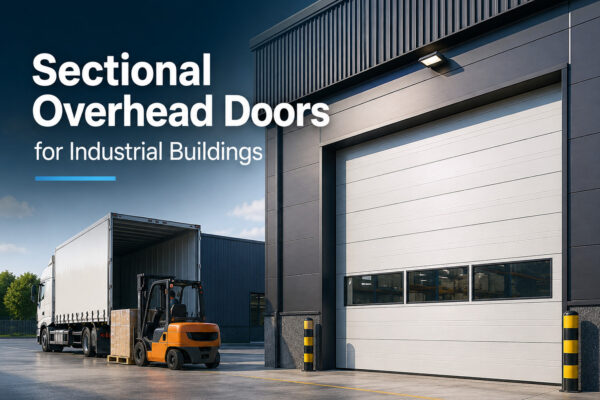
A porta seccional de elevação is a practical solution for warehouses, factories, logistics centers, workshops, and other industrial buildings. It opens vertically and moves along tracks beneath or above the ceiling, saving space around the doorway while providing good insulation, sealing, security, and wind resistance.
For industrial projects, choosing the right as portas seccionais de sobrecarga is not only about door size. The building structure, available headroom, opening frequency, insulation requirements, and outdoor conditions should all be considered.
Índice
AlternarWhat Is a Sectional Overhead Door?
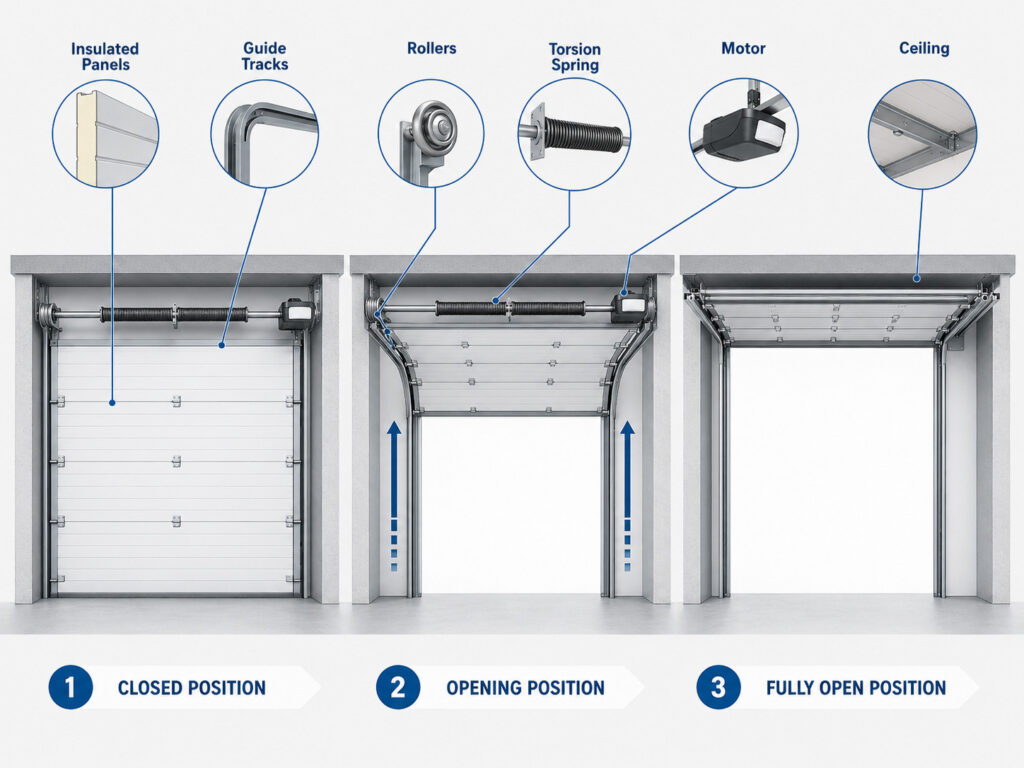
A sectional overhead door is made of several horizontal door panels connected by hinges. When the door opens, the panels move upward along guide tracks instead of swinging outward.
Most portas seccionais industriais use insulated sandwich panels, making them suitable for exterior entrances and buildings where temperature control is important.
Compared with traditional swing doors, sectional doors also allow forklifts and vehicles to park or operate closer to the entrance.
Why Are Sectional Overhead Doors Used in Industrial Buildings?
Good Thermal Insulation
Uma porta seccional isolada normally uses steel sandwich panels filled with polyurethane foam.
This construction helps reduce heat transfer between indoor and outdoor environments, making sectional doors suitable for:
- Armazéns
- Fábricas de manufatura
- Temperature-controlled workshops
- Logistics facilities
- Automotive service buildings
For facilities using heating or air conditioning, better door insulation can also help reduce unnecessary energy loss.
Better Sealing Against Wind, Dust and Rain
Industrial sectional doors can use seals around the top, sides, and bottom of the opening.
A properly installed sealing system helps reduce:
- Dust entering the building
- Outdoor air infiltration
- Wind
- Rainwater entering around the door edges
For exterior factory doors, sealing performance should be considered together with local weather conditions and the size of the opening.
Space-Saving Opening
Because as portas seccionais de sobrecarga open vertically, they do not require the clearance needed by traditional swing doors.
This is useful in loading areas and warehouses where trucks, forklifts, equipment, or stored goods need to stay close to the doorway.
Standard Lift, High Lift or Vertical Lift?
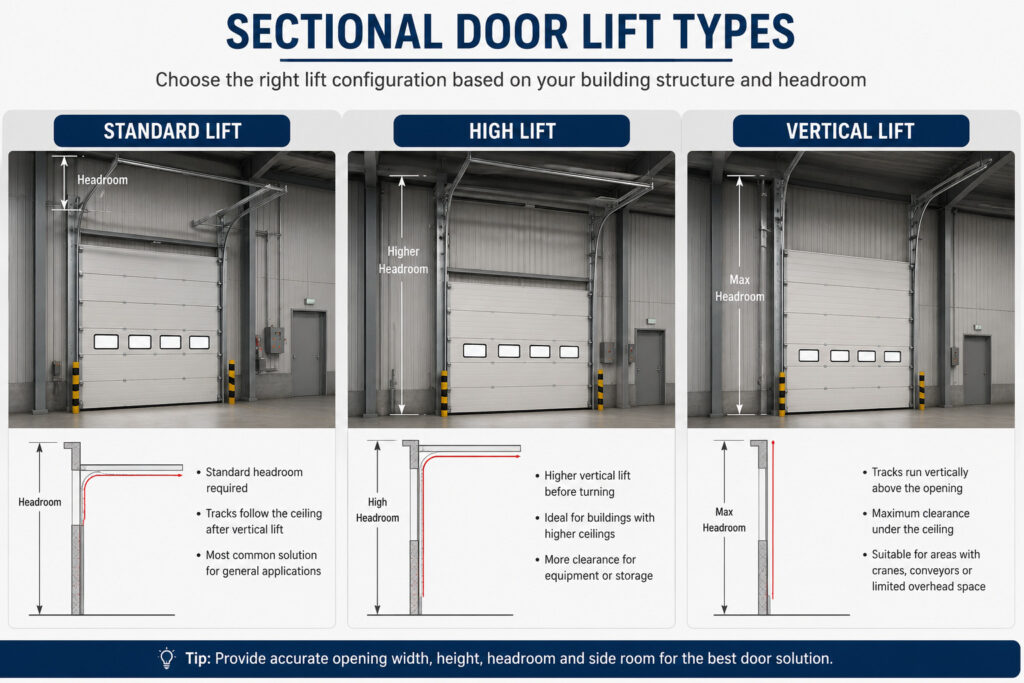
One important factor when choosing a sectional door is the lifting method.
The correct configuration depends mainly on the building structure and the available space above the opening.
| Building Condition | Recommended Lift Type |
|---|---|
| Normal warehouse with sufficient headroom | Standard lift |
| Limited ceiling space | Low headroom lift |
| High ceiling or tall warehouse | High lift sectional door |
| Maximum vertical clearance required | Elevação Vertical |
A Porta seccional de elevação alta, for example, allows the door to travel vertically for a longer distance before following the ceiling.
This can be useful in factories with high ceilings, cranes, warehouse racks, or other equipment near the doorway.
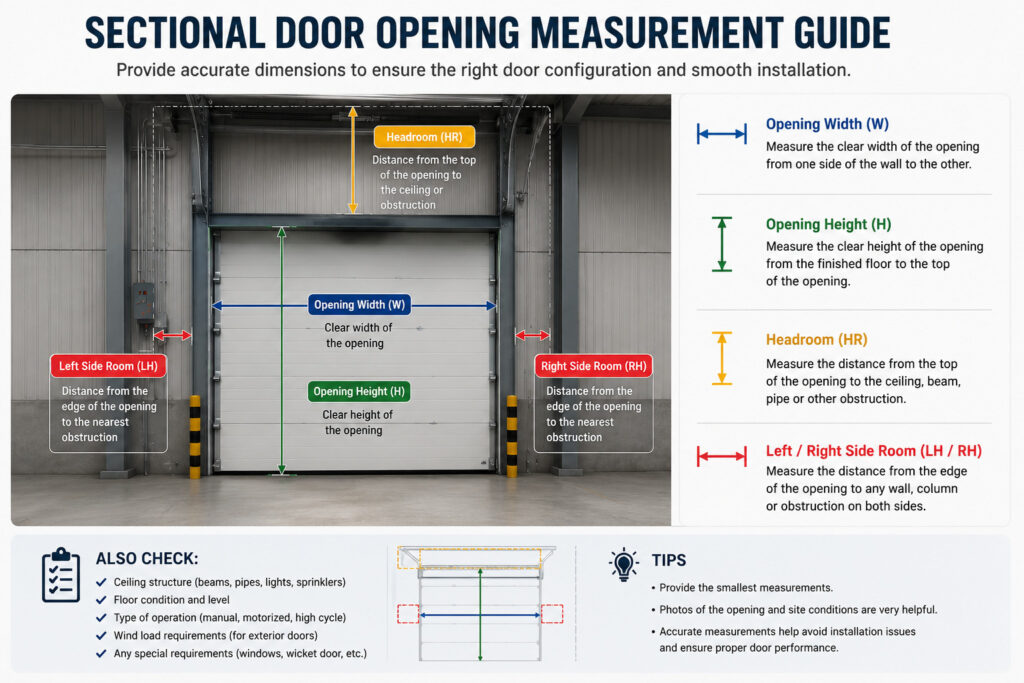
Before choosing the lift type, check the opening width, height, headroom, side room, ceiling structure, beams, pipes, and other possible obstacles.
Sectional Overhead Door vs. Roller Shutter Door
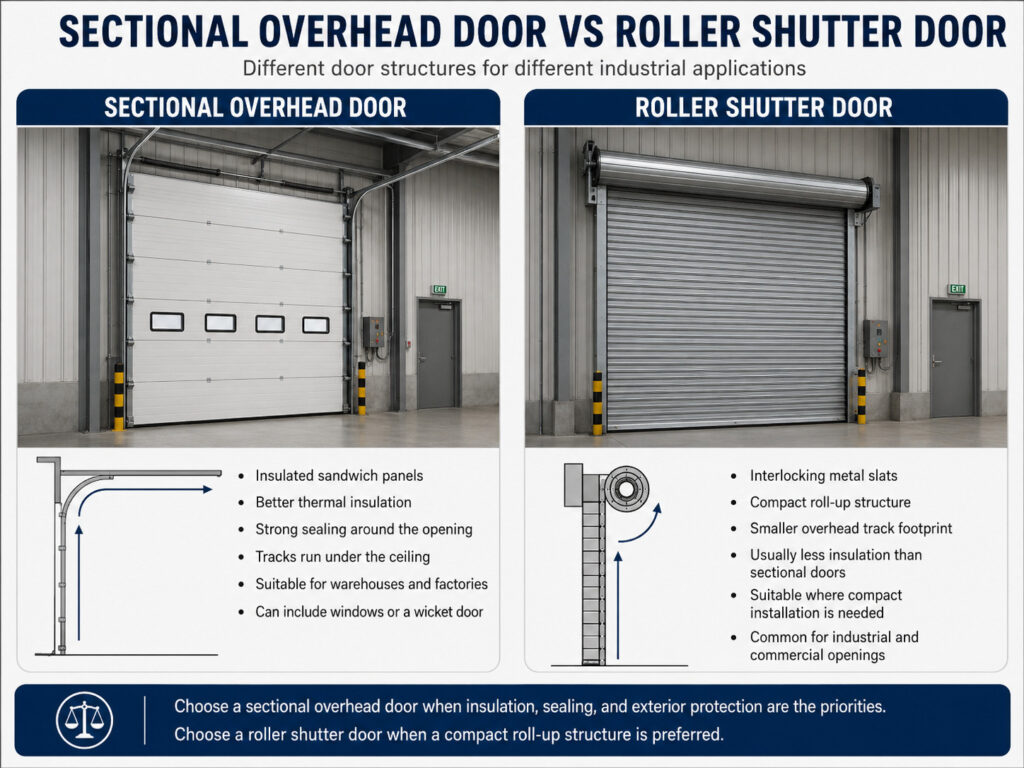
Both Portas seccionais e roller shutter doors are widely used for industrial entrances, but they have different strengths.
A sectional overhead door normally provides better thermal insulation because it uses thicker insulated panels and sealing systems.
Roller shutters, on the other hand, use interconnected slats that roll around a shaft above the opening. They can be useful where a compact door structure is required.
A sectional overhead door is often preferred when the project requires:
- Melhor isolamento
- Selagem forte
- Exterior building protection
- Resistência ao vento
- Janelas ou painéis de visão
- A more finished building appearance
The best option depends on the building and operating requirements rather than simply choosing one door type for every application.
Sectional Door or High Speed Door?
Choose an Porta seccional industrial when the main priorities are:
- Isolamento
- Segurança
- Exterior protection
- Resistência ao vento
- Moderate opening frequency
Consider a high speed door when the main priority is:
- Frequent forklift traffic
- Abertura e fechamento rápidos
- Production area separation
- Reducing air exchange
- Automated material flow
Some factories use both systems together: a sectional door provides exterior protection, while a high speed door manages frequent daily traffic.
What Should You Check Before Ordering?
Before requesting a quotation for a sectional overhead door, provide the following information whenever possible:
1. Opening width and height
These determine the basic door dimensions.
2. Available headroom
The space above the opening determines which lifting system can be used.
3. Left and right side room
Tracks and other components require installation space beside the opening.
4. Indoor or outdoor application
Exterior doors may require stronger wind resistance and sealing.
5. Opening frequency
A door used several times per day has different operating requirements from one used continuously by forklifts.
6. Insulation requirements
For facilities with indoor temperature control, panel thickness and sealing become more important.
7. Building obstacles
Check for pipes, beams, lighting, cranes, ducts, and other equipment near the door opening.
Providing this information helps the manufacturer recommend the appropriate panel, track system, motor, and safety configuration.
Aplicações Comuns
Sectional overhead doors are commonly used for:
- Armazéns
- Fábricas
- Centros logísticos
- Centros de distribuição
- Áreas de carga
- Automotive workshops
- Industrial garages
- Equipment entrances
For large exterior openings, door dimensions and local wind conditions should also be evaluated before confirming the final configuration.
Portas seccionais de elevação for industrial buildings provide a strong combination of insulation, sealing, security, and space efficiency.
However, the best door is not determined by the product name alone. The opening size, building structure, headroom, traffic frequency, weather conditions, and insulation requirements should all be considered.
If you are planning a warehouse or factory project, providing the door width, height, headroom, application, and installation conditions will make it much easier to select the right industrial sectional door configuration.