
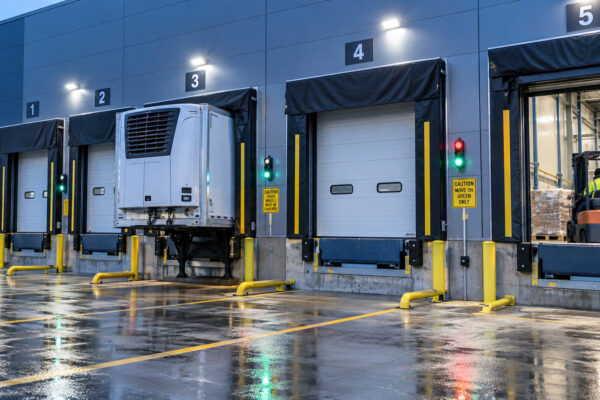
Loading dock safety is especially important at refrigerated dispatch bays, where forklifts, refrigerated trucks, dock levelers, sectional doors and sealing equipment operate within the same high-traffic area.
A safe loading bay is more than a dock leveler or industrial door. The loading dock door, dock shelter, vehicle restraint, traffic lights, loading dock bumpers, forklift routes and operating procedures should work as one coordinated system.
Cold-chain facilities must also consider wet floors, condensation, temperature differences and frequent movement between refrigerated storage and transport vehicles.
For a broader overview of refrigerated warehouse access systems, see the SEPPES cold storage doors and loading dock equipment solution .
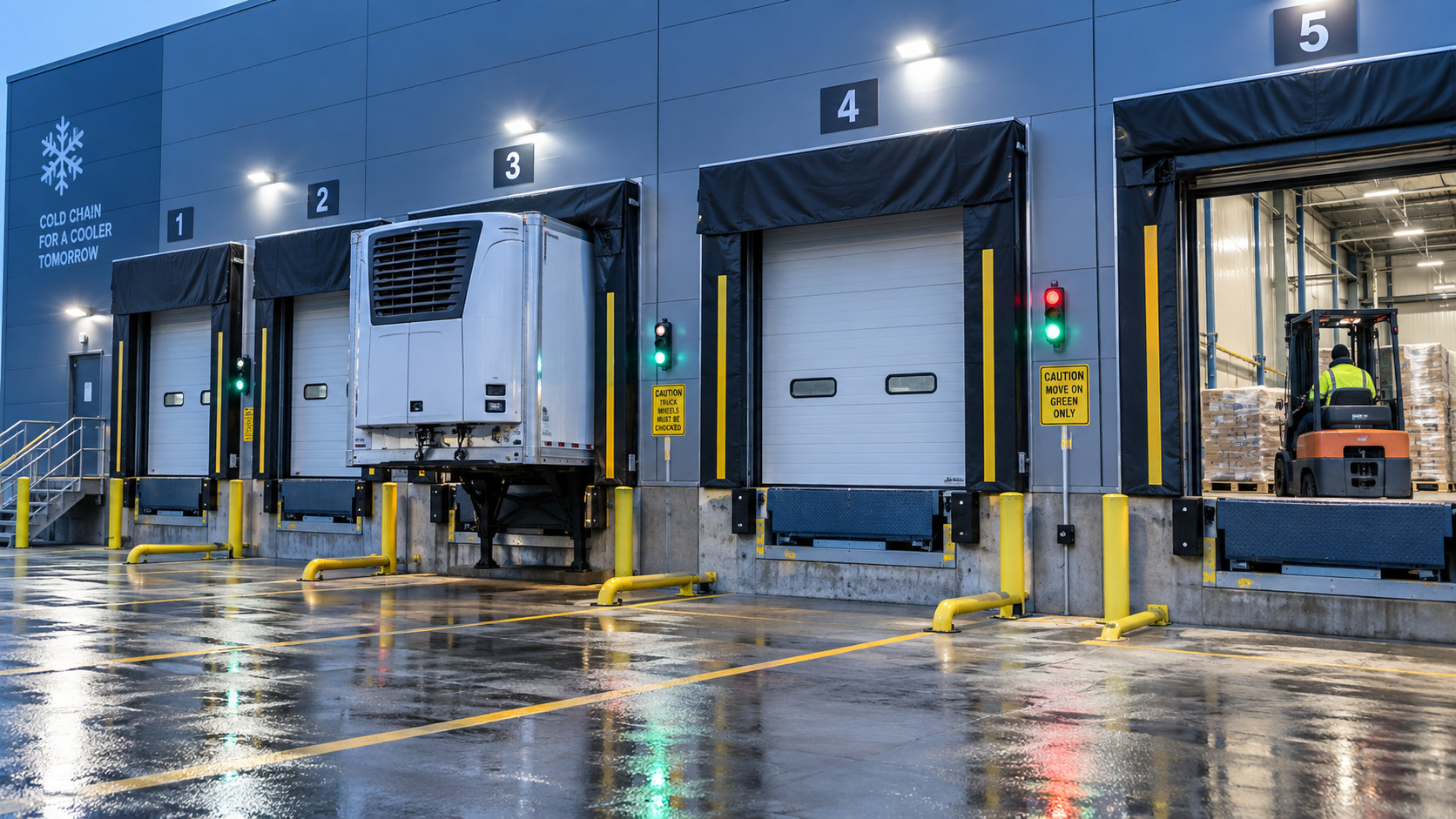
Why loading dock safety is different at refrigerated dispatch bays
Refrigerated loading docks combine normal warehouse dispatch risks with additional cold-chain operating conditions.
Common loading dock safety considerations include:
- forklifts repeatedly entering and leaving refrigerated trailers;
- differences between truck-bed height and warehouse platform height;
- trailers moving into and away from loading docks;
- wet, icy or condensation-affected working surfaces;
- open dock edges when no truck is positioned;
- restricted visibility around vehicles and dock shelters;
- high-frequency loading dock door cycles;
- temperature exposure during loading and unloading.
OSHA identifies loading dock hazards including forklifts falling from dock edges and slipping or skidding on wet or icy surfaces.
Official reference: OSHA loading dock forklift safety guidance .
Loading dock doors should be part of the safety system
A loading dock door controls access between the warehouse and the truck interface. At refrigerated facilities, an insulated sectional door can also help separate the temperature-controlled warehouse from outdoor conditions when the loading bay is not in operation.
The loading dock door should be coordinated with:
- dock leveler position;
- dock shelter or dock seal;
- loading dock bumpers;
- truck stopping position;
- traffic lights;
- vehicle restraint controls;
- forklift travel routes;
- door tracks and motor clearance.
See the SEPPES loading dock door for warehouse and refrigerated loading applications.
Dock shelters and refrigerated truck positioning
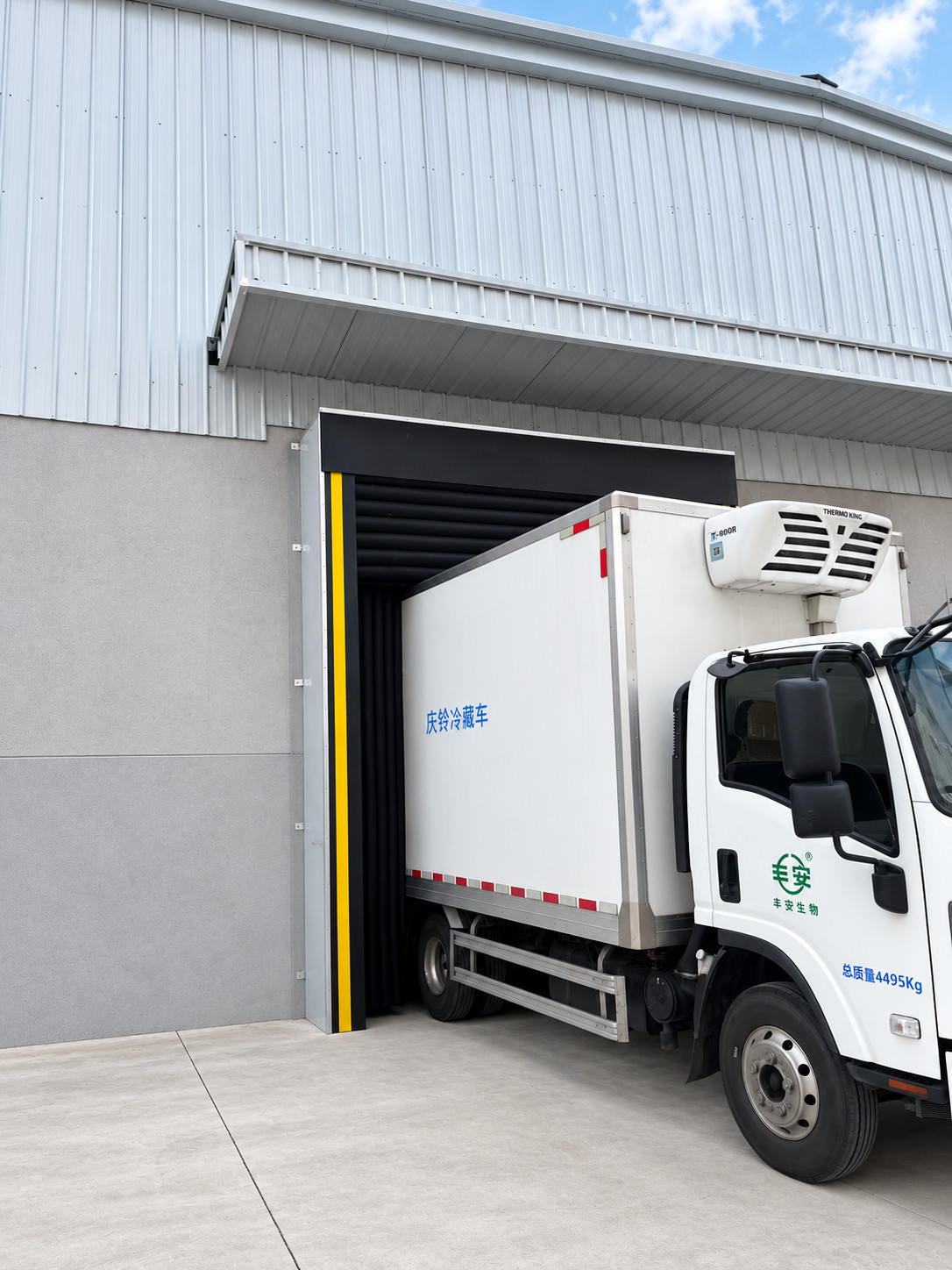
A dock shelter helps reduce the gap between the refrigerated vehicle and the warehouse opening. This can limit direct exposure to outside air, rain, wind and moisture during loading.
Correct vehicle positioning is essential. If the trailer is incorrectly aligned, the dock shelter may be compressed unevenly or damaged during repeated loading cycles.
For refrigerated facilities requiring tighter sealing, an Osłona dokowa nadmuchiwana uses inflatable top and side cushions around the parked vehicle.
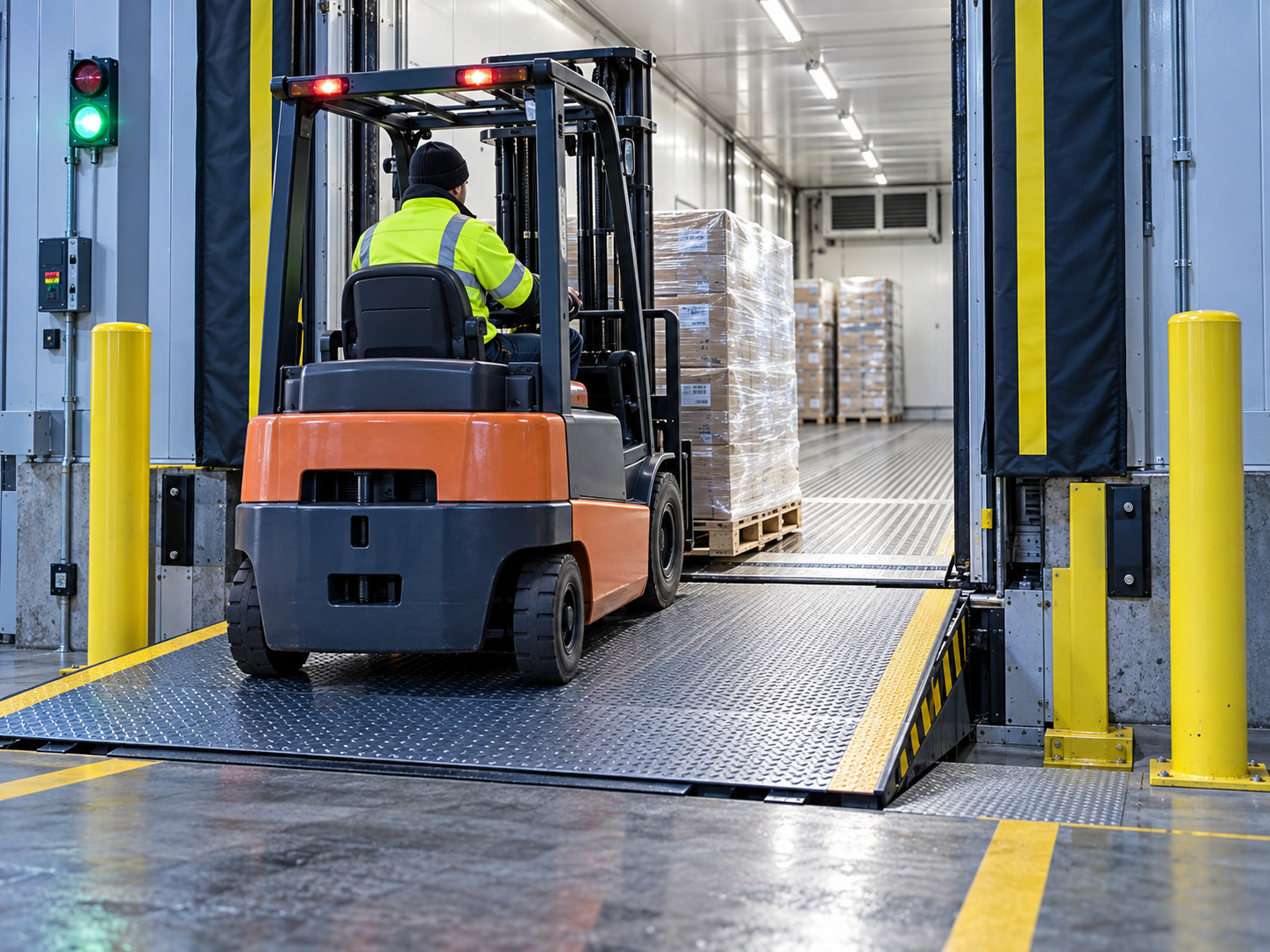
Dock levelers and forklift safety
The dock leveler forms the working bridge between the fixed warehouse platform and the truck floor. During each loading cycle, it must support the forklift, cargo and dynamic forces created as the forklift travels between the warehouse and trailer.
Przemysł SEPPES hydraulic dock leveler is available with reference load options including 6T, 8T, 10T and 12T, depending on project requirements.
Dock leveler selection should consider:
- forklift weight;
- maximum cargo weight;
- daily crossing frequency;
- truck type;
- minimum truck-bed height;
- maximum truck-bed height;
- warehouse platform height;
- pit dimensions;
- dynamic loading;
- operating environment.
OSHA requires dockboards to be capable of supporting the maximum intended load and requires measures to prevent vehicles from moving while employees are using dockboards.
Official reference: OSHA 1910.26 Dockboards .
Why forklift ramp slope matters
The height difference between a refrigerated trailer and the warehouse platform determines the dock leveler working angle.
If the transition becomes too steep, forklift movement can become less smooth and the forklift chassis, pallet or load may have reduced clearance at the transition point.
For this reason, buyers should provide both the minimum and maximum expected truck-bed height.
Loading dock bumpers protect the vehicle and building
Loading dock bumpers absorb repeated vehicle contact and establish the stopping position of the truck relative to the warehouse wall.
This position also affects the dock shelter and dock leveler.
Incorrect bumper projection may cause:
- the trailer to stop too close to the warehouse;
- excessive compression of the dock shelter;
- poor dock leveler contact;
- greater impact on the building structure;
- incorrect trailer alignment with the loading dock door.
Loading dock bumpers should therefore be planned as part of the complete loading dock equipment system .
Vehicle restraints vs wheel chocks
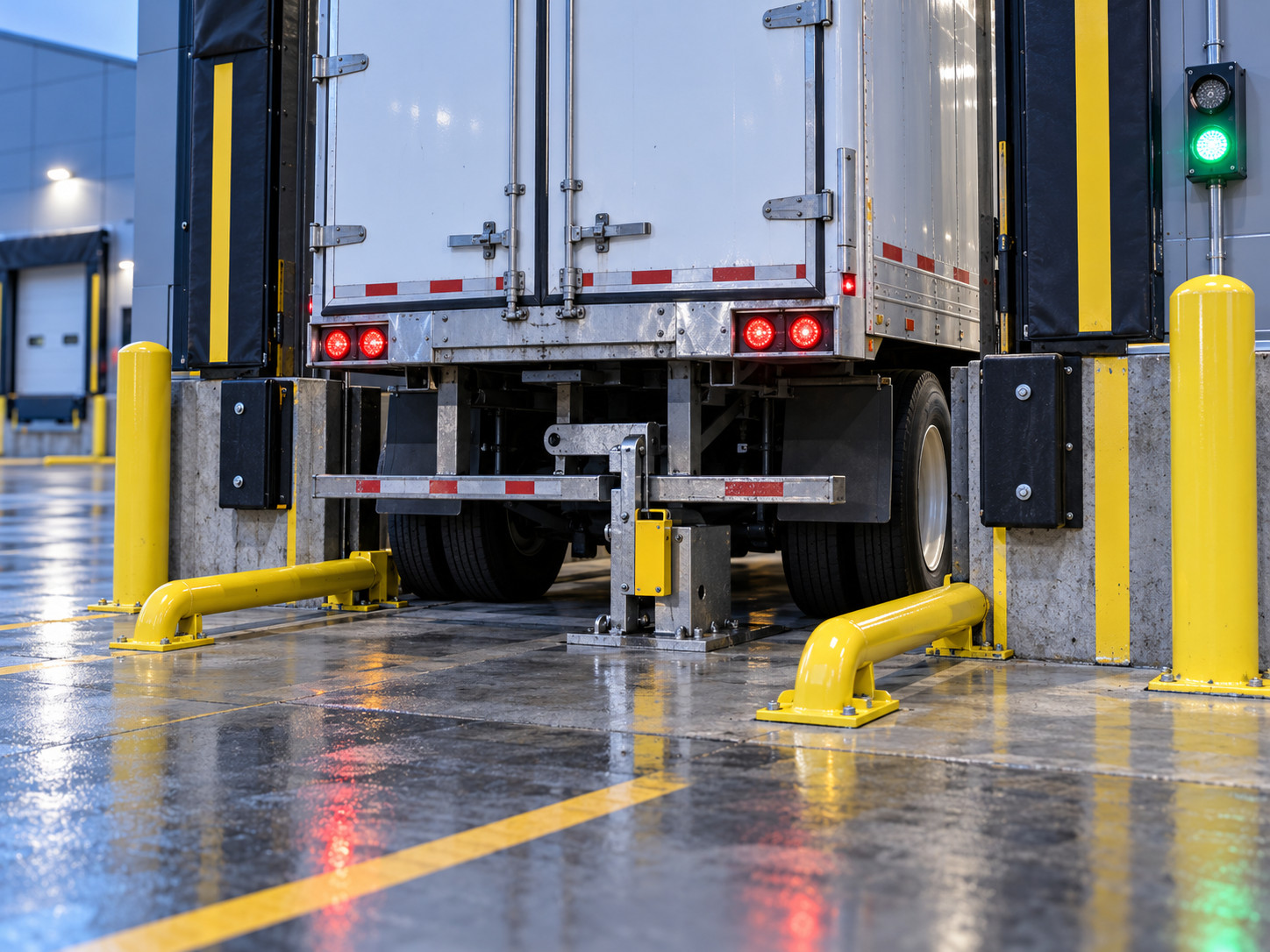
One important loading dock safety risk is unintended trailer movement while a forklift is inside the vehicle.
Depending on truck type, site procedures and applicable regulations, a facility may use wheel chocks, mechanical vehicle restraints or another approved system to help control trailer movement.
A system zabezpieczenia ciężarówek can mechanically secure the vehicle and integrate with internal and external warning signals.
Prevent premature trailer departure
Premature trailer departure occurs when a truck begins moving away from the loading dock before loading or unloading has been completed.
A controlled operating sequence should clearly communicate whether:
- the truck is correctly positioned;
- the vehicle is secured;
- the loading dock door may open;
- the dock leveler may deploy;
- forklift loading may begin;
- loading has been completed;
- the driver may leave the loading bay.
Vehicle restraints and dock traffic lights can help communicate these operating states.
Red and green traffic lights improve dock communication
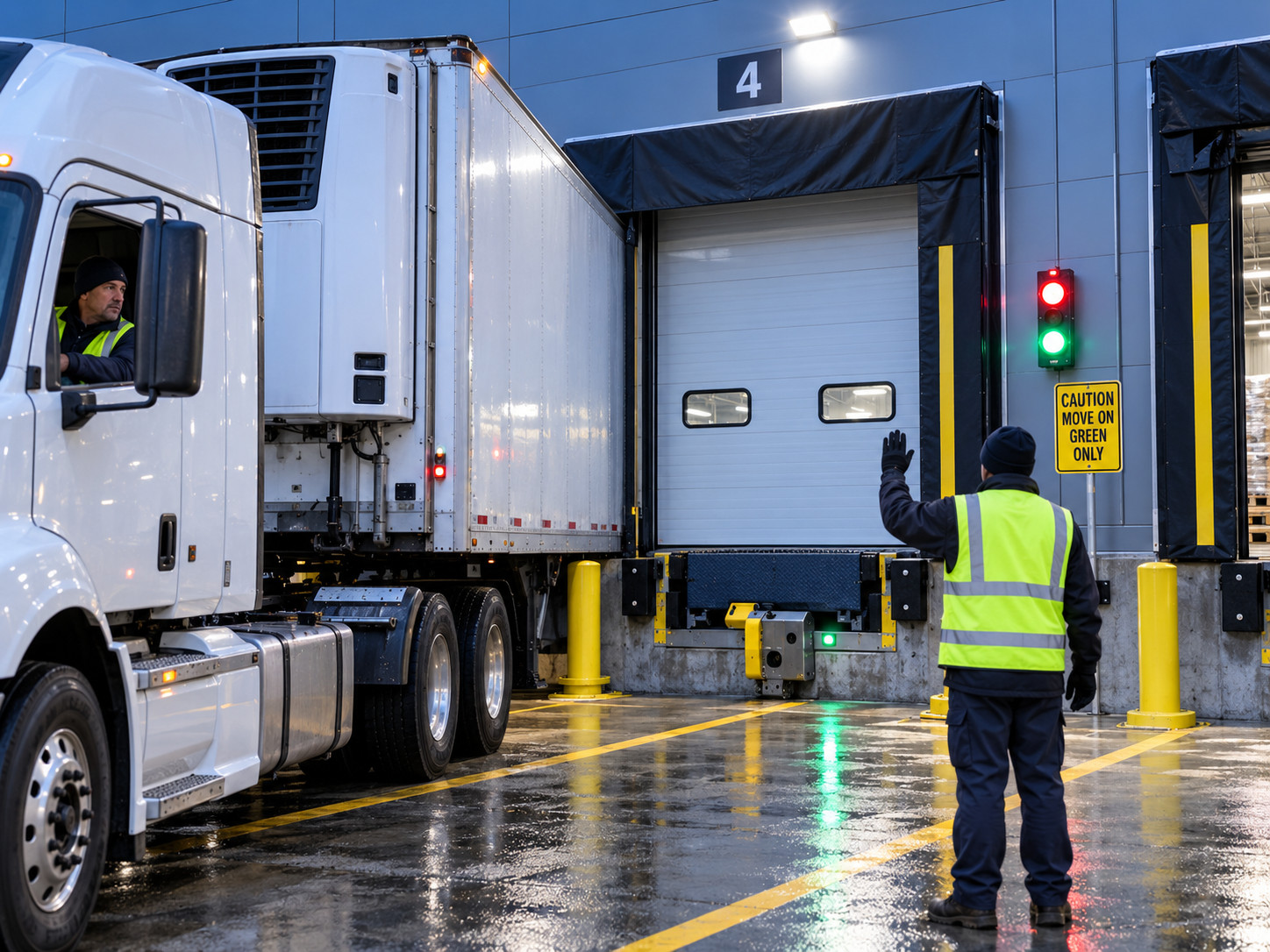
Truck drivers outside the warehouse and forklift operators inside may not have direct visual contact with one another.
Red and green traffic lights provide a simple visual communication system between both sides of the loading dock.
| Loading status | Outside signal | Inside signal |
|---|---|---|
| Truck positioning | Follow site procedure | Loading not started |
| Truck secured | Red – remain at dock | Green – loading permitted |
| Loading completed | Green – departure permitted | Red – forklift should not enter trailer |
Door, dock leveler and vehicle restraint interlocking
For higher-specification loading dock systems, the sectional door, dock leveler, vehicle restraint and traffic lights can be integrated into a controlled operating sequence.
A typical sequence may be:
- The refrigerated truck reverses into the loading bay.
- The vehicle restraint confirms secure engagement.
- The internal loading status changes.
- The loading dock door opens.
- The hydraulic dock leveler deploys.
- Forklift loading or unloading begins.
- The dock leveler returns to its stored position.
- The loading dock door closes.
- The vehicle restraint releases.
- The external signal permits the truck to leave.
The exact control logic should be designed according to the selected equipment, applicable requirements and facility operating procedures.
Wet and icy surfaces at refrigerated loading docks
Refrigerated dispatch bays can be exposed to rain, snow, condensation, ice and moisture carried into the loading area by vehicles.
These conditions can affect both forklift and pedestrian movement.
Practical controls include:
- keeping loading dock floors clean;
- removing standing water;
- addressing ice promptly;
- maintaining drainage;
- using suitable anti-slip surfaces;
- keeping floor markings visible;
- reducing forklift speed where necessary;
- separating pedestrian and forklift routes.
See: OSHA powered industrial truck requirements .
Cold-chain loading safety also includes product protection
Refrigerated dispatch safety is not limited to preventing forklift or vehicle incidents. Loading operations should also support the temperature and transportation requirements of the products being handled.
The U.S. FDA identifies inadequate refrigeration, improper loading and unloading practices, sanitation problems and unsuitable transportation equipment as potential food-transport concerns.
Official reference: FDA sanitary transportation of food guidance .
An insulated loading dock door and properly selected dock shelter can support the facility's cold-chain strategy, but they do not by themselves establish regulatory compliance.
Example refrigerated dispatch bay safety system
| Wyposażenie | Main function | Loading dock safety consideration |
|---|---|---|
| Insulated loading dock door | Controls warehouse access and thermal separation | Coordinate door movement with loading status |
| Nadmuchiwana osłona dokowa | Reduces the open gap around the refrigerated vehicle | Match shelter dimensions with vehicle size and bumper position |
| Hydrauliczny most dokowy | Bridges warehouse and truck-bed height | Select according to forklift, cargo and truck-height range |
| Loading dock bumpers | Absorb vehicle contact | Inspect wear, projection and alignment |
| Vehicle restraint | Helps control unintended trailer movement | Confirm engagement before forklift entry |
| Traffic lights | Communicate loading status | Use a clear internal and external signal sequence |
| Floor markings | Separate vehicle, forklift and pedestrian areas | Keep markings visible and routes clear |
Loading dock safety checklist
- Confirm that the truck is correctly aligned with the loading bay.
- Inspect loading dock bumpers for excessive wear or damage.
- Verify that the vehicle is secured according to site procedures.
- Confirm red and green dock signal status.
- Inspect the hydraulic dock leveler deck and lip.
- Confirm that dock leveler capacity matches the intended operation.
- Check stable contact between the dock leveler and trailer.
- Inspect the dock shelter for damage or excessive compression.
- Keep loading dock floors dry and clear of debris.
- Maintain safe clearance from exposed dock edges.
- Separate pedestrian and forklift routes where practical.
- Inspect the trailer floor before forklift entry.
- Complete loading before releasing the vehicle restraint.
- Return the dock leveler to its stored position.
- Close the loading dock door before truck departure where required.
What information should buyers provide before ordering loading dock equipment?
Accurate project information makes it easier to coordinate the loading dock door, dock leveler, shelter and vehicle safety equipment.
- number of loading bays;
- door opening width × height;
- loading platform height;
- dock leveler pit dimensions;
- minimum truck-bed height;
- maximum truck-bed height;
- truck width and height range;
- forklift weight;
- maximum cargo weight;
- daily loading frequency;
- required dock shelter type;
- vehicle restraint requirements;
- power supply;
- warehouse operating temperature;
- site photos;
- architectural drawings;
- destination country or port.
If the building is still under design, the loading bay should ideally be coordinated before dock pits, bumper positions and door openings are finalized.
Frequently asked questions
What is the most important part of loading dock safety?
There is no single component that creates a safe loading dock. Truck positioning, vehicle movement control, dock leveler condition, forklift procedures, floor conditions, loading dock doors, shelters and communication systems all need to work together.
How does a vehicle restraint improve loading dock safety?
A vehicle restraint helps reduce unintended trailer movement during loading or unloading. It can also work with loading dock traffic lights to communicate vehicle and loading status.
Why is dock leveler capacity important?
The dock leveler carries both the forklift and cargo as they move between the warehouse and trailer. Capacity should therefore be selected according to the full operating load, frequency, truck range and dynamic conditions.
What causes forklifts to slip at refrigerated loading docks?
Potential causes include wet floors, condensation, ice, debris and excessive speed. Good housekeeping, drainage, suitable surfaces and safe forklift operation all contribute to loading dock safety.
Why are dock shelters important for refrigerated trucks?
Dock shelters reduce the exposed gap around the refrigerated truck and can help limit outside air, wind, rain and moisture during loading.
Should loading dock doors and dock levelers be interlocked?
Interlocking can be used where the project requires a controlled operating sequence. The exact logic should be designed according to the equipment configuration and applicable safety requirements.
Planning a safer refrigerated dispatch bay?
Send us your loading bay dimensions, platform height, truck-bed range, vehicle sizes, forklift and cargo weight, door opening and project drawings. SEPPES can help coordinate the loading dock door, dock leveler, dock shelter and vehicle restraint system.
Request a project quote View loading dock equipment