

High-Speed Door Troubleshooting: Common Problems and Solutions
High speed door troubleshooting is essential for maintaining reliable industrial door operation in warehouses, manufacturing plants, and logistics facilities. Common problems such as sensor faults, controller errors, damaged curtains, and motor failures can cause unexpected downtime. This guide covers 12 common high-speed door problems, practical diagnostic steps, preventive maintenance tips, and when professional repair is necessary.
When a high-speed door stops working, replacing the motor or resetting the controller is not always the right solution. The problem may originate from a blocked safety sensor, incorrect position feedback, a damaged curtain, or an external automation signal.
This high-speed door troubleshooting guide covers 12 common problems, their possible causes, practical diagnostic steps, controller error codes, and preventive maintenance recommendations. It also explains when professional high-speed door repair or replacement may be necessary.
Whether you are a facility manager, maintenance technician, or warehouse operator, understanding these problems can help reduce unnecessary downtime and improve long-term door reliability.
Quick High-Speed Door Troubleshooting Chart
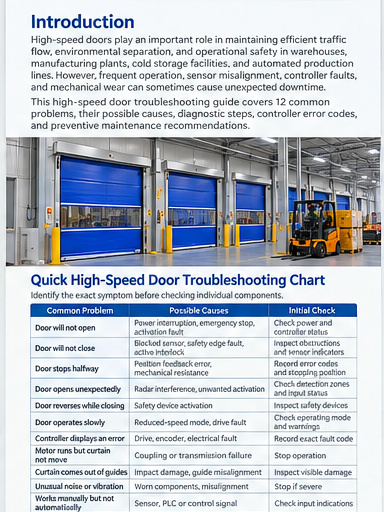
Before inspecting individual components, identify the exact symptom. Different failures may look similar but require different diagnostic approaches.
| Common Problem | Possible Causes | Recommended Initial Check |
|---|---|---|
| Door will not open | Power interruption, emergency stop, activation fault | Check power and controller status |
| Door will not close | Blocked sensor, safety edge fault, active interlock | Inspect visible obstructions and sensor indicators |
| Door stops halfway | Position feedback error, mechanical resistance | Record error codes and stopping position |
| Door opens unexpectedly | Radar interference, unwanted activation | Check detection zones and input status |
| Door reverses while closing | Safety device activation, curtain resistance | Inspect safety devices and opening |
| Door operates slowly | Reduced-speed mode, drive fault | Check operating mode and warnings |
| Controller displays an error | Drive, encoder, electrical, or safety fault | Record the exact fault code |
| Motor runs but curtain does not move | Coupling or transmission failure | Stop operation and arrange inspection |
| Curtain comes out of guides | Impact damage, guide misalignment | Inspect visible curtain and guide damage |
| Door makes unusual noise | Worn components, misalignment | Stop if noise or vibration is severe |
| Door works manually but not automatically | Activation sensor, PLC, or control signal problem | Check control mode and input indications |
| Repeated faults after reset | Unresolved electrical or mechanical fault | Review fault history |
These are preliminary diagnostic possibilities. Always follow the instructions for the specific door and controller model.
Safety Precautions Before Troubleshooting a High-Speed Door
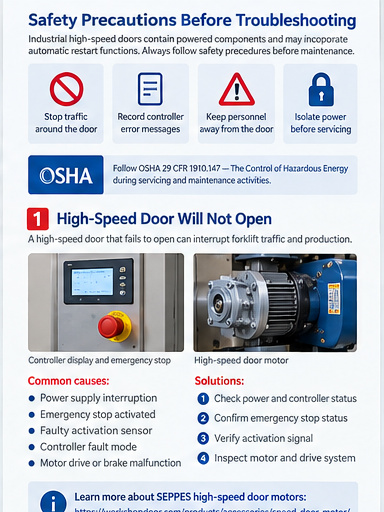
Industrial high-speed doors contain powered components and may incorporate automatic restart functions, electrical drives, brakes, and moving mechanical assemblies.
Before performing troubleshooting or maintenance:
Stop vehicle and pedestrian traffic through the opening.
Record controller error messages before resetting the system.
Keep personnel away from the moving door.
Follow the manufacturer’s shutdown procedures.
Ensure qualified personnel isolate hazardous energy before servicing electrical or mechanical components.
Never bypass photoelectric sensors, light curtains, safety edges, or emergency-stop devices.
In the United States, OSHA’s hazardous-energy control standard, 29 CFR 1910.147, addresses the protection of workers during covered servicing and maintenance activities.
Routine visual checks differ from repairs that require accessing potentially hazardous components. If the problem cannot be identified safely, contact a qualified technician.
12 Common High-Speed Door Problems and How to Troubleshoot Them
1. High-Speed Door Will Not Open
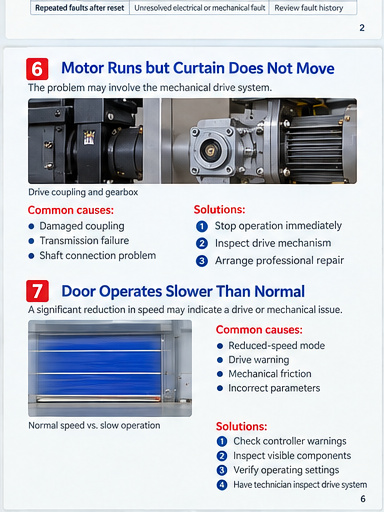
A high-speed door that fails to open can interrupt forklift traffic, material handling, and production operations.
Common causes:
Power supply interruption
Emergency-stop button activated
Faulty push button or activation sensor
Controller operating in fault mode
Motor drive or brake malfunction
PLC or interlock preventing activation
Troubleshooting steps
First, inspect the controller display and confirm whether it indicates normal power.
Check the emergency-stop status. If the emergency stop has been activated, identify the reason before restoring normal operation.
Next, determine whether the controller receives an opening request. Many industrial controllers provide input indicators that help technicians identify whether the signal is reaching the control system.
If the door responds to an authorized local control but not to automatic activation, the issue may involve the radar sensor, push button, or external command.
If the controller receives a valid opening request but the motor does not respond, a qualified technician should inspect the drive, motor, brake, and safety circuits.
For more information about industrial door drive components, explore the SEPPES High-Speed Door Motor.
2. High-Speed Door Opens but Will Not Close
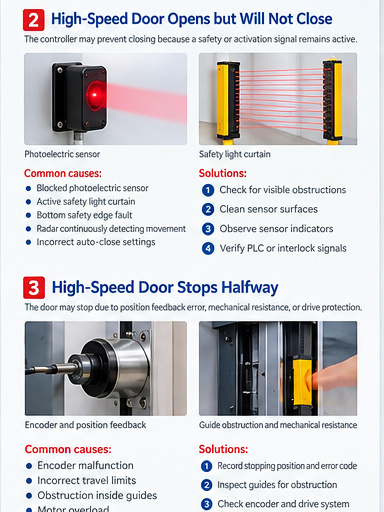
A high-speed door that remains open can increase energy loss, disrupt environmental separation, and interrupt warehouse operations.
In many situations, the controller is deliberately preventing the door from closing because a safety or activation signal remains active.
Common causes:
Blocked photoelectric sensor
Misaligned safety sensors
Active safety light curtain
Bottom safety edge fault
Radar continuously detecting movement
Incorrect automatic closing settings
Active PLC or door interlock
Troubleshooting steps
Begin by checking whether pallets, packaging materials, forklifts, or other objects are blocking the opening.
Inspect accessible photoelectric sensor surfaces for dust, condensation, or visible damage. Clean them according to the manufacturer’s instructions.
Observe the sensor indicators and controller input status. A safety signal that remains active may prevent the controller from issuing a closing command.
For automated facilities, verify whether an external PLC or interlock system is intentionally holding the door open.
If the issue remains unresolved, have a qualified technician inspect sensor alignment, wiring, and controller settings.
Important: Never disconnect safety sensors to force the door to close.
3. High-Speed Door Stops Halfway
A high-speed door may begin opening or closing normally but stop before reaching its programmed position.
This problem often involves position feedback, mechanical resistance, or drive protection.
Possible causes:
Encoder or position feedback malfunction
Incorrect opening or closing limits
Obstruction inside the side guides
Motor overload
Damaged curtain components
Mechanical misalignment
Troubleshooting steps
Record the position where the door stops and any error message shown on the controller.
Inspect visible guide areas for debris, damage, or obstructions.
If the stopping position changes between cycles, the issue may involve inconsistent position feedback or mechanical resistance.
If the door repeatedly stops at the same position, there may be a fixed obstruction, programmed travel limit problem, or position-related fault.
Do not increase motor torque or modify inverter settings without qualified technical assessment. Incorrect adjustments may create additional operating and safety risks.
4. High-Speed Door Keeps Opening and Closing Unexpectedly
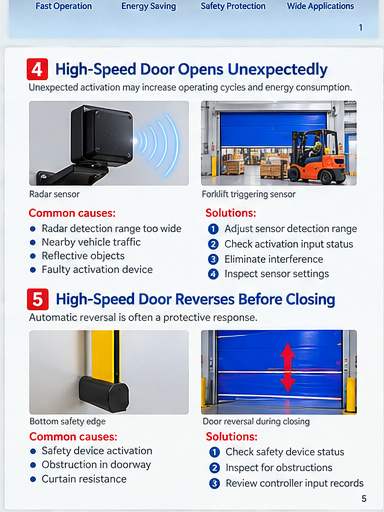
Unexpected door activation may increase mechanical wear, unnecessary operating cycles, and energy consumption.
This problem is especially common in areas with frequent forklift traffic or automatic activation systems.
Possible causes:
Radar detection range is too wide
Nearby forklifts trigger the opening sensor
Reflective objects interfere with detection
Faulty activation switch
Repeated external control signals
Incorrect PLC programming
Troubleshooting steps
Observe when the unexpected activation occurs.
Does the door open when a forklift passes nearby? Does it reopen immediately after closing? Does the controller show an active opening request?
Inspect the automatic sensor’s location and detection area from a safe position.
A qualified technician can adjust the sensor coverage or investigate the activation signal to reduce unnecessary opening cycles.
For automated industrial door applications, SEPPES provides compatible activation accessories such as Door Radar Sensors.
5. High-Speed Door Reverses Before Fully Closing
Automatic reversal is frequently related to safety protection.
The door may reverse when the controller detects an obstruction, safety edge activation, or abnormal resistance.
Possible causes:
Photoelectric sensor obstruction
Safety light curtain activation
Bottom safety edge activation
Damaged door curtain
Mechanical resistance in the guides
Sensor wiring fault
Troubleshooting steps
Check the door opening for obstructions.
Inspect accessible photoelectric sensors and light curtain surfaces for contamination or damage.
Observe whether reversal occurs at a consistent height.
A technician should review the controller’s safety input records to identify the device responsible for the reversal.
Repeated reversal should not be addressed by disabling safety devices or increasing closing force without proper diagnosis.
6. High-Speed Door Motor Runs but the Curtain Does Not Move
If the motor operates but the curtain remains stationary, the problem may involve the mechanical drive system.
Possible causes:
Damaged drive coupling
Transmission failure
Shaft connection problem
Drive mechanism damage
Motor or brake malfunction
Recommended action
Stop operating the door immediately.
Continued operation may worsen mechanical damage or create an unexpected movement hazard.
The drive assembly, shaft connections, transmission components, and brake should be inspected by qualified personnel after appropriate hazardous-energy isolation.
This is not a repair that untrained operators should attempt.
7. High-Speed Door Operates Slower Than Normal
High-speed doors are designed for frequent operation, but actual operating speeds depend on the model, size, configuration, and environmental conditions.
A noticeable reduction in speed may indicate a drive or mechanical problem.
Possible causes:
Reduced-speed operating mode
Motor drive warning
Abnormal mechanical resistance
Voltage or motor fault
Incorrect operating parameters
Excessive mechanical wear
Troubleshooting steps
Compare the current operating behavior with the door’s normal performance.
Check the controller display for warnings or reduced-speed settings.
Inspect accessible areas for visible curtain damage or obstructions.
If the problem persists, arrange a technical inspection of the drive and mechanical system.
Avoid increasing speed settings simply to compensate for slow movement.
8. High-Speed Door Sensor Is Not Working
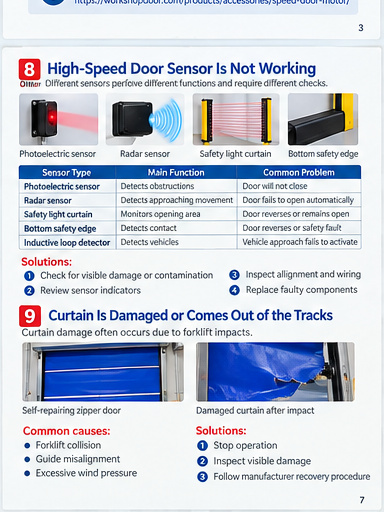
Sensor problems can affect automatic activation, closing safety, and overall door performance.
Industrial high-speed doors may use different sensors depending on their operating requirements.
| Sensor Type | Main Function | Common Problem |
|---|---|---|
| Photoelectric sensor | Detects obstructions | Door refuses to close |
| Radar sensor | Detects approaching movement | Door fails to open automatically |
| Safety light curtain | Monitors the protected opening area | Door reverses or remains open |
| Bottom safety edge | Detects contact with an obstruction | Door reverses or displays a safety fault |
| Inductive loop detector | Detects approaching vehicles | Vehicle approach fails to activate door |
Troubleshooting steps
Identify which sensor is associated with the observed problem.
Check for visible damage, contamination, or displaced mounting brackets.
Review sensor indicator lights and controller input status where accessible.
If cleaning and basic inspection do not resolve the issue, the sensor may require professional alignment, electrical testing, or replacement.
Safety devices must be verified using the manufacturer’s documented procedures before the door returns to normal operation.
9. High-Speed Door Curtain Is Damaged or Comes Out of the Tracks
Fabric high-speed doors may experience accidental impacts from forklifts, pallet loads, or other industrial equipment.
Although certain models incorporate self-repairing zipper systems, not every damaged curtain can automatically return to its guides.
Possible causes:
Forklift collision
Damaged side guides
Incorrect curtain alignment
Excessive wind pressure
Improper installation
Worn curtain retaining components
Troubleshooting steps
Stop the door and isolate the affected traffic area.
Inspect for visible tears, damaged retaining edges, bent guides, or detached curtain sections.
For compatible self-repairing doors, consult the manufacturer’s instructions to determine whether an approved re-engagement procedure is available.
Do not manually force a displaced curtain into the moving guide system.
If the curtain is torn or the supporting structure is damaged, professional repair may be necessary.
For warehouses with frequent forklift traffic, a Self-Repairing High-Speed Zipper Door may help reduce downtime following certain accidental impacts.
10. High-Speed Door Makes Unusual Noise or Vibrates Excessively
Unusual grinding, clicking, squealing, or strong vibration may indicate mechanical wear or misalignment.
Possible causes:
Worn bearings
Drive or transmission problems
Loose mechanical components
Damaged guides
Curtain friction
Structural misalignment
Troubleshooting steps
Identify whether the noise occurs during opening, closing, or both.
Stop operation if severe noise, vibration, or unusual movement suggests mechanical instability.
Qualified personnel should inspect the affected components and perform repairs using manufacturer-approved procedures.
Continuing to operate a mechanically unstable door may increase damage and create safety risks.
11. High-Speed Door Works Manually but Not Automatically
This issue is especially relevant to automated warehouses, AGV systems, conveyors, and robotic production lines.
A door may respond correctly to its local push button but fail to open when an external automation system requests movement.
Possible causes:
Faulty automatic activation sensor
Missing external opening signal
Incorrect control mode
PLC configuration error
Damaged communication wiring
Active interlock condition
Interface communication failure
Troubleshooting steps
Identify whether the problem affects one activation method or several.
For example, if the door responds to a local push button but not an AGV request, investigate the AGV control signal and its connection to the door controller.
An authorized technician can compare controller input indications with the expected external command sequence.
Depending on the installed configuration, door automation may use dry contacts, RS485, or compatible industrial communication interfaces.
Always follow the system’s approved control architecture and safety requirements.
12. High-Speed Door Keeps Displaying Faults After Reset
Repeated controller resets may temporarily restore operation without resolving the original fault.
Possible causes:
Intermittent sensor malfunction
Loose or damaged electrical connections
Encoder feedback instability
Recurring drive warnings
Abnormal supply conditions
Mechanical resistance
Unresolved safety or communication faults
Troubleshooting steps
Record the error code before attempting a manufacturer-approved reset.
Identify when the problem occurs: during startup, opening, closing, or after extended operation.
Check whether the problem is associated with heavy traffic, cleaning, low temperatures, or power interruptions.
Review the fault history and previous maintenance records.
If the error repeatedly returns, arrange a technical inspection rather than continuing to reset the controller.
How to Diagnose High-Speed Door Controller Faults and Error Codes
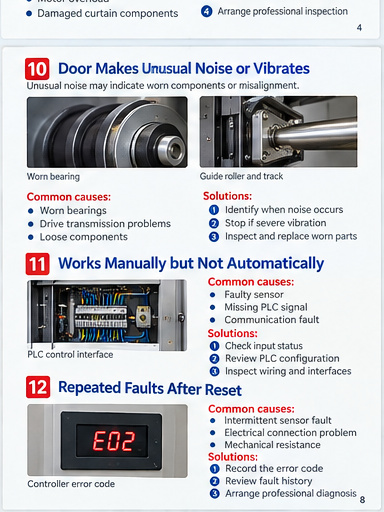
Modern high-speed doors use electronic control systems to coordinate motor operation, position feedback, automatic activation, and safety functions.
When a problem occurs, the controller may display an error code or diagnostic message.
However, high-speed door error codes are not universal. Different manufacturers and controllers may use different fault-numbering systems.
Common High-Speed Door Controller Fault Categories
| Fault Category | Possible Problem | Diagnostic Focus |
|---|---|---|
| Power supply fault | Interrupted or abnormal voltage | Electrical supply conditions |
| Motor or drive fault | Overcurrent, overload, drive malfunction | Motor and drive system |
| Encoder fault | Missing or inconsistent position feedback | Position feedback components |
| Position limit fault | Incorrect travel position | Travel limits and mechanical path |
| Safety circuit fault | Active or invalid safety signal | Sensors and safety devices |
| Communication fault | Interrupted communication | Control interfaces |
| Interlock fault | Another system prevents movement | Interlock sequence and control logic |
Why Error Codes Must Be Checked Against the Manufacturer’s Manual
A controller fault code does not always identify a failed component directly.
For example, an encoder-related fault may involve the encoder, its wiring, the position feedback circuit, or another control-system problem.
Similarly, a photoelectric fault may result from contamination, misalignment, wiring damage, or an actual obstruction.
Equipment-specific manuals should be used when interpreting error codes.
For reference, the Overhead Door Model 995LH Installation and Troubleshooting Manual (PDF) provides an example of manufacturer-specific controller diagnostics.
Its code definitions should not be applied to unrelated door models.
When requesting technical support, provide the door model, controller identification, exact fault message, controller photograph, and a description of when the problem occurs.
A Practical 5-Step High-Speed Door Troubleshooting Process
Rather than replacing components randomly, follow a consistent diagnostic sequence.
Step 1 — Identify the Problem
Record the door’s behavior and fault message.
Step 2 — Establish Safe Conditions
Control traffic and isolate hazards before servicing.
Step 3 — Review Controller and Sensor Status
Inspect warnings, operating mode, and visible indications.
Step 4 — Identify the Likely Root Cause
Separate mechanical, electrical, safety, and automation faults.
Step 5 — Repair, Verify, and Document
Qualified personnel complete repairs and required safety checks.
A structured diagnostic process improves communication between maintenance teams, equipment suppliers, and automation engineers.
High-Speed Door Troubleshooting in Different Industrial Environments
High-speed doors operate under different environmental and traffic conditions. Similar symptoms may have different causes depending on the application.
Warehouse and Logistics Facilities
Warehouses commonly experience frequent operating cycles, forklift impacts, unwanted sensor activation, and curtain damage.
Common concerns include:
Forklift collisions with side guides
Radar activation from nearby traffic
Increased wear from frequent opening cycles
Packaging materials obstructing movement
When troubleshooting warehouse doors, examine the traffic arrangement as well as the equipment.
Repeated accidental impacts may indicate that the sensor layout, opening dimensions, or door configuration should be reconsidered.
For industrial access applications, SEPPES High-Speed Roll-Up Doors provide a product category worth evaluating.
Cold Storage and Freezer Facilities
Cold storage doors face environmental conditions that can complicate troubleshooting.
Potential problems include:
Frost accumulation around guides
Condensation on sensor surfaces
Ice interfering with seals
Faulty heating accessories
Excessive moisture caused by prolonged opening
If a high-speed door operates normally in warmer conditions but malfunctions at low temperatures, investigate whether ice, condensation, or temperature-related component behavior is involved.
Do not chip ice from moving parts or apply unapproved heat sources.
For temperature-controlled facilities, explore Izolowane drzwi szybkobieżne oraz Freezer Door Applications.
Cleanrooms and Pharmaceutical Facilities
Cleanroom high-speed doors may be integrated with airlock systems, pressure control arrangements, and access management equipment.
A door that refuses to open is not necessarily malfunctioning.
For example, an interlocked cleanroom door may intentionally remain closed while another door is open or an interlock condition remains active.
Possible problems include:
Interlock communication errors
Sensor contamination
Damaged sealing components
Air-pressure-related resistance
Incorrect activation sequencing
Maintenance must account for hygiene requirements and contamination-control procedures.
Never override a safety-related interlock simply to restore traffic flow.
Automated Production Lines and AGV Systems
Industrial doors connected to automated guided vehicles, conveyors, or robotic equipment require additional diagnostic attention.
The problem may originate from the door or the external system requesting movement.
A typical investigation examines whether:
The external system generated an opening request.
The door controller received the request.
Safety and interlock conditions permitted movement.
The door completed the expected movement.
The external system received the correct position feedback.
Depending on the installed equipment, integration may involve dry contacts, RS485, PLC I/O, or compatible industrial communication modules.
The exact troubleshooting method must follow the installed controller and automation architecture.
High-Speed Door Maintenance: How to Prevent Recurring Problems
Preventive high-speed door maintenance helps identify developing problems before they lead to unplanned downtime.
Maintenance requirements depend on operating cycles, environmental conditions, equipment design, and manufacturer recommendations.
Suggested High-Speed Door Maintenance Checklist
The following is an illustrative facility maintenance schedule, not a universal manufacturer-prescribed interval.
| Inspection Frequency | Maintenance Item | Responsible Personnel |
|---|---|---|
| Daily / Each shift | Check visible curtain damage, obstructions, unusual sounds, and warnings | Trained operator |
| Weekly | Inspect accessible sensor surfaces and visible guides | Trained maintenance staff |
| Miesięcznie | Review fault history and operating records | Maintenance team |
| Kwartalnie | Conduct appropriate mechanical, electrical, and safety inspections | Qualified technician |
| Rocznie | Review overall condition, service history, and maintenance plan | Qualified service team |
High-cycle doors may require more frequent inspections.
Always follow the actual manufacturer’s maintenance instructions and applicable safety procedures.
Why Maintenance Records Matter
A useful maintenance record should include:
Door identification number
Installation location and date
Controller model
Operating environment
Fault codes and symptoms
Completed repair work
Replaced components
Safety verification records
Maintenance records help facility managers identify recurring issues and evaluate whether repair strategies are effective.
Smart Diagnostics and Predictive Maintenance Trends in 2026
Industrial maintenance is gradually moving beyond reactive repairs toward more systematic condition monitoring.
Traditional maintenance often begins when equipment fails. Predictive maintenance aims to identify abnormal conditions before they develop into major failures.
For compatible industrial high-speed door systems, useful monitoring information may include:
Door operating cycle count
Controller fault history
Motor current or drive warnings
Opening and closing duration
Sensor activation patterns
Position feedback errors
Maintenance history
For example, if a door gradually takes longer to close, maintenance personnel may investigate increasing mechanical resistance, changing drive conditions, or other developing issues.
Similarly, a rise in unnecessary opening cycles may suggest changes in traffic patterns or automatic sensor settings.
Not every high-speed door controller supports detailed monitoring, and collecting fault information does not automatically constitute predictive maintenance.
However, where suitable monitoring capability is available, the data can support more informed inspection and maintenance planning.
For new door projects, industrial buyers may wish to ask manufacturers about diagnostic interfaces, cycle counters, fault logging, and automation integration options.
High-Speed Door Repair vs. Replacement: Which Is Better?
Not every industrial high-speed door malfunction requires complete replacement.
Minor problems may be corrected through maintenance or compatible component replacement.
However, repeated structural damage, unavailable spare parts, or persistent mechanical failures may justify evaluating a new system.
| Door Condition | Repair Consideration | Replacement Consideration |
|---|---|---|
| Dirty or misaligned sensor | Cleaning, alignment, and testing | Usually unnecessary |
| Faulty activation device | Replace compatible component | Consider if control system is obsolete |
| Minor repairable curtain damage | Manufacturer-approved repair | Consider if damage is extensive |
| Repeated forklift collisions | Repair and improve traffic protection | Evaluate a more suitable door design |
| Recurring controller failures | Investigate and correct root cause | Consider if support or components are unavailable |
| Major structural damage | Assess safe repair feasibility | Often warrants replacement evaluation |
| New automation requirements | Upgrade compatible control equipment | Consider if existing equipment cannot meet requirements |
Questions to Ask Before Replacing an Industrial High-Speed Door
Before selecting a replacement, evaluate:
Clear opening width and height
Indoor or outdoor installation
Required operating frequency
Forklift or pedestrian traffic
Temperatura pracy
Warunki środowiskowe
Required safety features
Available installation space
Automation interface requirements
A new door should match the facility’s operating conditions rather than simply reproduce the previous equipment.
How to Choose a More Reliable High-Speed Door
Preventing recurring failures begins with selecting the right industrial door system.
Different applications require different designs and performance characteristics.
| Industrial Application | Potential Door Solution | Key Consideration |
|---|---|---|
| Indoor warehouse traffic | PVC high-speed door | Frequent access and traffic flow |
| Forklift-intensive opening | Self-repairing zipper high-speed door | Impact recovery |
| Large industrial opening | Szybkobieżne drzwi składane (stacking) | Opening dimensions and environmental conditions |
| Chłodnia | Izolowane drzwi szybkobieżne | Temperature and moisture control |
| Pomieszczenie sterylne (Cleanroom) | Cleanroom-compatible high-speed door | Sealing and interlocks |
| Automated production | High-speed door with compatible control interfaces | Safe automation integration |
SEPPES manufactures customizable Industrial High-Speed Doors for warehouses, manufacturing facilities, cleanrooms, cold storage facilities, and automated production environments.
Selecting the appropriate door design can help facilities reduce recurring maintenance problems and improve long-term reliability.
Frequently Asked Questions About High-Speed Door Troubleshooting
Why won’t my high-speed door close?
A blocked photoelectric sensor, active safety light curtain, bottom safety edge fault, continuous activation signal, or interlock condition may prevent closing. Check for visible obstructions and controller warnings before requesting professional inspection.
Why does my high-speed door stop halfway?
Possible causes include position feedback errors, travel limit problems, mechanical resistance, damaged guides, or drive protection. Recording the stopping position and controller message can help technicians identify the underlying issue.
How do I reset a high-speed door controller?
Reset procedures depend on the manufacturer and controller model. Record the error code before following the specific manual. Repeated faults require technical diagnosis rather than continuous resetting.
Why does my high-speed door keep opening by itself?
Unexpected opening may result from radar interference, an incorrectly configured detection zone, a faulty activation switch, or repeated external control commands. Checking the controller’s activation input status can help narrow down the cause.
Can a high-speed door sensor prevent the door from closing?
Yes. A blocked, damaged, misaligned, or faulty safety sensor can cause the controller to prevent closing or reverse the door. Safety-device repairs and verification must follow manufacturer procedures.
Can a damaged high-speed zipper door repair itself?
Certain self-repairing zipper door systems can re-engage the curtain after specified types of impact. However, this capability depends on the model and damage severity. Torn curtains and damaged guide structures may still require repair.
How often should industrial high-speed doors be serviced?
Maintenance frequency depends on operating cycles, environmental conditions, the manufacturer’s instructions, and the facility’s maintenance program. Doors with high operating frequencies may need more frequent inspection.
Is it better to repair or replace an old high-speed door?
Repair is generally worth considering when the problem is isolated, compatible parts are available, and safe operation can be restored. Replacement may be appropriate when repairs become frequent, structural damage is extensive, or the existing equipment no longer meets operating requirements.
Conclusion: Diagnose the Cause Before Replacing Components
Effective high-speed door troubleshooting begins with identifying the exact symptom and understanding how mechanical, electrical, safety, and automation systems interact.
A door that refuses to close may have an active safety signal rather than a motor failure. A door that stops halfway may have position feedback problems or mechanical resistance. Repeated resets may temporarily restore operation without correcting the underlying fault.
By following a structured diagnostic process, maintaining accurate service records, and selecting equipment suited to each industrial environment, facilities can improve door reliability and reduce avoidable interruptions.
For recurring problems, professional inspection and a review of the door’s operating conditions may provide a more sustainable solution than repeated short-term repairs.
Need a More Reliable High-Speed Door Solution?
SEPPES is an industrial door manufacturer based in Suzhou, China, specializing in customizable high-speed door solutions for warehouses, manufacturing plants, cold storage facilities, cleanrooms, and automated production environments.
If your existing industrial doors experience recurring failures, or you are planning a new high-speed door installation, our team can help evaluate your operating requirements and recommend an appropriate configuration.
To receive a product recommendation or quotation, please provide your door opening width and height, operating environment, traffic conditions, and automation requirements.