
SEPPES CLEANROOM SOLUTIONS
Clean Room Door Interlock System: How It Works
A clean room door interlock system coordinates two or more doors so that selected doors cannot open together during normal operation. In a two-door airlock, one door must close and its position must be confirmed before the other receives permission to open.
This controlled sequence helps limit direct air exchange between adjoining areas. For pharmaceutical buyers and cleanroom engineers, the complete solution includes the doors, position feedback, control logic and the room's operating requirements. This guide explains the sequence, the main components and how to specify suitable high-speed doors.

What Is a Clean Room Door Interlock System?
A cleanroom interlock system manages permission to open doors that separate controlled areas. A typical arrangement uses an enclosed airlock between two rooms. Preventing both airlock doors from opening together avoids creating a direct passage between those environments.
Interlocking supports the facility's contamination-control strategy, but the room still depends on its ventilation, filtration, cleaning procedures and door sealing. Closing one door does not by itself prove that the required room pressure or cleanliness has been restored.
For a technical introduction, see American Cleanroom Systems' explanation of cleanroom interlock operating principles.

Door type and control function are separate choices. Cleanroom doors may be hinged, sliding or roll-up designs. A zipper mechanism describes a particular high-speed door structure; an interlock describes how doors are controlled together.
How Does a Two-Door Interlock System Work?
The following example shows a typical transfer through Door A into an airlock and then through Door B. The project specification determines the opening requests, waiting conditions and fault responses.
-
Confirm the starting state
Both doors report closed. The controller checks the signals and any configured conditions before accepting a transfer request.
-
Request Door A to open
A push button, sensor or approved automation input requests entry. Door A receives permission only when the interlock conditions allow it.
-
Keep Door B inhibited
While Door A opens, remains open or closes, Door B's normal opening permission stays blocked.
-
Confirm Door A has closed
The controller checks closed-position feedback. Any specified recovery delay or process condition must also be satisfied.
-
Permit Door B to open
Door B becomes available for the next opening request. Door A remains inhibited throughout Door B's cycle. Automatic sequential opening must be specified separately.
-
Complete the transfer
Door B closes and its position is confirmed. The system returns to its agreed ready state for the next cycle.
A closed signal and a closing command are different. The controller should use the required position feedback before releasing the next door. A fixed timer alone cannot confirm that an obstructed door has actually closed.
Main Components of a Cleanroom Interlock System
The hardware depends on the selected door system. Hinged personnel doors may use electrically controlled locks. Powered high-speed doors can use compatible controllers that exchange status and inhibit opening.
| Component or function | Purpose | What to confirm |
|---|---|---|
| Door-position feedback | Reports the required door position. | How fully closed status is detected and how a missing signal is handled. |
| Interlock controller | Evaluates conditions and manages opening permission. | Door grouping, simultaneous requests, priorities and reset behaviour. |
| Opening inputs | Receive requests from operators or automation. | Push buttons, radar, access control or agreed PLC interfaces. |
| Locking or movement inhibition | Keeps the selected door unavailable during the other door's cycle. | The mechanism appropriate to that door and its controller. |
| Status indicators | Communicate ready, waiting or fault conditions. | Indicator positions and clear instructions for operators. |
| Optional process inputs | Add a specified delay or pressure-related condition. | The source of the signal, setpoints and response to signal failure. |
Document the signal interface before ordering. The specification should identify contact or communication requirements, voltage compatibility, signal meanings and which supplier provides the interlock logic.
Obstacle protection remains a separate requirement. Interlock logic does not replace the door's safety edge, light curtain or other specified protective devices. See our high-speed door safety sensor guide for the roles of different sensors.
Where Are Pharmaceutical Door Interlock Systems Used?
Personnel Airlocks and Changing Rooms
Personnel airlocks help organise movement between areas with different environmental requirements. Door selection should consider staff numbers, hands-free operation, available space and the facility's entry and exit procedures.
Material Transfer Rooms
For carts, pallet trucks and automated transport, check that the airlock can contain the full load before either door closes. A fast door cycle is useful only when the waiting space, detection zones and transfer sequence also suit the traffic.
Air Showers and Process-Controlled Entrances
Where an entrance includes an air-shower or another defined process cycle, door permission may depend on that process finishing. The door supplier and process-equipment supplier should agree the signals and release conditions.
For sterile medicinal product facilities: EU GMP Annex 1, section 4.13, addresses airlocks and pass-through hatches within its scope. Entry and exit doors should not open together. Airlocks serving Grade A or B areas should use interlocking; for Grade C or D, visual and/or audible warning is the minimum provision. A delay is established where needed to maintain area segregation.
This does not make every interlocked doorway suitable for every pharmaceutical process. For broader door-selection considerations, read our pharmaceutical cleanroom door guide.
Choosing Clean Room High-Speed Doors for Interlock Applications
Choose the door around the opening, traffic and environmental specification. An interlock can coordinate suitable doors with different opening mechanisms; it does not determine their sealing performance or cleanability.
| Typ drzwi | Application to consider | Selection questions |
|---|---|---|
| Hinged cleanroom doors | Personnel access and changing rooms. | Is swing clearance available? How will closing, locking and emergency release work? |
| Sliding cleanroom doors | Entrances where a swing arc is inconvenient. | Check side clearance, sealing, controls and access for cleaning tracks or recesses. |
| Drzwi szybkobieżne rolowane odgrywają ważną rolę we współczesnym przemyśle, magazynowaniu i logistyce. W miarę przyspieszania globalnej industrializacji coraz więcej firm skupia się na sposobach redukcji kosztów operacyjnych poprzez poprawę produktywności, zapewnienie bezpieczeństwa i oszczędzanie energii. W tym kontekście drzwi szybkobieżne rolowane stały się ważnym wyborem dla wielu organizacji. | Frequent movement of materials, carts or vehicles. | What are the traffic, leakage, pressure, cleaning and interface requirements? |
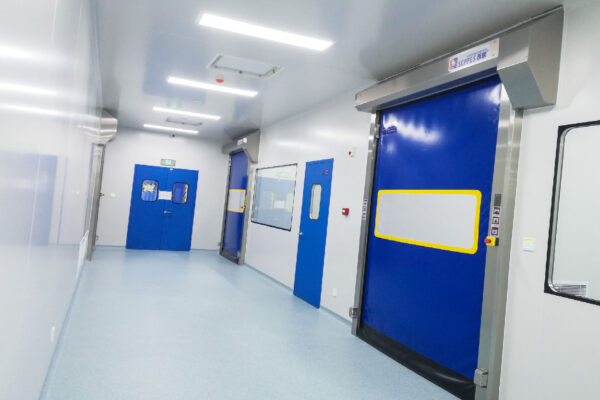
Cleanroom Roll-Up Doors for Material Transfer
Cleanroom roll up doors can provide access for frequent material movement while keeping the floor area clear of a door swing. Evaluate opening dimensions, operating speed, required clearances and the complete transfer cycle. The airlock's useful throughput also includes travel time, closing time and any required waiting period.
Explore our cleanroom door solutions to compare the application with the available door configurations.
Zipper Guides and Self-Repairing Curtain Features
A drzwi wysokiej prędkości z zamkiem błyskawicowym uses a zipper-style side-guiding arrangement. On models with a self-repairing function, a curtain that has been displaced from its guides can reinsert during an operating cycle. This feature does not repair torn fabric or damaged components.
For a cleanroom project, review the actual configuration: frame and curtain materials, access for cleaning, sealing details, pressure conditions and compatible controls. Zipper guidance or automatic reinsertion alone is not evidence of a particular cleanliness class.
Our SEPPES high-speed zipper door page introduces the product structure and available options. Confirm the interlock interface and project-specific performance when requesting a quotation.

ISO 14644-1 classifies air cleanliness by airborne particle concentration. It does not by itself certify a door or interlock system. Assess door suitability against the room specification and relevant performance evidence.
What to Specify Before Ordering an Interlock Door System
A useful enquiry describes the complete entrance. Send the supplier the following information so that the door and controls can be evaluated together:
- Layout: number of doors, airlock dimensions, travel direction and which doors must be mutually interlocked.
- Openings: clear width and height, wall construction, headroom and side clearance.
- Traffic: people, carts, forklifts or AGVs; load dimensions and expected operating frequency.
- Environment: room classification, pressure requirements, temperature and cleaning chemicals.
- Control sequence: opening requests, closed feedback, any delay or process permission, and manual operating modes.
- Interfaces: power supply, compatible signals, cable responsibilities and integration with other equipment.
- Abnormal conditions: the required response to obstruction, signal failure, power loss, emergency release and fire-system inputs.
Check the Complete Sequence During Commissioning
Use an agreed acceptance procedure to check each travel direction, simultaneous opening requests, a door that cannot close, loss of position feedback and recovery after an interruption. Confirm that indicators explain the system state and that operators understand waiting and reset procedures.
Emergency stop, emergency release and automatic opening are different functions. Their behaviour must match the selected equipment and the site's approved escape and fire arrangements. A standard cleanroom sequencing interlock should also not be treated as a substitute for a separately designed machine-safety function.
Często zadawane pytania
Are cleanroom doors always zipper doors?
No. Cleanroom doors include hinged, sliding and roll-up designs. Zipper guidance is one construction option for a high-speed door. Choose the door type and interlock controls against the actual application.
Does the second door open automatically?
Not necessarily. Interlocking controls whether the second door is permitted to open. Automatically opening it after the first door closes requires a separately specified sequence and appropriate protective measures.
Can an existing high-speed door be connected to an interlock?
Possibly. Check the controller model, available inputs and outputs, closed-position feedback, protective devices and supplier documentation. Compatibility should be confirmed before assuming that a retrofit only needs an additional cable.
Is a fixed time delay enough?
A delay cannot replace confirmation that the first door has closed. Where a recovery period or pressure-related condition is required, establish it from the process and room performance rather than choosing a universal delay for every installation.
Can more than two doors be interlocked?
Yes, with suitable controls. Define the permitted combinations, request priorities and recovery procedure. A three-door arrangement needs an explicit operating sequence rather than an assumed extension of a two-door connection.
Plan Your Cleanroom Door Interlock Solution
Share your opening dimensions, airlock layout, door quantity, traffic type and control requirements with SEPPES. Marina and our sales engineering team can help review suitable door configurations and prepare a project-specific quotation.
Discuss Your Project with SEPPES