
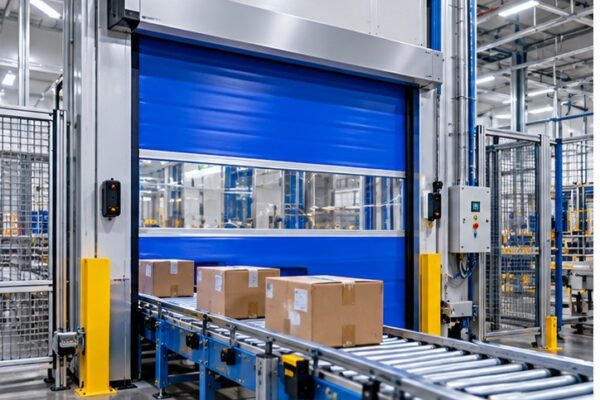
High-Speed Doors for Conveyor Systems: PLC Integration Guide
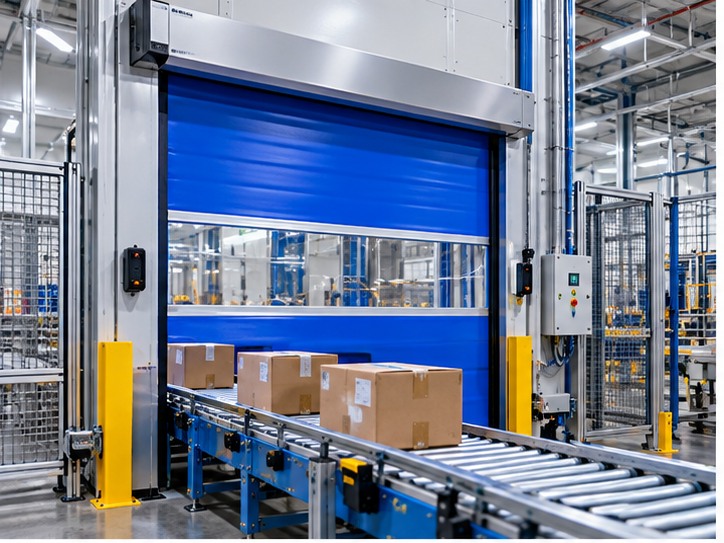 high-speed-door-conveyor-integration
High speed door conveyor integration connects an industrial rapid door with an automated material-handling line so that the door responds to product arrival, conveyor status, safety conditions, and position feedback. Rather than functioning as a standalone entrance, the door becomes a coordinated part of the conveyor automation sequence.
For warehouse engineers and system integrators, the important questions are not simply how fast the door opens. The bigger questions are: When can a conveyor release a load? How does the PLC know that the doorway is fully open? What happens when a sensor fails or an emergency stop is pressed? And how should the system recover from a fault without unexpectedly restarting?
This practical guide explains PLC input/output signals, an example operating sequence, safety interlocks, common integration errors, and seven engineering considerations for high-speed doors used with roller, belt, chain, and pallet conveyors.
Engineering note: The signal names, tables, and sequence below are illustrative, not SEPPES-certified wiring instructions. A project-specific electrical schematic, controller manual, risk assessment, and commissioning procedure are required. Safety functions must not rely solely on ordinary PLC logic or standard door-position indication.
What Is a High-Speed Door for Conveyor Systems?
A conveyor high-speed door is an automatically operated industrial door positioned at a material-transfer opening. It can separate production zones, reduce uncontrolled air exchange, or form part of a guarded transfer system while allowing packages, totes, or pallets to move through the opening.
Unlike a typical pedestrian entrance, its opening request may originate from a conveyor PLC, photoelectric product sensor, WMS/WCS-controlled sequence, or another authorized automation controller. Its closing sequence must coordinate with product-clear signals and appropriate protective devices.
For product choices, review SEPPES high-speed doors et PVC high-speed roll-up doors. The correct model depends on clear opening size, duty cycle, conveyor layout, environmental separation, and safety requirements.
Why Conveyor Automation Needs Door Integration in 2026
Material handling is becoming more automated, with warehouses adopting robotics, connected equipment, and system-level orchestration. The 2026 MHI Annual Industry Report, developed with Deloitte, discusses AI, robotics, and supply-chain technology adoption. In the report’s public announcement, robotics and automation ranked among the technologies perceived as highly disruptive to supply chains.
For conveyor-equipped facilities, these trends raise the importance of dependable handoffs between equipment. A door that opens late can create a queue. A missing open-confirmation signal can stop a line. A door that closes before the transfer opening is clear can create an unacceptable hazard. Reliable integration therefore depends on deterministic, tested control sequences—not simply purchasing a faster motor.
How High-Speed Doors Integrate with PLC Systems
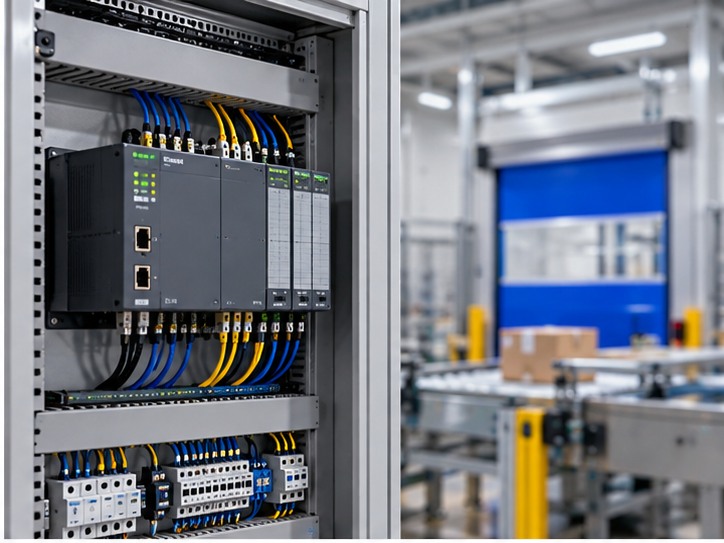 high-speed-door-plc-control
In a typical architecture, the conveyor PLC manages material movement and requests that the door open. The door controller operates its drive and reports its status. A separate or integrated safety-rated system manages identified protective functions according to the machine risk assessment.
Typical Control Architecture
- Material detected: A photoelectric or other process sensor identifies a load approaching the transfer point.
- Open request: The conveyor PLC sends a request through a compatible interface, often a dry contact or specified communication protocol.
- Door motion: The door controller checks permissive conditions and starts opening.
- Open confirmation: A validated status signal indicates the door is in the required open position.
- Conveyor release: The line permits transfer only when required conditions are satisfied.
- Clearance and closing: After transfer clearance is confirmed, the controller may close the door if the protective conditions permit.
Available connection methods depend on the specific controller and its optional modules. Dry-contact I/O, RS485, PROFINET, or EtherNet/IP should only be specified where the door and automation hardware actually support them.
PLC Input and Output Signals: Example I/O List
| Signal | Direction relative to conveyor PLC | Typical purpose | Important note |
|---|---|---|---|
| DOOR_OPEN_REQUEST | Output | Requests door opening | Command, not confirmation |
| DOOR_CLOSE_REQUEST | Output (if supported) | Requests door closing | Must not override protective controls |
| DOOR_FULLY_OPEN | Input | Position feedback | Validate suitability before using as a permissive |
| DOOR_FULLY_CLOSED | Input | Closed-position indication | Not inherently safety-rated |
| DOOR_FAULT | Input | Alarm or unavailable status | Stop/restrict transfers as defined by design |
| CONVEYOR_LOAD_PRESENT | Input | Detect approaching material | Process sensing, not personnel protection |
| TRANSFER_CLEAR | Input | Confirm product has cleared monitored point | Sensor placement is application-dependent |
| SAFETY_PERMISSIVE | Safety-rated interface where required | Protective authorization | Design and validate via safety engineering |
These are functional examples rather than a wiring map. Signal polarity, normally-open/normally-closed selection, feedback integrity, timing, and behavior during loss of power must be defined in project documentation.
Step-by-Step Conveyor Door Operating Sequence
Step 1 — Detect the Approaching Product
A process sensor identifies a package or pallet upstream of the doorway. The sensing position and conveyor speed determine the available lead time for opening.
Step 2 — Request the Door to Open
The PLC issues an opening request and manages the upstream material-release state. A request alone does not prove the door is open.
Step 3 — Wait for Open Confirmation
The transfer sequence waits for appropriate door-open indication and all applicable safety permissives. Timeouts should generate defined alarms rather than silently releasing the product.
Step 4 — Transfer Material Through the Opening
Once required conditions are confirmed, the conveyor moves material through the doorway. The product envelope, side clearance, and load height need to be considered at design time.
Step 5 — Confirm the Opening Is Clear
Process sensors confirm that material has passed the monitored point. A product-clear signal must not be confused with a personnel-protection device.
Step 6 — Allow Closing
The door controller may close when opening commands are released and its own operating and protective conditions permit movement.
Step 7 — Handle Faults and Recovery
If the door fails to open, confirmation is lost, or a protective device operates, the system enters its engineered fault response. Recovery must avoid unexpected conveyor or door motion, particularly after power restoration.
Sensors, Safety Interlocks, and Emergency Stops
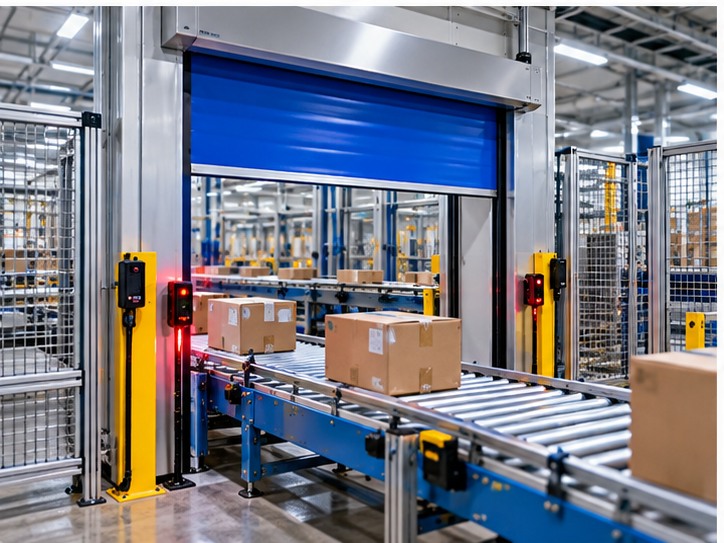 conveyor-door-photoelectric-sensors
The most important design distinction is between process control et safety-related control. A sensor that detects a carton may help coordinate conveyor timing but should not automatically be used as a personnel safety safeguard.
Depending on the risk assessment, the system may require guarding, monitored photoelectric protection, safety interlocks, emergency-stop functions, safety-rated logic, or other measures. A door operating as part of a machine-guarding arrangement requires more than a standard open/close request.
For US installations, consider OSHA 29 CFR 1910.212 (machine guarding) et OSHA 29 CFR 1910.147 (control of hazardous energy) where applicable. Specific guarding and control requirements depend on the machinery and work activities.
Never defeat the door’s safety edge, light curtain, or safety interlock to maintain conveyor throughput. Engineering personnel must assess safe stopping behavior, unexpected restart prevention, and fault detection for the entire line.
Which Door Type Is Best for Conveyor Applications?
| Scénarios d'application | Possible door choice | Primary consideration |
|---|---|---|
| Small indoor material transfer | Compact PVC high-speed roll-up door | Opening clearance, cycle rate, accessible guarding |
| Frequent impact risk | Compatible zipper high-speed door | Recovery design and material envelope |
| Temperature-separated production | Appropriately specified insulated high-speed door | Thermal performance and sensor environment |
| Guarded robotic cell transfer | Purpose-engineered machine safety door | Validated safety function and machine interface |
| Large pallet conveyor opening | Custom industrial high-speed door | Clearance, duty cycle, structure and controls |
Browse portes à fermeture éclair à grande vitesse or the existing SEPPES guide to machine guarding systems for robot cells and automated lines. A standard traffic door should not be presented as a machine safety door without specific evidence of the protective function.
SEPPES Conveyor Integration: Application Reference
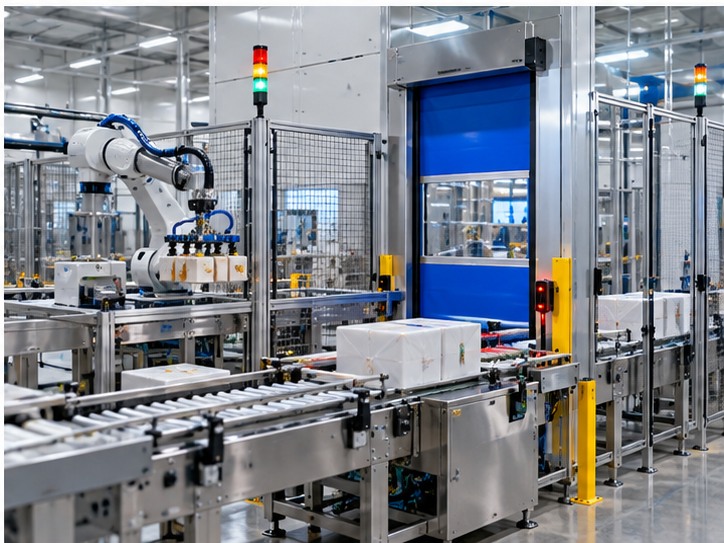 automated-conveyor-system-door
SEPPES publishes an automated conveyor system door application page explaining how industrial doors can interface with roller, belt, chain, and pallet conveyors. It provides a useful reference for discussing equipment compatibility and project requirements.
For this article, the illustrations are conceptual and the signal table is generic. Before presenting specific project counts, lead-time savings, or safety performance figures, verify them against the manufacturer’s approved case records and technical drawings.
7 Essential Engineering Tips for PLC Integration
- Define the material envelope: Measure the maximum load width, height, overhang, and conveyor elevation.
- Separate commands from status: An open request is not an open-confirmation signal.
- Specify timing: Define lead distance, opening time, stop delay, transfer duration, and timeout handling.
- Document fail-safe behavior: Describe power loss, communication loss, emergency stops, and unexpected restart prevention.
- Keep safety functions independent where required: Use an appropriately engineered safety system instead of ordinary PLC bits for protective functions.
- Check controller interfaces early: Confirm voltage, I/O types, supported protocols, and whether optional modules are needed.
- Commission with real loads: Test maximum loads, abnormal sensor states, blocked openings, and controlled fault recovery.
Common High-Speed Door Conveyor Integration Problems
| Symptom | Possible cause | Engineering check |
|---|---|---|
| Door does not open before product arrives | Late trigger, slow opening, missing request | Review sensor position and event timestamps |
| PLC requests opening but receives no feedback | Input mapping, wiring, controller fault | Verify signals with approved diagnostics |
| Door closes while loads are nearby | Faulty sequence or inadequate detection design | Stop system; reassess controls and protective coverage |
| Conveyor remains stopped | Missing permissive or latched fault | Review fault history and recovery conditions |
| Unexpected restart after power returns | Insufficient restart interlock | Review safety design; prohibit unintended automatic restart |
| Frequent nuisance opening | Sensor zone or command logic | Check process-trigger conditions |
Project Information to Send the Door Manufacturer
To receive a practical conveyor door proposal, provide: clear opening width × height in millimeters; conveyor type and elevation; maximum load dimensions; expected cycles per hour; door installation orientation; available headroom and side room; electrical supply; desired PLC interface; available door-position feedback; existing protective devices; temperature and hygiene requirements; and commissioning responsibilities.
If the door will be part of a machine safeguarding system, also provide the machine risk assessment and required safety functions so that suitability can be evaluated explicitly.
Foire aux questions
Can a PLC open a high-speed door automatically?
Yes, when the door controller supports a compatible opening-request interface. The PLC should rely on appropriate state confirmation before releasing material transfer.
Can high-speed doors integrate with roller and belt conveyors?
They can be integrated into roller, belt, chain, and other automated material-handling lines, subject to opening dimensions, control compatibility, protective measures, and commissioning.
Which signals are most important?
Typical signals include opening request, door-open feedback, fault indication, upstream product detection, and transfer-clear information. The complete signal list is project-specific.
Can standard PLC inputs serve as safety interlocks?
Not automatically. Safety-related functions require engineering assessment and suitable components and architecture for the identified risks.
What happens if communication fails?
The line should follow its predefined fault response. Depending on the risk assessment, that may require inhibiting transfer, stopping motion, reporting an alarm, and controlled recovery.
Are AGVs and conveyors controlled the same way?
Both may request door opening through a control interface, but AGV traffic management, localization, route permissions, and safety requirements differ from fixed conveyor lines.
Conclusion: Make the Door Part of the Material-Handling System
Successful high speed door conveyor integration depends on coordinated timing, reliable position feedback, compatible PLC interfaces, and a properly designed protective system. A high-speed door should not be treated as a standalone motorized barrier when it forms part of an automated transfer sequence.
For an industrial conveyor door project, explore SEPPES high-speed door solutions ou contact SEPPES with your door dimensions, conveyor layout, product envelope, automation interface, and safety requirements to discuss a suitable configuration.