
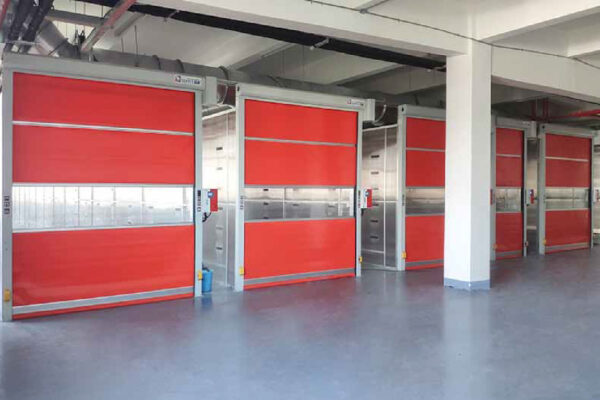
High speed door installation requires accurate opening measurements, adequate structural support, correct electrical connections, and careful safety testing. This practical guide covers the main planning, assembly, commissioning, and maintenance steps for industrial PVC high speed roll up doors used in warehouses, factories, and logistics facilities.
Important: This guide supports project planning; it is not a substitute for the installation and wiring manuals supplied with your exact door model. Qualified technicians must perform installation and commissioning in accordance with applicable local requirements.

Before Installation: Confirm the Door Type and Safety Requirements
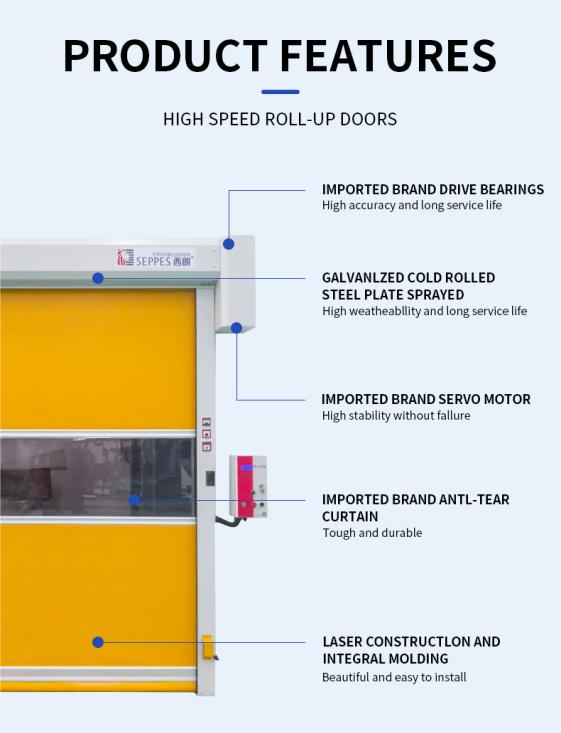
High speed doors do not all use the same mechanical system. A PVC roll up door typically has a flexible curtain, winding shaft, header, side guides, drive motor, controller, and safety devices. A puerta de cremallera de alta velocidad has model-specific curtain guidance. Rigid spiral and insulated freezer doors may require substantially different assembly methods.
- Check the approved model, opening dimensions, installation layout, packing list, and wiring diagram.
- Confirm safe access, suitable lifting equipment, electrical isolation and lockout/tagout, and any site-specific permits.
- Verify the wall or steel frame can safely support the door assembly and specified fixings.
- Confirm the site risk assessment and required protective devices before commissioning.
High Speed Door Installation Requirements
1. Measure the Opening, Headroom, and Side Clearances
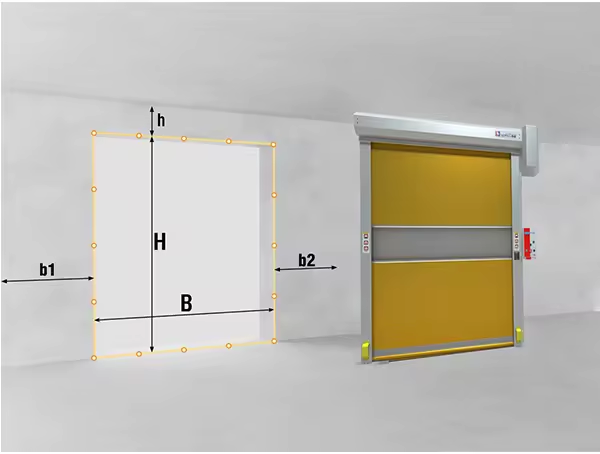
Measure the opening width at the top, middle, and bottom, and the opening height at the left, center, and right. Check obstructions above and beside the opening, the floor condition, and access for maintenance. Use the smallest available clearance when checking whether the equipment will fit.
| Measurement | On-site check |
|---|---|
| Opening width (W) | Take measurements at the top, center, and bottom. |
| Opening height (H) | Take measurements on the left, center, and right. |
| Headroom | Check clear distance above the opening for the header and service access. |
| Side clearance | Check both sides; confirm the motor and control cabinet layout. |
| Mounting surface | Verify substrate, fixing locations, and supporting structural condition. |
| Floor level | Check for slopes, gaps, drainage channels, and obstructions. |
For one SEPPES high speed roll up door layout, the product page describes approximately 600 mm of headroom, at least 200 mm lateral clearance, and approximately 500 mm on the motor side. These are model-page references, not universal installation dimensions. The approved project drawing takes priority; custom sizes and motor arrangements may require different space.
2. Check Structural Support and Installation Environment
Inspect the mounting surface for damage, unevenness, loose masonry, unsupported cladding, and interference from piping or equipment. Determine the appropriate anchors and structural reinforcement from the project engineer and approved drawings. For forklift traffic, consider suitable impact protection adjacent to the doorway.
Identify the operating environment before installation: indoor or outdoor exposure, temperature, moisture, washdown, corrosion, dust, and required sealing. A standard PVC curtain should not automatically be treated as an insulated freezer door or a certified cleanroom barrier.
3. Verify Power Supply, Controls, and Automation
Check voltage, frequency, circuit protection, grounding, controller location, and cable routes against the supplied electrical drawings. The referenced SEPPES high speed roll up product sheet lists 220 V / 50 Hz for that configuration; other supplies require a separately confirmed specification. A qualified electrician should complete and test connections.
If the opening will work with a conveyor, AGV, PLC, or forklift activation system, define the required open/closed feedback, activation signals, safety interlocks, and failure response before commissioning. Do not assume every communication protocol is supported by every controller.
Tools and Main Components Checklist
| Category | Typical tools or components |
|---|---|
| Measurement | Tape measure, laser level, spirit level |
| Mechanical installation | Approved anchors, fasteners, drilling tools, hand tools, lifting equipment |
| Electrical | Insulated tools and suitable test instruments operated by qualified personnel |
| Seguridad | PPE, work-area barriers, isolation equipment |
| Documentation | Model-specific installation manual, approved drawing, wiring diagram, packing list |
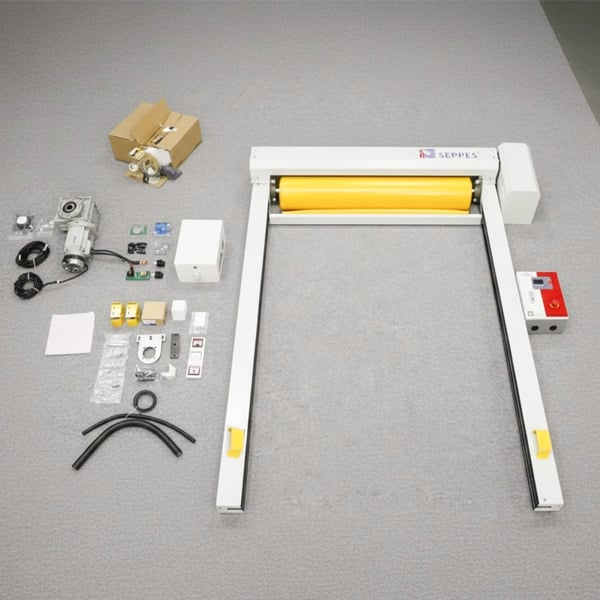
| Door assembly | Flexible curtain, shaft/header, side guides, motor, controller, seals |
| Protective and activation devices | Photoelectric sensor; optional safety bottom edge, radar, pull cord, or other devices as specified |
Review the actual packing list before assembly. Spring counterbalances and sectional panels are not universal components of a flexible PVC high speed roll up door.
How to Install a High Speed Roll Up Door: Six Main Steps
Step 1: Inspect the Delivery and Prepare the Site
Examine packaging for damage and match all items to the packing list. Protect the PVC curtain, control cabinet, motor, and sensors during handling. Compare the site measurements and mounting layout with the approved drawing. Do not proceed if essential parts are damaged or missing.
Step 2: Position and Secure the Side Guide Rails
Locate each side guide in accordance with the model-specific drawing. Check plumb, spacing, alignment, fixing points, and clearance along the full curtain travel path. Use approved fasteners suitable for the substrate. Misaligned or distorted guides may cause friction, poor sealing, and premature wear.
Step 3: Mount the Header and Curtain Assembly
Use rated lifting equipment appropriate to the assembly and follow the approved lifting method. Position and secure the header or winding-shaft assembly on its designed supports. Ensure the flexible curtain is correctly engaged with its guide system and free from twisting or obstruction. Do not run the motor to force a misaligned curtain into position.
Step 4: Connect the Motor and Control Cabinet
Mount the drive and controller in their specified locations. A qualified electrician must follow the supplied wiring diagram and verify the supply, grounding, protective devices, and connections before energizing. Terminal layout and parameters can vary by controller model; do not copy settings from another door.
Step 5: Install Activation and Safety Devices
Fit the specified photoelectric sensors, safety edge where provided, and activation devices according to the safety design and installation manual. Test the response to obstructions and evaluate whether the detection coverage suits pedestrians, forklifts, and goods handling. Automation involving conveyors, robots, or AGVs requires an appropriate system-level safety assessment.
Step 6: Configure Limits and Test Door Travel
An authorized technician should configure travel limits, opening and closing positions, and applicable operating parameters. Run controlled tests and inspect for abnormal noise, uneven travel, curtain rubbing, and unexpected movement. Verify each required protective function before handing the door over for normal use.
High Speed Door Commissioning and Acceptance Checklist
| Artículo | Acceptance check |
|---|---|
| Frame and header | Securely fixed, correctly aligned, and accessible for inspection |
| Curtain and guides | Smooth travel without abnormal friction or obstruction |
| Electrical system | Connections and protection checked by qualified personnel |
| Travel limits | Correct open and closed positions |
| Safety sensors | Each protective function tested as required |
| Activation devices | Correct response to intended users and traffic |
| Automation interlocks | Signal logic and fault response verified where fitted |
| Documentation | Test results, manuals, and relevant settings handed over |
If a safety function fails or the door operates unexpectedly, keep it out of service until the issue has been resolved and the relevant checks repeated.
Common Installation Mistakes and How to Avoid Them
| Mistake | Better approach |
|---|---|
| Measuring the opening only once | Measure at multiple points and compare with the approved drawing. |
| Ignoring motor-side space | Check motor location, control cabinet access, and side clearance. |
| Installing guides out of alignment | Verify plumb and spacing before final fastening. |
| Assuming any electrical supply will work | Match the exact motor and controller specification. |
| Skipping safety-device testing | Test every installed protective function before handover. |
| Assuming AGV or PLC signals are plug-and-play | Confirm interface design and interlocks with the system integrator. |
High Speed Door Installation Cost: What Affects the Budget?
Project costs depend on door dimensions, model, opening condition, required structural work, electrical supply, lifting access, optional safety devices, and automation interfaces. Site labor, commissioning, freight, and import charges may be separate from the manufactured-door quotation.
SEPPES provides customized industrial doors and can review project-specific technical requirements. Overseas installation should be arranged with suitably qualified local contractors unless a separate service scope is explicitly agreed. For related selection considerations, see our warehouse industrial door selection guide.
Maintenance After Installation
A properly commissioned door still needs periodic inspection. Maintenance intervals must follow the model-specific instructions and reflect operating frequency and environmental conditions.
- Inspect the PVC curtain and guide rails for wear, damage, and obstructions.
- Test protective devices according to the service instructions.
- Check the motor, drive, fixings, seals, and controller for abnormal behavior or damage.
- Clean suitable surfaces using the manufacturer-recommended method.
- Document recurring faults and unusual cycle behavior for service personnel.
- Do not lubricate guides or adjust drive components unless the service manual instructs you to do so.
Preguntas frecuentes
How long does high speed door installation take?
It depends on the door model, opening structure, electrical preparation, site access, and commissioning scope. Ask the installer for a project-specific schedule rather than relying on a universal installation time.
Can I install a high speed roll up door myself?
Powered industrial doors should be installed and commissioned by suitably qualified personnel. Mechanical alignment, wiring, protective devices, and safety testing require the applicable technical expertise.
How much headroom is needed for a high speed door?
Requirements vary by model and motor configuration. One SEPPES high speed roll up door page describes about 600 mm above the opening, but the approved installation drawing controls the actual requirement.
What electrical supply is required?
Confirm voltage, frequency, grounding, and protective equipment from the exact model specification. One SEPPES roll up door configuration lists 220 V / 50 Hz; this must not be assumed for every order.
Can high speed doors work with AGVs and conveyors?
Yes, with a suitable controller, validated signal interfaces, and a system-level safety design. Confirm the required interlocks and feedback before commissioning.
What checks are required before using the door?
Verify structural fixings, travel limits, curtain guidance, activation, electrical safety, protective devices, and any automation interlocks. Document the acceptance results.
Does SEPPES install high speed doors overseas?
SEPPES can support product selection and provide relevant technical documentation. Customers should plan for qualified local installation unless a different service arrangement has been expressly agreed.
Request SEPPES Installation Drawings and a Project Quote
Planning an industrial high speed door installation? SEPPES can review your opening requirements and advise on a suitable customized door configuration. Send the following details for a more useful technical review and quotation:
- Opening width × height and door quantity
- Installation environment and application
- Available headroom, side clearance, and mounting structure
- Available power supply
- Safety devices and automation requirements
- Destination country and preferred terms (EXW / FOB / CIF / DDP)
Contact SEPPES for installation documentation and a project quotation