
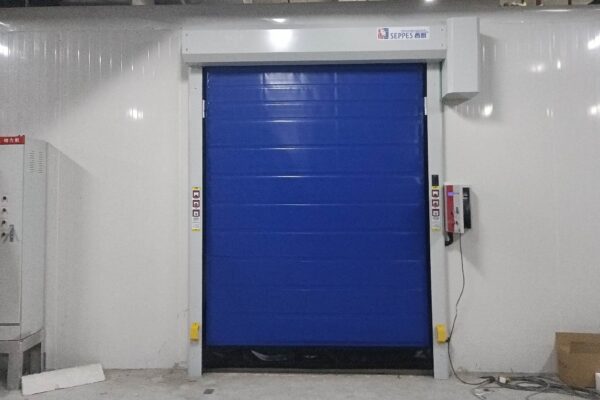
Puertas rápidas para congeladores play an important role in modern cold storage facilities. Every time a freezer entrance opens, cold air can escape while warmer, moisture-laden air enters the refrigerated space. This air exchange increases refrigeration demand and may contribute to condensation, frost accumulation, and operational problems.
For cold chain warehouse managers, the challenge is not simply selecting a door with thicker insulation. It is controlling the total amount of air and moisture entering through the doorway during daily operations.
A properly configured puerta de congelador de alta velocidad can help reduce unnecessary exposure time while supporting efficient material movement between temperature-controlled areas.
This technical guide explains how cold storage air infiltration occurs, how to estimate the influence of door opening time, and how high speed roll up freezer doors, sealing systems, automatic controls, and vestibules can help manage refrigeration loads.
It also examines the development of cold storage door technology, research on humidity infiltration, and published SEPPES cold chain application information.
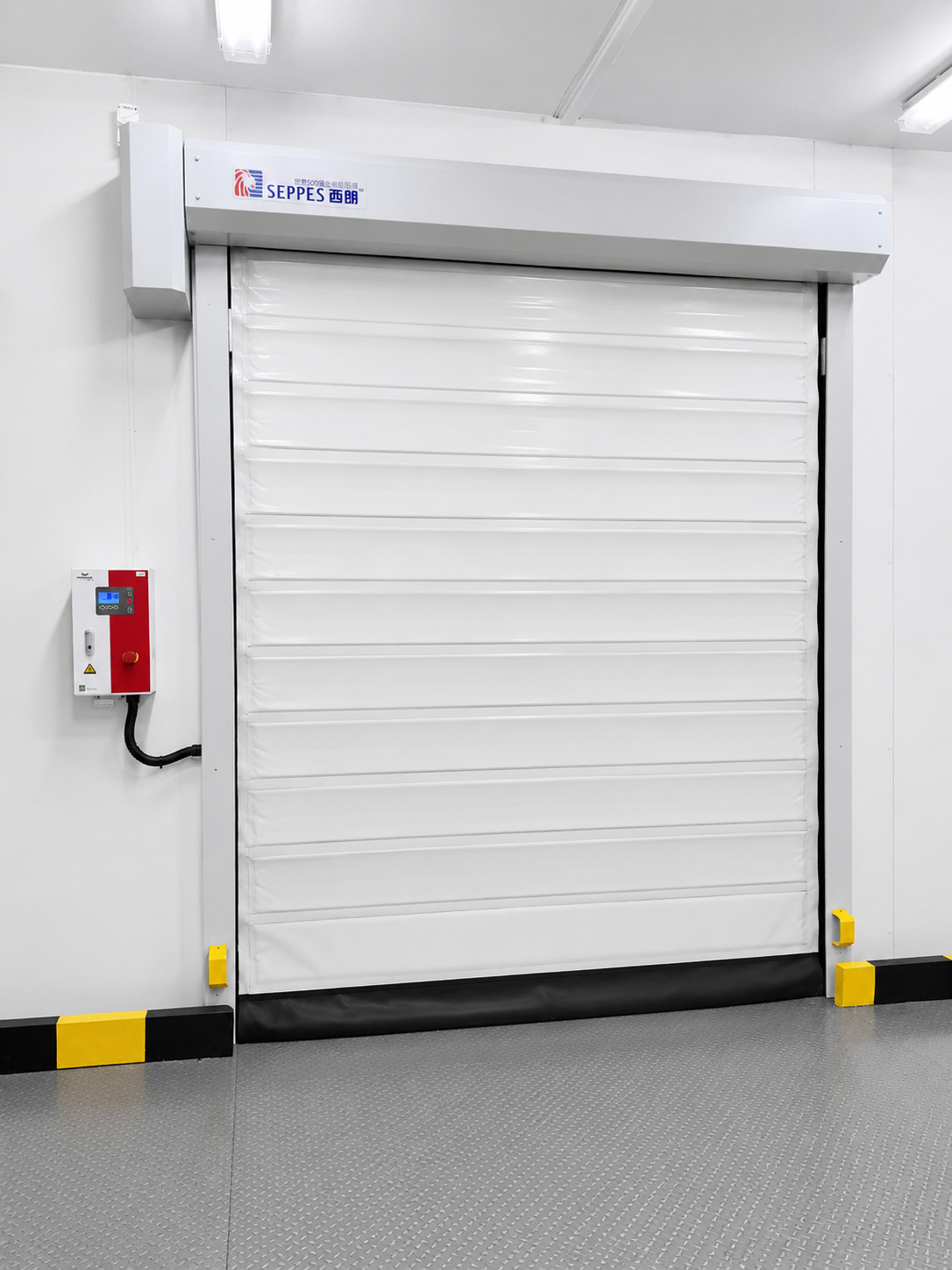
1. ¿Qué Es la Infiltración de Aire en Almacenamiento en Frío?
Cold storage air infiltration refers to the uncontrolled movement of air from a warmer environment into a refrigerated room through doorways, construction gaps, and other openings.
When a freezer door opens, the temperature difference between the cold room and the adjacent environment creates an air-density difference.
Cold air is denser than warm air. It tends to move outward through the lower portion of the doorway, while warmer air enters through the upper region.
The resulting exchange carries both heat and water vapor into the refrigerated space.
Según la ASHRAE Handbook , doorway air exchange is an important consideration in refrigerated-facility load calculations.
Factores que Afectan la Infiltración de Aire
- Diferencia de temperatura: Larger differences can increase density-driven air exchange.
- Área de la puerta: Larger openings allow greater potential airflow.
- Altura de la puerta: Height influences buoyancy-driven air movement.
- Duración de la apertura: Longer exposure generally permits more air exchange.
- Humedad relativa: Humid incoming air adds moisture and latent refrigeration load.
- Diferencia de presión: Mechanical ventilation and wind can alter airflow through the opening.
- Tráfico y protección: Forklifts, strip curtains, air curtains, and vestibules influence actual airflow.
2. Por Qué las Aperturas de Puertas de Congeladores Aumentan la Carga de Refrigeración
The refrigeration system must remove heat entering through walls, ceilings, products, equipment, and door openings.
For freezer entrances, infiltration load is particularly important because incoming air may be both warmer and more humid than the air inside the freezer.
Carga de Calor Sensible
Sensible heat is the energy removed as warmer incoming air cools toward the freezer temperature.
It depends on airflow, air temperature, and the properties of the air entering the refrigerated space.
Carga de Calor Latente
Latent load arises when incoming moisture condenses or freezes.
This process can increase refrigeration demand and contribute to frost accumulation on evaporator coils and nearby surfaces.
Infiltración de Aire vs. Transferencia de Calor a Través de Paneles de Puertas
These are two different energy-loss mechanisms.
Heat transfer through a closed door depends on the door's thermal resistance, area, surface conditions, and temperature difference.
Air infiltration occurs when air passes through an open doorway or through leakage paths around the closed door.
An insulated curtain may reduce heat transfer when the door is closed. Fast operation and effective sealing address different parts of the problem.
For high-frequency traffic, a suitable combination of curtain insulation, rapid movement, seals, and control logic can be more useful than evaluating insulation thickness alone.
3. High Speed Freezer Door Opening Time and Energy Calculations
A practical energy assessment should begin with the actual operating conditions of each doorway.
Engineers need the door dimensions, temperatures and humidity on both sides, pressure conditions, operating cycles, and total open time.
The opening speed of a high speed freezer door is important, but total door exposure time also includes approach detection, vehicle passage, hold-open delay, and closing.
Paso 1: Calcular el Tiempo Diario de Apertura de Puertas
The result indicates total doorway exposure time. It is not itself an energy-consumption calculation.
Paso 2: Comparar Diferentes Condiciones de Operación de Puertas
Consider a hypothetical freezer entrance used 120 times per day.
For illustration, assume a conventional door remains effectively open for 20 seconds per cycle, while a controlled high speed freezer door arrangement reduces exposure to 7 seconds.
Puerta convencional:
120 × 20 seconds = 2,400 seconds = 40 minutes per day.
Puerta de alta velocidad:
120 × 7 seconds = 840 seconds = 14 minutes per day.
The assumed operating scenario results in a reduction of 26 minutes of cumulative daily opening time, equivalent to a 65% reduction in the assumed exposure duration.
Paso 3: Estimar la Carga de Refrigeración
A simplified engineering relationship expresses air infiltration heat load as a function of incoming air mass flow and the enthalpy difference between warmer and colder air.
Q = tasa de transferencia de calor (kW)
m = caudal másico de aire seco entrante (kg/s)
h = moist-air specific enthalpy
(kJ/kg dry air)
This relationship is an explanatory simplification.
Accurate doorway load calculations must account for the air-exchange mechanism, doorway open-time factor, flow factor, moisture content, and effectiveness of protective devices.
For actual refrigeration design, consult ASHRAE refrigeration engineering guidance .
Paso 4: Estimar el Costo Energético
Once a validated refrigeration-load reduction has been established, electrical savings can be assessed using the refrigeration system's actual or modeled coefficient of performance (COP), operating hours, part-load behavior, defrost requirements, and electricity price.
This simplified relationship is not a complete annual energy model.
It is important to include electricity used by heated frames, air curtains, additional fans, and automatic door equipment when comparing solutions.
4. Puertas Rápidas para Congeladores vs. Puertas Convencionales de Almacenamiento en Frío
Different freezer entrance designs provide different advantages.
The best choice depends on how frequently the opening is used and whether the main priority is closed-door insulation, traffic efficiency, or environmental separation.
A high speed freezer door is often considered for frequently used internal routes, while an insulated sliding door may remain suitable for entrances with limited daily traffic.
| Tipo de puerta | Ventaja principal | Consideraciones | Aplicación típica |
|---|---|---|---|
| Puerta de Congelador de Enrollado de Alta Velocidad | Ciclos operativos cortos y acceso automatizado | Verify insulation, sealing, low-temperature rating, frost protection and duty cycle | Movimiento interno frecuente de materiales |
| Puerta Corredera Aislada para Cámara Frigorífica | Fuerte separación térmica con puerta cerrada | Slower operation may increase opening exposure in busy passages | Entradas de congelador de baja frecuencia |
| Puerta seccional aislada | Paneles aislados rígidos para grandes aberturas | Track layout, opening speed, seals and overhead space must be considered | External cold-storage entrances and loading bays |
| Puerta de Alta Velocidad con Cortina de Aire | Combines a physical closure with an airflow barrier | Requires engineering verification of airflow, controls and energy balance | High-traffic or moisture-sensitive cold-room passages |
| Vestíbulo con Puertas Interbloqueadas | Reduces simultaneous exposure between different temperature zones | Requires additional floor area and coordinated control logic | Freezer entrances with significant temperature differences |
For detailed product information, review the Puerta Rápida Aislada SEPPES .
For a broader comparison of temperature-controlled warehouse entrances, read Cold Storage High Speed Door: Energy-Saving Solutions .
5. Seis Formas de Reducir la Infiltración de Aire en Puertas de Almacenamiento en Frío
1. Reducir el Tiempo de Apertura Innecesario
Select a door system appropriate for the daily traffic frequency.
A high speed freezer door may help reduce exposure time, but the overall cycle includes detection, opening, passage, hold-open delay, and closing.
The correct closing delay must allow safe passage without keeping the entrance open unnecessarily.
2. Seleccionar Cortinas Aislantes Adecuadas
Cold storage entrances often require insulated curtains or panels rather than ordinary single-layer PVC material.
The thermal design should match the indoor and adjacent temperature conditions.
En Puerta Rápida Aislada SEPPES uses a multi-layer insulated curtain design, with operating configurations that should be selected according to project requirements.
The supplier should confirm whether the selected high speed freezer door model is suitable for the actual temperature, humidity and operating frequency.
3. Mejorar el Sellado Perimetral de la Puerta
A closed door should limit uncontrolled leakage around the curtain edges, bottom seal, upper housing, and frame interfaces.
Inspect seals regularly for wear, deformation, accumulated ice, or installation gaps.
Even a well-insulated curtain cannot compensate for substantial air leakage around damaged seals.
4. Considerar Rieles Guía Calefactados
In low-temperature environments, moisture can freeze around guide rails and sealing surfaces.
Appropriately designed heating systems may help prevent ice formation at sensitive locations.
However, heating systems consume electricity and should be controlled and sized according to operating conditions.
5. Utilizar Controles de Activación y Enclavamiento Adecuados
Radar sensors, loop detectors, automated control signals, and door interlocks can help coordinate the operating sequence.
For example, a two-door temperature-buffer area may be configured to avoid both doors opening simultaneously during normal operation.
Any interlocking design must also meet applicable emergency-operation and personnel-safety requirements.
6. Evaluar Cortinas de Aire y Vestíbulos
A properly selected air curtain can reduce the exchange of warm and cold air through an open doorway.
Its performance depends on discharge velocity, direction, opening dimensions, airflow interaction and pressure differences.
Air curtains should not be assumed to eliminate infiltration completely.
For high-traffic cold storage operations, a vestibule or coordinated high speed freezer door and air-curtain system may provide additional control.
6. Condensación, Escarcha y Hielo en Puertas de Congeladores: Causas y Soluciones
Condensación en puertas de congeladores is often linked to moisture movement from a warmer environment toward colder surfaces.
When humid air enters a freezer, water vapor can condense or freeze on door frames, floors, guides, and nearby equipment.
Excessive moisture can also increase frost formation on evaporator coils, potentially affecting heat transfer and defrost requirements.
When evaluating a high speed freezer door for cold environments, buyers should pay attention to guide rail protection, curtain sealing, and moisture-control features.
Señales de Advertencia Comunes
- Hielo alrededor del marco de la puerta
- Condensación en superficies del lado cálido
- Acumulación de escarcha cerca de las guías
- Agua o hielo en el suelo
- Requisitos frecuentes de descongelación
- Dificultad para cerrar la puerta
Respuestas de Ingeniería
- Inspeccionar el sellado y la alineación
- Reducir el tiempo de apertura innecesario
- Investigar la infiltración de aire húmedo
- Verificar el drenaje y las barreras de vapor
- Evaluar la calefacción localizada
- Revisar el equilibrio de presión y ventilación
En ASHRAE Handbook provides engineering guidance relevant to refrigerated-facility design and moisture-control issues.
7. De Puertas Convencionales de Almacenamiento en Frío a Entradas Automatizadas para Congeladores
Cold storage doorway technology has developed around a consistent engineering problem: how to allow people and goods to pass through an opening without excessive heat and moisture exchange.
Puertas Aislantes Convencionales
Historically, cold storage warehouses have relied on insulated sliding or hinged doors to separate temperature-controlled spaces.
These designs remain useful where entrances open infrequently and closed-door insulation is the main requirement.
Puertas Industriales de Alta Velocidad
As distribution facilities became more dependent on frequent pallet movement and automated handling, faster industrial doors became increasingly relevant.
The development of the high speed freezer door provided an alternative for facilities requiring frequent access and controlled exposure times.
Shorter door cycles can help reduce the duration of uncontrolled openings when the operating sequence is correctly configured.
Aislamiento, Sellado y Controles Integrados
Modern freezer entrance design can combine insulated curtains, improved seals, heated guides, automatic detection, interlocked doors, and airflow protection.
These functions address different aspects of the problem, including closed-door heat transfer, open-door air exchange, ice formation and traffic flow.
Established refrigeration engineering methods provide the basis for estimating the air-exchange loads associated with these doorways.
8. SEPPES Cold Chain Application: Insulated High-Speed Door Systems
SEPPES supplies insulated high-speed door systems for temperature-controlled industrial environments, including cold storage, food processing and logistics applications.
A published SEPPES project reference describes an insulated high-speed door application for a Canadian cold chain logistics company.
The application involved a temperature-controlled warehouse where thermal separation and efficient movement of goods were important operating concerns.
Project Application
- Cold chain logistics environment
- Temperature-controlled warehouse access
- Movement of goods through an industrial entrance
- Insulated high-speed industrial door
Engineering Considerations
For this type of warehouse entrance, the insulated curtain addresses heat transfer through the closed door, while rapid operation helps limit exposure during material movement.
A high speed freezer door configuration must also be assessed for the facility's actual temperature, humidity, daily operating cycles and frost protection requirements.
¿Qué Se Puede Verificar?
The manufacturer-published project reference provides an application example and general door type.
However, independently verified before-and-after electricity consumption, infiltration measurements, complete door dimensions and temperature logs are not available in the cited public information.
Therefore, this article does not attribute numerical energy savings or infiltration reductions to the project.
Referencia: SEPPES Published Cold Chain Logistics Application .
9. Industry Research: Air Curtains and Moisture Control
Cold-storage energy management has increasingly focused on both temperature differences and the movement of moisture across frequently opened entrances.
An AMCA International technical article dated October 24, 2026, titled Air Curtains for Humidity Control in Refrigerated Spaces , discusses the role of warm, moisture-laden air in refrigerated facility operations.
Moisture infiltration can contribute to latent refrigeration loads, fog formation, frost accumulation and additional defrost requirements.
Implicaciones para Compradores de Puertas Industriales
For cold chain warehouses, evaluating only the insulation thickness of a high speed freezer door may be insufficient.
Door opening time, sealing, humidity, air pressure, traffic conditions and any air-curtain system should be evaluated together.
A suitable high-speed door and an engineered air curtain may complement one another in some applications, but performance should be verified against actual site conditions.
For additional technical background, see AMCA's article on optimizing cold-storage environments with air curtains .
10. How to Specify a High Speed Freezer Door for Your Facility
Before requesting a quotation, facility owners and engineering teams should collect complete project information.
A suitable high speed freezer door configuration should consider both the operating environment and the frequency of traffic.
| Información del proyecto | Por qué es importante |
|---|---|
| Clear opening width × height | Determines door size and potential airflow area |
| Freezer temperature | Supports material selection and low-temperature configuration |
| Adjacent room temperature | Defines the thermal boundary across the doorway |
| Humidity conditions | Helps evaluate condensation, frost and latent load |
| Daily opening cycles | Supports duty-cycle and exposure assessment |
| Vehicle and pedestrian traffic | Influences opening controls and safety design |
| Doorway space | Determines installation and guide-frame feasibility |
| Suministro eléctrico | Supports drive and control equipment selection |
| Defrost and heating needs | Helps assess door heating and moisture management |
| Existing energy data | Provides a baseline for engineering comparisons |
For high-traffic internal freezer routes, high speed roll up freezer doors may be considered when a suitable insulated curtain, sealing system and low-temperature operating configuration are available.
For external loading areas, insulated sectional doors and dock sealing systems may be more appropriate.
For broader cold-chain planning, review the Workshopdoor Cold Storage High-Speed Door Guide .
¿Necesita Reducir la Infiltración de Aire en la Entrada de Su Congelador?
SEPPES can review your doorway dimensions, operating temperature, traffic frequency, installation conditions and required door controls to recommend a suitable industrial door configuration.
Provide the door width × height, quantity, freezer temperature, adjacent temperature and daily traffic conditions for a more relevant technical assessment.
Request a Cold Storage Door RecommendationPreguntas frecuentes
How do high speed freezer doors reduce energy loss?
High speed freezer doors may reduce the time a doorway remains exposed during frequent traffic. Combined with suitable insulation, sealing and control systems, they can help manage air infiltration and refrigeration loads. Actual energy savings require project-specific assessment.
What causes air infiltration in cold storage warehouses?
Air infiltration can be caused by temperature-driven density differences, pressure imbalance, wind, prolonged door openings and leakage around poorly sealed openings.
Is a high speed freezer door better than a sliding door?
A high speed freezer door may be more suitable for high-frequency traffic where short operating cycles are important. An insulated sliding door can remain appropriate for lower-frequency entrances prioritizing closed-door thermal separation.
How does freezer door condensation occur?
Condensation occurs when moisture in warmer air encounters surfaces below the local dew point. Under freezing conditions, moisture can form frost or ice around the doorway and nearby equipment.
Can an air curtain replace an insulated freezer door?
Not necessarily. An air curtain limits airflow while the opening is exposed, whereas an insulated door provides a physical closure. Some cold-storage applications benefit from a coordinated combination.
Does a faster freezer door always reduce electricity consumption?
No. Total energy use also depends on opening frequency, hold-open time, sealing, pressure conditions, insulation, refrigeration efficiency and any added electrical equipment.
How can I calculate cold storage door infiltration load?
An engineering calculation requires doorway dimensions, indoor and adjacent air conditions, air properties, operating time and flow conditions. ASHRAE provides established methods for refrigerated-facility infiltration analysis.
What information is required for a SEPPES freezer door quotation?
Provide opening width and height, quantity, freezer temperature, adjacent temperature, daily operating frequency, preferred activation method, power supply, site location and any special installation restrictions.
Conclusión
Puertas rápidas para congeladores can be an important part of an engineered approach to reducing cold storage air infiltration.
However, speed is only one factor. Effective cold-storage doorway design must also consider closed-door insulation, air leakage, moisture, pressure, safety, operating cycles and refrigeration-system performance.
For new facilities and retrofit projects, evaluating these factors together provides a stronger basis for door selection than relying on generalized energy-saving claims.
Choosing the right high speed freezer door requires balancing temperature control, operating efficiency, installation conditions and long-term maintenance requirements.
Referencias Técnicas y Lecturas Adicionales
- ASHRAE Handbook . Engineering reference for refrigeration and building systems.
- AMCA International: Air Curtains for Humidity Control in Refrigerated Spaces . Technical discussion of moisture infiltration.
- AMCA International: Optimizing Cold-Storage Environments with Air Curtains .
- Puerta Rápida Aislada SEPPES . Product information and available configurations.
- Workshopdoor Cold Storage High Speed Door Guide . General cold-chain door selection and application background.
- SEPPES Cold Chain Application Reference . Manufacturer-published project information.