
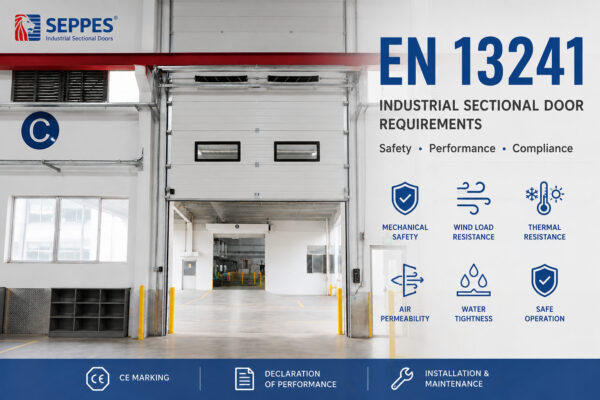
EN 13241 is one of the key European product standards buyers should understand when specifying industrial sectional doors for factories, warehouses, logistics centers and other commercial buildings.
In practical terms, the standard does much more than define whether a sectional door can open and close correctly. It addresses important safety and performance characteristics such as mechanical strength, safe operation, wind resistance, water tightness, thermal resistance, air permeability, installation and maintenance.
For industrial buyers, EN 13241 therefore provides a useful framework for comparing sectional overhead doors beyond basic specifications such as door size, panel thickness and opening speed.
This guide explains the main EN 13241 requirements and what purchasing teams should check before selecting an industrial door.
Índice
AlternarWhat Is EN 13241?
EN 13241:2003+A2:2016 is titled:
“Industrial, commercial, garage doors and gates — Product standard, performance characteristics.”
The standard covers manually operated and power-operated doors and gates intended primarily to provide safe access for goods and vehicles accompanied or driven by people in industrial, commercial and residential premises. It can also cover pass doors incorporated into the main door leaf.
For industrial applications, this means the standard is relevant to products such as:
- portas seccionais industriais
- as portas seccionais de sobrecarga
- commercial sectional overhead doors
- certain rolling doors and shutters
- manually operated industrial doors
- power-operated industrial doors
It is important to understand one limitation: EN 13241 does not itself cover fire-resistance and smoke-control performance. Those characteristics are addressed by EN 16034.
As of 2026, BSI lists BS EN 13241:2003+A2:2016 as current and under review.
EN 13241 Requirements at a Glance
For buyers comparing an overhead sectional door for an industrial facility, the following areas are among the most important requirements addressed by EN 13241.
| Requirement | What It Means for Industrial Door Buyers |
|---|---|
| Mechanical resistance | The door must withstand forces and stresses expected during normal operation |
| Mechanical durability | Operational durability should be demonstrated for a declared number of cycles |
| Safe openings | Vertically moving doors must address risks associated with uncontrolled movement |
| Crushing and shearing protection | Power-operated doors require protection against hazardous movement |
| Operating forces | Forces generated during automatic operation must be controlled |
| Electrical safety | Electrical components and power operation must meet applicable safety requirements |
| Wind load resistance | Door performance should be declared where wind resistance is relevant |
| Water tightness | Performance against water penetration may need to be declared |
| Thermal resistance | Important for insulated industrial doors and temperature-controlled buildings |
| Air permeability | Indicates how effectively the closed door limits air leakage |
| Instruções de instalação | Correct installation is part of maintaining expected performance |
| Maintenance instructions | Maintenance requirements must be provided for safe operation |
| Marking and conformity | Product performance and conformity information must be properly documented |
The standard specifically addresses mechanical aspects, power operation, water tightness, resistance to wind load, thermal resistance, air permeability, installation, maintenance, marking and evaluation of conformity.
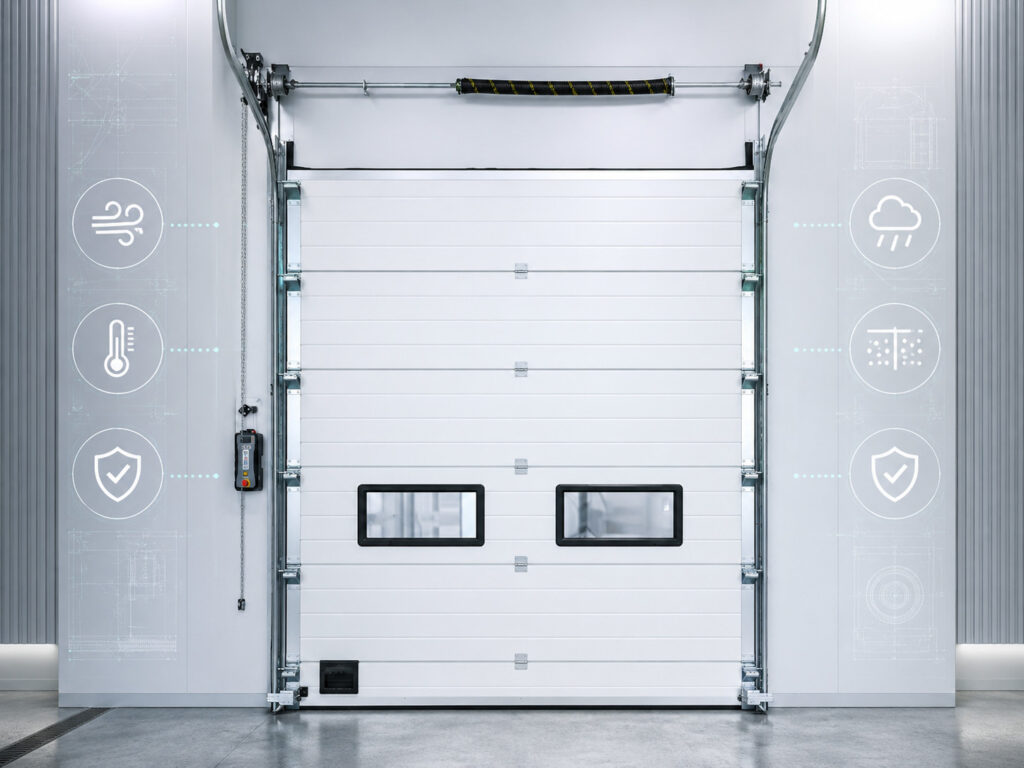
1. Mechanical Safety of Industrial Sectional Doors
Mechanical safety is one of the most important parts of selecting industrial sectional doors.
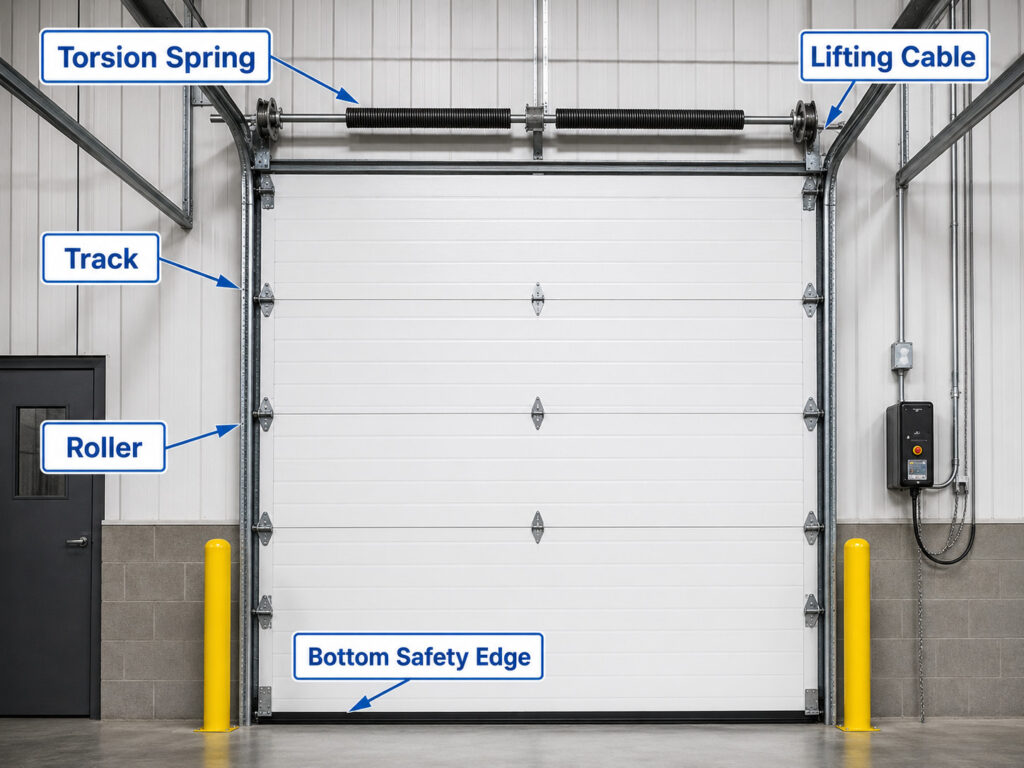
A large sectional door may contain substantial moving mass. Components such as door panels, tracks, rollers, lifting cables, drums, shafts and springs work together every time the door operates.
EN 13241 addresses areas including:
- manual operating force
- mechanical resistance
- mechanical durability
- glazing safety
- protection against cutting hazards
- protection against tripping
- safe openings
The standard requires doors to be designed so that forces, impacts and stresses generated during normal operation do not damage the door or impair its mechanical performance. It also addresses mechanical durability based on operational cycles declared by the manufacturer.
For a B2B buyer, this means purchasing decisions should not be based only on panel appearance or price.
Ask the manufacturer about the complete mechanical system, including:
- track construction
- lifting cables
- spring system
- cable-break protection
- spring-break protection
- bottom safety protection
- expected operating cycles
- recommended maintenance frequency
These factors become especially important for frequently used warehouse and factory entrances.
2. Requirements for Power-Operated Sectional Doors
Most modern industrial sectional doors are electrically operated.
Once motors, controls and automatic opening systems are added, additional hazards must be considered.
EN 13241 includes requirements related to power operation, including protection against:
- crushing
- shearing
- drawing-in
- excessive operating forces
- electrical hazards
The current related standard EN 12453:2017+A1:2021 deals specifically with safety in use and test methods for power-operated industrial, commercial and garage doors, gates and barriers.
For an automatic sectional door, practical safety solutions can include devices such as safety edges and photoelectric sensors, depending on the door design, operating mode and risk assessment.
This becomes particularly important when doors interact with forklifts, trucks, employees or automated material-handling systems.
3. Wind Load Resistance
Wind resistance is particularly important when an overhead sectional door is installed on the external wall of a warehouse, factory or logistics building.
EN 13241 includes resistance to wind load as one of the specific performance characteristics that may need to be declared.
This should be considered carefully for:
- coastal facilities
- exposed industrial sites
- large warehouse entrances
- centros de distribuição
- buildings in high-wind regions
- very wide or high sectional doors
Door dimensions matter because increasing the opening size can significantly increase the wind load acting on the door surface.
When purchasing a large industrial sectional door, buyers should therefore provide the manufacturer with:
- door opening width
- door opening height
- installation location
- indoor or outdoor application
- local wind conditions
- building exposure conditions
The manufacturer can then determine the appropriate panel reinforcement, track system and supporting structure.
A door that is suitable for an internal warehouse opening may not necessarily be suitable for an exposed exterior façade.
4. Thermal Resistance and Insulation
Thermal performance is increasingly important in warehouses, production facilities and temperature-controlled buildings.
EN 13241 includes thermal resistance among the product performance characteristics that can be declared.
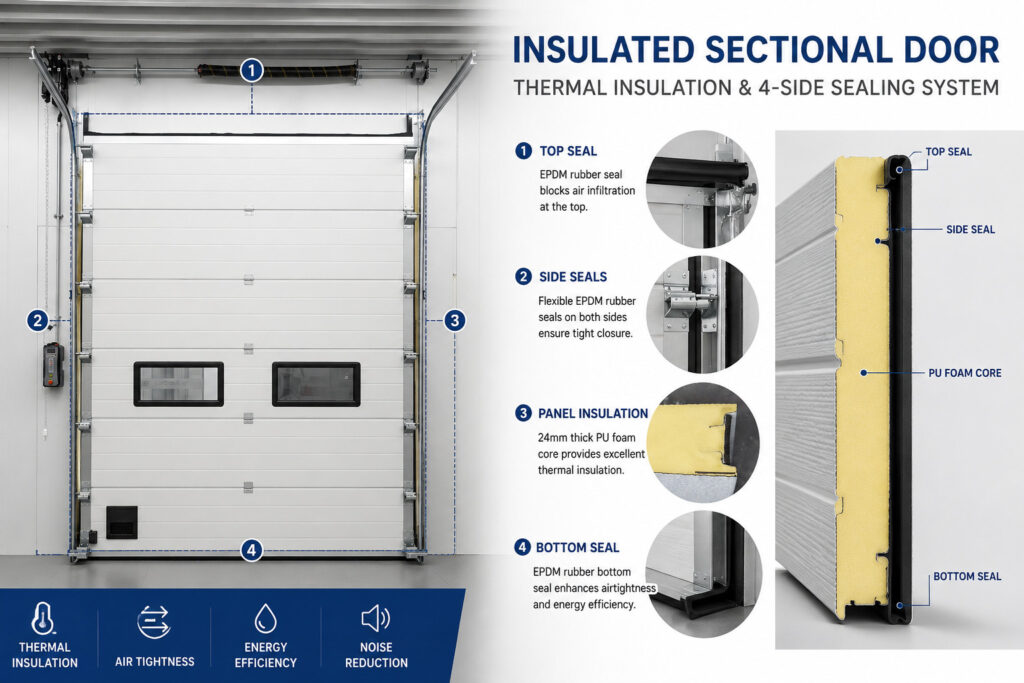
An insulated overhead door commonly uses sandwich panels containing an insulating core between metal skins.
However, buyers should not evaluate insulation based only on panel thickness.
Overall thermal performance can also be affected by:
- panel joints
- perimeter seals
- bottom seals
- frame construction
- windows
- pass doors
- installation quality
This is especially relevant when selecting insulated sectional overhead doors for warehouses where indoor temperature stability and energy consumption are important.
For example, SEPPES industrial sectional doors can use insulated sandwich door panels combined with perimeter sealing systems to improve thermal separation between indoor and outdoor environments.
When comparing an insulated overhead door, request the manufacturer’s declared thermal performance rather than assuming that a thicker panel automatically means better whole-door insulation.
5. Air Permeability
Air permeability describes the amount of air that can pass through a closed door under specified pressure conditions.
EN 13241 includes air permeability as another performance characteristic that manufacturers may declare.
This can be important for:
- heated warehouses
- air-conditioned production facilities
- instalações de processamento de alimentos
- temperature-controlled storage
- clean industrial environments
- facilities with pressure differences between areas
Good sealing around the sides, header, bottom and panel joints can help reduce uncontrolled air movement.
For buyers, this means the sealing design of a sectional door deserves as much attention as the door panel itself.
6. Water Tightness
Exterior commercial sectional overhead doors may also be exposed to wind-driven rain.
EN 13241 includes water tightness as a declared performance characteristic where applicable.
Water resistance can be influenced by:
- bottom sealing
- side seals
- top seals
- panel joints
- threshold conditions
- installation accuracy
- wind pressure
For exterior warehouse entrances, it is therefore important to tell the supplier that the sectional door will be exposed directly to outdoor weather.
This allows the door configuration and sealing solution to be selected according to the actual application rather than treating every opening in the same way.
7. Mechanical Durability and Operating Cycles
Industrial doors can operate much more frequently than residential doors.
A warehouse entrance may open dozens or even hundreds of times during a working day.
EN 13241 addresses mechanical durability and requires mechanical performance to be maintained, subject to prescribed maintenance, for a number of operating cycles declared by the manufacturer.
Buyers should therefore ask:
How often will the door operate?
A door used three times per day has very different requirements from one serving a busy logistics area.
Consider:
- daily opening frequency
- annual operating cycles
- spring cycle rating
- motor duty
- maintenance intervals
- expected service life
For high-frequency traffic, a high-speed door may sometimes be more suitable than a conventional sectional door. Door selection should always start with the actual operating conditions.
8. Installation, Operation and Maintenance
Even a correctly manufactured sectional door can perform poorly if it is installed incorrectly.
EN 13241 addresses instructions for installation, operation and maintenance as part of the product requirements.
Installation can influence:
- track alignment
- door balance
- sealing
- safety-device operation
- opening and closing movement
- motor performance
- long-term component wear
Buyers importing industrial doors should therefore check whether the supplier provides:
- installation drawings
- installation manuals
- electrical diagrams
- commissioning instructions
- operating instructions
- maintenance guidance
- troubleshooting support
SEPPES industrial doors are supplied with technical documentation to help local installers complete installation and commissioning according to the specified door configuration.
9. EN 13241 and CE Marking
EN 13241 has also been published as a harmonised European standard for industrial, commercial and garage doors and gates. Its reference appears in EU harmonised-standard publications for construction products.
The European Construction Products Regulation provides a common framework for assessing and communicating the performance of construction products placed on the EU market.
There is an important 2026 transition to understand.
Regulation (EU) 2024/3110, the new Construction Products Regulation, applies from 8 January 2026. It also provides transitional arrangements under which harmonised standards that were still valid under Regulation (EU) No 305/2011 on that date remain valid under the previous framework until they are withdrawn or otherwise repealed by the European Commission.
For buyers, the practical lesson is simple:
Do not ask a supplier only, “Is the door CE certified?”
Instead, request the documentation relevant to the specific product and project and confirm which declared performance characteristics apply to the intended installation and destination market.
Regulatory requirements can also depend on the final door configuration, power operation, intended use and national requirements.
10. Does EN 13241 Cover Fire-Rated Sectional Doors?
Not by itself.
EN 13241 specifically excludes fire-resistance and smoke-control characteristics from its own scope. These characteristics are covered by EN 16034.
This distinction is important when a project specification requests terms such as:
- fire-rated industrial door
- fire-resistant sectional door
- smoke-control door
- fire compartment door
A standard industrial sectional door should not automatically be described as a fire-rated door simply because it follows EN 13241 requirements.
Fire performance requires the appropriate product design, testing, classification and documentation.
What Should Buyers Check Before Ordering?
Before requesting a quotation for industrial sectional doors, provide the supplier with more than just width and height.
A useful project specification should include:
| Project Information | Example |
|---|---|
| Tamanho da abertura | W 4,000 × H 4,500 mm |
| Quantidade | 6 doors |
| Cenários de aplicação | Armazém logístico |
| Installation position | External wall |
| Opening frequency | 50 cycles/day |
| Operação | Elétrica |
| Insulation requirement | Obrigatório |
| Wind exposure | Características da porta espiral de |
| Access method | Botão de pressão + controle remoto |
| Safety requirements | Safety edge + photocell |
| Available headroom | 800 mm |
| Destination | EU market |
With this information, the manufacturer can recommend a more appropriate door configuration and determine whether standard lift, high lift or vertical lift is suitable for the building.
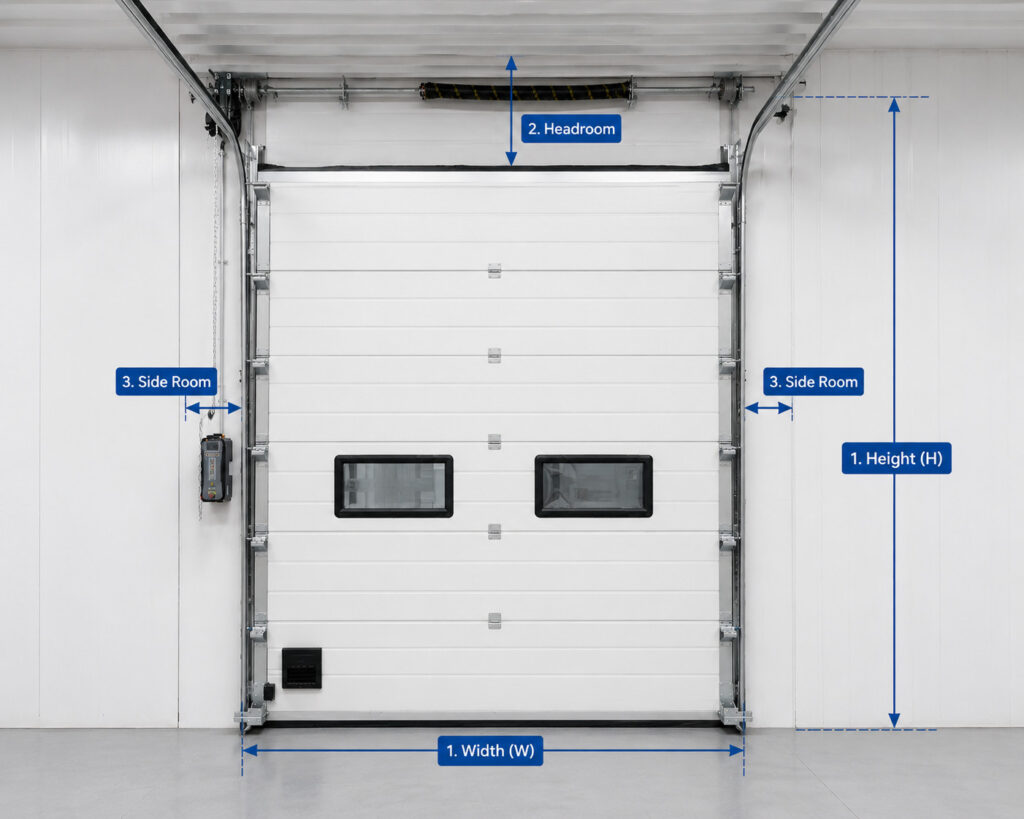
EN 13241 Does Not Mean Every Sectional Door Is the Same
Two doors can both be described as sectional overhead doors while having very different performance.
Differences may exist in:
- panel construction
- insulation
- wind resistance
- track thickness
- spring life
- lifting cable design
- safety devices
- motor and control system
- sealing
- testing
- installation documentation
This is why industrial buyers should compare declared performance and complete technical specifications rather than relying on the product name alone.
At SEPPES, industrial sectional door configurations can be customized according to opening dimensions, available headroom, installation environment, operating frequency, control method and project requirements.
Perguntas Frequentes (FAQ)
What is EN 13241?
EN 13241 is a European product standard covering safety and performance characteristics for industrial, commercial and garage doors and gates. It addresses areas including mechanical safety, power operation, wind resistance, water tightness, thermal resistance, air permeability, installation and conformity evaluation.
Does EN 13241 apply to industrial sectional doors?
Yes. Industrial sectional doors used to provide access for goods and vehicles fall within the type of industrial door applications covered by the standard when they meet its defined scope.
Does EN 13241 apply to manual sectional doors?
Yes. The scope includes both manually operated and power-operated doors.
What safety requirements apply to automatic sectional doors?
Power-operated doors need additional consideration for hazards such as crushing, shearing, drawing-in and operating forces. EN 12453 is an important related standard covering safety in use of power-operated industrial, commercial and garage doors.
Does EN 13241 include wind resistance?
Yes. Resistance to wind load is one of the performance characteristics addressed by EN 13241. The required performance should be considered according to the door size, installation position and local conditions.
Does EN 13241 include thermal insulation?
The standard includes thermal resistance as a performance characteristic. Buyers selecting an insulated overhead door should therefore compare declared thermal performance as well as panel construction.
Is an EN 13241 sectional door automatically fire rated?
No. Fire-resistance and smoke-control characteristics are outside the scope of EN 13241 and are covered separately by EN 16034.
What information should I provide when requesting a sectional door quotation?
Provide the opening width and height, quantity, installation location, indoor or outdoor use, available headroom, operating frequency, required control method, insulation requirements, wind conditions and any specific safety or compliance requirements.
EN 13241 gives industrial buyers a structured way to evaluate industrial sectional doors based on safety and measurable performance rather than appearance or price alone.
Mechanical durability, safe operation, wind resistance, thermal resistance, air permeability, water tightness and proper installation can all affect how an industrial door performs during its service life.
When comparing a sectional door for a warehouse or factory, define the actual operating environment first and then ask the manufacturer for the relevant technical documentation and declared performance.
SEPPES provides customized industrial sectional door solutions for factories, warehouses, logistics centers and industrial facilities. Door size, lift type, panel configuration, control method and safety devices can be selected according to the project requirements.
Send us your required L × A dimensions, installation location and operating conditions to receive a suitable industrial door configuration.