
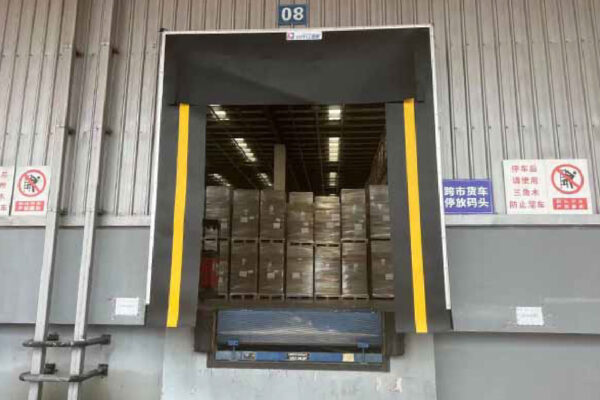
A nivelador de doca is used to bridge the height and distance gap between a loading dock and a truck, allowing forklifts and pallet trucks to move goods safely and efficiently.
For warehouses, factories, logistics centers, and distribution facilities, choosing the right dock leveler mainly depends on five factors: dock height, truck height range, platform size, load capacity, and operating frequency.
For most industrial loading docks with frequent daily operation, a Nivelador de doca hidráulico is one of the most practical choices because it provides automatic operation, stable lifting, and relatively low operating effort.
Índice
AlternarO Que É um Nivelador de Doca?
A dock leveler is a loading dock device installed between a warehouse floor and a truck bed.
Truck bed heights are rarely exactly the same as the loading dock height. A loading dock leveler creates an adjustable bridge so forklifts can travel between the building and the vehicle.
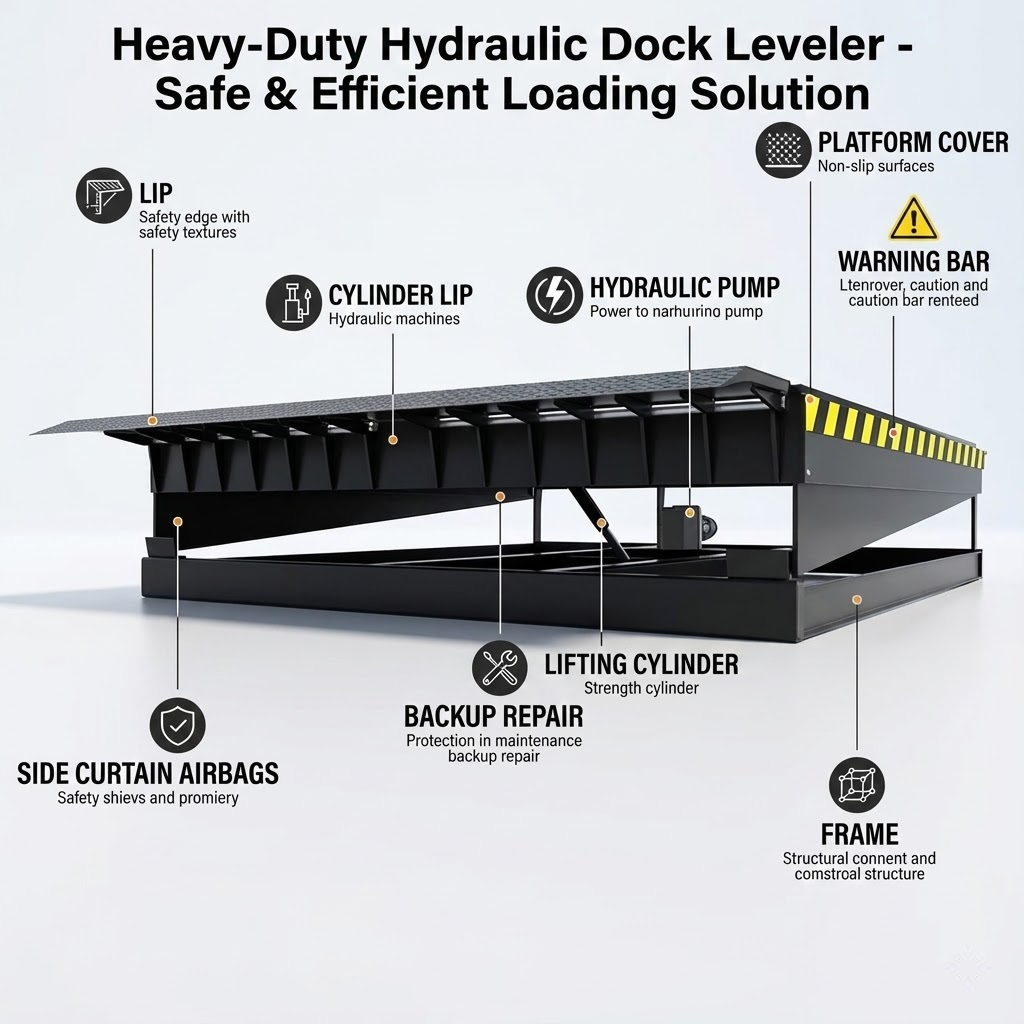
A typical dock leveler includes:
- Steel platform
- Hinged lip
- Hydraulic or mechanical lifting system
- Sistema de controle
- Safety supports
- Side guards or toe guards
- Structural frame
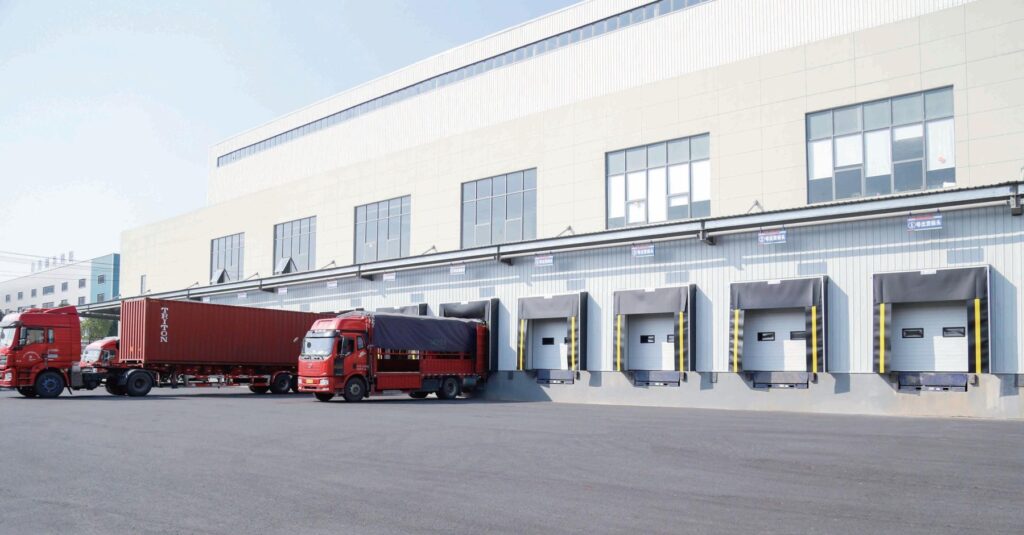
Dock levelers are commonly installed together with sectional doors, dock shelters, dock seals, bumpers, and other Equipamento de doca to create a complete loading dock system.
Common Dock Leveler Specifications
| Parâmetro | Hydraulic Hinged Lip Dock Leveler | Hydraulic Telescopic Lip Dock Leveler |
|---|---|---|
| Standard Size | W1600 × L2000 × H600 mm | W1600 × L2000 × H600 mm |
| Personalização de Tamanho | Tamanhos personalizados disponíveis | Tamanhos personalizados disponíveis |
| Rated Load | Standard 6T; optional 8T / 10T / 15T / 20T | Standard 8T |
| Sample Load Capacity | Dynamic load 8T | Dynamic load 8T |
| Standard Color | RAL5005 Blue | RAL9017 Black |
| Optional Colors | RAL5005 Blue / RAL9017 Black / RAL7016 Gray | RAL5005 Blue / RAL9017 Black / RAL7016 Gray |
| Sistema Hidráulico | KS hydraulic system | KS hydraulic system |
| Main Cylinder | Ø65 × Ø40 × 450 mm | Ø75 × Ø50 × 250 mm |
| Main Platform Plate | 8 mm steel plate | 8 mm steel plate |
| Platform Reinforcement | 4 mm L-shaped reinforcement | Reinforced square steel structure |
| Lip Plate | Sample: 16 mm thick × 400 mm long; standard 14 mm, optional 16 mm | Telescopic lip: 8 mm × 700 mm + 16 mm × 400 mm |
| Telescopic Extension | — | Up to approx. 1000 mm |
| Safety Valve | Incluído | Not included |
| Control Box | 380V / 1.1 kW with emergency stop | 380V / 1.5 kW with emergency stop |
| Cable Length | Standard 8 m | Standard 8 m |
| Toe Guards | Standard matching color | Standard matching color |
| Fita de Vedação | Rubber sealing strip | Rubber sealing strip |
Load Capacity and Plate Thickness
| Rated Load | Main Platform Plate | Lip Plate |
|---|---|---|
| 6T Hinged Lip | 6 mm | 12 mm |
| 8T Hinged Lip | 8 mm | 14 mm |
| 10T Hinged Lip | 8 mm | 16 mm |
| 8T Telescopic Lip | 8 mm | 16 mm |
Main Types of Dock Levelers
1. Nivelador de Doca Hidráulico
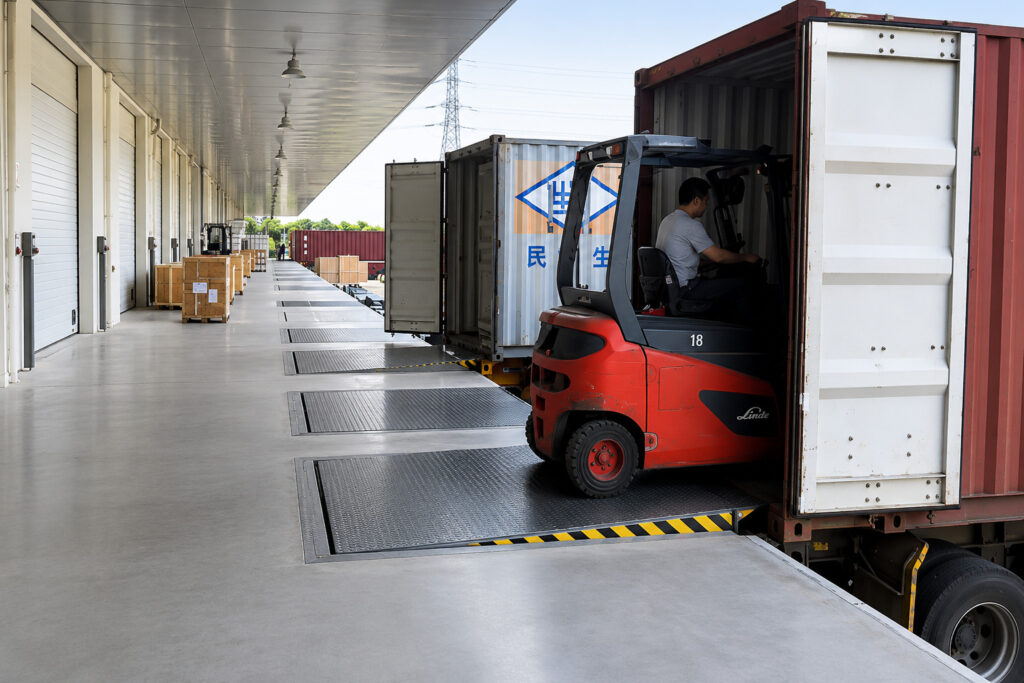
A Nivelador de doca hidráulico uses hydraulic cylinders to raise the platform and operate the lip.
The operator normally presses a control button to raise the platform. After the lip extends, the dock leveler lowers onto the truck bed.
Hydraulic models are widely used in warehouses with frequent loading operations.
Main advantages include:
- Simple push-button operation
- Suitable for frequent daily loading
- Stable platform movement
- Less manual effort
- Suitable for forklifts and pallet trucks
- Easy integration into a loading dock system
For many modern factories and logistics warehouses, hydraulic dock levelers are the preferred option.
2. Nivelador de Doca Mecânico
Mechanical dock levelers normally use springs and mechanical components instead of a hydraulic power unit.
They can be suitable for loading docks with lower operating frequency.
Advantages include:
- Estrutura simples
- No hydraulic power unit
- Suitable for some lower-frequency applications
However, operation normally requires more manual effort and maintenance of springs and mechanical components.
3. Hydraulic Telescopic Lip Dock Leveler
A telescopic dock leveler uses a lip that extends horizontally toward the truck instead of simply rotating outward.
This provides more control over how far the lip reaches into the vehicle.
It can be useful when:
- Truck positions vary
- Precise lip positioning is required
- Different vehicle sizes use the same loading dock
- The loading dock requires a longer bridge range
Telescopic lip systems are often selected for more demanding logistics applications.
4. Edge-of-Dock Leveler
An edge-of-dock leveler is installed at the edge of the loading dock instead of inside a large recessed pit.
It requires less installation space but normally provides a smaller operating range.
It is more suitable when truck bed heights remain relatively close to the loading dock height.
Hydraulic vs Mechanical Dock Leveler
The correct choice depends primarily on operating frequency and budget.
| Característica | Nivelador de Doca Hidráulico | Nivelador de Doca Mecânico |
|---|---|---|
| Operação | Push button | Mainly manual |
| Daily Frequency | Medium to high | Low to medium |
| Operator Effort | Baixa | Maior |
| Custo Inicial | Maior | Usually lower |
| Conveniência | Características da porta espiral de | Médio |
| Automação | Fácil | Limitada |
| Typical Application | Factory / logistics warehouse | Smaller warehouse |
For loading docks operating many times per day, a hydraulic loading dock leveler usually provides better convenience.
What Size Dock Leveler Do You Need?
Dock leveler dimensions should not be selected only according to the width of the loading dock door.
Several measurements need to be checked.
Dock Leveler Width
The platform must provide enough width for the forklift and cargo while maintaining sufficient safety clearance.
Common industrial platform widths are approximately:
- 1,800 mm
- 2,000 mm
- 2,200 mm
The correct width depends on forklift width, pallet size, vehicle opening, and dock layout.
Dock Leveler Length
The platform length affects the operating angle between the warehouse floor and truck bed.
A longer platform generally creates a gentler slope when there is a larger height difference.
Common lengths may include:
- 2,000 mm
- 2,500 mm
- 3,000 mm
The required length should be calculated according to the loading dock height and the highest and lowest trucks using the dock.
Loading Dock Height Matters
Loading dock height is one of the most important measurements when selecting a dock leveler.
If the warehouse dock is significantly higher or lower than the truck bed, the platform angle becomes steeper.
A steeper angle can create problems for:
- Low-clearance forklifts
- Electric pallet trucks
- Heavy pallet loads
- Long-wheelbase material handling equipment
Before choosing a loading dock leveler, confirm:
- Finished warehouse floor height
- Loading dock height
- Lowest truck bed height
- Highest truck bed height
- Typical truck bed height
- Forklift ground clearance
This information helps determine the correct platform length and operating range.
What Dock Leveler Capacity Do You Need?
Dock leveler capacity should not be selected based only on the cargo weight.
The total moving load may include:
Forklift + driver + cargo + attachments
For example:
Forklift weight: 4,000 kg
Cargo weight: 2,000 kg
Driver and equipment: 150 kg
Total moving load already exceeds 6,000 kg.
Repeated forklift movement also creates dynamic impact loads.
Therefore, capacity should include an appropriate safety margin.
Common industrial dock leveler capacities may include:
- 6 tons
- 8 tons
- 10 tons
- 12 tons
Higher capacities can be customized for special industrial applications.
Dock Leveler vs Dock Plate
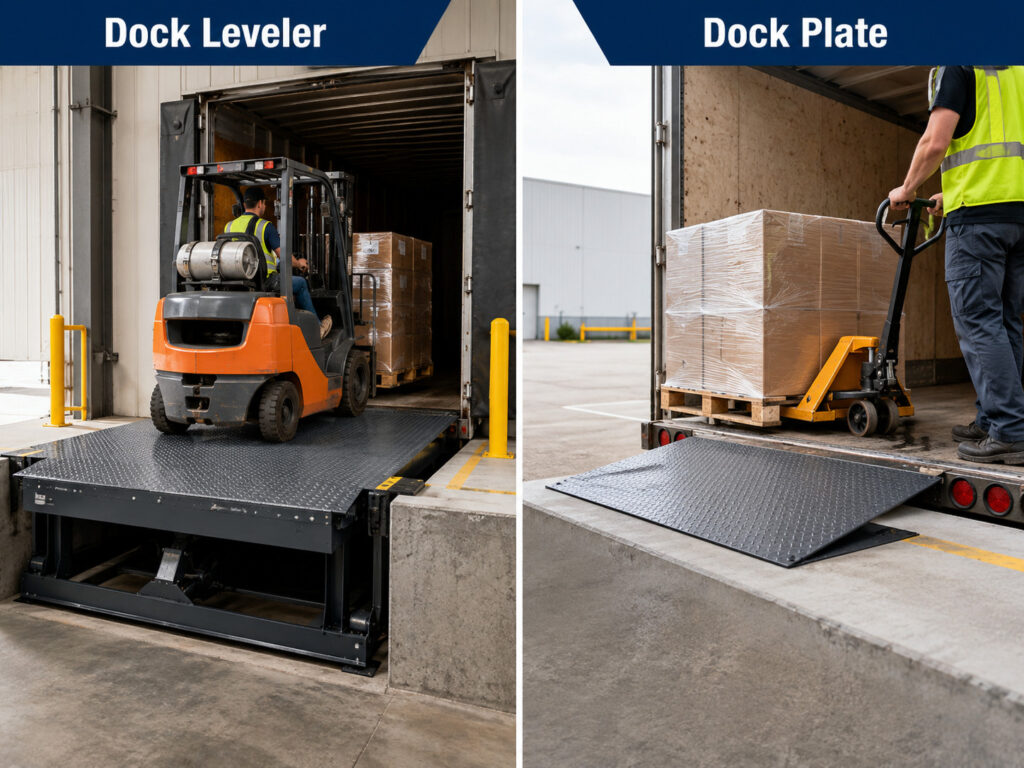
A dock plate and a dock leveler perform similar basic functions, but they are designed for different loading conditions.
| Característica | Nivelador de Doca | Placa de Atracação |
|---|---|---|
| Instalação | Fixed | Usually portable |
| Capacity | Maior | Usually lower |
| Height Adjustment | Larger range | Limitada |
| Forklift Use | Suitable | Depends on model |
| Operation Frequency | Características da porta espiral de | Baixa |
| Typical Application | Industrial loading dock | Light-duty loading |
For warehouses using forklifts frequently, a dock leveler usually provides a more permanent solution.
Dock plates are generally better for lighter and less frequent loading applications.
Dock Ramp vs Dock Leveler
A dock ramp is different from a fixed dock leveler.
Dock ramps or yard ramps are often used where there is no permanent raised loading dock.
They allow forklifts to travel from ground level into a truck or container.
Choose a dock ramp when:
- No loading dock is available
- Loading locations change
- Ground-level forklift access is required
- Temporary loading operations are common
Choose a dock leveler when:
- The warehouse has a permanent raised loading dock
- Trucks regularly reverse into fixed loading bays
- Loading frequency is high
- A permanent dock equipment system is required
Important Safety Features
Industrial loading operations involve forklifts, heavy cargo, vehicles, and moving equipment, so safety should be considered during dock leveler selection.
Useful safety features can include:
Emergency Stop
Allows the operator to immediately stop the system when abnormal operation occurs.
Anti-Slip Platform
A textured steel surface helps improve forklift traction during loading and unloading.
Safety Support
Maintenance support mechanisms prevent accidental platform movement during service work.
Side Toe Guards
These help reduce exposure to moving platform components.
Truck Restraint or Wheel Chocks
These help reduce unintended truck movement during loading.
Dock bumpers can also protect the building structure when trucks reverse toward the loading dock.
Dock Leveler Installation Requirements
Most standard hydraulic dock levelers are installed inside a prepared concrete pit.
Before production, the supplier usually needs accurate pit dimensions.
Important dimensions include:
- Pit width
- Pit length
- Pit depth
- Finished floor height
- Dock height
- Dimensão da abertura da porta
For new warehouse construction, it is better to confirm the dock leveler dimensions before pouring the loading dock pit.
For existing warehouses, the current pit should be measured carefully before ordering replacement equipment.
Dock Leveler and Sectional Door Integration
A complete loading bay commonly includes more than just a dock leveler.
A typical loading dock system may contain:
- Porta industrial seccional
- Nivelador de docas
- Dock shelter or dock seal
- Para-choques de doca
- Vehicle restraint
- Safety barriers
- Traffic lights
- Loading dock control system
Integrating these components improves loading efficiency and creates a more organized loading process.
For example, a sectional door can remain closed until the truck reaches the loading position. After the vehicle is secured, the door opens and the dock leveler is activated.
This type of dock equipment combination is commonly used in warehouses, logistics centers, food factories, and manufacturing facilities.
How to Choose the Right Dock Leveler
Before requesting a quotation, confirm the following information.
1. Dock Opening Size
Provide the loading bay width and height.
2. Loading Dock Height
Measure the distance from ground level to the finished warehouse floor.
3. Truck Bed Height Range
Provide the minimum and maximum vehicle bed heights.
4. Required Capacity
Confirm forklift weight plus maximum cargo weight.
5. Daily Loading Frequency
Tell the manufacturer approximately how many loading cycles occur each day.
6. Truck Type
Different trucks and containers may require different lip lengths and operating ranges.
7. Existing Pit Dimensions
For replacement projects, provide accurate pit width, length, and depth.
With these measurements, a dock leveler manufacturer can recommend a suitable platform size, capacity, and operating range.
Applications of Dock Levelers
Dock levelers are widely used in:
- Armazéns
- Centros de distribuição
- Fábricas de manufatura
- Centros logísticos
- Fábricas de processamento de alimentos
- Armazéns frigoríficos
- Centros de atendimento de comércio eletrônico
- Automotive plants
- Instalações farmacêuticas
- Transportation hubs
Facilities with frequent forklift loading normally benefit most from a permanent hydraulic dock leveler.
Perguntas Frequentes (FAQ)
What is a dock leveler?
A dock leveler is an adjustable platform installed between a loading dock and a truck. It bridges differences in height and distance so forklifts and pallet trucks can move safely between the warehouse and vehicle.
What is the standard size of a dock leveler?
There is no universal size for every project. Common industrial dock levelers are approximately 1,800–2,200 mm wide and 2,000–3,000 mm long, but final dimensions should be selected according to loading dock height, truck dimensions, and forklift requirements.
How much weight can a dock leveler hold?
Common industrial capacities include approximately 6, 8, 10, and 12 tons. Higher capacities can also be designed for heavy-duty applications.
Is a hydraulic dock leveler better than a mechanical dock leveler?
For warehouses with frequent loading operations, hydraulic dock levelers normally provide easier operation and lower operator effort. Mechanical models may still be suitable for lower-frequency applications.
What is the difference between a dock leveler and a dock plate?
A dock leveler is normally permanently installed and provides a greater height adjustment range. A dock plate is generally used for lighter-duty applications and smaller height differences.
What is the difference between a dock ramp and a dock leveler?
A dock leveler is normally installed at a permanent raised loading dock. A dock ramp or yard ramp allows forklifts to travel between ground level and a truck when no raised loading dock is available.
What information is needed for a dock leveler quotation?
Normally the supplier needs the dock opening size, dock height, truck bed height range, required capacity, forklift weight, existing pit dimensions, quantity, and operating frequency.
Can dock levelers be customized?
Yes. Platform dimensions, capacity, lip design, operating range, control configuration, and other specifications can be customized according to the loading dock project.
The right dock leveler should match the loading dock height, truck bed range, forklift weight, cargo capacity, and daily operating frequency.
For most high-frequency industrial loading bays, a hydraulic dock leveler provides a practical combination of easy operation, high load capacity, and reliable performance.
Instead of choosing a dock leveler only by platform size or price, evaluate the entire loading process, including the truck, forklift, sectional door, dock shelter, pit dimensions, and safety requirements.
A properly configured loading dock system can improve loading efficiency, reduce unnecessary forklift movement, and create a safer connection between the warehouse and the truck.