
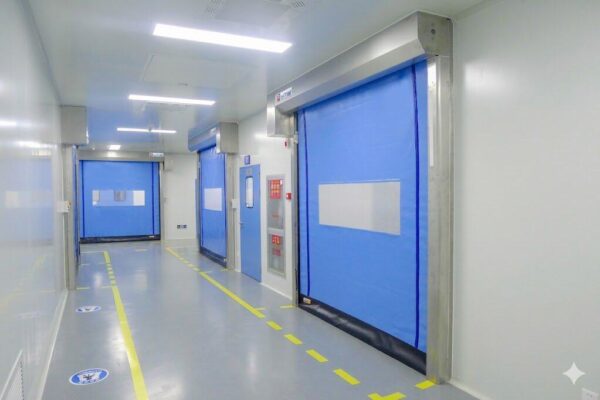
Cold Storage Door Selection: Temperature, Insulation and Traffic
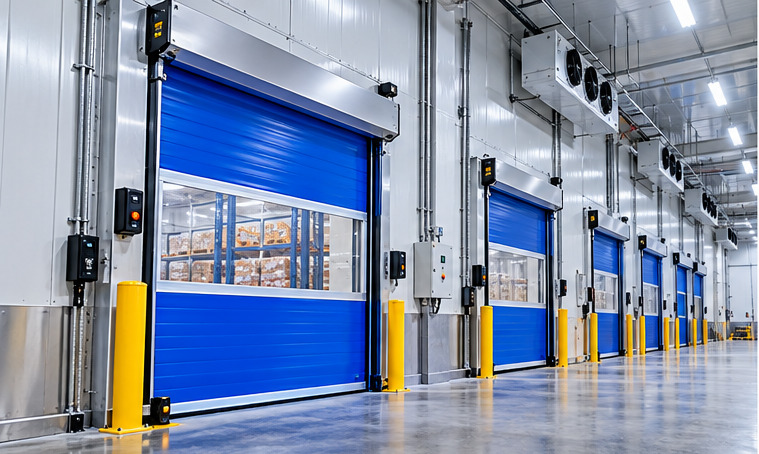 Filename: cold-storage-door-selection.jpg
ALT: Cold storage door selection for a refrigerated warehouse with industrial high speed freezer doors
Placement: Directly below H1
Suggested size: 1200 x 800 px
Replace this comment with an IMG tag after uploading to WordPress.
-->
Cold storage door selection can have a major impact on temperature stability, refrigeration efficiency, forklift traffic, and daily operating costs. Imagine a frozen food warehouse where forklifts cross between a -25°C freezer and a warmer loading area dozens of times per hour. Even a well-insulated door can contribute to significant air exchange if it remains open too long.
Meanwhile, a refrigerated food processing room operating at 2°C may need a completely different door configuration. Its main priorities could be hygiene, easy cleaning, smooth personnel movement, and reliable sealing rather than extreme low-temperature performance.
Choosing the right cold storage doors requires more than comparing prices or door thickness. Facility managers must evaluate temperature differences, insulation performance, operating cycles, opening speed, moisture conditions, and traffic requirements.
This guide explains seven essential factors in cold storage door selection, compares insulated sectional doors with high-speed freezer doors, and provides practical recommendations for cold chain warehouses, food factories, pharmaceutical facilities, and refrigerated distribution centers.
Why Cold Storage Door Selection Matters in 2026
Cold chain operators face increasing pressure to maintain product quality while managing energy consumption and operational efficiency.
According to the International Energy Agency's Energy Efficiency 2025 report, improving energy efficiency remains an important priority across industrial and building sectors.
A UN Environment Programme's Global Cooling Watch 2025 also highlights the growing global demand for cooling and the importance of sustainable cooling strategies.
For refrigerated warehouses, these developments reinforce a practical engineering principle: energy efficiency should be considered throughout the facility, not only in the refrigeration equipment.
Door systems influence air infiltration, moisture entry, opening duration, and traffic movement. Poorly selected doors can undermine otherwise efficient temperature-control systems.
UNEP's Cold Chain Technology Brief on Cold Storage and Refrigerated Warehouses identifies energy use as a significant operating-cost concern for refrigerated storage businesses.
The right door is therefore an important part of an integrated cold storage facility design.
7 Essential Factors for Cold Storage Door Selection
1. Identify the Operating Temperature and Temperature Difference
The first step in selecting cold storage doors is determining the temperature on both sides of the doorway.
For example, a door connecting a 4°C refrigerated warehouse to a 15°C preparation area faces different operating conditions from a freezer door separating a -25°C storage room from a 20°C warehouse.
A larger temperature difference can increase the potential for heat transfer and air infiltration, especially during frequent opening cycles.
Temperature-related selection factors include:
- Inside operating temperature
- Outside or adjacent room temperature
- Temperature difference across the opening
- Relative humidity on both sides
- Required temperature stability
- Exposure to frost and condensation
Very low-temperature environments may require additional features such as suitable sealing materials, heated guide components, or dedicated freezer-door configurations.
However, temperature ratings must be confirmed for the specific door model and installation conditions. Not every insulated high-speed door is suitable for continuous operation at -25°C or below.
2. Evaluate Thermal Insulation and Air Sealing
Thermal insulation is essential when selecting doors for refrigerated and frozen storage environments.
Insulated door structures help reduce heat transfer when closed. At the same time, effective perimeter sealing helps limit unintended air leakage.
Important insulation considerations include:
- Door panel or curtain construction
- Insulation material and thickness
- Declared thermal transmittance or U-value, where available
- Side, top, and bottom sealing
- Thermal bridging
- Air leakage performance
- Long-term sealing durability
An insulated sectional door with polyurethane-filled panels may provide strong thermal resistance when closed, while an insulated high-speed door may provide advantages where rapid opening and closing are needed.
The most effective solution depends on the balance between closed-door thermal performance and air exchange during operation.
For an example of industrial insulated panel construction, explore the Porta de Seção Isolada SEPPES.
3. Consider Door Opening Speed and Traffic Frequency
Traffic frequency is another critical factor in cold storage door selection.
A cold storage room opened only a few times per day may prioritize insulation and sealing. A high-frequency forklift passage may benefit more from rapid opening, automated activation, and short open times.
Consider the following questions:
- How many opening cycles occur each hour?
- Will forklifts travel through the doorway?
- Do workers need frequent pedestrian access?
- How long does the door remain open per cycle?
- Is traffic continuous or intermittent?
- Can automatic activation reduce unnecessary opening time?
Opening speed alone does not determine total energy performance. Detection distance, vehicle speed, closing delay, and unnecessary sensor activation can also affect the duration of each opening.
For busy facilities, an appropriately specified insulated high-speed door can support rapid access while providing a thermal barrier when closed.
4. Prevent Frost, Condensation and Ice Buildup
Condensation and ice are common concerns when warm, humid air enters low-temperature storage areas.
Depending on the facility's conditions, moisture may accumulate on door frames, sealing surfaces, floors, or guide systems.
Potential problems include:
- Frost around side guides
- Ice buildup near the threshold
- Condensation on sensor surfaces
- Door seals freezing to contact surfaces
- Reduced door reliability
- Slippery floors near the opening
For freezer applications, possible measures include properly specified heated components, moisture-resistant materials, effective sealing, and appropriate air management.
Not every application requires the same anti-frost equipment. A qualified supplier should evaluate local humidity, temperature difference, operating frequency, and the proposed door configuration.
5. Match the Door to Forklift and Pedestrian Traffic
Industrial cold storage doors frequently serve mixed traffic, including forklifts, pallet trucks, workers, and automated material-handling equipment.
Traffic characteristics influence both door dimensions and the required safety arrangement.
Important factors include:
- Forklift height and load dimensions
- Clear opening width
- Approach direction and turning space
- Pedestrian traffic volume
- Visibility through the doorway
- Automatic activation requirements
- Obstruction detection and protective devices
Radar sensors, photoelectric sensors, light curtains, and other devices may be used according to the application.
In high-traffic warehouses, selecting a suitable door configuration can help reduce unnecessary vehicle stops while supporting controlled closing operation.
6. Evaluate Hygiene, Durability and Maintenance
Cold storage facilities often operate in demanding environments where moisture, cleaning procedures, and accidental impacts can affect equipment durability.
Food processing and pharmaceutical facilities may also have specific hygiene and cleaning requirements.
When evaluating a door, consider:
- Corrosion resistance
- Cleanability of exposed surfaces
- Suitability for washdown conditions, where applicable
- Resistance to frequent operating cycles
- Availability of replacement seals and parts
- Inspection and maintenance access
- Suitability of motors and electrical components for the environment
For facilities with frequent forklift movement, the risk of accidental impacts should also be considered during the specification stage.
7. Compare Total Operating Cost, Not Just Purchase Price
The cheapest door is not necessarily the most economical choice over its operating life.
Total cost considerations may include:
- Initial equipment cost
- Installation cost
- Refrigeration load related to door operation
- Inspection and maintenance costs
- Replacement parts
- Unplanned downtime
- Productivity losses caused by slow traffic flow
A realistic cost comparison should account for the expected opening frequency, temperature difference, air infiltration, and maintenance requirements.
Energy savings should be evaluated using project-specific assumptions rather than universal percentage claims.
How Temperature Affects Cold Storage Door Selection
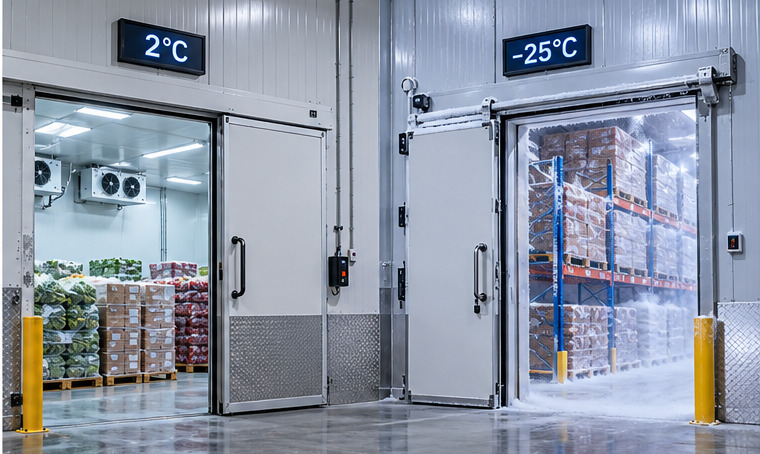 Filename: cold-storage-door-temperature.jpg
ALT: Cold storage door selection for chilled rooms and low temperature freezer warehouse applications
Placement: Below this H2
Suggested size: 1000 x 650 px
-->
Temperature requirements vary significantly across cold chain facilities.
The table below provides illustrative application ranges. They are not universal door performance ratings or product temperature limits.
| Cenários de aplicação | Illustrative Temperature | Key Door Considerations |
|---|---|---|
| Chilled food storage | 0°C to 8°C | Sealing, hygiene, moisture control |
| Refrigerated distribution | 0°C to 5°C | Frequent traffic, automatic activation |
| Frozen food storage | Approximately -18°C | Insulation, air infiltration, frost control |
| Low-temperature freezer | Approximately -25°C | Model-specific low-temperature suitability, heating accessories |
| Specialized deep-freeze application | Below -30°C | Specialized engineering and confirmed equipment ratings |
For example, a seafood distribution center may operate separate chilled receiving, frozen storage, and refrigerated dispatch areas.
Each doorway should be evaluated according to its actual temperatures and traffic conditions rather than applying one door model throughout the facility.
Explore the SEPPES Freezer Door Applications page for additional cold storage door options.
Insulated Sectional Doors vs High-Speed Freezer Doors
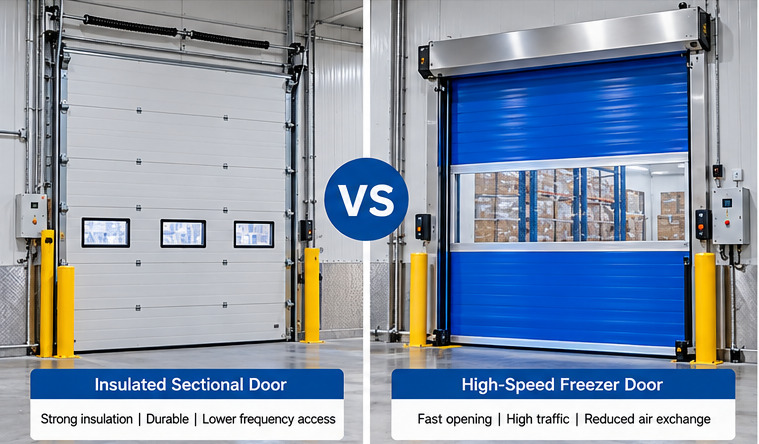 Filename: insulated-vs-high-speed-freezer-doors.jpg
ALT: Insulated sectional door vs high speed freezer door comparison for refrigerated warehouse selection
Placement: Below this H2
Suggested size: 1200 x 750 px
-->
Two commonly considered categories for temperature-controlled facilities are insulated sectional doors and insulated high-speed doors.
Both may support cold storage applications, but their strengths depend on the operating conditions and model specifications.
| Selection Factor | Porta Seccional Isolada | Porta Rápida Isolante |
|---|---|---|
| Typical priority | Closed-door insulation and robust construction | Rapid access and shorter opening duration |
| Door structure | Insulated rigid panels | Insulated curtain or specialized rapid-door structure |
| Opening frequency | Depends on model and duty rating | Often designed for frequent operation |
| Velocidade de abertura | Generally lower than specialized rapid doors | Generally faster, model-dependent |
| Space requirement | Track and lift arrangement needed | Depends on roll-up or other rapid-door design |
| Cold-room suitability | Must verify insulation and sealing | Must verify low-temperature rating and sealing |
| Best suited to | Lower-frequency access or suitable industrial openings | High-frequency traffic between controlled spaces |
When Should You Choose an Insulated Sectional Door?
An insulated sectional door may be suitable when closed-door thermal performance, structural strength, and relatively infrequent vehicle access are important.
For example, a refrigerated warehouse loading entrance that operates intermittently may benefit from insulated rigid panels and perimeter seals.
SEPPES offers industrial sectional door configurations with polyurethane insulation and EPDM sealing for suitable industrial applications.
Explore the SEPPES High Insulation Sectional Door for product details.
When Should You Choose an Insulated High-Speed Door?
Insulated high-speed doors are especially relevant when frequent traffic makes prolonged door opening a major concern.
These doors can reduce the time an opening remains exposed, provided the activation and closing controls are correctly configured.
SEPPES offers insulated high-speed door models designed for temperature-controlled industrial environments. Its published product page lists a maximum reference size of 5000 × 5000 mm and an adjustable opening speed of 0.8–1.2 m/s for the specified model.
These figures are model-specific and should not be applied to every freezer door configuration.
Read the Insulated High-Speed Door Specifications before requesting a customized quotation.
Choosing Cold Storage Doors for High-Traffic Areas
High-frequency forklift traffic can change which door design is most appropriate.
Consider two refrigerated facilities:
Facility A: A cold room opens approximately ten times per day for occasional pallet movement.
Facility B: A cold chain distribution center uses the same opening dozens of times per hour during loading and order fulfillment.
Both facilities may have similar temperature requirements, yet their door-selection priorities can differ significantly.
Facility A may focus on closed-door insulation and dependable sealing. Facility B may benefit from rapid opening, automatic vehicle detection, and an optimized closing delay.
Why Opening Duration Matters
Every open-door event creates an opportunity for air exchange between spaces with different temperatures and humidity levels.
For frequent traffic, a shorter opening period can help limit this exchange, but the benefit depends on the doorway dimensions, air pressure conditions, traffic pattern, and control settings.
Automatic radar detection can be useful for forklift access, although the sensor coverage must be configured to prevent unnecessary openings caused by nearby traffic.
See the SEPPES Door Radar for compatible automatic activation equipment.
Should You Consider Two-Door Airlocks?
For facilities with particularly large temperature differences or strict environmental requirements, a two-door arrangement may be considered.
Interlocking control can help prevent both doors from remaining open at the same time, subject to the installation's safety and emergency egress requirements.
Such systems require a project-specific design rather than simply installing two independent doors.
Can Air Curtains Reduce Cold Storage Energy Loss?
Air curtains may be used as auxiliary air-separation equipment at certain refrigerated openings.
However, an air curtain is not a direct replacement for a properly selected and insulated cold storage door.
Air curtain effectiveness depends on doorway size, temperature difference, pressure conditions, air velocity, and installation configuration.
In low-temperature environments, the interaction between air curtains and moisture movement must be carefully evaluated.
For most projects, the starting point should remain the selection of suitable doors, seals, protective controls, and traffic management.
Cold Storage Door Selection by Industry
Meat and Poultry Processing
Meat processing facilities may require refrigerated doors with hygienic surfaces, reliable temperature separation, and compatibility with cleaning procedures.
Door selection should consider washdown exposure, material resistance, pedestrian movement, and equipment access.
Seafood Cold Storage
Seafood facilities often combine wet operating conditions with chilled or frozen storage areas.
Corrosion-resistant materials, moisture-resistant components, and reliable sealing are important considerations.
SEPPES has published an insulated high-speed door application for a seafood warehouse in Thailand, illustrating how thermal separation and traffic requirements can influence door selection.
Ice Cream and Frozen Food Warehouses
Frozen food storage requires careful temperature management and reliable freezer-door operation.
Low-temperature suitability, condensation control, and opening frequency should be evaluated together.
Frequent movement between a frozen storage room and a warmer preparation area may justify a specialized high-speed freezer-door configuration.
Cold Chain Distribution Centers
Distribution centers prioritize rapid goods movement and reliable temperature control.
Forklift traffic, loading schedules, automatic activation, and opening dimensions are major selection factors.
For high-frequency movement, appropriately selected high-speed doors may help reduce the amount of time openings remain exposed.
Armazenamento Frio Farmacêutico
Temperature-sensitive pharmaceutical storage can involve demanding environmental monitoring and operational procedures.
Door selection should account for temperature stability, sealing, access control, cleaning protocols, and the facility's applicable validation requirements.
A door cannot guarantee pharmaceutical storage compliance by itself; it is one part of the broader controlled-environment system.
Cold Storage Door Selection Checklist for Industrial Buyers
Before contacting a manufacturer, collect the following project information.
| Project Detail | Information to Provide |
|---|---|
| Opening dimensions | Clear width × height in mm |
| Inside temperature | Normal operating temperature in °C |
| Adjacent area temperature | Temperature outside the cold room |
| Humidity | Expected moisture and condensation conditions |
| Traffic type | Forklift, pallet truck, pedestrian, AGV |
| Opening frequency | Estimated cycles per hour or day |
| Available space | Headroom and side clearance |
| Fonte de alimentação | Voltage and frequency |
| Control requirements | Radar, push button, pull cord, PLC, interlock |
| Installation location | Country, city, and applicable project standards |
For example, a useful inquiry might describe a W2500 × H4000 mm opening, a -25°C freezer, a 20°C adjacent warehouse, frequent forklift traffic, and a requirement for automatic activation.
With this information, the manufacturer can assess whether a specialized insulated high-speed door, freezer door, or another configuration is appropriate.
Common Cold Storage Door Selection Mistakes
Choosing a Door Based Only on Panel Thickness
Insulation thickness matters, but air leakage, sealing, and opening duration can also affect overall performance.
Ignoring Traffic Frequency
A door suitable for occasional access may not be ideal for a busy forklift passage.
Assuming Every Insulated Door Is Freezer-Rated
Low-temperature suitability must be verified from the specific model and operating conditions.
Overlooking Frost and Moisture
Temperature difference and humidity can create condensation or ice-related operating problems.
Choosing Sensors Without Considering the Traffic Pattern
Poorly configured activation devices may cause unnecessary openings or inefficient traffic flow.
Ignoring Maintenance Accessibility
The ability to inspect seals, guides, heating accessories, and control components affects long-term operating reliability.
Why Choose SEPPES for Cold Storage Door Solutions?
SEPPES manufactures customizable industrial door systems for warehouses, food processing facilities, logistics centers, and temperature-controlled environments.
Its product portfolio includes:
- Portas Rápidas Isoladas for suitable temperature-controlled applications.
- Portas Seccionais Isotérmicas for industrial openings requiring insulated rigid-panel construction.
- Freezer Door Solutions for low-temperature project evaluation.
- Industrial High-Speed Doors for frequent traffic and automatic access applications.
SEPPES supports project-based customization, allowing buyers to discuss dimensions, insulation requirements, activation methods, safety equipment, and control-system integration.
Rather than selecting a door based on a single feature, industrial customers should evaluate the entire operating environment with the supplier.
Frequently Asked Questions About Cold Storage Door Selection
What is the best door for a cold storage warehouse?
The best door depends on temperature, traffic frequency, required insulation, and operating conditions. Insulated sectional doors may suit certain lower-frequency openings, while specialized insulated high-speed doors may be appropriate for frequent traffic.
Are high-speed doors suitable for freezer rooms?
Some high-speed doors are specifically designed for freezer applications. The operating temperature rating, sealing system, and required anti-frost features must be confirmed for the selected model.
How can cold storage doors reduce energy loss?
Suitable insulation, effective sealing, reduced opening duration, and appropriate automatic control can help limit heat transfer and unwanted air exchange.
Which is better: an insulated sectional door or a high-speed freezer door?
An insulated sectional door may emphasize closed-door thermal performance, while a specialized high-speed freezer door may be better suited to frequent access. The correct choice depends on project conditions.
Why does ice form around a freezer door?
Ice formation may be related to moisture entering the freezer, condensation, air leakage, inadequate heating arrangements, or operating conditions. A site-specific technical inspection is necessary to determine the cause.
Can radar sensors be used on cold storage doors?
Yes, when the sensor and controller are compatible and suitable for the environment. Sensor positioning should be configured to match traffic conditions and avoid unwanted activation.
What information is needed for a cold storage door quotation?
Manufacturers typically need the opening dimensions, inside and outside temperatures, traffic frequency, environmental conditions, electrical supply, and required control features.
Can an air curtain replace an insulated freezer door?
Generally, an air curtain should not be considered a direct substitute for a correctly engineered freezer door. It may be used as part of an auxiliary air-management strategy where appropriate.
Conclusion: Choose Cold Storage Doors Based on Real Operating Conditions
Effective cold storage door selection requires balancing temperature difference, insulation, opening frequency, moisture control, and daily traffic requirements.
For a low-frequency refrigerated entrance, a well-insulated sectional door may be appropriate. For a high-frequency forklift passage, a specialized insulated high-speed door may offer operational advantages. In freezer environments, verified low-temperature suitability and frost-control provisions are especially important.
By assessing these factors before purchasing, facility managers can make more informed decisions about long-term operating reliability, maintenance, and refrigeration efficiency.
Get a Customized Cold Storage Door Solution from SEPPES
Planning a refrigerated warehouse, frozen food facility, or cold chain distribution project?
SEPPES can help review your door opening dimensions, temperature requirements, traffic conditions, and control-system needs to recommend a suitable industrial door configuration.
For an accurate quotation, please provide your required width and height, operating temperature, opening frequency, and installation location.