
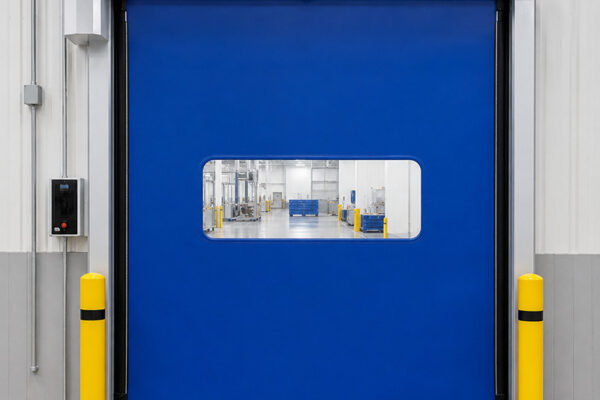
Self Repairing High Speed Doors with Touchless Hand-Wave Control: Why Choose This Setup?
Self repairing high speed doors with touchless hand-wave switches offer a practical.
This guide explains how the combination works,.
The focus is on intentional touchless operation,.

1. How Does a Touchless Hand-Wave Switch Open a Zipper Door?
A touchless hand-wave switch is a close-range, intentionally operated.
A person moves a hand within the device's.
- An operator approaches the switch on the entry side.
- The operator waves a hand close to the sensing.
- The controller receives the opening request.
- The operator passes through the doorway while.
- The door closes according to its configured logic.
Why Intentional Activation Matters
At a busy intersection of two factory.
A broad-area motion radar can register.
A correctly positioned hand-wave switch.
However, users must still be able to approach.
2. Why Choose Self Repairing High Speed Doors with Hand-Wave Activation?
The main advantage of this configuration comes from combining deliberate contactless opening with the mechanical benefits of a high-speed zipper-guided curtain.
Less Routine Contact
Operators can request opening without pressing shared buttons. This can support established hygiene workflows but does not replace proper hand hygiene or cleaning procedures.
More Deliberate Openings
For pedestrian routes next to busy production areas, intentional activation can help reduce unwanted opening requests compared with poorly positioned motion detectors.
Fast Curtain Operation
The published SEPPES high-speed zipper door range lists adjustable operating speeds of approximately 0.8–2.0 m/s. The actual speed depends on the selected configuration and installation.
Recovery After Certain Impacts
On models equipped with a self-repairing system, a displaced flexible curtain can re-enter its side guides under specified recovery conditions, potentially reducing some manual resets.
How Self Repairing High Speed Doors Recover After Certain Impacts
A zipper-style curtain edge is guided along the door frame.
In a compatible self-repairing design, a curtain that has been pulled out of its guide by a limited accidental impact can return to the track during an appropriate recovery cycle.
This functionality can be useful at busy industrial entrances where accidental contact with the flexible curtain may occur.
However, self-repairing does not mean that torn PVC fabric, bent frames, damaged guides, or every collision can repair itself.
The door should be inspected and serviced whenever damage is suspected.

Why the Zipper Guide Is Important
The edge-guided curtain supports close engagement with the door frame.
Compared with certain brush-guided roll-up door configurations, a suitable zipper system may improve side-edge sealing and help reduce uncontrolled air movement between adjacent areas.
However, a zipper-guided door should not automatically be described as airtight.
Actual sealing performance depends on the top housing, bottom seal, installation quality, pressure difference, and complete door construction.
Why Fast Closing Matters
In frequently used production corridors, keeping an industrial doorway open longer than necessary may increase air exchange between adjacent areas.
An appropriately configured high-speed door can shorten opening and closing cycles compared with slower door designs.
The actual benefit depends on door size, operating speed, traffic volume, closing delay, and sensor behavior.
The hand-wave switch and controller should therefore be configured together. An unnecessarily long hold-open period may reduce the intended advantages of intentional activation.
3. Hand-Wave Switch vs Radar Sensor vs Push Button
Although these three systems can request door movement, they support different traffic patterns and operating requirements.
| Cecha | Hand-Wave Switch | Motion Radar | Push Button |
|---|---|---|---|
| Activation | Deliberate hand gesture | Motion or approach detection | Physical button press |
| Physical contact | Niewymagane | Niewymagane | Wymagane |
| Typowe zastosowanie | Industrial personnel passages | Vehicle and automatic pedestrian access | Manual control stations |
| Passing traffic nearby | Can reduce accidental activation with suitable placement | Detection-zone configuration is important | Typically opens only when pressed |
| Workers with occupied hands | May be inconvenient | Often convenient | May be inconvenient |
| Ruch wózków widłowych | Usually not preferred | Often suitable with correct configuration | Requires manual operation |
| Zabezpieczenia bezpieczeństwa | Separate protective functions required | Activation radar alone is not sufficient | Separate protective functions required |
For a more detailed explanation of motion activation and obstruction protection, read our High-Speed Door Safety Sensors Guide .
That article explains radar and photoelectric sensor technologies, while this guide focuses on intentional hand-wave opening for self repairing high speed doors.
4. Watch the Touchless Hand-Wave Door Video
The following video is provided to illustrate the industrial door application discussed in this guide.
When reviewing an installation, pay attention to the position of the opening control, the operator's approach, and the door's operating sequence.
If the video does not display, watch it directly on YouTube .
5. Where Are Touchless Self Repairing High Speed Doors Most Useful?
Food Processing and Packaging Entrances
Employees frequently move between packaging rooms, production corridors, and ingredient-handling areas.
Where employees can safely make a hand gesture, a contactless switch reduces routine contact with shared wall controls.
An automatically closing zipper door can also support the facility's traffic and environmental separation strategy.
For US food manufacturing facilities, entrances should be evaluated as part of the site's sanitary operations and hazard-control procedures under FDA 21 CFR Part 117 .
These requirements do not mandate a particular touchless switch, and installing one does not independently establish regulatory compliance.
Pharmaceutical and Controlled Production Rooms
Intentional hands-free opening can be useful at selected personnel passages where operators follow defined entry procedures.
If the facility requires an airlock, differential pressure management, access authorization, or environmental qualification, those functions must be designed and verified separately.
A zipper door is not automatically certified for a particular cleanroom classification.
Electronics and Precision Manufacturing
In electronics manufacturing areas, a door may be located beside frequently used workstations or busy internal pedestrian corridors.
A deliberate hand-wave opening request may be preferable to a radar zone that could detect people working nearby.
The complete door specification must still consider particulate control, electrostatic-discharge requirements, pressure conditions, and traffic safety.
Internal Factory Personnel Corridors
Self repairing high speed doors with touchless switches may be considered where frequent personnel access and reduced physical interaction are priorities.
The configuration is particularly worth evaluating when the entrance is intended primarily for pedestrians rather than continuous forklift traffic.
When Not to Choose Hand-Wave Activation
For continuous forklift passage, users unable to approach a switch, AGV traffic, or fully automated material movement, a different opening method may be more suitable.
For freezer conditions or exterior high-wind exposure, confirm whether a specialized insulated or wind-rated door is required rather than a standard PVC zipper-door configuration.

6. Self Repairing High Speed Doors: Specification and Safety Checklist
Industrial buyers should specify the complete door assembly rather than focusing only on the curtain or the contactless opening switch.
| Project Item | Co należy potwierdzić |
|---|---|
| Wymiarów otworu | Clear width and height, available side space, headroom and mounting surface. |
| Traffic conditions | Pedestrian, trolley, forklift or automated movement; expected operating frequency. |
| Switch technology | Manufacturer, sensing principle, operating distance, enclosure rating and installation position. |
| Two-way access | One switch or two switches, controller input compatibility and operating sequence. |
| Protective functions | Suitable obstruction detection, monitored protective edge or safety light curtain as required by the risk assessment. |
| Sterownik bramy | Opening and closing logic, hold-open delay, manual operation and power failure behavior. |
| Warunki środowiskowe | Temperature, humidity, cleaning procedures, pressure difference and material compatibility. |
| Konserwacja | Self-repairing recovery procedure, inspection requirements, spare parts and technical support. |
7. Why Consider SEPPES Self Repairing High Speed Doors?
Przy porównywaniu self repairing high speed doors for a touchless industrial entrance, buyers should evaluate the complete door assembly rather than the activation switch alone.
Przemysł SEPPES High-Speed Zipper Door product range includes flexible PVC curtains, zipper-style side guides, self-repairing functionality, selectable frame materials, and adjustable operation.
For a project requiring contactless hand-wave activation, a compatible switch should be evaluated alongside the selected door controller and appropriate protective devices.
If you are comparing different industrial door designs, explore our High-Speed Door Overview .
For additional information about controlled production applications, see our article on Rapid Roll-Up Doors in Clean Rooms .
Need a High-Speed Zipper Door with Hand-Wave Opening?
Tell SEPPES your doorway dimensions, required quantity, industry, traffic type, power supply, and preferred contactless switch arrangement.
Our team can evaluate a suitable door and control configuration for your specific project requirements.
Request a Project-Specific RecommendationCzęsto zadawane pytania
What are self repairing high speed doors?
They are industrial high-speed doors with a compatible curtain-guiding system that allows certain displaced flexible curtains to return to their tracks under specified recovery conditions. They do not automatically repair torn fabric or damaged components.
Does a touchless hand-wave switch open a door when someone walks past?
Typically, a hand-wave switch is intended for deliberate near-field activation rather than broad-area movement detection. Actual behavior depends on the device model, settings, and installation.
Can hand-wave switches be installed on both sides of a zipper door?
Yes, provided the chosen controller supports the arrangement and the installation meets the operating and safety requirements.
Does a hand-wave switch replace a safety light curtain?
No. It is an opening-command device. Protective functions must be specified separately according to applicable requirements and the door's risk assessment.
Are touchless zipper doors suitable for food processing facilities?
They can be suitable for selected internal passages, depending on hygiene procedures, cleaning compatibility, door construction, traffic, and safety requirements.
Is hand-wave control better than radar?
Neither is universally better. Gesture control supports deliberate personnel requests, while radar often suits traffic requiring automatic approach detection. The correct option depends on the operating environment.
Jakie informacje są wymagane do wyceny?
Provide the opening width and height, quantity, application, expected traffic, temperature and humidity, power supply, preferred opening controls, and any special safety or installation requirements.
Further Reading and Technical References
- SEPPES High-Speed Zipper Door Specifications — Product construction, guiding system, and published operating speed.
- High-Speed Door Activation and Safety Sensors — Radar activation and photoelectric protection principles.
- US FDA — 21 CFR Part 117 — Current good manufacturing practice and preventive controls for applicable human-food facilities.