
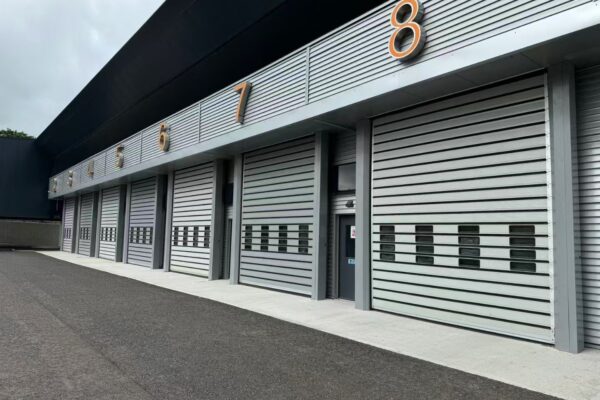
Rapid garage doors are high-speed door systems designed for industrial and commercial vehicle entrances that require faster opening and closing than conventional sectional or rolling doors. Depending on the application, they can use PVC fabric, insulated panels, or rigid aluminum slats and can be activated by radar, loop detectors, remote controls, access systems, or automation signals.
This guide explains the main types of rapid garage doors, typical operating speeds, safety features, cost factors, applications, and how to choose the right door for warehouses, workshops, parking garages, logistics facilities, and temperature-controlled areas.
What Is a Rapid Garage Door?
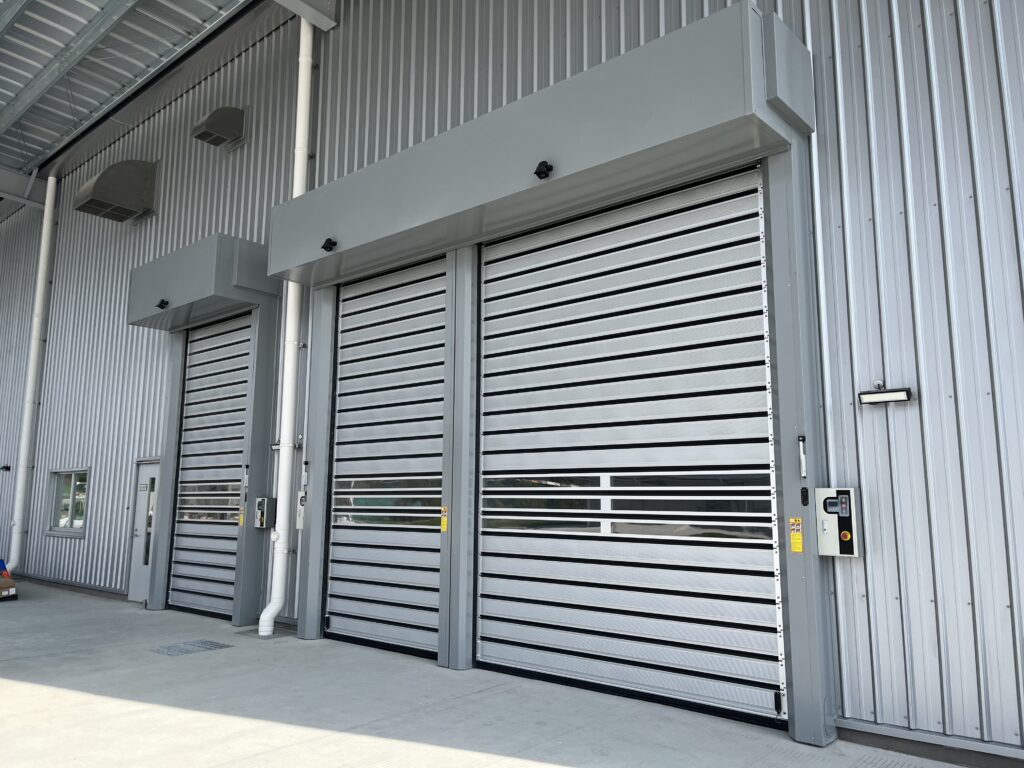
A rapid garage door is an automatically operated high-speed door designed to minimize the time an entrance remains open. It is commonly used in factories, warehouses, logistics facilities, workshops, parking areas, food processing plants, and temperature-controlled environments.
Unlike a conventional sectional garage door that moves relatively slowly along overhead tracks, a rapid garage door is designed for frequent opening and closing. Depending on the door type, the curtain or rigid panel travels vertically and is stored above the opening when the door is open.
The main reasons businesses choose rapid garage doors include faster traffic flow, reduced air exchange, improved separation between work areas, and easier integration with automated access systems.
Common activation options include radar sensors, geomagnetic loops, push buttons, pull cords, remote controls, photoelectric sensors, and access control systems. For automated facilities, the door control system can also be configured to communicate with equipment such as PLCs, conveyors, AGVs, and warehouse automation systems.
Where Are Rapid Garage Doors Used?

仓库 和配送中心
Rapid garage doors are commonly installed in locations where conventional doors create unnecessary waiting time or allow excessive air exchange.
仓库和配送中心
Fast opening helps forklifts and trucks move through busy entrances with less waiting, making rapid doors suitable for high-frequency logistics areas.
制造工厂
Rapid doors can separate production zones while allowing materials, forklifts, and personnel to move efficiently between different work areas.
Cold Storage and Temperature-Controlled Areas
Reducing door-open time helps limit warm and cold air exchange. For low-temperature applications, an insulated high-speed door should be selected according to the operating temperature and required thermal performance.
餐饮设施
Rapid doors help separate processing, packaging, storage, and logistics areas while supporting efficient internal traffic.
Parking Garages and Vehicle Entrances
Radar, loop detectors, remote controls, or access control systems can automatically activate the door when authorized vehicles approach.
Types of Rapid Garage Doors
PVC Rapid Roll-Up Door
A PVC rapid roll-up door uses a flexible curtain that rolls around a shaft above the opening. It is a practical choice for factories, warehouses, workshops, logistics areas, and internal traffic passages where fast opening and frequent operation are required.
PVC doors are generally lighter and more economical than rigid high-speed doors. They can also be equipped with transparent vision sections, radar sensors, photoelectric protection, remote controls, and other activation systems.
Learn more about our 高速卷帘门
High Speed Spiral Garage Door
A high speed spiral door uses rigid slats that travel through a spiral or track system above the opening. Compared with flexible PVC doors, rigid spiral doors provide stronger physical protection and are often selected for exterior vehicle entrances, commercial garages, workshops, and industrial buildings.
They are suitable when a project requires both fast operation and a rigid door panel.
Learn more about our 高速螺旋门
Insulated Rapid Garage Door
For facilities where temperature control is a priority, an insulated rapid garage door combines fast operation with improved thermal separation. Typical applications include cold storage, food facilities, temperature-controlled warehouses, and production areas.
The correct configuration depends on the operating temperature, door size, traffic frequency, sealing requirements, and installation environment.
Learn more about our 隔热高速门
快速车库门的主要特点和材料
材料选项:PVC、铝和钢
在选择快速车库门时,PVC、铝和钢在设计和性能方面各有特点。
聚氯乙烯重量轻,成本效益高,而且防潮,非常适合需要非腐蚀性表面但不需要重型保护的场所。
铝质材料兼具轻质和高强度的特点,其简洁的表面处理适合零售入口和设施,因为外观和耐用性同样重要。
钢质门的优越韧性使其在面对严格的日常使用或恶劣天气的环境中大放异彩;它的强度可以保护门洞,阻止破门而入,因此成为工业和重要安全应用领域的首选。
了解了这些优势,用户就能选择不仅适合当前任务,而且能可靠运行多年的材料。
How Fast Does a Rapid Garage Door Open?
Opening speed depends on the rapid garage door type, door size, motor system, and application.
For example, SEPPES PVC high-speed roll-up doors can be configured with an opening speed of approximately 1.0–2.0 m/s and a closing speed of approximately 0.8 m/s, depending on the door size and project requirements.
Faster operation is particularly valuable at high-traffic entrances because vehicles and forklifts spend less time waiting for the doorway to clear. Shorter opening periods can also help reduce unnecessary air exchange between indoor and outdoor or temperature-controlled areas.
However, the fastest available speed is not always the best choice. Door dimensions, traffic type, safety requirements, wind conditions, daily operating frequency, and the surrounding environment should all be considered when selecting the operating speed.
降噪和隔热
如今的高速门可满足现代工业运行中的两个关键需求--降低噪音和提高热效率。工程师们采用了先进的密封技术和专门的阻尼材料来抑制噪音。独立测量结果表明,采用隔音板的门可将噪音水平降低多达 30 分贝(dB),这对于重型机械或机械流程持续运行的环境尤为有利。更安静的环境不仅能保护工人的听力,还能提高整体生产率。
热性能同样重要。严密的密封和复合结构最大限度地减少了辐射和对流热传导,使总得热量减少高达 55%。这对于冷藏库或洁净室等受控空间至关重要,因为在这些空间中,即使是微小的温度变化也会影响工艺或产品质量。热增量或热损耗的减少意味着对暖通空调系统需求的降低,进而推动能源成本的下降。在对使用寿命、舒适度和效率都有严格要求的情况下,高速门成为致力于噪音控制和能源管理的企业的前沿解决方案。
与其他类型车库门的比较
快速车库门与分节式车库门
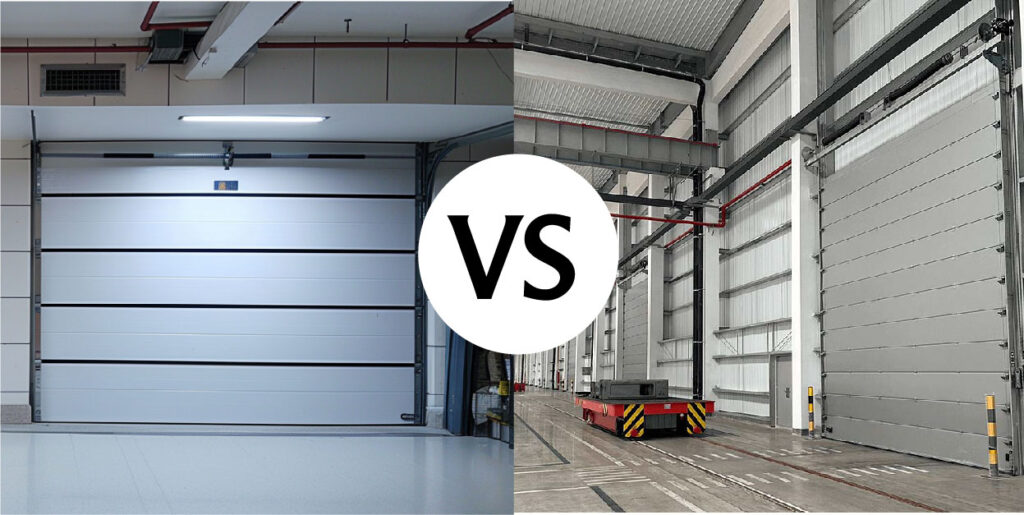
Rapid garage doors and sectional garage doors can both be used for vehicle entrances, but they are designed for different operating priorities. Rapid doors focus on speed and frequent traffic, while sectional doors are commonly selected when insulation, security, and conventional overhead operation are more important than very fast opening..
对照表
| 考虑 | Rapid Garage Door | 分节式车库门 |
|---|---|---|
| 开启速度 | 快速 | Relatively slow |
| Traffic Frequency | High-frequency traffic | Moderate traffic |
| Door Construction | PVC curtain or rigid high-speed panels | 保温分段门板 |
| 最佳适用场景 | Logistics, factories, vehicle entrances, high-traffic areas | Warehouses, workshops, garages, industrial buildings |
| 绝缘 | Depends on door type | Generally strong with insulated panels |
| 自动化 | Radar, loop detector, remote, access control, PLC | Button, remote, radar and access control |
| Headroom | Depends on rapid door design | Depends on lifting method and track layout |
| 定制 | Size, color, controls, sensors and materials | Size, color, windows, tracks and controls |
| Main Advantage | 快速操作 | Insulation and versatile lifting options |
Choose a rapid garage door when opening speed, traffic efficiency, and frequent operation are the main priorities.
Choose a sectional garage door when the entrance operates less frequently and the project prioritizes insulated panels, traditional overhead lifting, or specific architectural requirements.
For applications where both speed and rigid construction are required, a high-speed spiral door may provide a suitable alternative.
成本效益分析详情
初始投资
快速门:由于功能先进、耐用、速度快,前期成本较高。
隔断门:初期性价比较高,适合有预算意识的买家。
维护费用
快速门:只需最低限度的维护,从而实现长期节约。
隔断门:维护需求适中,随着时间的推移可能会产生额外费用。
使用快速顶置式车库门可以大大提高运行效率。
快速门:在商业环境中,更快的操作可提高效率,节省时间并提高生产率。
隔断门:运行速度较慢,对时间敏感的工作流程有影响,但在住宅区使用功能良好。
定制选项
快速门:有限的定制选项可能无法满足所有具体要求。
隔断门:定制潜力大,可更灵活地满足不同用途和审美偏好。
总体寿命
快速门:高耐用性可延长使用寿命,提供更好的长期投资回报。
隔断门:中等耐用性,适用于磨损要求较低的环境。
何时选择快速车库门
快速车库门非常适合必须快速进出的企业。快速车库门专为必须经常开关门的高人流量区域而设计,其更快的循环速度可缩短等待时间,保持工作流程的顺利进行。在必须保持严格气候控制的环境中,如冷藏仓库和制造工厂,它们也能大显身手,因为它们的快速运行限制了空气交换,保持了温度稳定。得益于坚固的结构和宽松的维护计划,快速车库门不仅性能卓越,还能保持设施的生产效率,同时降低能源成本。
How to Choose the Right Rapid Garage Door
Choosing a rapid garage door should be based on the actual operating conditions of the entrance rather than speed alone.
1. Measure the Opening Size
Provide the clear opening width × height. The available headroom and side clearance should also be measured because the motor, tracks, frame, and door storage system require installation space.
2. Identify the Application
Specify whether the door will be installed in a warehouse, factory, workshop, cold room, parking garage, food facility, clean area, or exterior entrance. Different environments require different curtain materials, sealing systems, insulation levels, and structural designs.
3. Estimate Traffic Frequency
Consider how many vehicles, forklifts, or personnel pass through the opening each day. High-frequency entrances require a door system and motor designed for repeated operation.
4. Determine Temperature Requirements
If the door separates areas with different temperatures, provide the indoor and outdoor operating temperatures. Cold storage applications may require an insulated rapid door and additional sealing or heating components.
5. Select an Activation Method
Common options include push buttons, remote controls, pull cords, radar sensors, geomagnetic loops, card readers, and contactless sensors. Automated facilities can also integrate the door with PLCs, AGVs, conveyors, or other equipment.
6. Review Safety Requirements
Photoelectric sensors, safety edges, emergency stops, warning devices, and other protective systems should be selected according to the traffic type and site conditions.
For an accurate recommendation, provide your opening width × height, application, quantity, operating temperature, traffic type, and preferred activation method.
Rapid Garage Door Installation Requirements
Before ordering a rapid garage door, the opening and surrounding installation space should be measured carefully.
Important dimensions normally include:
• Opening width
• Opening height
• Available headroom above the opening
• Left-side clearance
• Right-side clearance
• Motor installation side
• Distance to nearby walls, pipes, beams, equipment, or other obstacles
For SEPPES PVC high-speed roll-up doors, installation space varies according to the door size and configuration. The product design should therefore be confirmed after reviewing the actual site dimensions.
The supporting wall or steel structure must also be suitable for fixing the door frame. Power supply, control box location, sensor positions, and cable routing should be planned before installation.
For export projects, installation drawings, wiring information, and technical guidance can be provided so the local installation team can complete assembly and commissioning according to the supplied instructions.
Rapid Garage Door Maintenance
Regular inspection helps maintain reliable high-speed operation.
Maintenance should include checking the door curtain or rigid panels, guides, seals, safety sensors, electrical connections, motor system, and control unit. Photoelectric sensors should remain clean and correctly aligned, while damaged seals or curtain components should be replaced when necessary.
The maintenance interval should be based on operating frequency and environmental conditions. Doors operating hundreds of cycles per day generally require more frequent inspection than entrances used only occasionally.
If abnormal noise, irregular movement, sensor errors, or repeated control faults occur, stop unnecessary operation and inspect the system before returning the door to normal service.
How Much Does a Rapid Garage Door Cost?
There is no single standard price for a rapid garage door because most industrial doors are manufactured according to the project dimensions and operating requirements.
The main factors affecting rapid garage door cost include:
• Opening width and height
• PVC, insulated, or rigid door construction
• Motor and control system
• Required opening speed
• Safety sensors and protection devices
• Radar, remote control, loop detector, or access control options
• Insulation and sealing requirements
• Wind resistance requirements
• Stainless steel or other frame upgrades
• Quantity
• Shipping destination and trade terms
In general, a standard PVC rapid roll-up door is usually more economical than a rigid high-speed spiral door or an insulated rapid door designed for temperature-controlled applications.
For project pricing, provide the opening width × height, quantity, application, installation environment, and required control method.
Rapid Garage Door Safety Features and Compliance
Safety is an important consideration when selecting a rapid garage door, particularly at entrances shared by forklifts, vehicles, and personnel.
Depending on the door configuration, safety options can include photoelectric sensors, safety bottom edges, light curtains, emergency stop controls, warning lights, and automatic reopening functions.
For automated entrances, sensors should be positioned according to the traffic direction and operating environment so the door can detect approaching vehicles or obstacles before closing.
Certification and compliance requirements vary by country and project. Buyers should confirm the applicable electrical, machinery, building, and workplace safety requirements for the installation location before ordering.
For projects requiring CE or other specific certification documentation, the requirement should be confirmed with the manufacturer during the quotation and engineering stage.
Common Rapid Garage Door Applications
制造工厂
Rapid garage doors are commonly used between production workshops, material handling areas, and logistics passages. Fast automatic opening allows forklifts and personnel to move between zones without leaving the entrance open for long periods.
Warehouses and Logistics Centers
At busy warehouse entrances, rapid doors can be activated automatically by radar or vehicle detection systems. This reduces unnecessary waiting and supports smoother forklift and pallet movement.
Cold Storage and Food Facilities
Where temperature differences exist between two areas, fast opening and closing helps reduce the duration of air exchange. Insulated rapid doors can be selected when thermal performance is a major project requirement.
Parking and Vehicle Entrances
For parking garages, service centers, and industrial vehicle entrances, rapid garage doors can work with remote controls, radar sensors, loop detectors, card readers, or other access control systems.
Automated Production Areas
Rapid doors can also be integrated with PLCs, conveyors, AGVs, robots, or warehouse management systems. The door can receive an opening signal and provide open-position or closed-position feedback for equipment coordination.
Rapid Garage Door Automation and Access Control

Modern rapid garage doors can be configured with different activation systems according to how the entrance is used.
Radar sensors are suitable for automatic vehicle or pedestrian detection. Geomagnetic loops can detect approaching vehicles, while remote controls, pull cords, push buttons, card readers, and contactless sensors provide additional access options.
For industrial automation, rapid doors can also exchange signals with PLCs, conveyors, AGVs, robots, and other equipment. Typical control signals can include door-open commands, door-close commands, fully-open feedback, and fully-closed feedback.
The correct activation method should be selected according to traffic type, required access control, automation level, and safety requirements.
Learn more about industrial door radar
Conclusion: Choosing the Right Rapid Garage Door
A rapid garage door is most suitable when an entrance requires fast operation, frequent vehicle or forklift traffic, automatic activation, or reduced air exchange.
PVC rapid roll-up doors are a practical option for many factories and warehouses. Rigid high-speed spiral doors are better suited to applications requiring stronger panels and exterior security, while insulated rapid doors are designed for facilities where temperature separation is especially important.
Before requesting a quotation, prepare the opening width × height, available installation space, quantity, application, operating temperature, traffic frequency, and preferred activation method.
SEPPES manufactures customized industrial door systems for different industrial and commercial applications. If you are planning a new project, send us your door dimensions and application requirements for a project-specific recommendation.
Frequently Asked Questions About Rapid Garage Doors
What is a rapid garage door?
A rapid garage door is a high-speed automatic door designed for industrial and commercial entrances that require fast and frequent access. It is commonly used in factories, warehouses, logistics centers, workshops, parking garages, and temperature-controlled facilities.
How fast does a rapid garage door open?
The opening speed depends on the door type, size, motor system, and application. SEPPES PVC high-speed roll-up doors can be configured with opening speeds of approximately 1.0–2.0 m/s, depending on the door dimensions and project requirements.
What is the difference between a rapid garage door and a sectional garage door?
A rapid garage door is mainly designed for fast opening and high-frequency traffic, while a sectional garage door is generally selected for insulation, security, and conventional overhead operation.
What types of rapid garage doors are available?
Common types include PVC rapid roll-up doors, high-speed spiral doors, and insulated rapid doors. The right type depends on traffic frequency, installation environment, insulation requirements, and security needs.
How much does a rapid garage door cost?
The cost depends on the door size, material, motor system, opening speed, safety devices, control method, insulation requirements, quantity, and shipping destination. Industrial rapid garage doors are normally quoted according to project specifications.
Can a rapid garage door open automatically for forklifts?
Yes. Rapid garage doors can work with radar sensors, geomagnetic loops, remote controls, pull cords, push buttons, and access control systems. They can also be integrated with PLCs, conveyors, and AGVs.
What information is required for a rapid garage door quotation?
Please provide the opening width × height, quantity, application, operating temperature, available installation space, traffic type, and preferred activation method. Site photos or drawings are also helpful for engineering review.