
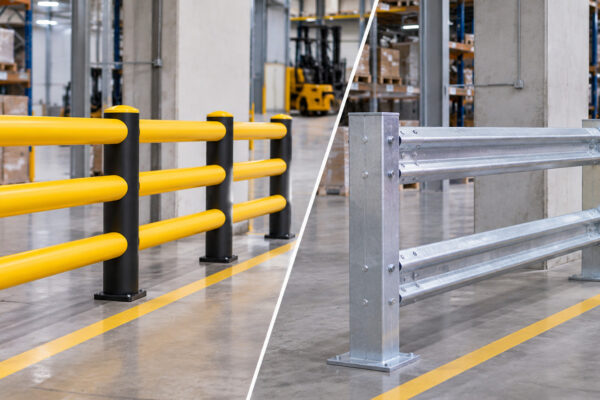
Guardas flexíveis vs guardas de aço é uma comparação importante para gestores de armazém, engenheiros de segurança e compradores industriais que planejam proteção para empilhadeiras. Ambos os sistemas podem ajudar a separar o tráfego de veículos de pedestres, equipamentos e estruturas vulneráveis, mas comportam-se de forma diferente durante colisões e podem exigir abordagens de manutenção distintas.
As guardas industriais flexíveis geralmente utilizam trilhos à base de polímeros projetados para defletir sob condições de impacto especificadas. As guardas de aço convencionais geralmente dependem de trilhos metálicos, postes e conexões ancoradas para resistir ao contato de veículos.
A melhor escolha depende dos perigos reais das empilhadeiras, do espaço de instalação disponível, do desempenho de impacto documentado, dos requisitos de reparo e dos custos de propriedade a longo prazo.
Este guia compara ambas as soluções sob uma perspectiva de engenharia e aquisição. Também explica onde as guardas flexíveis de polímero podem ser vantajosas e quando um sistema de aço pode permanecer uma opção prática.
As guardas flexíveis podem ser uma escolha útil onde a deflexão controlada, os componentes modulares e a exposição repetida ao contato de veículos são importantes. As guardas de aço podem ser apropriadas onde uma estrutura de proteção comparativamente rígida é necessária e o projeto completo é adequado às condições de impacto esperadas.
Nenhum material é automaticamente mais seguro. Os compradores devem comparar dados de impacto do sistema completo, movimento durante o impacto, requisitos de fundação e necessidades de manutenção antes de tomar uma decisão.
1. O Que São Sistemas de Guardas Flexíveis e de Aço?
Guardas Flexíveis de Polímero
As guardas flexíveis utilizam materiais e arranjos estruturais destinados a sofrer deformação controlada durante uma colisão de veículo. Dependendo do modelo, o trilho pode recuperar-se em direção à sua posição original após o alívio da carga.
O sistema completo geralmente inclui trilhos de proteção horizontais, postes de suporte, conectores, placas de base e ferragens de ancoragem.
O desempenho das guardas flexíveis depende do conjunto completo e não apenas do polímero. O reforço interno, a geometria das conexões e o comportamento das ancoragens podem afetar materialmente sua resposta ao impacto.
Veja a Guardas industriais flexíveis SEPPES página do produto para configurações disponíveis e detalhes de construção.
Guardas de Aço Convencionais
As guardas de aço tradicionais para armazéns geralmente utilizam postes metálicos fabricados e trilhos horizontais conectados por parafusos, soldas ou outras juntas estruturais. Frequentemente são galvanizadas, pintadas ou submetidas a outro tratamento superficial.
Steel systems can provide substantial structural resistance when correctly designed, but a collision may create permanent deformation in the rail, post, connections or anchoring assembly.
The outcome depends on the steel grade, section geometry, thickness, supporting connections and specific impact event. Steel should not be assumed to have a fixed performance level merely because it is a rigid material.
2. Guardas Flexíveis vs Guardas de Aço: Principais Diferenças
The following comparison highlights practical differences buyers should review when choosing warehouse forklift safety barriers. These are general engineering characteristics, not guaranteed performance statements for every available product.
Conceptual illustration only. Not a measured impact test, certified performance comparison or SEPPES test result.
| Fator | Guarda-corpos Flexíveis | Steel Guardrails |
|---|---|---|
| Primary material | Engineered polymer with model-dependent reinforcement | Fabricated steel sections |
| Impact behavior | Designed to deflect under specified loading | Typically resists loading through comparatively rigid sections |
| After a collision | May recover toward original geometry; inspection still required | May bend permanently or damage connections |
| Required clearance | Must accommodate expected barrier deflection | Must accommodate deformation and safe vehicle clearance |
| Corrosion considerations | Polymer rail does not rust; metal components still require inspection | Coating, galvanizing and environmental exposure affect corrosion resistance |
| Repairs | Assess rail, connectors, posts and anchors; replace damaged parts as required | Assess deformation, joints, coatings and anchors; repair or replace as required |
| Foundation | Requires suitable anchoring and supporting concrete | Requires suitable anchoring and supporting concrete |
| Cost assessment | Compare purchase, installation and lifetime maintenance | Compare purchase, installation and lifetime maintenance |
The central difference is not simply that one system bends and the other does not. It is how each complete structure manages impact forces and what condition remains after a collision.
For procurement purposes, the most useful comparison is between two systems evaluated under equivalent vehicle weight, speed, impact angle and installation conditions.
3. Como as Guardas Flexíveis Respondem aos Impactos de Empilhadeiras?
When a forklift contacts a protective rail, the collision generates forces that transfer through the rail, posts, connectors and anchors. The amount of energy involved depends partly on the vehicle's mass and velocity.
A flexible rail system can undergo elastic or partly recoverable deformation, depending on the material and impact severity. This movement may help redistribute the collision forces through the assembly.
By comparison, a rigid steel rail generally undergoes less intended deflection at ordinary service loads, although severe impact can cause yielding, bending, local buckling or connection damage.
Por Que as Condições de Impacto Importam
Two barriers cannot be compared fairly using material descriptions alone. Buyers should request test information covering the following:
- Vehicle mass, including the relevant loading condition
- Travel speed at impact
- Impact angle and direction
- Contact point along the barrier span
- Rail and post geometry
- Base anchoring and supporting surface
- Maximum deflection and post-impact condition
For example, doubling the travel speed increases a vehicle's translational kinetic energy by a factor of four when mass remains unchanged.
However, the full kinetic energy cannot automatically be equated with energy absorbed by the guardrail. Vehicle deformation, collision geometry and the surrounding structure also matter.
For detailed information about collision angles, model specifications and impact assessment, read our guia de seleção de barreiras de proteção para empilhadores .
4. Materiais e Construção de Guardas de Polímero vs Aço
Construção do Trilho de Polímero
Flexible industrial guardrails may use engineered polymer materials that permit controlled deformation under a specified range of forces.
The SEPPES flexible guardrail product information describes modified polymer rail materials and reinforced structural arrangements. The construction may include metal components in posts or bases, depending on the model.
This distinction matters because describing a product as a "polymer guardrail" does not mean every component is made of polymer. Anchors and structural connections still require inspection.
Construção do Trilho de Aço
Steel guardrails are commonly fabricated from hollow sections, beams or formed metal members.
Their performance depends on material properties, section geometry, wall thickness, joint construction and the foundation.
Galvanized or coated steel can provide corrosion resistance, but scratches, impacts and aggressive environments may require coating maintenance.
O Polímero Dura Automaticamente Mais que o Aço?
No. Service life depends on the actual environment and use conditions. Impact frequency, UV exposure, temperature, cleaning chemicals, abrasion, installation quality and maintenance all influence durability.
A polymer rail that recovers its shape after a minor collision may reduce the need for certain types of repair, but it must still be inspected.
A properly specified steel barrier can also offer a long service life, particularly where impacts are uncommon and the system is maintained.
5. Requisitos de Instalação e Ancoragem em Concreto
Both flexible and steel guardrails require careful installation. The protective assembly depends on its supporting floor, base plates, anchor hardware and installation details.
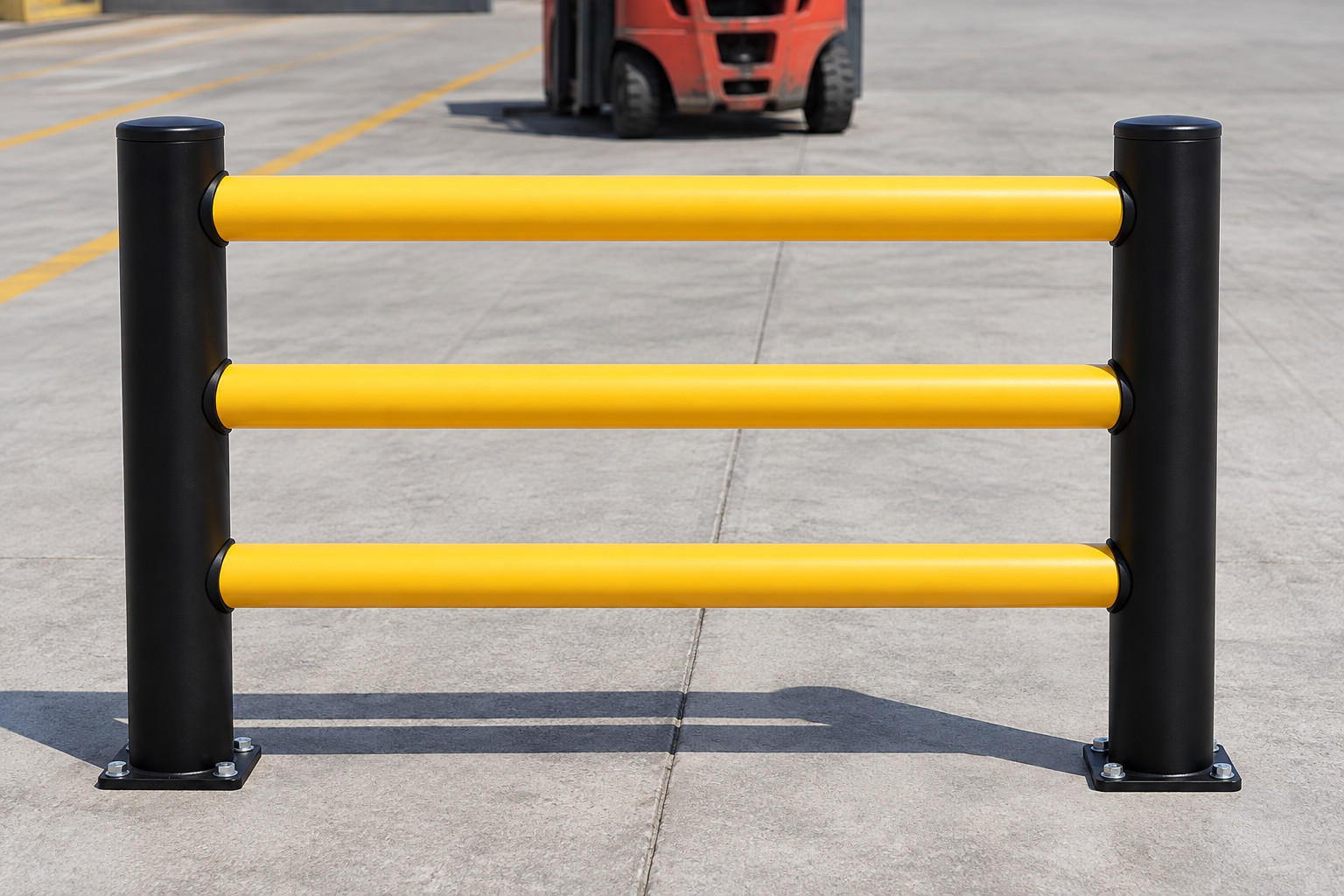
Condições do Piso de Concreto
Before installing a barrier, review the concrete floor's strength, thickness, condition and geometry. The location of expansion joints, floor edges, cracks and embedded services may affect anchor selection.
A strong rail installed into an unsuitable floor may still fail to provide the required protection.
Carga de Ancoragem e Comportamento da Barreira
Flexible and rigid systems can transfer forces differently through their anchors. It is therefore unsafe to assume that the same anchor arrangement will be suitable for both.
The manufacturer should supply the required mounting specifications, and the supporting substrate should be checked for the project conditions.
Espaço Atrás da Barreira
A particularly important difference is the space required for movement. Flexible guardrails need appropriate deflection clearance behind the rail, while steel guardrails must also allow for possible deformation and the required separation from hazards.
6. Manutenção, Reparos e Custos de Propriedade a Longo Prazo
Initial purchase price is only one part of the cost of a warehouse guardrail system.
For facilities with regular forklift activity, buyers should examine how each barrier is inspected and repaired after contact, how readily components can be replaced, and how maintenance affects warehouse operations.
Inspeção Pós-Impacto
A flexible polymer rail may appear to recover after contact, but visible recovery does not prove the system remains undamaged.
Inspect connectors, rails, posts, bases and anchors after significant impact, following the manufacturer's guidance.
Steel guardrails should similarly be examined for permanent bending, loose joints, damaged coatings and anchor displacement.
Custos de Reparo e Substituição
The cost of repairing either system depends on the damaged components, labor requirements, access limitations and spare-part availability.
A modular flexible guardrail may allow individual components to be replaced, but this advantage depends on the specific product design. Steel systems may also use modular and replaceable rail sections.
Custo total de propriedade
| Cost Category | What Buyers Should Compare |
|---|---|
| Initial purchase | Rails, posts, connectors and associated hardware |
| Instalação | Site preparation, anchors and labor |
| Inspection | Routine checks and post-impact assessment |
| Repairs | Replacement parts, coating repair and skilled labor |
| Operational interruption | Temporary aisle closure and access restrictions |
| Vida útil | Environmental exposure and long-term performance |
A useful procurement comparison can be expressed as:
Without verified price quotations, damage history and maintenance data, it is not possible to claim that every flexible guardrail system will be cheaper than every steel alternative over its lifetime.
Buyers should request a comparable bill of materials and evaluate their own traffic and maintenance conditions before reaching a cost conclusion.
7. Qual Guarda é Melhor para Diferentes Aplicações em Armazéns?
Barrier selection should be based on the protected area and vehicle exposure, not simply the apparent strength of the material.
Corredores Movimentados de Empilhadeiras
Where repeated vehicle contact is a credible risk, a flexible system with relevant impact documentation may be worth evaluating. Confirm its deflection clearance.
Passarelas de Pedestres
Both material types may be considered when supported by appropriate system performance. The barrier must preserve safe walking width and access.
Proteção de Máquinas
Where equipment is close behind the barrier, available movement and minimum separation distances may determine the preferred design.
Áreas de Armazenamento de Baixo Tráfego
A suitably engineered steel system may remain a practical solution where impact exposure is limited and maintenance requirements are manageable.
Centros de Fulfillment de Comércio Eletrónico
E-commerce fulfillment centers often combine pallet handling, picking, packing and frequent material movement. Protection layouts must accommodate both vehicle routes and daily pedestrian access.
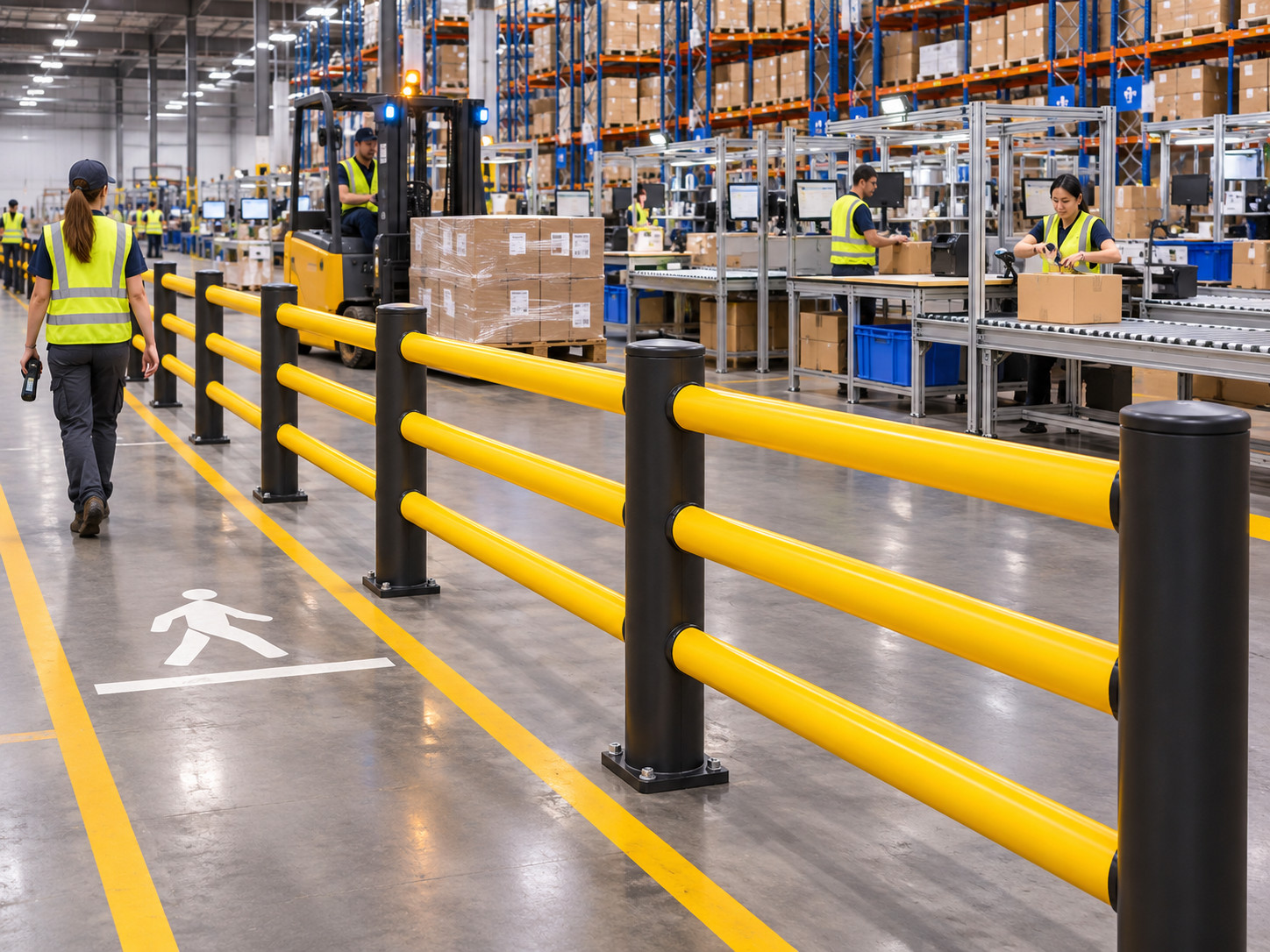
In such facilities, flexible barriers may be considered for continuous protection along busy circulation routes. The final layout must account for vehicle turning, workstations, crossings and maintenance access.
For detailed walkway layout considerations, read our warehouse pedestrian barriers and forklift traffic separation guide .
Portas Industriais e Áreas de Carregamento
At industrial doors, guardrails should protect exposed structures without interfering with door guides, sensors or the clear opening.
Both flexible and steel barriers may be used where their installation and impact performance are appropriate. Compact point protection may be preferable where a continuous rail would obstruct vehicle access.
The wider solution may involve industrial safety barriers and localized protective systems rather than a single guardrail type.
8. Modelos e Configurações de Guardas Flexíveis SEPPES
SEPPES offers flexible guardrail configurations intended for warehouse vehicle routes, pedestrian areas and industrial equipment protection.
The available product information describes single-rail, double-rail and three-rail arrangements. Project dimensions and specific configurations should be reviewed before ordering.
O Que os Compradores Devem Comparar Entre Modelos?
- Required rail height and overall protection length
- Number and positions of horizontal rails
- Post and rail section dimensions
- Available corners and custom layouts
- Vehicle weight, speed and relevant impact scenario
- Required deflection clearance
- Concrete anchoring and installation limitations
SEPPES product information includes reinforced polymer structures and anchored base assemblies. However, a model's published performance conditions should not be applied automatically to a customized configuration.
For current configurations, contact the supplier through the SEPPES flexible guardrail product page .
9. Como Escolher a Guarda Certa: Lista de Verificação para Compradores
Before selecting a flexible or steel guardrail system, prepare the following project information:
- Define the protection goal. Identify whether the barrier protects people, machinery, equipment, racks or building structures.
- Map vehicle movement. Show forklift routes, crossings, turning areas and reversing zones.
- Record vehicle conditions. Confirm vehicle type, loaded mass, typical speed and potential impact direction.
- Measure the installation area. Include rail length, height, corners, obstacles and available clearance.
- Check the floor. Confirm concrete conditions and any restrictions on anchoring.
- Request performance evidence. Compare the test configuration and relevant impact conditions.
- Evaluate maintenance. Ask how components are inspected, repaired and replaced after impact.
- Compare complete quotations. Include hardware, installation, transport and expected service costs.
A OSHA forklift pedestrian safety guidance identifies physical barriers as one possible measure for separating powered industrial trucks and pedestrians.
A UK Health and Safety Executive also emphasizes separate routes, appropriate protective barriers and suitable crossing arrangements.
These resources support traffic-risk management, but they do not establish that every polymer or steel guardrail meets the requirements of a particular site.
10. Perguntas Frequentes Sobre Guardas Flexíveis vs Aço
Os guardrails flexíveis são melhores do que os guardrails de aço?
Neither is universally better. Flexible guardrails are designed to deflect under specified impact conditions, while steel guardrails typically resist contact through comparatively rigid sections. The better choice depends on impact performance, available clearance, installation and maintenance requirements.
Os guarda-corpos flexíveis absorvem a energia de impacto de empilhadeiras?
Flexible guardrails can deform during a collision and may help absorb and redistribute impact energy. Actual performance depends on the complete rail, post, connector and anchoring assembly, as well as the tested vehicle mass, speed and impact direction.
Os guarda-corpos de polímero requerem menos manutenção do que os guarda-corpos de aço?
Some polymer guardrails may reduce certain repairs after minor contact, but maintenance depends on the design, collision severity and environment. Both polymer and steel systems require periodic inspection and post-impact assessment.
Podem os guarda-corpos flexíveis substituir as barreiras de aço em todos os armazéns?
No. Replacement suitability depends on the required protection level, available deflection clearance, floor conditions and applicable workplace requirements. Each proposed system should be reviewed against the actual hazard and documented impact performance.
Qual é mais econômico: guardrails flexíveis ou de aço?
Cost-effectiveness depends on purchase price, installation, inspection, replacement parts, repair frequency and operational interruption. A lifetime cost comparison is more useful than comparing the initial rail purchase price alone.
Que requisitos concretos de ancoragem se aplicam às guardas flexíveis?
Requirements depend on the selected model, impact conditions, base design and concrete substrate. Verify concrete strength, slab thickness, anchor type, embedment, spacing and edge distances using the approved project specifications.
Que informações são necessárias para escolher um guardrail flexível SEPPES?
Provide the required protection length, height and layout, forklift type, loaded operating weight, travel speed, impact direction, installation surface, project location and desired quantity. Site photographs or drawings help clarify the application.
11. Veredicto Final: Guardas Flexíveis ou de Aço?
The right choice between flexible guardrails and steel guardrails depends on the complete protection system and the operating conditions of the warehouse.
Flexible polymer guardrails are worth evaluating when controlled deflection, modular construction and exposure to repeated contact are important design considerations.
Steel guardrails can remain suitable where a properly engineered rigid system meets the protection requirements and available maintenance arrangements.
For both solutions, verified impact performance, anchoring and site clearances matter more than the material label.
An informed purchasing decision should compare complete system documentation, installation requirements and expected long-term costs.
Compare Soluções de Guardas para Seu Armazém
SEPPES provides flexible industrial guardrail options for warehouse traffic areas, pedestrian zones and industrial equipment protection.
Share your forklift operating conditions, required dimensions, site layout and installation requirements for a project-specific review and quotation.
Request a Flexible Guardrail QuoteReferências e Recursos Relacionados
- OSHA — Empilhadoras: Tráfego de Peões . Guidance on pedestrian exposure and protective barriers.
- UK HSE — Separação entre Peões e Veículos . Workplace traffic separation and protective-barrier considerations.
- SEPPES — Guarda-corpos Industriais Flexíveis . Product construction, configurations and applications.
- Forklift Protection Barriers: Selection Guide . Related technical selection article.
- Warehouse Pedestrian Barriers Guide . Related warehouse traffic-layout article.
Editorial and engineering note: Material comparisons are general, not certified comparative test results. Product characteristics must be confirmed against current manufacturer documentation. Images and diagrams illustrate applications and do not establish certified impact performance.