
What is a dock leveler? This guide explains how dock levelers work, the main types, key specifications, and how to choose the right loading dock solution for warehouses and industrial facilities.
Table des matières
BasculerQu'est-ce qu'un Niveleur de Quai ?
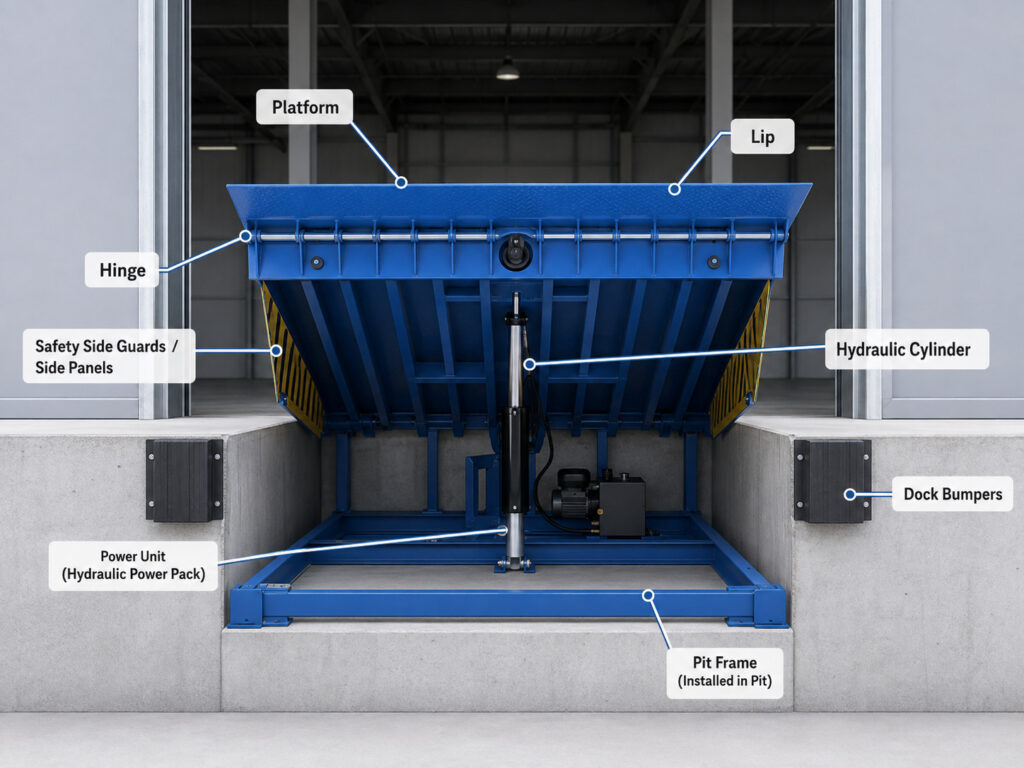
A niveleurs de quai is a piece of loading dock equipment that creates a smooth bridge between a warehouse loading dock and a truck trailer. It compensates for the height difference between the dock and the truck bed, allowing forklifts, pallet jacks, and other material-handling equipment to move safely between the warehouse and trailer.
In a typical warehouse, trucks may arrive at different heights depending on the trailer type, suspension, load condition, and parking position. Without a dock leveler, the height gap can make loading and unloading slower and more difficult.
A properly selected Rampe de quai helps create a continuous working surface between the dock and the trailer, improving loading efficiency and reducing unnecessary handling problems.
How Does a Dock Leveler Work?
A dock leveler is installed at the edge of a loading dock, usually in a recessed pit or as an edge-mounted solution.
When a truck backs into the loading bay, the dock leveler is positioned so that its deck and lip extend from the dock toward the trailer.
The basic operating sequence is:
- The truck backs into the loading dock.
- The dock leveler deck is raised or activated.
- The lip extends toward the truck bed.
- The lip rests securely on the trailer floor.
- Forklifts or pallet jacks cross the leveler during loading and unloading.
- After loading is complete, the leveler returns to its stored position.
This simple bridge function is why dock levelers for loading docks are an important part of warehouse material-handling systems.
What Are the Main Types of Dock Levelers?
Different warehouses have different loading requirements. The most common niveleurs de quai include mechanical, hydraulic, and edge-of-dock designs.
1. Mechanical Dock Leveler
A niveau de quai mécanique uses a mechanical operating system to raise and position the deck and lip.
Mechanical dock levelers are widely used in warehouses because of their relatively straightforward construction and operation. They can be suitable for facilities that need a dependable loading solution without relying on a hydraulic power unit.
How Does a Mechanical Dock Leveler Work?
A mechanical dock leveler typically uses a spring or mechanical counterbalance system. The operator activates the mechanism, allowing the deck to rise and the lip to extend toward the trailer.
Once the lip reaches the trailer floor, the leveler provides a transition surface for forklifts and pallet jacks.
The actual operating mechanism varies by design, so the manufacturer’s operating and safety instructions should always be followed.
For facilities evaluating mechanical dock levelers, important considerations include:
- Capacité de charge
- Platform dimensions
- Longueur de la lèvre
- Dock pit dimensions
- Trailer height range
- Fréquence de fonctionnement
- Exigences de maintenance
2. Hydraulic Dock Leveler
A Niveleur de quai hydraulique uses hydraulic cylinders and a power unit to control the deck and lip.
Compared with manually operated mechanical systems, hydraulic systems can provide convenient powered operation, which is useful for busy distribution centers and warehouses with frequent truck movements.
When selecting hydraulic dock levelers, consider:
- Rated capacity
- Platform size
- Hydraulic system design
- Lip configuration
- Fréquence de fonctionnement
- Available electrical power
- Installation conditions
For high-volume facilities, the choice between a mechanical dock leveler and a hydraulic dock leveler should be based on the actual loading frequency, operating requirements, maintenance capabilities, and budget.
3.Dock Leveler Installation Options
Edge-of-dock describes the installation/configuration of a dock leveler rather than its operating method.
For example, a dock leveler can be designed around different installation requirements depending on the existing loading dock structure, available space, and trailer height range.
This distinction is important when choosing equipment:
- Mechanical vs. Hydraulic → operating method
- Pit-mounted vs. Edge-of-dock → installation/configuration
Dock Leveler vs. Edge-of-Dock Leveler
These two solutions perform a similar basic function, but their installation and operating characteristics are different.
| Caractéristique | Niveleur de quai | Edge-of-Dock Leveler |
|---|---|---|
| Installation | Commonly pit-mounted | Mounted at dock edge |
| Height adjustment | Generally greater | More limited |
| Platform | Full deck | Compact transition plate |
| Scénarios d'application | High-volume loading docks | Suitable for specific dock/trailer conditions |
| Exigences d’installation | More involved | Generally simpler |
| Best for | Warehouses with varying trailer heights | Facilities with relatively consistent dock heights |
When comparing an edge of dock leveler vs. pit leveler, the key question is not simply which product is better. The decision should be based on trailer height variation, traffic volume, available dock construction, load requirements, and installation conditions.
Dock Leveler vs. Dock Shelter: What's the Difference?
A dock leveler and a dock shelter solve two completely different problems.
Niveleur de quai
A dock leveler:
- Bridges the height gap
- Provides a transition surface
- Supports forklift and pallet-jack movement
- Improves loading and unloading access
Abri de quai
A dock shelter:
- Seals the area around the truck and dock opening
- Helps reduce exposure to outdoor conditions
- Helps control air movement and dust
- Supports a more controlled loading environment
In a modern warehouse, the two systems can work together.
For example, a truck arrives at a distribution center. The de shelters de quai seals around the trailer, while the niveleurs de quai creates the physical transition between the warehouse floor and trailer bed.
Why Are Dock Levelers Important for Warehouses?
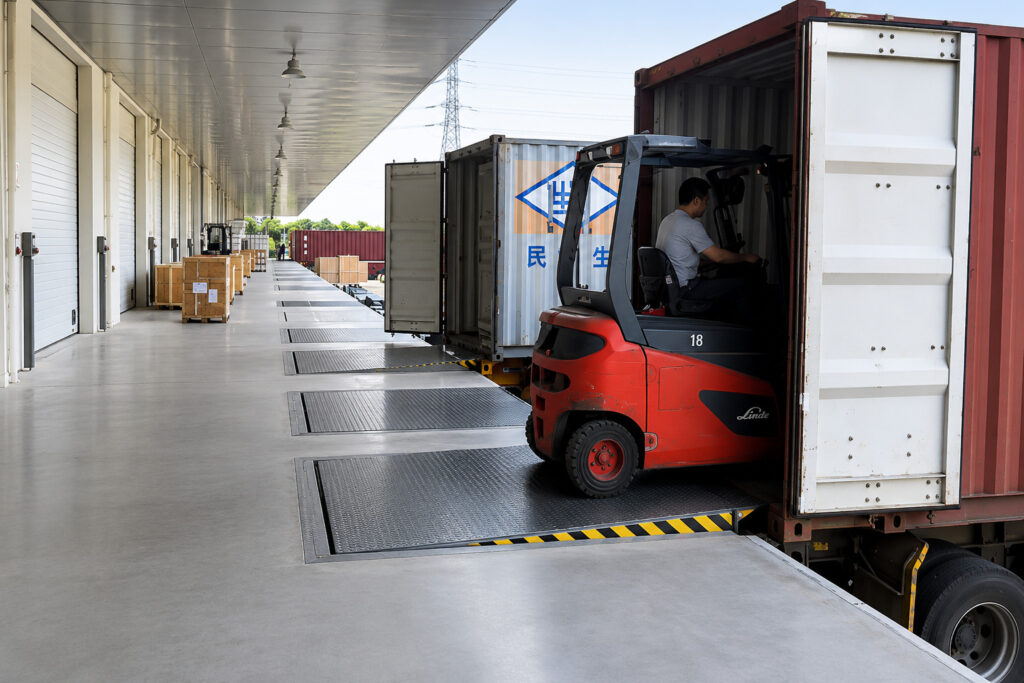
magine a distribution warehouse receiving several trucks during a busy morning shift.
A forklift needs to move pallets from the trailer directly into the warehouse. If there is a significant height difference between the trailer and dock, the forklift cannot simply drive across the gap.
The dock leveler creates the required transition.
This can help improve:
Faster Loading and Unloading
Forklifts can move directly between the trailer and warehouse instead of requiring additional manual handling.
Safer Material Movement
A properly selected and correctly operated leveler provides a more controlled transition between two different elevations.
Better Loading Dock Efficiency
The loading dock is often one of the busiest areas of a warehouse. Efficient dock equipment helps keep truck turnaround and material flow organized.
Adaptation to Different Trailers
Trailer bed heights are not always identical. A suitable dock leveler can accommodate the operating range required by the facility.
What Should You Consider When Choosing a Dock Leveler?
Choosing a niveleurs de quai should start with the actual conditions of the loading dock rather than simply selecting the highest-capacity model.
1. Capacité de charge
Consider the combined weight of the forklift, pallet, operator, and other loads that will cross the leveler.
A dock leveler’s rated capacity should be appropriate for the intended equipment and operating conditions.
2. Dock and Trailer Heights
Measure the warehouse dock height and the typical trailer bed heights.
This information is essential when determining the required leveler range.
3. Platform Dimensions
The width and length of the leveler should provide sufficient clearance for the equipment used at the facility.
4. Operating Frequency
A small warehouse with several truck movements per day has different requirements from a distribution center operating continuously.
High-frequency loading applications may require a more robust commercial dock leveler system.
5. Mechanical or Hydraulic Operation
Consider:
- Fréquence d'utilisation
- Operator requirements
- Available power
- Maintenance capability
- Budget
- Required automation
6. Installation Conditions
For a new facility, the dock pit can be designed around the selected equipment.
For an existing warehouse, the available pit dimensions and dock structure may significantly influence the appropriate solution.
Dock Leveler Capacity and Dimensions
Capacity and dimensions are two of the most important specifications when purchasing a dock leveler.
Typical selection data may include:
- Platform width
- Platform length
- Longueur de la lèvre
- Rated capacity
- Dock height
- Trailer height range
- Pit dimensions
- Operating method
Do not select a leveler based solely on the nominal capacity. The actual application—including forklift weight, load weight, wheel configuration, traffic frequency, and operating conditions—should be considered.
For a project quotation, providing your dock leveler dimensions, dock height, trailer range, and expected load can help the manufacturer recommend a suitable configuration.
Where Are Dock Levelers Used?
Warehouse dock levelers are commonly found in facilities where trucks and trailers regularly exchange goods with the warehouse.
Typical applications include:
- Centres de distribution
- Entrepôts logistiques
- Usines de fabrication
- Les centres de traitement des commandes de commerce électronique
- les entrepôts agroalimentaires
- Cold-chain facilities
- Retail distribution centers
- Les entrepôts industriels
In a busy logistics facility, the loading dock should be considered as a complete system rather than a single piece of equipment.
A typical loading bay may combine:
Dock Leveler + Dock Shelter + Industrial Door + Safety Equipment
The dock leveler handles the elevation difference, while the industrial door controls access to the building.
Dock Leveler and Industrial Door: Why the Combination Matters
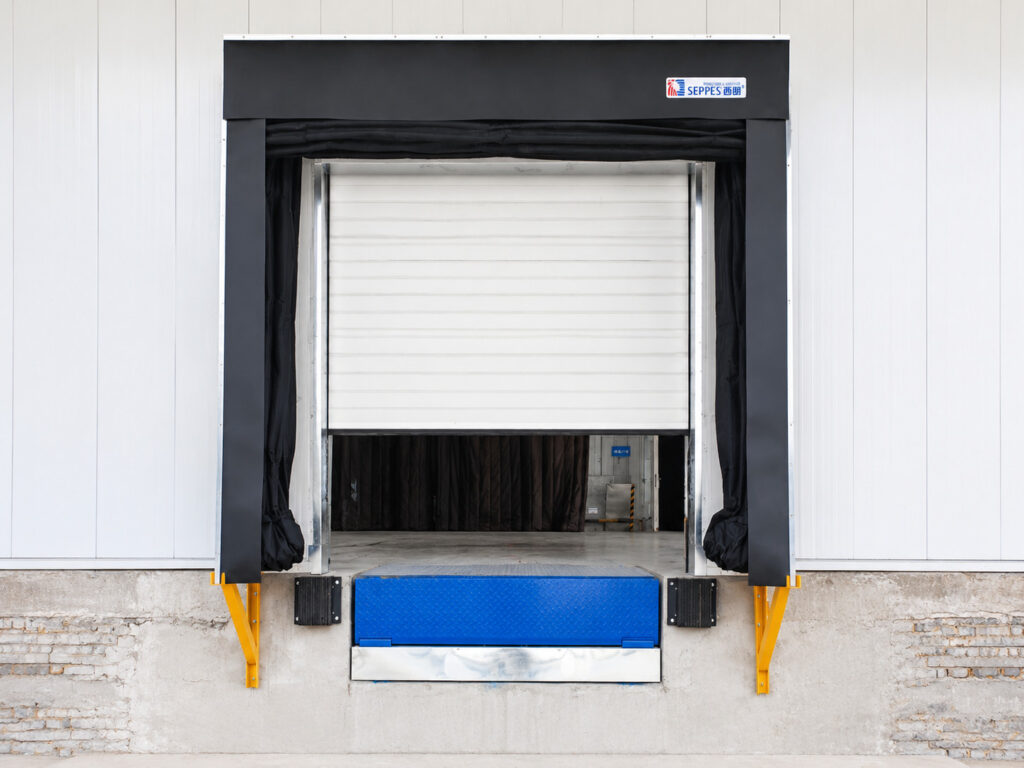
A loading dock does not operate independently from the rest of the warehouse.
After a truck is positioned at the dock, the loading process may require the industrial door to open repeatedly for forklift traffic. If the door is slow to operate, it can interrupt material flow and expose the warehouse to outdoor air, dust, and temperature changes.
This is where a high-speed industrial door can complement loading dock equipment.
For example:
Truck arrives → Dock shelter seals the trailer → Dock leveler bridges the height difference → High-speed door opens → Forklift moves goods
This creates a more efficient loading workflow while helping separate the warehouse interior from the outside environment.
If your facility is upgrading its loading dock, it is worth evaluating the dock leveler and industrial door as one complete loading-bay solution rather than treating them as unrelated products.
How Much Does a Dock Leveler Cost?
The cost of a dock leveler depends on the configuration and project requirements.
Important factors include:
- Mechanical or hydraulic operation
- Capacité de charge
- Platform dimensions
- Lip design
- Installation method
- Pit construction
- Optional safety features
- Quantity required
- Installation location
For an accurate quotation, provide the manufacturer with your dock dimensions, expected trailer heights, load requirements, operating frequency, and project quantity.
A project-specific quotation is much more useful than relying on a generic online price.
How to Choose the Right Loading Dock Leveler
For most warehouses, the selection process can be simplified into five steps:
Step 1 — Measure the dock
Record dock height, pit dimensions, and available installation space.
Step 2 — Identify the trailers
Determine the typical and minimum/maximum trailer bed heights.
Step 3 — Calculate the required capacity
Consider the forklift, operator, pallet, and maximum expected load.
Step 4 — Select the operating system
Compare mechanical, hydraulic, and edge-of-dock options based on operating frequency and site conditions.
Step 5 — Consider the complete loading bay
Evaluate the leveler together with the dock shelter, industrial door, traffic control, and safety requirements.
This approach helps avoid selecting a dock leveler based only on price or nominal capacity.
Foire aux questions
1. What is a dock leveler?
A dock leveler is loading dock equipment that bridges the height difference between a warehouse dock and a truck trailer, allowing forklifts and pallet jacks to move goods between the two surfaces.
2. How does a mechanical dock leveler work?
A mechanical dock leveler uses a mechanical operating and counterbalance system to raise the deck and position the lip onto the trailer floor, creating a transition surface for loading and unloading.
3. What is the difference between a dock leveler and an edge-of-dock leveler?
A conventional dock leveler generally provides a larger adjustable platform and is commonly installed in a dock pit. An edge-of-dock leveler is mounted at the dock edge and is generally suited to applications with a smaller range of trailer height variation.
4. What is the difference between a dock leveler and a dock shelter?
A dock leveler bridges the physical height gap between the dock and trailer. A dock shelter seals the area around the trailer and dock opening. They perform different functions and can be used together.
5. How do I choose the right dock leveler for my warehouse?
Consider dock height, trailer height range, forklift and load weight, platform dimensions, loading frequency, installation conditions, and whether mechanical or hydraulic operation is more appropriate for the facility.
If you are looking for reliable overhead garage door solutions, SEPPES provides high-quality garage door systems and components designed for residential and commercial applications.
With professional manufacturing experience, SEPPES offers solutions including:
- Garage Door Remote – Reliable remote control solutions for convenient operation.
- Garage Door Parts – Durable components for maintenance and replacement.
- Overhead Door Components – Complete system components to ensure smooth and stable performance.
Whether you need replacement parts, a complete overhead garage door system, or technical support, our team can provide suitable solutions based on your application requirements.