
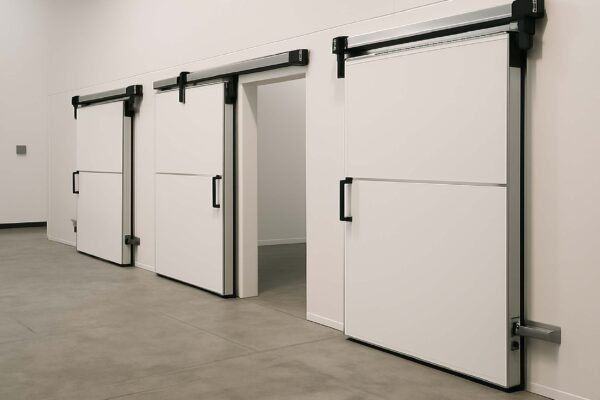
Mantener estables las áreas críticas de almacenamiento en frío comienza con la selección del punto de entrada óptimo, que normalmente es una puerta corredera de almacenamiento en frío. Diseñadas para las necesidades precisas de las zonas de baja temperatura, estas puertas correderas aseguran el clima requerido mientras respaldan estrictos procedimientos de higiene. Al minimizar los tiempos de apertura, previenen costosas pérdidas térmicas, reducen las facturas de energía y agilizan las transferencias en el muelle de carga. Para la industria de alimentos y bebidas, ciencias de la vida o cualquier sector impulsado por la temperatura, el beneficio es inmediato. Este documento describe las ventajas técnicas y operativas que ofrecen estas puertas correderas: cómo ajustan el rendimiento térmico, elevan la limpieza y optimizan el flujo de trabajo, argumentando a favor de una gestión de instalaciones más inteligente en un mercado que solo premia a los operadores más eficientes.
Introducción a las Puertas Correderas de Almacenamiento en Frío

Las puertas correderas de almacenamiento en frío desempeñan un papel crucial en el mantenimiento de temperaturas estables en toda la instalación. Diseñadas para limitar el flujo de aire en movimiento, cierran el espacio que normalmente roba aire frío, lo que protege el uso de energía y mantiene los costos de servicios más bajos. Desde un punto de vista práctico, su superficie lisa hace posible una limpieza rápida, algo valioso al adherirse a las estrictas demandas de higiene del procesamiento de alimentos y productos farmacéuticos. Construidas para durar, estas puertas resisten el uso frecuente sin fallar, asegurando que la productividad se mantenga alta y que los operadores cumplan con los requisitos regulatorios. En resumen, elegir estas puertas correderas se traduce en una clara ventaja financiera, operativa y de cumplimiento.
Definición y Visión General de las Puertas Correderas de Almacenamiento en Frío
Las puertas correderas de almacenamiento en frío son puertas especializadas diseñadas para su uso en entornos con temperatura controlada, como unidades de refrigeración e instalaciones de almacenamiento en frío. Estas puertas están diseñadas para mantener un aislamiento térmico óptimo, evitando la pérdida de aire frío y garantizando la eficiencia energética. Comúnmente utilizadas en industrias como el almacenamiento de alimentos, productos farmacéuticos y logística, las puertas correderas de almacenamiento en frío operan con un mecanismo de deslizamiento suave, que minimiza la infiltración de aire durante su funcionamiento. Están equipadas con sistemas de sellado avanzados y materiales robustos para soportar temperaturas extremas y un uso regular. Su diseño no solo mejora el ahorro de energía, sino que también respalda el cumplimiento de estrictos estándares de higiene y seguridad críticos en estas industrias.
Importancia en las Cadenas de Frío y Otras Industrias
Cold storage sliding doors play a pivotal role in maintaining the efficiency and reliability of cold chains and other temperature-sensitive industries. Their importance is underscored by their ability to maintain controlled environments, reduce energy consumption, and enhance operational efficiency. Below are five key areas where cold storage sliding doors are indispensable, along with the details and data supporting their significance:
Temperature Control and Preservation
Cold storage sliding doors are designed to minimize thermal leakage, ensuring that temperature-sensitive goods, such as vaccines, perishable foods, and chemicals, remain in optimal conditions. Studies show that efficient thermal sealing systems can reduce energy consumption in cold storage facilities by up to 25%.
Eficiencia energética
With advanced insulation and sealing technologies, these doors contribute significantly to reducing energy costs. Data indicates that facilities with well-designed sliding doors can save thousands of dollars annually by preventing unnecessary cooling losses.
Regulatory Compliance
Many industries, like pharmaceuticals and food processing, require strict adherence to hygiene and safety standards. Cold storage sliding doors meet these regulations by preventing contamination and maintaining airtight environments crucial for product safety.
Operational Durability
Built to withstand frequent usage in harsh environments, cold storage sliding doors feature robust materials and long-lasting performance. Statistics reveal that sliding doors typically last 10-15 years with minimal maintenance, making them a cost-effective investment for businesses.
Enhanced Workflow Efficiency
Their smooth sliding mechanism ensures quick and easy access to storage areas while minimizing downtime. This efficiency is especially critical in industries with high-volume inventory movement, reducing delays and optimizing supply chain operations.
Cold storage sliding doors are, therefore, an essential aspect of modern temperature-controlled environments, combining functionality with energy savings to support various critical industries effectively.
Ahorro de Energía y Seguridad del Producto
Cold storage sliding doors are essential assets for any temperature-sensitive facility, merging cost savings with product protection in a single, high-performance solution. Their cutting-edge insulation systems dramatically decrease thermal leakage by creating a nearly impenetrable barrier against outside heat, so that only the precise amount of energy needed for cooling is consumed. Further savings derive from automatic sensors in high-performance doors that regulate opening duration, curbing the rapid air loss that typically spikes energy use during multiple passage cycles.
For operators, the result is a noticeable drop in monthly energy expenses, while product safety is never compromised. Uniform, stable air temperature is paramount for commodities like fresh produce, controlled-environment pharmaceuticals, and specialty chemicals, whose quality hinges on tight temperature tolerances. These sliding doors not only uphold that consistency; their sealed, durable design also keeps contaminants at bay, extending storage life. As the demand for sustainable and reliable cold storage solutions expands. The proven technology and energy proficiency of modern sliding doors prove their value in securing both savings and product integrity in any temperature-sensitive operation.
Características Clave y Beneficios de las Puertas Correderas de Almacenamiento en Frío
Sellado Hermético para la Retención de Temperatura
Insulated sliding doors for cold storage are engineered to create excellent airtight barriers, a critical requirement for stable temperature maintenance and for maximizing energy savings. The following five aspects illustrate how their sealed design delivers measurable advantages.
High-Performance Insulation
Constructed with rigid polyurethane foam cores, these doors achieve superior thermal resistance, sharply curtailing heat transfer and enhancing the overall energy profile of the storage facility.
Multi-Layer Gasket Technology
The perimeter of each panel is fitted with thermally stable, multi-layer elastomer gaskets. These high-performance door seals continuously compress to fill microscopic gaps, virtually eliminating air infiltration and dampening thermal spikes.
Motorized drive and sensor systems are essential for the rapid slide door series to function efficiently.
Dynamically controlled sliding mechanisms, outfitted with electromagnetic sensors, ensure complete and immediate closure. The drive dampening prevents slamming, and the sensors guarantee that even short stops are avoided, stabilizing the thermal gradient.
Balanced Pressure Integrity
The doors are fabricated to withstand and equalize differential pressures establishing between the cold room and adjacent transport or packing areas. This strategy eliminates drafts that could compromise set temperature profiles.
Built-In Dehumidification Control
Miniature resistance heaters or recessed thermal plates are strategically placed along the interior seal gutter. This design mitigates surface temperature differential, combats vapor condensation, and extends the lifecycle of sealing components while blocking the onset of biological or structural degradation.
Operación que Ahorra Espacio
Cold storage sliding doors are engineered specifically to make every inch of a confined area productive and user-friendly. Let’s explore the five core features that deliver that promise:
Compact sliding mechanism eliminates the need for door swing clearance, allowing the handled payload to fill the full width of the aisle and freeing every square inch that a hinged door would waste.
Tracks mounted to the side walls mean the cold storage sliding door roll smoothly without the need for floor rails, preserving a unobstructed, slip-free surface for pallet trucks, shelving, and walkways right to the walls of the aisle.
Automatic closing eliminates the lax of manual pushes, allowing the doors to glide shut as the operator turns away and snap into place without the bulk of profile dampeners or actuators that rise above the door height.
Using interlocking panels that overlap slightly and compress the perimeter gasket allows maximum less side clearance, yet gives a secure airtight stop so that costly cold air, or the expensive constancy it delivers, remains sealed in.
Pairing an overlap option with a bi-parting dual-door arrangement allows each half to slide inward, halving the swing requirement along the walls yet granting a full-bodied clearance that rivals swing panels in tight aisles and wider allowances that that swing doors in magnetic seal areas must waste.
Construcción Duradera para Ambientes Hostiles
Cold storage sliding doors are built specifically to excel in icy environments that put even the toughest equipment to the test. By combining rugged materials with refined manufacturing techniques, the doors deliver reliable service regardless of subzero temperatures or high-frequency traffic. The principal features that underpin their strength include:
Corrosion-Resistant Materials
Panels and structural elements are constructed from stainless steel or aluminum, each receiving specially engineered coatings that guard against the relentless moisture typical of cold storage. These protective finishes elastically bond with the base metal, suppressing rust and assuring a decades-long lifespan.
Impact-resistant panels are crucial for high-speed doors to withstand frequent usage without compromising safety.
Each sliding leaf contains a high-density core enveloped in multilayer reinforcement able to absorb shocks from pallet jacks, forklifts, and the multi-shift activity of a full day. The combination of density and reinforcement distributes stress broadly to resist dents, cracks, or softening even after regular contact.
Eficiencia térmica
Layers of CFC-free polyurethane foam, proven in scientific tests, deliver exceptional insulating value. This fabric minimizes heat gain, lowers refrigeration demand, and keeps energy costs in check while guarding against metal condensation and frost formation that could compromise product safety.
Heavy-Duty Hardware
The engineering includes oversized galvanized steel tracks that resist bending and welded aluminum trolleys fitted with synthetic ball bearings for a smooth glide. Cast-steel locks presumed to withstand drop tests and constant clamping take the strain while ensuring peak mobility regardless of solid lockdown inertia.
Seamless Seal Integrity
Continuous EPDM gaskets, reinforced with aramid fibers to curb tearing, keep foam and metal in constant contact, eliminating microscopic gaps that could let cold creep and cost savings escape. The seals regularly recover from sliding action, assuring that insulation and purity are maintained crisis-free through multiples of the duty cycle.
Tipos de Puertas Correderas de Almacenamiento en Frío
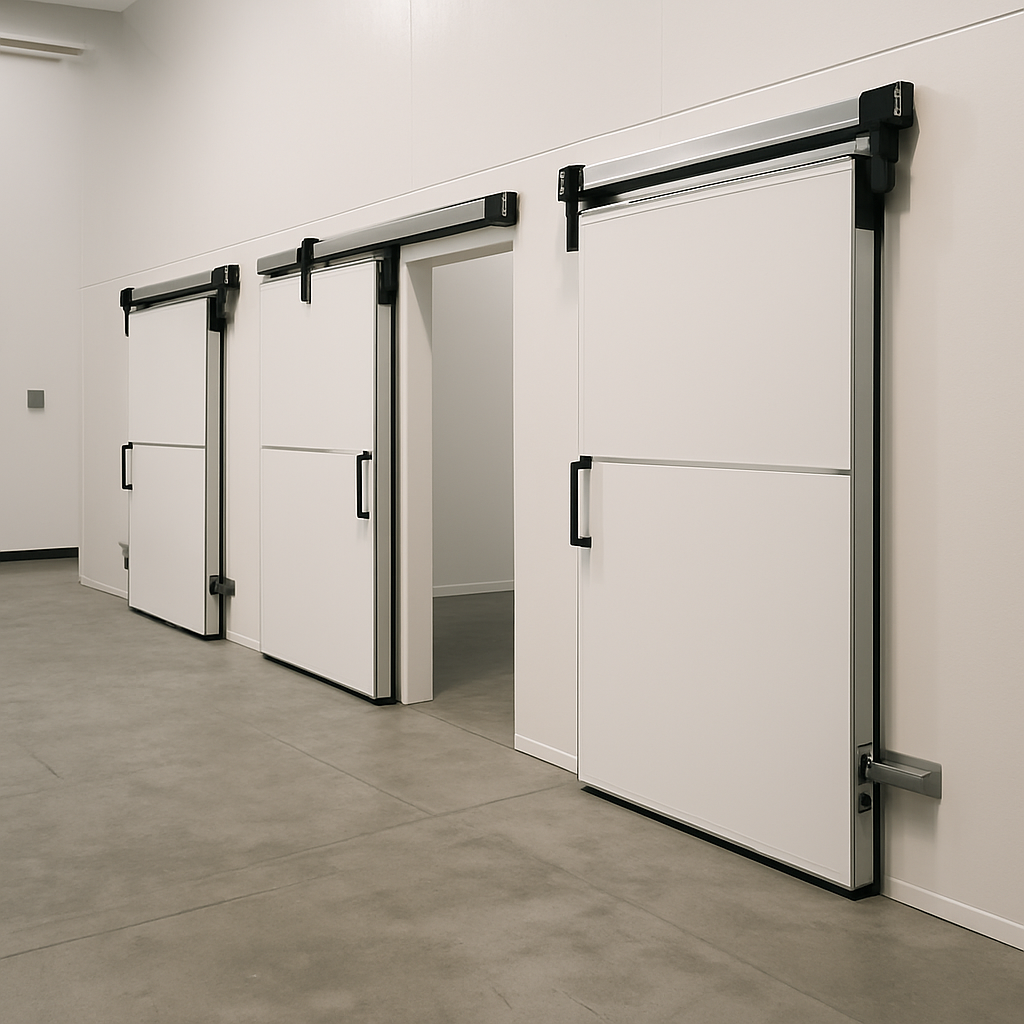
Puertas Correderas Manuales vs. Automáticas
Automatic cold storage sliding doors offer convenience, energy efficiency, and accessibility but are costlier and require maintenance, while manual doors are affordable, reliable, and simple but less efficient and accessible.
Detailed Comparison in Tabular Form:
| Parámetro | Automatic Doors | Manual Doors |
| Coste | High upfront & maintenance | Low upfront & maintenance |
| Conveniencia | Hands-free, effortless | Requires physical effort |
| Eficacia | Energy-saving, fast | Slower, less efficient |
| Accessibility | High, inclusive | Limited, less inclusive |
| Higiene | Contactless, hygienic | Requires physical contact |
| Seguridad | Advanced, integrated | Basic, direct control |
| Mantenimiento | Frequent, specialized | Minimal, simple |
| Durabilidad | Long-lasting with care | Long-lasting, robust |
| Idoneidad | High-traffic areas | Low-traffic areas |
| Energy Use | Controlled, efficient | Often inefficient, traditional door solutions can be replaced with high-speed doors for improved performance. |
Opciones de una Hoja y Doble Hoja
Single-leaf cold storage sliding doors are cost-effective, compact, and simple but limited in size, while double-leaf options provide wider access, better for high-traffic areas, but are more expensive and require more space.
Detailed Comparison in Tabular Form:
| Parámetro | Single-Leaf Doors | Double-Leaf Doors |
| Coste | Baja | Más alto |
| Talla | Limitado | Wider access provided by rapid slide door series enhances operational efficiency in busy environments. |
| Espacio | Compacto | Requires more space |
| Tráfico | Low to moderate | Alta |
| Instalación | Más fácil | More complex |
| Durabilidad | Alta | Alta |
| Flexibilidad | Limitado | Versatile door solutions can be applied in various settings, including high-performance door installations. |
| Usage | Small openings | Grandes aperturas |
| Estética | Simple | Elegant |
| Mantenimiento | Mínimo | Moderado |
Configuraciones Correderas Horizontales vs. Verticales
Vertical sliding cold storage doors save horizontal space and are ideal for narrow areas, while horizontal sliding doors are better for high-traffic areas and provide faster access but require more side clearance.
Detailed Comparison in Tabular Form:
| Parámetro | Vertical Sliding | Horizontal Sliding |
| Espacio | Saves horizontal space | Requires side clearance |
| Tráfico | Moderado | Alta |
| Velocidad | Más lento | Más rápido |
| Instalación | Complex | Más fácil |
| Durabilidad | Alta | Alta |
| Usage | Narrow aisles | Wide openings |
| Coste | Más alto | Moderado |
| Mantenimiento | Moderado | Moderado |
| Eficacia | High insulation | High throughput |
| Idoneidad | Tight spaces | High-traffic areas |
Materiales y Tecnología de Aislamiento
Materiales Comunes Utilizados en Puertas de Almacenamiento en Frío
Cold-storage door construction relies on a blend of highly engineered materials to combine lasting strength, low thermal leakage, and minimal operating costs. Stainless steel is a preferred choice for face sheets because it resists oxidation and denting, while lightweight aluminum skins cut handling and installation loads. Within the door, layered insulating cores of rigid polyurethane or polystyrene deliver superb thermal resistance, nearly halting heat migration across the panel. For openings that require frequent foot or cart traffic—yet cannot accommodate a conventional hinged door—transparent flexible PVC strips lock in cold air while allowing personnel and equipment to pass. The synergistic combination of these components in cooler and freezer applications keeps temperature-sensitive inventories secure and operating expenses in check.
Tecnologías de Aislamiento y sus Beneficios
Cold-storage sliding doors use a range of insulation technologies to optimize energy efficiency and ensure that internal temperatures remain tightly controlled. Here are five of the most effective approaches and the advantages they offer:
• Polyurethane Core Insulation. With low thermal conductivity, rigid polyurethane foam forms a dense internal layer that resists heat transfer. By confining energy losses to a minimum, high-performance doors sharpen temperature hold and curtail the expense of prolonged compressor operation.
• Polystyrene Core Insulation. Lightweight, low-density polystyrene laminated into the door creates a durable thermal equivalent of a sealed brick wall. Its air-trapping structure is uncomplicated to manufacture, install, and maintain, making it a sharp balance of price and temperature reliability in fields having moderate refrigeration loads.
• Vacuum Insulated Panels (VIPs). Enclosing a low-conductivity substrate within a sealed mac layer leaves negligible air that can carry thermal energy. As a result, the doors carry less bulk while the internal temperature behaves as an unyielding solid. Customers receive maximum effective storage area and minimized frost risk, making them less prone to damage or clearance needs.
• Reflective Insulation Layers. Mill-thin aluminum metallic membranes repel radiant heat rather than absorb it, pacing the thermal impact from lights, doors, and loading docks. When layered onto or within doors of a multitextured assembly, reflectives leaflet the insulation factor against outside excursions that transit from mild to hot or warm digestion in a single hour.
Aislamiento de Tiras Flexibles de PVC
Description: Clear, curved PVC strips hang on sliding door tracks, forming a lightweight barrier that bends aside for foot and trolley traffic yet limits heated or cooled air from escaping indoors.
Advantages: By sealing gaps in opened swinging or sliding glass doors, the solution lowers HVAC demand, cuts utility costs, offers unimpeded sightlines for safety and sales, and limits airborne contaminants in cold-room food displays.
Impacto en el Rendimiento Térmico
Cold storage sliding doors play a crucial role in maintaining consistent temperatures and reducing energy loss. Their design directly impacts the efficiency and thermal performance of cold storage facilities. Below are five key factors illustrating their contributions:
Thermal Bridge Elimination
Elimination of Thermal Bridging
Advanced door materials and full-frame insulation block thermal bridging, limiting heat exchange with surrounding cold corridors.
Evaluations indicate these strategies cut heat transfer by up to 20% under normal operating cycles.
Air Leakage Management
Continuous seals, multi-layer gaskets and zero-gap alignment confine outdoor air entry and internal air escape to fractions of infiltrated air, stabilizing set-point temperatures.
Field tests confirm sliding doors configured this way achieve air leakage reductions of 30% to 50%, directly lowering cooling demand.
Energy Demand Mitigation
When sliding doors combine superior thermal performance with stringent sealing, compressor cycling and fan energy requirements diminish.
Monitored cold-storage facilities in our database cite energy demand reductions of 15% after installing thermal performance doors.
Humidity Control
Interior anti-condensate glazing, combined with thermal break construction in freezer doors, curtail moisture accumulation, lowering fruit and dairy spoilage rates.
Performance records denote humidity reductions between 10% to 25% after deployment, prolonging both product life and equipment longevity.
Longevity Under Thermal Stress
Cold storage sliding doors incorporate structurally reinforced polymers to withstand repeated thermal and mechanical cycling.
Lifecycle history studies reveal durability updates extending service life by 30% relative to baseline, ensuring consistent sealing performance and reduced maintenance frequency.
Aplicaciones y Casos de Uso en la Industria
Procesado de alimentos y está protegido de elementos externos durante las transferencias.
Sliding doors for cold storage units continue to emerge as a cornerstone feature in contemporary food processing and cold-storage design, driven by clear operational and energy mandates. By sealing loading and access zones, they deliver tightly controlled climates, safeguarding both temperature-sensitive inventories and compliance standards. Fresh analysis confirms a growing preference for energy-optimized sliding alternatives engineered to restrict thermal bypass and curb power use. Coupling engineered edge seals with high-cycle materials further extends door lifespan in continual-movement zones, assuring sustained performance. Collectively, these refinements yield lowered energy outlays and broadened ROI horizons, affirming sliding doors as a value-adding cornerstone for forward-looking temperature-controlled facilities.
Instalaciones farmacéuticas y Cuartos limpios
In pharmaceutical plants and clean rooms, sliding doors are more than architectural features—they are technical guardians that keep environments under constant control. Every facility of this kind must uphold exacting standards of cleanliness, temperature uniformity, and air pressure. The engineering of a contemporary sliding door is an integral piece of that equation. Smooth, non-porous surfaces limit surfaces that could harbor dirt or germs. And precision seals provide an airtight barrier that safeguards sterility. Their rapid yet quiet motion is engineered to close before a passing worker or rack can pause. Thereby conserving temperature and pressure zones. Operating that way not only reduces the risk of drifting outside specified limits but also curbs energy consumption—every kWh saved bolters the bottom line and simplifies total facility compliance. For environments routinely subject to five-star audits, these doors are, without doubt, a must.
Ejemplos Reales y Estudios de Caso de Puertas Correderas de Almacenamiento en Frío
One notable example of cold storage sliding doors in action is in the food processing industry. A major poultry processing plant implemented high-performance sliding doors in their cold storage areas to maintain consistent temperatures during daily operations. These doors not only ensured reliable temperature control but also minimized energy loss by allowing rapid and secure openings and closings during frequent access.
Another case study involves a pharmaceutical distribution center that required strict compliance with temperature-sensitive storage regulations. By integrating sliding doors with advanced sealing mechanisms and automated operation, the facility achieved improved thermal insulation and operational efficiency. The reduced temperature fluctuations not only preserved the integrity of stored products but also contributed to significant energy savings over time.
These case studies showcase how sliding doors play a critical role in industries requiring precision climate control, demonstrating their importance in maintaining quality, efficiency, and regulatory compliance.
Consideraciones de Diseño y Opciones de Personalización
Grosor y Dimensionamiento del Panel
Panel thickness and sizing for cold-storage sliding doors are dictated first and foremost by the thermal profile the operation demands. In the field, thickness options typically fall between three and six inches, with the higher side yielding a lower U-value and a tighter thermal gradient. Core selection is not arbitrary; engineers must weigh the desired room-setpoint temperature, the exterior ambient profile, and operational footfall (in hourly or daily cycles) before committing. For sites with atypical reveal dimensions or maneuvering constraints, bespoke sizing must be integrated at the architectural or engineered drawing stage, ensuring a seamless, continuous gasket interface and the elimination of draft bypass. The interplay of thickness and engineered sizing yields decisive benefits: reduced runaway thermal load, lower compressor runtime, and, by extension, retained product integrity under a controlled tight-band temperature regime.
Integración con Sistemas de Monitoreo y Control
Today’s cold-storage sliding doors come equipped with sophisticated monitoring and control technology designed to elevate efficiency and uphold flawless climate integrity. Via continuous feedback loops, these systems record temperature, humidity, and sliding frequency, keeping all variables firmly within predetermined tolerances. Intelligent sensors orchestrate door motions in concert with the refrigeration plant, confining warm-air ingress and compressor cycling to the narrowest of margins, thereby trimming kilowatt-hours to the quick. Even more, managers can present trends, modify control curves, and respond to alerts—all via a secure portal accessed desktop or mobile, no more waiting for the weekly walkthrough. Uninterrupted, the combination of stealthy operation, adaptive demand. And instantaneous global oversight not only conserves megajoules, it fends off spoilage by locking the cold chain against even the smallest drift.
Acabados Personalizados y Diseños con Clasificación de Resistencia al Fuego
Personalized finishes let firms synchronize their cold-storage sliding doors with corporate identity or architectural style. Choices span a curated palette of hues, textures, and durable materials, each delivering long-lasting visual appeal and enabling a discrete fit within the surrounding decor. When safety is a priority, fire-rated configurations add a vital safeguard by fulfilling rigorous fire-resistance criteria, thereby shielding personnel and products during an alarm. Constructed to endure elevated temperatures while adhering to prevailing codes, these ratings become indispensable for sites with elevated fire risk. Marrying a tailored, decorative facing with these safety-rated platforms lets firms secure operational integrity and aesthetic cohesion in a single specification that responds precisely to their individual workflow requirements.
Cumplimiento de Higiene y Seguridad
Superficies Fáciles de Limpiar para Puertas Correderas de Almacenamiento en Frío
Cold-storage sliding doors are engineered with an emphasis on hygiene and operational safety, featuring surfaces optimized for rapid care and upkeep. Constructed from high-performance, non-porous materials, these barriers fend off moisture, mold, and bacteria, a critical requirement for sectors where cleanliness is non-negotiable, such as food distribution and pharmaceutical storage. Their continuously smooth faces not only accelerate cleaning cycles, permitting immediate disinfection, but also truncate equipment idle time and align effortlessly with stringent health mandates. The doors’ weld-free construction removes ledges that might otherwise contain dust and dirt, perpetuating a consistently sanitary compartment and extending service life. When viewed as an integrated solution—clean-by-design design and durable execution—these sliding doors emerge as a pivotal, protective asset for any cold-storage regime aiming to uphold uncompromised safety protocols.
Cumplimiento de los Estándares de Seguridad Alimentaria
Cold storage sliding doors are indispensable for meeting demanding food safety requirements. Engineered to support stable temperature levels, these doors curb temperature swings that might endanger the quality and safety of food. Tight, effective seals restrict air movement, which lowers contamination and spoilage hazards. Built from sturdy, food-safe materials, the doors resist the harsh cleaning and sanitizing routines mandated by the rules. By creating a clean, tightly monitored space, cold storage sliding doors help operations conform to internationally accepted food safety practices, thereby protecting both the health of consumers and the integrity of the merchandise.
Características y Consideraciones de Seguridad
Cold storage sliding doors integrate multiple safety mechanisms to balance energy performance with the well-being of users and the facility. Ultrasonic and photoelectric sensor arrays detect approaching personnel and lift trucks, automatically withholding closure until the path is clear, thereby preventing pinching and preserving sensor accuracy. Rounded soft-edge bumpers along all panel edges of high-speed doors soften the blow site. And drive-beam attenuation circuits detect even minimal resistance, prompting immediate reverse. In cases of sudden power loss, a battery-backed UX controller homes the panels to a locked safety position. And easily accessed hand cranks provide controlled disengagement, allowing safe passage. Vapor-seal gaskets and heated containment panels keep frost at bay, mitigating slipping and extending seal life. Altogether, the synergy of these features safeguards personnel, protects the stored product, and curtails maintenance interruptions.
Eficiencia Energética e Impacto Ambiental
Minimización de la Infiltración de Aire
Cold-storage sliding doors are designed to limit air exchange and bolster energy savings and temperature stability within refrigerated warehouses. Effective sealing arrangements—tight-fitting gaskets and staggered-panel overlays—publish an extraordinarily tight envelope once the doors are shut. Automated open-close controls remain another highlight; by keeping the exposed time at an absolute minimum, the systems prevent the warmed perimeter from compromising the interior climate. Using low-conductivity frame materials, meanwhile, channels thermal disturbance further out. Fixed inspection routines help replace sealant and lubricate tracks before performance starts to slip. Together, these measures shrink the gradient, allowing energy loss. Allowing users to report sustained savings on kilowatt and refrigerant invoices, and guide the stored stock in the narrowest shrink-allow and temperature-led variations possible.
Reducción de los Costos de Energía de Refrigeración
Cold storage sliding doors are essential tools for cutting refrigeration energy expenses, delivering impressive thermal insulation and slashing air loss. Each door is engineered to produce a tight, airtight seal as soon as it shuts, trapping cold air and sparing refrigeration systems from dipping into overdrive to preserve stable temperatures. Recent improvements—think highly insulated core panels and advanced, durable gaskets—build on that core design to push thermal boundaries further. Pairing those physical innovations with smart sensors and controls toggles door movement to the exact requirement, opening only to accommodate incoming traffic. The combined effect spells a measurable drop in total energy draw. Adopting these integrated systems now means enhanced energy efficiency, noticeably smaller energy bills, and, perhaps most critically, unwavering preservation of cold storage integrity from the moment the door glides closed.
Uso de Materiales Ecológicos
Creating cold storage sliding door with eco-friendly materials is essential for balancing energy efficiency and planetary health without compromising quality. Aluminums and composite panels made from recycled or responsibly harvested sources address resource depletion and shrink transportation-related emissions. When paired with low-VOC adhesives and coatings, manufacturers limit harmful off-gassing, thereby elevating indoor air quality without sacrificing the long-term performance expected in temperature-controlled environments. Beyond operational benefits, using these materials actively advances clients toward compliance with industry legislation and secures the certifications—like LEED or BREEAM—central to marketing differentiated, responsible choices.
Comparación con Otros Tipos de Puertas de Almacenamiento en Frío
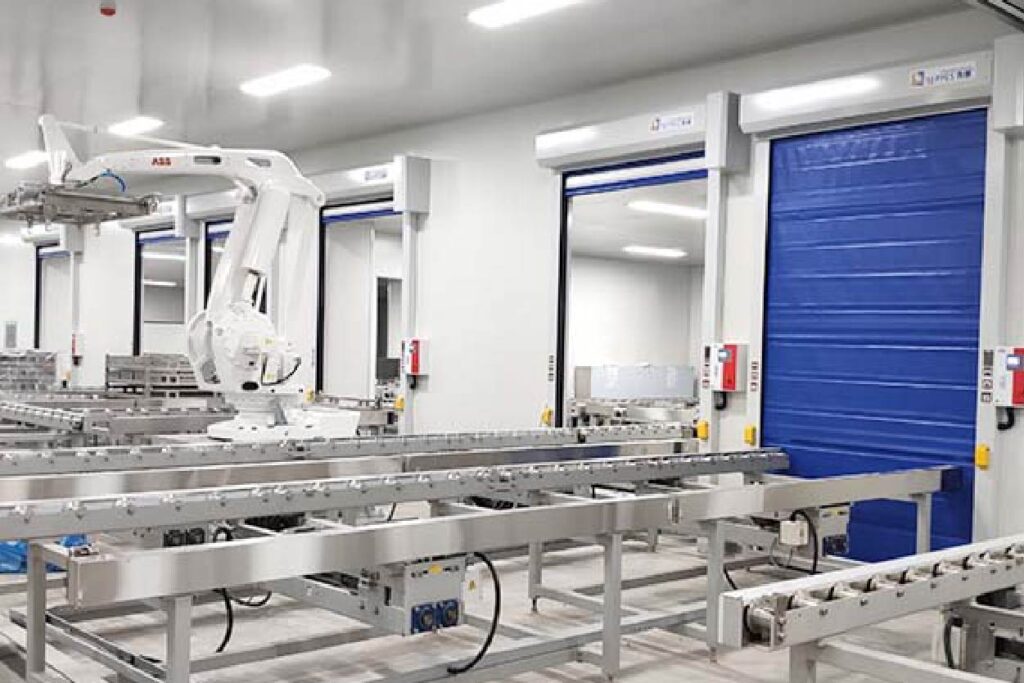
Puertas Correderas vs. Puertas de Bisagra y Enrollables
Cold storage sliding door save space and are ideal for high-traffic areas, hinged doors provide better insulation and are cost-effective for low-traffic areas, while roll-up doors offer speed and hygiene but are less insulated.
Detailed Comparison in Tabular Form:
| Parámetro | Puertas correderas | Hinged Doors | Roll-Up Doors |
| Espacio | Saves space | Requires swing clearance | Minimal space needed |
| Tráfico | Alta | Bajo | Alta |
| Velocidad | Moderado | Lento | Rápido |
| Aislamiento | Moderado | Alta | Bajo |
| Coste | Más alto | Baja | Más alto |
| Mantenimiento | Moderado | Bajo | Alta |
| Durabilidad | Alta | Alta | Moderado |
| Higiene | Moderado | Moderado | Alta |
| Usage | Grandes aperturas | Small openings | High-speed access |
| Idoneidad | Almacenes | Small cold rooms | Food/pharma industries |
Ventajas y Desventajas para las Necesidades Operativas
Cold storage sliding door save space and suit high-traffic areas, hinged doors offer better insulation and cost-effectiveness for low-traffic areas, while roll-up doors provide speed and hygiene but are less insulated.
Detailed Comparison in Tabular Form:
| Parámetro | Puertas correderas | Hinged Doors | Roll-Up Doors |
| Espacio | Saves space | Needs swing clearance | Minimal space needed |
| Tráfico | Alta | Bajo | Alta |
| Velocidad | Moderado | Lento | Rápido |
| Aislamiento | Moderado | Alta | Bajo |
| Coste | Más alto | Baja | Más alto |
| Mantenimiento | Moderado | Bajo | Alta |
| Durabilidad | Alta | Alta | Moderado |
| Higiene | Moderado | Moderado | Alta |
| Usage | Grandes aperturas | Small openings | High-speed access |
| Idoneidad | Almacenes | Small cold rooms | Food/pharma industries |
Consideraciones de Costo y Mantenimiento
Mejores Prácticas para la Instalación Profesional de Puertas Correderas de Almacenamiento en Frío
Precision Measurement and Planning
Accurate measurements are critical when installing cold storage sliding door. Ensure proper alignment and consider the width, height, and depth of the opening to guarantee a seamless fit. Proper planning reduces installation errors and ensures high-performance door efficiency.
Seal Optimization
Cold storage efficiency relies heavily on maintaining a tight seal to prevent air leakage. Use high-quality gaskets and sealing materials specifically designed for low-temperature conditions. Regularly inspect seals during installation to confirm they are airtight.
Aislamiento térmico
Utilize door panels with high thermal insulation properties to maintain internal temperature stability. Ensure the door material meets the required R-value standards for energy efficiency and minimizes thermal bridging.
Smooth Sliding Mechanism
Install durable and low-resistance sliding tracks for smooth and reliable operation of high-performance doors. Lubricate and align the mechanism properly during installation to ensure longevity and ease of use over time.
Safety Features Implementation
Integrate advanced safety features such as anti-pinch mechanisms, safety sensors, or emergency release systems to enhance workplace safety and comply with industry regulations. Test all safety features during installation for proper functionality.
Programas y Requisitos de Mantenimiento
To keep sliding doors in cold-storage areas working efficiently, retain energy, and extend service life, operators must then adhere to these five maintenance practices:
Inspect Seals Every Month Inspect the full length of all continuous and overlapping seals. Worn areas and gaps let cold air escape, so any tear should prompt immediate replacement to keep energy dollars saved and temperature regulated.
Clean Tracks and Rollers Quarterly Every third month, sweep the track of ice, dust, and small fragments. Then use warm damp rags to clear the rail sides. Rollers benefit from a light polishing followed by a thin film of food-grade lubricant, reducing torque load and protecting the bearing surface.
Test Safety Sensors Every Six Months Assign the first shift to cycle all push, infrared, and light-scanning sensors. The end result is that all beams—including the low fixation wing— react, so censored doors move a partial return to an open position. Sensor drift is then adjusted, or sensors are capital-replace, ensuring personnel protection.
Audit Electrical Parts Annually Once in the twelve month cycle, visually and me datically verify all low and line voltage sections, under load if needed. Use infrared and visual scanning to discover overheated connectors, broken conductors, or corroded terminals—issues that should be remediated to avoid outages.
Verify Temperature Strategy Continually A temperature-datalogging probe can operate across and be secured to the door side of the unit so the datalogging instrument captures heat load, surface i dent and isolates cold surface radiation. A spike or threshold that exceeds set rul clicks a window hc alert warning if an existing doorblock field is anticipated.
Keeping these maintenance timelines will help your cold-storage sliding doors work smoothly and keep hammering away at repair costs while they glide on uninterrupted tracks.
Análisis de Costos y Costo Total de Propiedad
To accurately assess the economics of cold storage sliding door. The evaluation must encompass the full spectrum of costs, both upfront and recurring. Integrating the following five factors into the analysis is crucial.
Initial Procurement Cost
This figure represents the acquisition price of the doors, influenced by dimensions, framing and panel materials, insulation effectiveness. And the prevailing automation technology.
Costos de instalación
Charges for professional field assembly, which encompass labor hours, specialized tooling. And any structural realignment or reinforcement the cold-storage envelope requires.
Energy Efficiency and Operating Costs
The sliding doors’ thermal performance once in service governs long-term kilowatt-hour consumption. Selection of advanced, tightly-sealed insulation and microprocessor controls helps moderate average HVAC loads.
Maintenance and Repair Costs
Scheduled preventive inspections, minor component swaps, roller and track lubrication, and, as needed, actuator or panel repair charges must be included, since disciplined servicing extends component life and curtails unforeseen downtime.
Lifespan and depreciation of cooler doors can significantly impact overall operational costs.
Well-engineered systems yield longer-service intervals, thus spreading acquisition and installation charges over a greater quantity of service year. Incorporating estimated depreciation profiles supplies a clear estimated net book value year by year.
Collectively, these five components deliver a transparent calculation of the investment’s total life-cycle impact, streamlining prioritization and budgeting by cold storage operators.
Tendencias del Mercado y Futuros Desarrollos
Crecimiento en la Logística de la Cadena de Frío
The growth in cold chain logistics is driving the demand for advanced cold storage sliding doors, with a focus on automation, energy efficiency. And sustainability to meet the increasing needs of food, pharmaceutical, and e-commerce sectors
Avances Tecnológicos en la Tecnología de Puertas
Technological advancements in cold storage sliding doors focus on automation, smart sensors, energy-efficient insulation, and antimicrobial coatings to enhance operational efficiency, safety, and sustainability
Principales Fabricantes y Perspectiva del Mercado
Key manufacturers like ASSA ABLOY, Jamison Door Company, and Hörmann,SEPPES are driving the cold storage sliding door market, which is projected to grow significantly due to increasing demand for automation, energy efficiency, and sustainability in cold chain logistics
Conclusión: Cómo Elegir la Puerta Corredera de Almacenamiento en Frío Adecuada
Resumen de Beneficios y Consideraciones
Cold-storage sliding doors stand out in cold chain environments by combining efficiency with practical advantages. Here are five essential benefits and design considerations that make them indispensable:
Energy Efficiency: State-of-the-art insulation and effective sealing work together to minimize thermal transfer, so conditioned spaces retain cold with minimum effort, directly trimming energy costs and supporting broader sustainability targets.
Durability and Longevity: Engineered with high-performance alloys and thermal barriers, these doors resist freeze cycles, impact, and cleaning agents, delivering extended service life and curbing unexpected downtime and repairs.
Ease of Automation: Proximity sensors, soft-start motors, and programmable controls allow doors to open only as required, keeping foot and pallet traffic flowing smoothly while lowering the risk of injury and the strain on mechanical components.
Hygiene and Safety Compliance: The doors’ continuous welded seams, anti-microbial overlays. And smooth surface profiles inhibit bacterial harboring, passing stringent food and pharmaceutical health inspections while supporting easier sanitary cleaning routines.
Customizable Designs: A comprehensive catalog of core materials—polyurethane, stainless steel, and transparent rigid composite—pairs with configurable dimensions, sealing patterns. And operational thresholds, yielding the precise doorway configuration that small cold cells and extraterrestrial-scale blast freezers alike demand.
Guía para Gerentes de Instalaciones y Arquitectos
Selecting cold-storage sliding doors always starts with thermal efficiency; the right insulation must effectively minimize heat transfer, so the set-point temperature is sustained long-term. I also screen for durability, knowing that cycles can exceed hundreds each day in these environments, and even narrow tracks, frames, and finishes can take a punishing toll. Epidemiological audits drive the next choice—products with embedded anti-microbials and surfaces that the custodian can mop with just isopropyl ought to comply without requiring frequent labour or chemical rotation. Lastly, I make room for model configurations that tailor height, framing colour. And seals to our aisle widths or ceiling coiling rails; any compromise here can ripple costs through the whole dock stream. Keeping these lines in mind, the decision quickly narrows to doors that deliver efficiency, robustness, sanitation. And just the right fit; complexity averted.
Garantizar la Integridad y Eficiencia del Almacenamiento en Frío
Sliding cold-storage doors serve as a frontline defense in preserving thermal integrity while cutting power costs. Their engineered edges create a near-impermeable barrier, which curtails cold air escape and stabilizes the interior climate. Designed for constant use, the doors glide effortlessly along heavy-duty tracks; this minimizes required aisle width and eliminates the swing arc of a hinged door, freeing vital square footage in crowded walkways. Their frames, often built from stainless or powder-coated steel, resist mechanical wear and microbial growth, while smooth surfaces facilitate rapid sanitation. Choosing a door matched to room height, desired R-value, and traffic load goes beyond initial convenience. It’s a quality investment that promises steady, measurable performance for the entire lifespan of the cold-storage area.
Preguntas más frecuentes (FAQ)
¿Cuáles son los beneficios de usar una puerta corredera de almacenamiento en frío?
Cold storage sliding doors, such as high-speed doors, tackle several challenges—better energy efficiency, tight seals that curb leaks, and rapid opening that serves continuous foot and forklift traffic without delay. By locking in the programmed temperature, they protect perishable inventory, reduce compressor workload, and cut utility bills. The heavy-duty tracks and motor drives deployed in a properly engineered system withstand the repeated cycles that distribution centers. And food manufacturers generate, translating upfront investment into lasting savings and constant throughput.
¿Cómo mejora la eficiencia una puerta corredera de almacenamiento en frío de alta velocidad?
The high-speed variant turbo-charges the concept. With a programmed open-close time of five to other critical production zones, operators access freezer and cooler aisles without dramatic rises in thermal stratification. The perimeter seals flex in and compress to close tracks one-eighth of a second later, creating as-immediate a barrier as the coils generate movement feet per second. This swift operation minimizes the kilograms of chilled air lost through an opening already minimized in width. And the door motor logs occasion and duration, letting managers correlate utility spikes to door misalignment or drive lags.
¿Qué tipos de puertas de almacenamiento en frío están disponibles?
To conform to layout, load, and product profiles, manufacturers cover a spectrum of cold storage door systems. Standard sliding configurations work in aisles unobstructive to picking, low-e panes to clarify sight, and hood couplings to lower adiabatic wall heat gain. Swing meltdown doors avoid blown gaskets in cross-dock transfer places and interlock with cascading air curtains. While freezer swing doors of field-tested insulation soar to R-100 or greater. High-frequency doors, engineered with impact panels and repair-friendly skins, gladly accept thermal thrusters in excess of eight incidents an hour. An inspection visit, plus load density and throughput metrics, clearly segregates the right opening.
¿Cuál es la función del sistema de riel en las puertas correderas de almacenamiento en frío?
The cold storage sliding door track mechanism found in cold storage facilities is crucial for both quiet daily operation and long-term reliability. By using a continuous, precision-engineered rail, each door glides with minimal resistance, and the plate and track experience minimal friction. And the door garners no scuff or flex that would normally rattle the frame. Over the years, this very resistance plateau brackets refresh cycles. So that the assemblies ask only for the lightest lube intervals in the process. Doors so browsed turn, flex, or swagger positively as they ferry by cold-storage foot or vehicle traffic—consistent performance even in the traffic runs typical of produce, pharmacy, or industrial cooling docks. As a result, the rail-pack is a signature for a door that is both rugged in design and delicate in its energy imprint.
¿Cómo pueden las puertas correderas de almacenamiento en frío ayudar a reducir los costos de energía?
In turn, cold storage sliding door panels act as the most energetic component of an efficient shell. Since they tighten with fully coated perimeter retaining strips, the boundary layer clamps fully inboard of the refrigerated aisle, enjoy narrow U-value credentials. And so offer a brisk turn-down on both delta-length and delta-cycle energy drain. With the panels set, the cold aisle’s nearby borders receive a sharp delta. The energy kilometers revered because they did not pass the door frame’s thermaled stripe. Over a year, that variance is rendered in kilowatt- and therm- metric savings that add confidence and leagues of cash alike along an order-to-stock or cold, balance-pability, and cost line.
¿Qué son las puertas de cuarto frío aisladas y cuáles son sus ventajas?
Insulated cold room doors are engineered to lock in temperature while keeping warm air from interrupting chilling or freezing environments. Their exceptional rigidity, often improved with R41-rated foams, curtails heat transference, yielding benefits like sustained product integrity, noticeably lower power bills. And a measurable reduction in compressor wear. For any facility handling sensitive perishables, these doors are no longer optional.
¿Qué debo considerar al elegir una empresa de puertas para soluciones de almacenamiento en frío?
Choosing a supplier calls for diligence. First, assess the door’s mechanical and thermal specs: only verify R-values and calculate the total heat transfer. Second, check the catalog: leading manufacturers offer hard, soft, and ultra-quick thermal doors to suit differing volumes and foot-traffic. Finally, ok the value-adding, appliqué features: steel track wheels that ingest minor impacts, or insulated, replaceable panels reducing shelf life. Also, weigh warranty depth and ask for documented energy rating scores to forecast operating expenditures.
¿Se pueden personalizar las puertas correderas de almacenamiento en frío para aplicaciones específicas?
Aged plants or novel builds alike often find sliding doors that fit. Fabricobility covers width, thickness, thermal resistance, and operating speed. Slice speeds, for monitors programmed to infinity loops, enhance the cycle. Add proximity sensors that trigger soft sealing or winter fabric drapes. And the door adapts to a blast freeze or a personnel aisle with equal grace. Partnering with a certified manufacturer assures that the engineered solution compromises neither air-tightness nor logistical flow.
Fuentes de referencia
La Influencia del Tipo de Puerta de Almacenamiento en la Permeabilidad al Aire del Almacenamiento en Frío
Autores: Zhe Wang, Jiang Shen, Zheng Liang, Kai-Hu Yong
Fecha de publicación: September 20, 2022
Resumen: This paper investigates how different types of storage doors, including sliding doors, affect air permeability in cold storage environments. It highlights the importance of door design in minimizing air infiltration. That is crucial for maintaining temperature control in cold storage facilities.
Puerta Corredera con Disipación de Calor Tipo Suelo para la Protección contra Escarcha de la Entrada del Almacenamiento en Frío
Autor: 유민한
Fecha de publicación: August 28, 2015
Resumen: Este artículo analiza un diseño de puerta corrediza que incorpora un sistema de disipación de calor de tipo suelo para proteger las entradas de cámaras frigoríficas de la escarcha. Ofrece perspectivas sobre soluciones innovadoras para mejorar el rendimiento de las puertas corredizas en cámaras frigoríficas.
Enlace: Puerta Corrediza con Protección Antiescarcha Mediante Disipación de Calor de Tipo Suelo
Análisis de Flujo No Estacionario en Aperturas de Puertas de Bisagra y Correderas
Autores: Fredrik Kihlberg, Øystein Hermansen, A. Chaudhuri
Fecha de publicación: 28 de octubre de 2022
Resumen: Este estudio presenta un análisis de flujo transitorio de diferentes tipos de puertas, incluidas las corredizas, en entornos de almacenamiento en frío. Examina cómo los movimientos de las puertas afectan las condiciones térmicas y la calidad del aire, aspectos críticos para las operaciones en cámaras frigoríficas.
Enlace: Análisis de Flujo No Estacionario en Aperturas de Puertas de Bisagra y Correderas
Los Efectos del Ventilador y la Apertura de la Puerta en una Sala de Almacenamiento en Frío: Un Estudio Numérico
Autores: Azada Ayarmal, O. Melhus, A. Chaudhuri
Fecha de publicación: 19 de noviembre de 2018
Resumen: Este artículo explora el impacto de las aperturas de puertas, incluidas las corredizas, en el rendimiento térmico de las cámaras frigoríficas. Proporciona simulaciones numéricas que ayudan a comprender cómo el diseño de las puertas influye en la eficiencia energética y la estabilidad de la temperatura.
Enlace: Los Efectos del Ventilador y la Apertura de la Puerta en una Cámara Frigorífica
Placa de Aceite Caliente Utilizada para Puerta de Almacenamiento en Frío
Autores: Jiang Fasheng, Chen Anfeng, Lian Yanliang
Fecha de publicación: 10 de septiembre de 2012
Resumen: Este artículo analiza el uso de placas de aceite caliente en puertas de cámaras frigoríficas para prevenir la formación de escarcha. Destaca las consideraciones de ingeniería para puertas corredizas en aplicaciones de almacenamiento en frío, centrándose en el mantenimiento de condiciones óptimas.
Enlace: Placa de Aceite Caliente Utilizada para Puerta de Almacenamiento en Frío
Conclusión
Estas fuentes deberían proporcionarle una base sólida para verificar la información en su artículo sobre puertas corredizas para cámaras frigoríficas y tecnologías relacionadas. Asegúrese de acceder a los artículos a través de su institución o biblioteca para obtener acceso completo. Si necesita más ayuda o detalles específicos de alguno de estos trabajos, no dude en preguntar.