
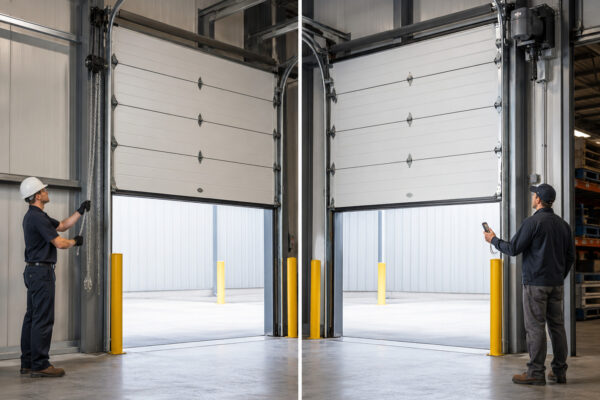
Choosing between manual and automatic sectional doors depends on how often the door is used, the size of the opening, the traffic flow, and the level of convenience required.
For small workshops or low-frequency entrances, a manual sectional door may be sufficient. For warehouses, factories, logistics centers, and frequently used vehicle entrances, an automatic sectional door is usually more efficient and practical.
This guide compares both options to help you choose the right sectional door for your facility.
目录
切换What Is a Manual Sectional Door?
A manual sectional door is typically operated using a hand chain hoist. The operator pulls the chain to raise or lower the door without using an electric motor.
The torsion spring system helps balance the door weight, making manual chain operation smoother and reducing the force required to move the door.
Manual sectional doors are generally suitable for:
- Low-frequency entrances
- Storage buildings
- Small workshops
- Locations where electrical power is unavailable or inconvenient
- Applications where automatic control is not required
The main advantage is simplicity and lower initial cost.
However, the operator must stand beside the door and manually pull the chain each time the door needs to open or close.
What Is an Automatic Sectional Door?
一个 automatic sectional door uses an electric motor to open and close the door.
The operator drives the sectional door through the track system, allowing the user to activate it through different control methods.
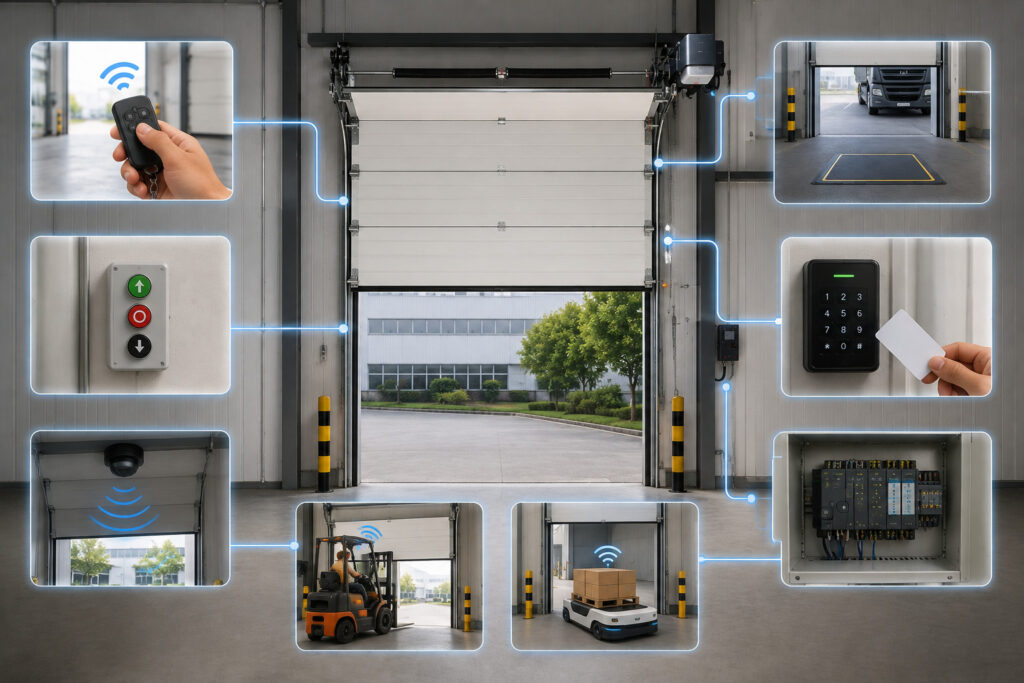
Common opening options include:
- Push button
- Remote control
- Pull cord
- Radar sensor
- Vehicle detector
- Card reader
- Access control
- PLC signal
Automatic operation is commonly used in warehouses, factories, loading areas, logistics centers, and automotive workshops where the door is opened frequently.
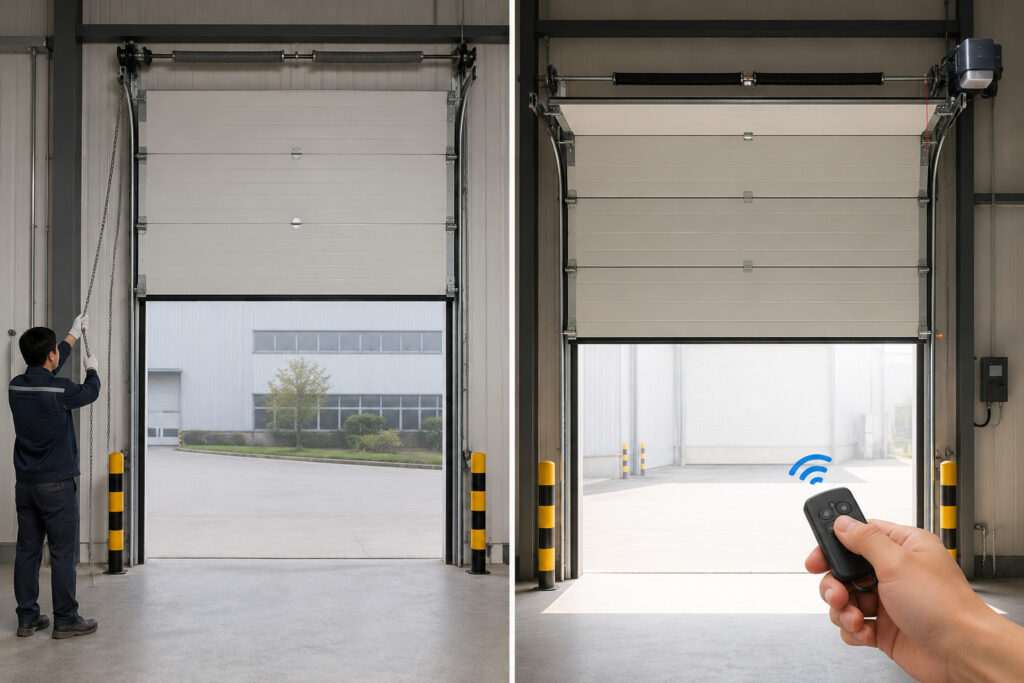
Manual vs Automatic Sectional Doors
| 特点 | Manual Sectional Door | Automatic Sectional Door |
|---|---|---|
| 运行 | Hand chain hoist | Electric motor |
| Power Supply | 不需要 | 需要 |
| 初始成本 | 较低 | 更高 |
| 便利性 | 较低 | 更高 |
| Opening Frequency | 低 | Medium to high |
| 遥控器 | 无 | 是 |
| PLC / AGV Integration | 无 | 是 |
| 最佳适用场景 | Low-frequency use | Frequent industrial use |
1. Opening Frequency
Opening frequency is one of the most important factors when choosing between manual and automatic operation.
If a door is opened only a few times per day, manual operation may be practical.
For example, a small storage building may only need the door opened in the morning and closed at the end of the day.
In this situation, installing an electric operator may not provide much additional value.
However, if forklifts, trucks, or employees pass through the doorway frequently, manual operation can quickly become inconvenient.
An automatic sectional door allows the operator to open the entrance without repeatedly leaving the vehicle or work area.
For higher traffic facilities, automatic operation is normally the better choice.
2. Door Size and Weight
Commercial sectional doors can be much larger than residential garage doors.
Although torsion springs help balance the door, larger doors still require more effort to operate manually.
For wide or tall industrial openings, an electric motor provides more consistent and convenient operation.
Automatic operation is therefore especially suitable for:
- Large warehouse doors
- Truck entrances
- 装卸区
- 工业车间
- Equipment access openings
For very small sectional doors, manual operation may remain a simple and economical solution.
3. Convenience
Convenience is one of the biggest differences between manual and automatic sectional doors.
With a manual sectional door, the operator must stand beside the door and pull the hand chain each time the door needs to open or close.
An automatic sectional door can instead be operated using:
- Push button
- Remote control
- Pull cord
- Radar sensor
- Vehicle detector
- Access control system
This is especially useful in warehouses and factories where forklifts, trucks, or employees pass through the entrance frequently.
Automatic operation reduces manual effort and makes daily traffic more efficient.
4. Traffic Efficiency
In warehouses and logistics facilities, door operation can directly affect traffic efficiency.
If employees must stop, leave the forklift, manually open the sectional door, drive through, and then close the door again, each passage takes additional time.
Automatic operation simplifies this process.
The door can be activated before the vehicle reaches the entrance and closed after it passes.
For facilities with frequent vehicle traffic, this can improve overall operational efficiency.
5. Safety
Both manual and automatic sectional doors should include appropriate mechanical safety systems.
Common sectional door safety features can include:
- Bottom safety edge
- Cable break protection
- Spring break protection
- End buffer design
Automatic sectional doors can also use additional electronic safety devices.
For example:
- 光电传感器
- Safety light curtains
- Vehicle detection systems
- Emergency stop controls
A photoelectric sensor can detect an obstacle in the doorway and prevent the door from closing onto a person, forklift, or vehicle.
For busy industrial entrances, these additional safety options can be valuable.
6. Automation and Smart Control
One major advantage of an automatic sectional door is the ability to integrate it with other systems.
Industrial sectional doors can be connected with:
- PLC systems
- AGVs
- Conveyors
- Robots
- Access control systems
- RFID readers
- Warehouse management systems
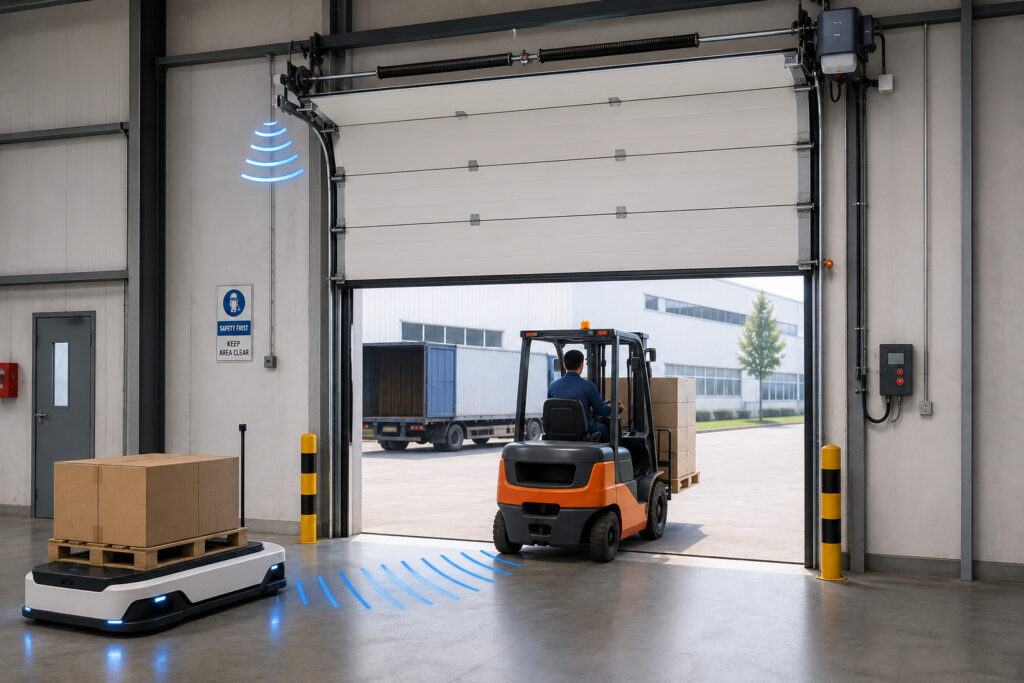
For example, an AGV can send a signal to the door before approaching.
The sectional door opens automatically, the AGV passes through, and the door closes after the area is clear.
This type of integration is not possible with a standard manually operated door.
For automated factories and logistics facilities, an automatic sectional door is therefore usually the more suitable option.
7. Energy Efficiency
Automatic operation can also help reduce unnecessary door opening time.
With manual doors, employees may leave the door open longer than necessary.
An automatic sectional door can be programmed or controlled so that it closes after traffic passes through.
This is particularly useful in:
- Heated warehouses
- Air-conditioned workshops
- Temperature-controlled facilities
- Industrial buildings with insulated sectional doors
Reducing unnecessary open time can help limit heat exchange between indoor and outdoor areas.
However, if the entrance requires extremely frequent and rapid opening, a high-speed door may be more suitable than a standard sectional door.
8. Installation Cost
Manual sectional doors generally have a lower initial cost because they do not require an electric operator or advanced control system.
Automatic sectional doors require additional components such as:
- 电机
- Control box
- Electrical wiring
- Push button
- Sensors
- 遥控器
Optional automation devices can increase the total project cost further.
However, buyers should consider the total operational value rather than initial price alone.
For frequently used industrial doors, the convenience and time savings of automatic operation may justify the higher initial investment.
9. Maintenance
Manual sectional doors have fewer electrical components.
Maintenance mainly focuses on:
- Tracks
- Hinges
- Rollers
- Torsion springs
- Cables
- Mechanical safety devices
Automatic sectional doors require these same checks, plus inspection of:
- Electric motor
- 控制系统
- Sensors
- Limit switches
- Wiring
- 安全装置
This means automatic doors generally require slightly more maintenance.
However, regular preventive maintenance can help keep the system operating reliably.
When Should You Choose a Manual Sectional Door?
A manual sectional door with a hand chain hoist can be a good choice when:
- The door operates only a few times per day
- Opening frequency is low
- Remote control is not required
- PLC or automation integration is not needed
- Electrical power is unavailable or inconvenient
- Lower initial cost is preferred
- The user can easily access the chain operating position
For low-frequency industrial entrances, manual chain operation can provide a simple and reliable solution.
When Should You Choose an Automatic Sectional Door?
An automatic sectional door is usually better when:
- The door is large
- Vehicles pass frequently
- Forklifts use the entrance
- The door opens many times per day
- Remote operation is required
- Access control is needed
- Sensors are required
- The door must integrate with automation systems
For most modern warehouses, factories, and logistics centers, automatic operation provides greater convenience and efficiency.
Manual or Automatic: Which Is Better?
There is no single answer for every building.
For low-frequency and smaller openings, a manual sectional door can provide a simple and economical solution.
For larger industrial doors and frequently used entrances, an automatic sectional door is usually the better investment.
The simplest rule is:
Low traffic + small opening → Manual sectional door
Frequent traffic + large opening → Automatic sectional door
If the facility uses forklifts, trucks, AGVs, or automated equipment, automatic operation is normally the more practical choice.
常见问题
Can a manual sectional door be converted to automatic later?
In many cases, yes. An electric operator can be added if the existing door structure, shaft, balance system, and installation conditions are suitable.
However, it is better to confirm this requirement with the manufacturer during the initial design stage.
Are automatic sectional doors safe?
Yes, when properly designed and equipped with suitable safety systems.
Automatic doors can use photoelectric sensors, safety edges, emergency controls, and other devices to reduce operating risks.
Do automatic sectional doors need electricity?
Yes. The motor and control system require a suitable electrical power supply.
The required voltage depends on the motor and project specifications.
Are manual sectional doors difficult to open?
Manual sectional doors use a hand chain hoist together with a torsion spring balancing system.
The torsion springs help balance the door weight, reducing the force required to move the door.
However, manual chain operation is still slower and less convenient than an electric operator, especially for large doors or frequently used industrial entrances.
Can automatic sectional doors use remote controls?
Yes.
Remote controls are one of the most common opening methods, along with push buttons, pull cords, radar sensors, and access control systems.
Can automatic sectional doors connect to PLC systems?
Yes.
Industrial automatic sectional doors can be configured with control interfaces for PLC systems and other automated equipment.
The choice between manual and automatic sectional doors mainly depends on door size, operating frequency, traffic flow, automation requirements, and budget.
Manual operation is simple and cost-effective for smaller, infrequently used entrances.
Automatic operation provides better convenience, traffic efficiency, safety options, and system integration for warehouses, factories, workshops, and logistics centers.
For most high-traffic industrial applications, an automatic sectional door is the more practical long-term solution.