

Sectional door safety depends on much more than whether the door can open and close normally.
Industrial sectional doors contain heavy moving panels, lifting cables, torsion springs, tracks, rollers, motors and safety devices. Wear, impact damage, incorrect adjustment or failure of one component can affect the operation of the entire door system.
For factories, warehouses and logistics facilities, a regular sectional door inspection can help identify problems before they lead to unexpected downtime or unsafe operation.
For power-operated industrial and commercial doors, EN 12453:2017+A1:2021 addresses significant hazards associated with powered operation and specifies safety requirements and test methods. BSI currently lists the standard as current.
The following sectional door safety checklist covers 10 areas that facility managers, maintenance teams and industrial door buyers should pay attention to.
Table des matières
BasculerSectional Door Safety Checklist at a Glance
| No. | Check | What to Look For | Priority |
|---|---|---|---|
| 1 | Lifting cables | Fraying, corrosion, slack or uneven tension | Élevé |
| 2 | Torsion springs | Cracks, broken coils, corrosion or unusual gaps | Élevé |
| 3 | Cable break protection | Damage, loose mounting or modification | Élevé |
| 4 | Spring break protection | Secure installation and visible condition | Élevé |
| 5 | Safety edge | Correct stop or reverse response | Élevé |
| 6 | Tracks and rollers | Alignment, wear, loose brackets or deformation | Élevé |
| 7 | Panels and hardware | Impact damage, loose hinges and fasteners | Moyen |
| 8 | Motor and controls | Smooth movement and correct control response | Élevé |
| 9 | Sensors and photocells | Alignment, cleanliness and obstacle detection | Élevé |
| 10 | Door opening area | Obstructions, floor condition and damaged seals | Moyen |
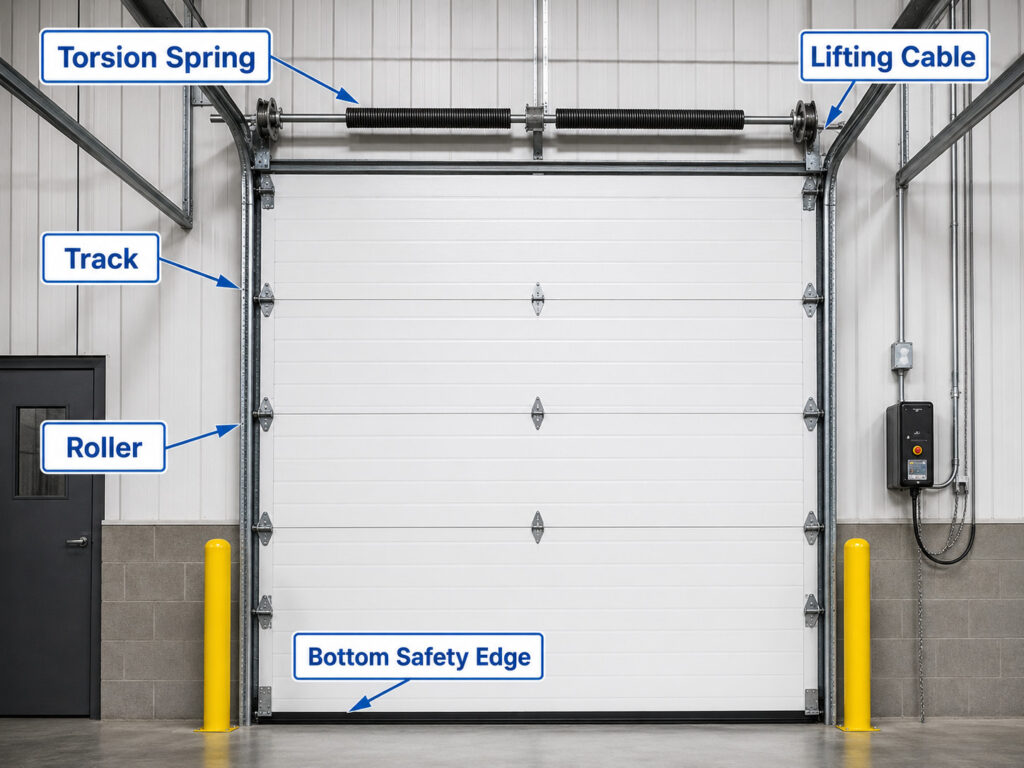
1. Inspect the Lifting Cables
Lifting cables are a critical part of many sectional door counterbalance systems.
They transfer force between the door and the spring or counterbalance system, helping the door move smoothly through the tracks.
During a sectional door inspection, look closely for damaged strands, corrosion, kinks, unusual slack or cables that no longer sit correctly on the drum.
Uneven cable tension can sometimes cause one side of the door to rise faster than the other.
ANSI/DASMA 110-2025 specifically covers lifting cables used as part of sectional door counterbalance systems. It addresses characteristics including cable strength, flexibility, durability and safety for residential, commercial and industrial sectional-type doors.
A damaged lifting cable should not simply be readjusted and returned to service without identifying the cause.
Because cables operate under significant tension, repairs and adjustments should be performed by appropriately trained personnel.
2. Check the Torsion Springs
The torsion spring helps counterbalance the weight of the door.
Without proper spring balance, the motor or manual operator may need to overcome much more of the door’s weight during every operating cycle.
Look for visible spring damage, broken coils, corrosion, unusual gaps or loose mounting components.
Changes in door movement may also indicate a problem.
For example, the door may suddenly become difficult to open, rise unevenly or place noticeably more load on the motor.
Spring systems store considerable mechanical energy. They should not be loosened, dismantled or adjusted by untrained personnel.
Mechanical safety requirements and test methods for industrial, commercial and garage doors are addressed by standards including EN 12604:2017+A1:2020 for products within its scope. BSI currently lists this version as current and under review.
3. Inspect Cable Break Protection
Cable break protection is an important sectional door safety device used on appropriate door configurations.
Its purpose is to reduce the risk of uncontrolled door movement if a lifting cable fails.
During inspection, check whether the device is securely attached and whether there is visible deformation, corrosion or damage around its mounting position.
A safety device should never be removed or intentionally bypassed simply because it interferes with normal door operation.
Repeated activation of a safety mechanism usually means the underlying mechanical problem needs to be investigated.
For industrial buyers, this is also something worth checking before ordering a door.
Ask the manufacturer what protection is provided in the event of lifting-system failure and how that system should be inspected and maintained.
4. Inspect Spring Break Protection
A spring failure can significantly affect the balance of a sectional door.
Depending on the door design, spring break protection may be incorporated to reduce the risk associated with failure of the counterbalance spring.
Check that the mechanism remains firmly installed and has not been damaged, modified or bypassed.
The inspection should also include the surrounding shaft, brackets and mounting hardware.
This is especially important on larger industrial sectional doors because the total moving door weight can be substantial.
The exact safety configuration depends on the door design, applicable standards and intended application, so buyers should confirm the safety system with the manufacturer rather than assuming every sectional door uses the same components.
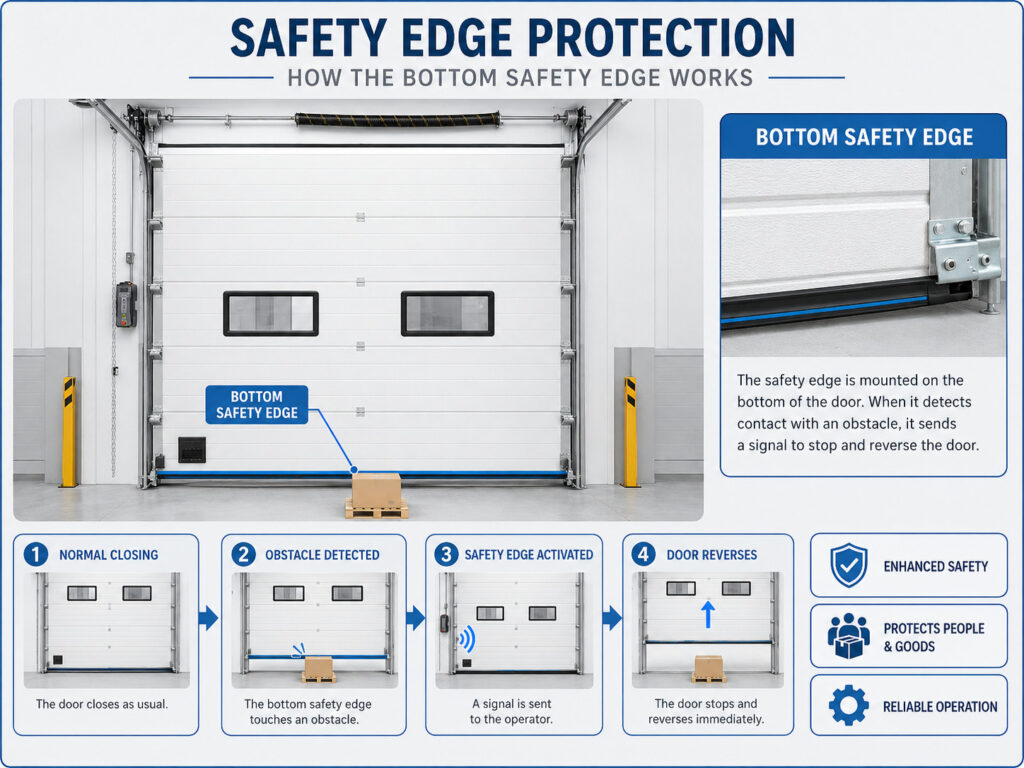
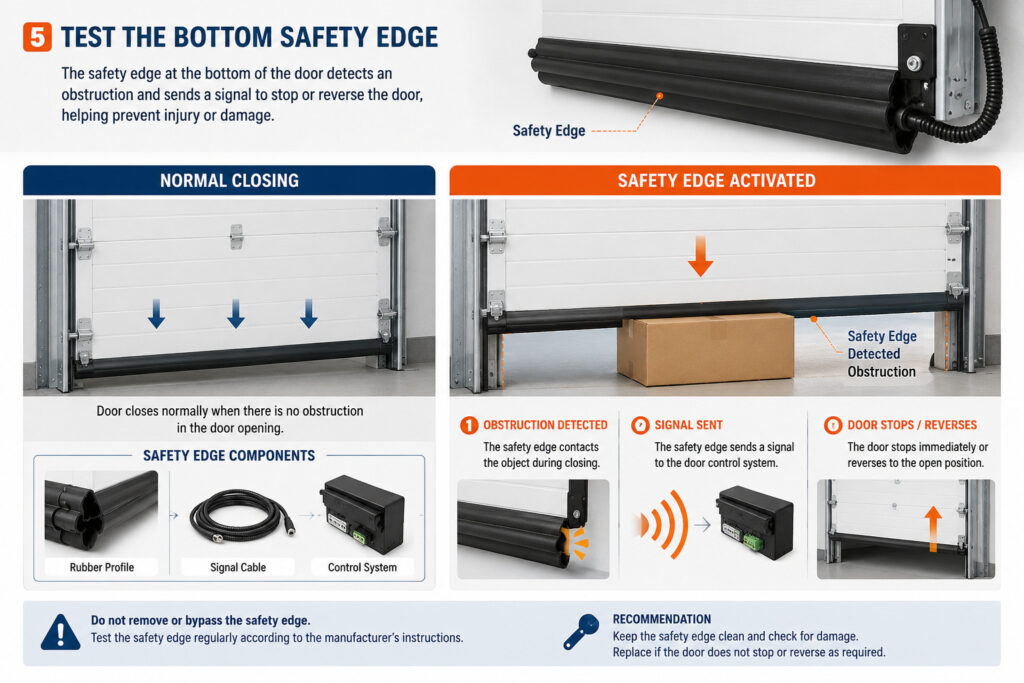
5. Test the Bottom Safety Edge
For many automatic industrial sectional doors, the bottom safety edge forms part of the closing protection system.
When the bottom edge encounters an obstruction, the control system should respond according to the door’s designed safety function.
During sectional door maintenance, check the rubber profile for visible damage and test the device according to the manufacturer’s instructions.
Pay attention to delayed responses, intermittent signals or situations where the door continues closing when the safety system should react.
The condition of the cable or wireless signal system connected to the safety edge should also be checked where applicable.
Visual inspection alone is not enough.
A safety edge can appear undamaged while having an electrical, pneumatic or signal-related fault.
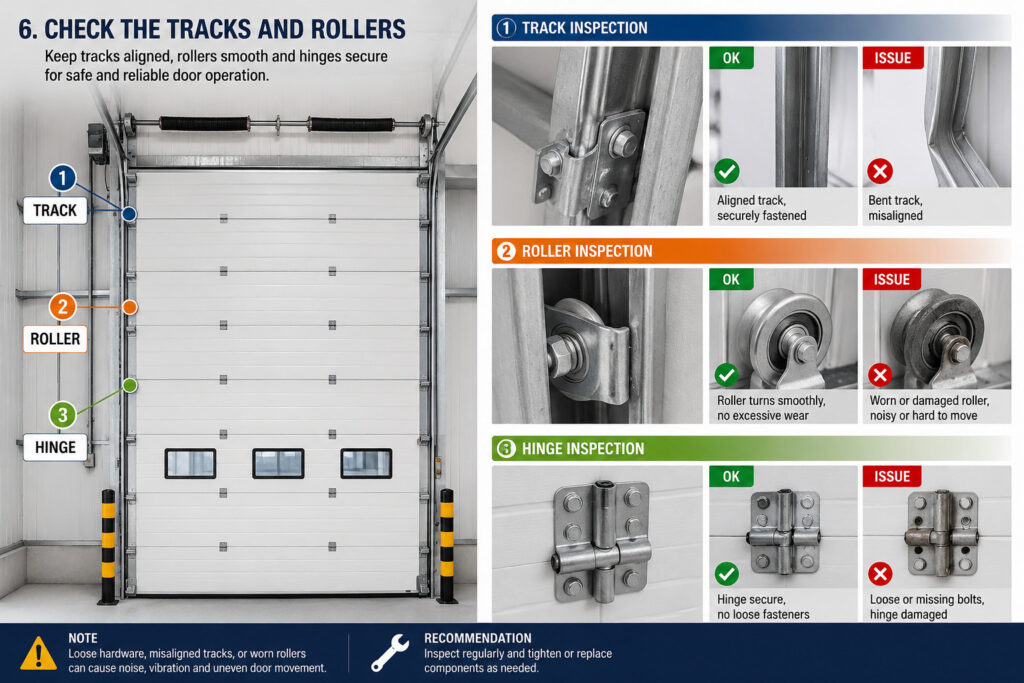
6. Check the Tracks and Rollers
Industrial sectional doors move vertically and then follow their track configuration using a series of rollers.
Problems with the tracks or rollers can result in increased vibration, noise, resistance and uneven door movement.
Look for bent tracks, damaged joints, loose brackets, missing fasteners and rollers that no longer move smoothly.
The gap and alignment between the rollers and tracks should also remain consistent.
A forklift or vehicle impact can cause a track to move even when the damage initially appears minor.
If a roller has left the track, or the track is visibly deformed, the door should not continue normal operation until it has been properly inspected.
DASMA’s current standards library includes ANSI/DASMA 102 for sectional overhead-type doors as well as standards addressing life-cycle performance, structural performance and lifting cables.
7. Inspect Door Panels, Hinges and Fasteners
Sectional door safety also depends on the condition of the door leaf itself.
Inspect the panels for dents, cracks, separation or deformation.
The hinges connecting individual door sections should remain securely mounted, and bolts or other fasteners should not be visibly loose or missing.
This deserves particular attention in factories and logistics facilities where forklifts, pallet trucks and vehicles frequently pass through the opening.
A collision may damage more than the panel surface.
Impact can also affect hinges, rollers, tracks, reinforcement components and the balance of the door.
After a significant vehicle impact, the complete affected door system should be inspected before normal operation resumes.
8. Test the Motor and Control System
Power-operated sectional doors introduce additional safety considerations because movement is controlled electrically rather than solely by the operator.
EN 12453 covers significant hazards associated with the power operation of industrial, commercial and garage doors and includes requirements and testing relating to safety in use.
Operate the door using its normal control method and observe whether movement remains smooth and predictable.
An industrial sectional door may use push buttons, remote controls, pull cords, radar sensors, access control systems or automatic signals from other equipment.
The door should start, stop and respond consistently.
Unusual motor noise, hesitation, unexpected stopping or irregular movement deserves further investigation.
Emergency stopping and manual emergency operation should also be tested according to the manufacturer’s instructions.
9. Test Photocells and Other Protective Sensors
Photocells are commonly used to detect people, vehicles or other obstacles in the door opening.
Their performance can be affected by dirt, incorrect alignment, damaged wiring or physical impact.
During an overhead door inspection, confirm that sensors are securely installed, clean and properly aligned.
Then test whether the door reacts as intended when the detection area is interrupted.
Protective devices should never be intentionally covered or bypassed to prevent unnecessary stops.
If false triggering occurs frequently, the correct solution is to identify the source of the problem.
Modern industrial doors may also use other detection technologies, so maintenance procedures should always follow the specifications of the installed system.
10. Inspect the Door Opening and Floor Area
Not every sectional door safety problem originates inside the door mechanism.
The surrounding operating area matters as well.
Keep pallets, packaging, tools, cables and stored materials away from the door travel path.
The floor underneath the door should also remain reasonably level and free from objects that can interfere with closing.
Inspect the bottom rubber seal and perimeter seals for visible tearing or displacement.
Damaged seals mainly affect airtightness and environmental performance, but badly displaced components can also interfere with normal door movement.
People should avoid remaining unnecessarily underneath a moving door.
Clear operating zones and good traffic management are particularly important at entrances shared by pedestrians and forklifts.
Warning Signs That Require Immediate Attention
A sectional door does not always fail suddenly. Many problems produce warning signs first.
Abnormal noise, shaking, uneven lifting, loose cables, excessive motor effort, rollers leaving the track or inconsistent safety-device operation should all be treated as reasons for further inspection.
A door that suddenly moves differently from its normal operating pattern should not simply be forced to continue working.
The change may indicate wear or damage elsewhere in the system.
This is one reason routine sectional door maintenance is valuable: technicians can compare current operation with the door’s normal condition and detect gradual changes before they become more serious.
How Often Should a Sectional Door Be Inspected?
There is no single inspection interval suitable for every industrial sectional door.
A door operating five times per day does not experience the same mechanical demand as a logistics entrance operating dozens or hundreds of times per day.
Inspection frequency should consider operating cycles, door size, environmental conditions, vehicle traffic, previous damage, component ratings and the manufacturer’s maintenance instructions.
A useful maintenance program usually combines frequent visual checks with scheduled technical inspection.
Facility personnel can monitor visible condition and abnormal operation, while qualified technicians periodically inspect components such as springs, lifting cables, counterbalance systems, motors and safety devices.
Manufacturer instructions should remain the primary reference for inspection and maintenance intervals for the specific door.
Sectional Door Safety Starts Before Installation
Industrial door safety should be considered when selecting the door, not only after installation.
Buyers should compare the complete safety configuration when evaluating different suppliers.
Important questions include whether cable and spring failure protection is provided where applicable, which closing protection devices are included, what safety edge system is used, whether photocells are available, and how emergency operation works.
Operating frequency also matters.
Spring life, motor duty and mechanical component selection should match the expected number of cycles.
The installation environment is equally important.
An internal warehouse door, an external factory entrance and a heavily used logistics door may require different configurations.
For projects in Europe, applicable requirements may involve EN 13241 together with related standards such as EN 12453 and EN 12604, depending on the door type and operating system.
You can also read our guide to EN 13241 requirements for industrial sectional doors for a broader explanation of performance and conformity considerations.
Sectional Door Safety Devices Used by SEPPES
SEPPES industrial sectional doors can be configured with multiple safety components according to the project and door configuration.
Typical protection can include a bottom safety edge, cable break protection, torsion spring break protection and end-position buffering.
Automatic doors can also integrate photocells and different control methods according to the operating environment.
Safety equipment should not be selected independently from the rest of the door.
Door dimensions, weight, operating frequency, control method, traffic type and installation conditions should all be considered together when determining the appropriate configuration.
FAQ
What should be checked during a sectional door safety inspection?
A sectional door inspection should cover lifting cables, torsion springs, safety devices, tracks, rollers, hinges, panels, controls, sensors and the surrounding operating area.
What are the most important sectional door safety devices?
Depending on the door design and application, important devices can include bottom safety edges, cable break protection, spring break protection, photocells and emergency controls.
How often should industrial sectional doors be inspected?
Inspection frequency depends on operating cycles, environment, door size and manufacturer recommendations. Frequently used industrial doors generally require more frequent inspection than lightly used doors.
Can a damaged sectional door still be operated?
If the door has damaged lifting cables, springs, tracks, rollers or malfunctioning safety devices, normal operation should generally stop until the problem has been properly assessed.
Can I adjust a sectional door torsion spring myself?
Torsion springs contain significant stored energy. Spring adjustment or replacement should be carried out by personnel trained to work with the specific counterbalance system.
Why does my sectional door lift unevenly?
Possible causes include cable tension problems, damaged lifting components, track misalignment, roller problems or counterbalance issues. The cause should be inspected before continued operation.
What standard applies to automatic industrial sectional door safety?
EN 12453:2017+A1:2021 specifies safety-in-use requirements and test methods for power-operated industrial, commercial and garage doors and gates within its scope.
What standard covers sectional door lifting cables?
ANSI/DASMA 110-2025 establishes minimum performance specifications for lifting cables used as part of sectional-door counterbalance systems, including strength, durability, flexibility and safety characteristics.
Sectional door safety depends on the condition of the complete system.
Cables, springs, tracks, rollers, panels, safety edges, sensors and controls all contribute to reliable door operation.
Regular inspection helps identify wear, impact damage and abnormal operation before they develop into larger problems.
For industrial buyers, safety should also be part of the purchasing specification. The correct sectional door should be selected according to opening size, operating frequency, traffic conditions, installation environment and required safety configuration.
SEPPES provides customized industrial sectional door solutions for factories, warehouses, workshops and logistics facilities.
Provide your door opening width × height, quantity, application and operating requirements to receive a suitable sectional door configuration.