
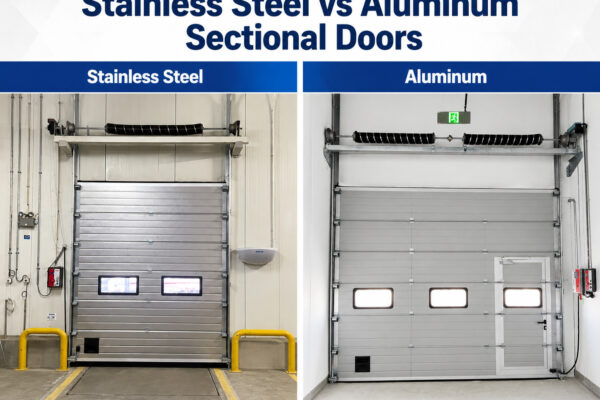
When choosing an industrial sectional door for humid, hygienic, or corrosive environments, stainless steel and aluminum are two common material options.
The main difference is straightforward: stainless steel sectional doors offer higher strength, excellent corrosion resistance, and easier hygienic cleaning, while aluminum sectional doors provide lighter weight, good corrosion resistance, and greater flexibility for large glazed sections.
Stainless steel is particularly suitable for food processing plants, pharmaceutical facilities, cleanrooms, car washes, and other environments where hygiene and corrosion resistance are important.
Aluminum is often preferred for automotive facilities, showrooms, commercial buildings, and applications requiring a lightweight frame or large vision panels.
The right choice depends on the operating environment, door size, insulation requirements, cleaning procedures, and desired appearance.
目录
切换Stainless Steel vs Aluminum Sectional Doors at a Glance
| 特点 | 不锈钢分段门 | 铝合金分段式门 |
|---|---|---|
| 实力 | 优异 | 良好 |
| 重量 | Heavier | Lighter |
| 抗腐蚀能力 | 优异 | 优异 |
| 卫生 | 优异 | 良好 |
| 清洁 | Easy to clean | Easy to maintain |
| 绝缘 | Excellent with insulated sandwich panels | Depends on panel construction |
| 抗冲击性 | 更高 | Lower than stainless steel |
| Large Glass Sections | 可选配 | 优异 |
| Appearance | Clean, industrial, hygienic | Modern and architectural |
| 典型应用 | Food, pharma, cleanrooms, car washes | Showrooms, service centers, commercial facilities |
| 费用 | Usually higher | Depends on frame and glazing |
Actual performance depends on the grade of stainless steel, aluminum profile, panel structure, insulation core, surface treatment, and complete door design.
1. Strength and Durability
One of the most important differences between stainless steel vs aluminum sectional doors is mechanical strength.
Stainless steel generally provides greater strength and impact resistance than aluminum.
This makes a stainless steel sectional door suitable for demanding industrial environments where the door may be exposed to:
- Frequent forklift traffic
- Equipment movement
- Cleaning operations
- Moisture
- Industrial impact risks
- 频繁的日常运行
For factories and production facilities, stainless steel can provide a strong and durable exterior surface while maintaining good resistance to corrosion.
Aluminum is also durable, but it is softer and lighter.
Under significant mechanical impact, aluminum frames or panels may deform more easily than stainless steel.
Therefore, if strength and durability are major priorities, stainless steel is usually the stronger option.
2. Door Weight
Aluminum has a clear advantage when it comes to weight.
Aluminum has a much lower density than stainless steel, which allows manufacturers to create relatively lightweight door frames and glazed sections.
A lighter structure may be useful for:
- Large glazed sectional doors
- Automotive service centers
- Commercial entrances
- Showrooms
- Buildings requiring large vision areas
However, door weight should not be considered independently.
An industrial sectional door operates as a complete system including:
- Door panels
- Torsion springs
- Lifting cables
- Tracks
- Rollers
- 电机
- 安全装置
The spring and drive systems are selected according to the actual door weight.
Therefore, both stainless steel and aluminum sectional doors can operate smoothly when the complete system is correctly engineered.
3. Corrosion Resistance
Both materials provide strong corrosion resistance, but their performance characteristics are different.
不锈钢
Stainless steel contains chromium, which forms a protective passive layer on the surface.
This makes it highly suitable for environments exposed to:
- Water
- Humidity
- Frequent washing
- Cleaning chemicals
- Food production conditions
- Coastal air
Different stainless steel grades can also be selected according to the environment.
例如,, 304 stainless steel is commonly used in industrial and hygienic applications.
More demanding corrosive environments may require a different stainless steel grade depending on project conditions.
铝质
Aluminum also naturally forms a protective oxide layer and provides excellent resistance to normal corrosion.
It performs particularly well in:
- Humid environments
- Commercial buildings
- Automotive facilities
- Exterior applications
- Coastal environments
For many projects, both materials offer good corrosion performance.
The final choice should therefore also consider strength, hygiene, weight, appearance, and cost.
4. Hygiene and Cleaning
This is one of the biggest advantages of a stainless steel sectional door.
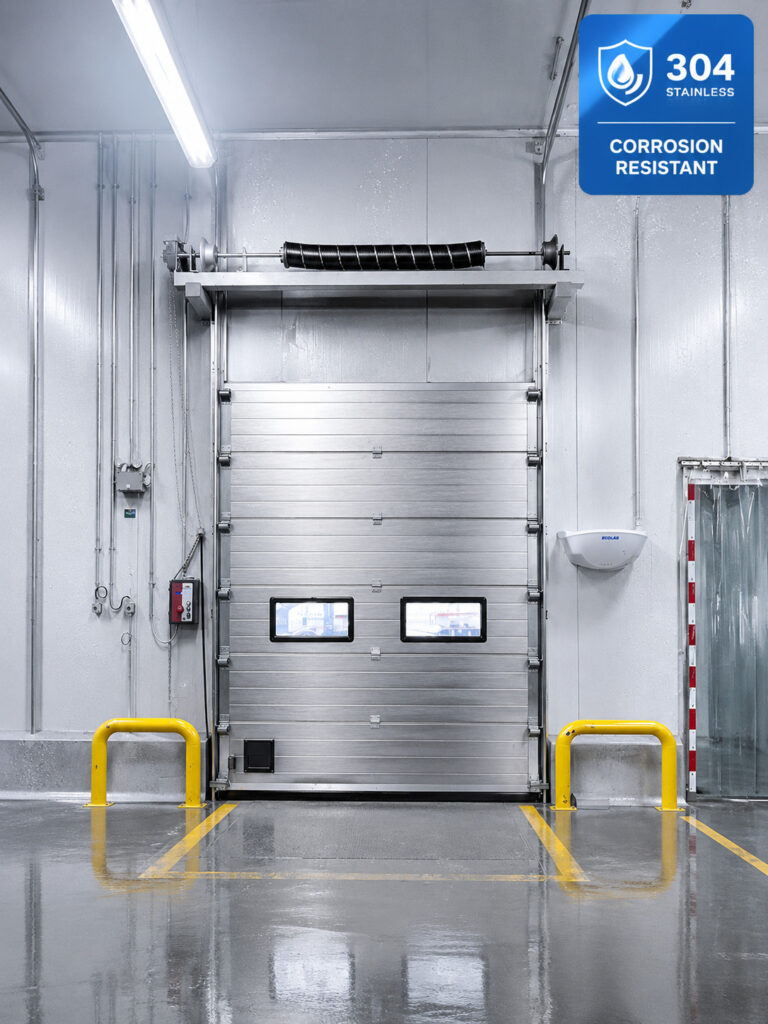
Stainless steel provides a smooth, durable surface that is easy to clean and suitable for environments with strict hygiene requirements.
Typical applications include:
- 食品加工厂
- Meat processing facilities
- Beverage factories
- Pharmaceutical production
- Clean manufacturing areas
- 冷藏设施
- Industrial kitchens
Where doors are regularly washed or exposed to cleaning procedures, stainless steel can provide better long-term surface durability.
For this reason, stainless steel is often selected when hygiene is more important than reducing door weight.
Aluminum is also easy to maintain, but stainless steel is generally preferred in applications where sanitation requirements are particularly high.
5. Thermal Insulation
The external metal does not determine the insulation performance of a sectional door by itself.
For an insulated sectional door, the complete panel construction is more important.
A typical insulated panel may use:
Metal surface + polyurethane foam + metal surface
For stainless steel sectional doors, stainless steel can be used on one or both panel surfaces while polyurethane foam provides the main thermal insulation layer.
Typical panel thicknesses may include:
- 40 mm
- 50 mm
Insulation performance also depends on:
- PU foam density
- Panel joints
- Side seals
- Top seals
- Bottom seals
- 窗户
- Wicket doors
- Installation quality
Therefore, when comparing stainless steel vs aluminum sectional doors, buyers should ask for the complete thermal specification rather than judging insulation only by the exterior material.
6. Glass and Natural Light
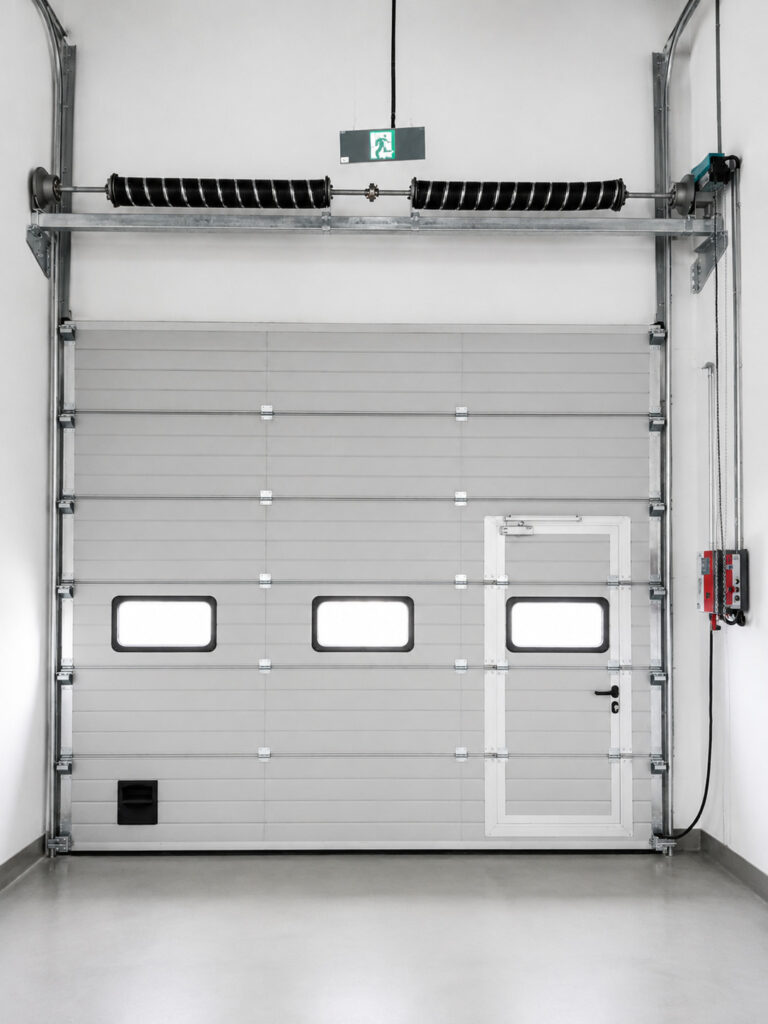
Aluminum has a major advantage when large glazed sections are required.
Aluminum profiles can be used to create a lightweight frame around transparent or translucent panels.
This makes aluminum sectional doors particularly suitable for:
- Automotive dealerships
- Car service centers
- 消防站
- Showrooms
- Exhibition buildings
- Commercial workshops
A full-view aluminum sectional door allows more natural light into the building while maintaining a modern appearance.
Stainless steel sectional doors can also include windows.
However, if the project requires almost the entire door surface to be transparent, an aluminum framed full-view sectional door is usually the more practical solution.
7. Appearance
Stainless steel and aluminum create noticeably different visual styles.
不锈钢
Stainless steel creates a clean and professional industrial appearance.
It is particularly suitable for:
- 食品工厂
- 制药设施
- Clean production areas
- 商用厨房
- Hygienic industrial environments
The metallic surface also visually communicates cleanliness and durability.
铝质
Aluminum offers a lighter and more architectural appearance.
When combined with glass, it is especially suitable for customer-facing buildings.
For example:
Food Processing Facility → Stainless steel is usually more practical.
Automotive Showroom → Aluminum and glass may be more suitable.
The application should determine the material rather than appearance alone.
8. Maintenance Requirements
Both stainless steel and aluminum require relatively little maintenance compared with untreated carbon steel surfaces.
However, the complete sectional door still contains many mechanical components that require regular inspection.
Important maintenance points include:
- Torsion springs
- Lifting cables
- Rollers
- Tracks
- Hinges
- Safety bottom edge
- Seals
- 电机
- 控制系统
Stainless steel surfaces should still be cleaned regularly, particularly in environments exposed to chemicals, salt, grease, or food residue.
Aluminum surfaces should also be inspected for mechanical damage.
In both cases, good maintenance helps extend the service life of the complete door.
9. Which Material Is Better for Food and Pharmaceutical Facilities?
For food processing and pharmaceutical environments, stainless steel sectional doors are usually the stronger choice.
Important reasons include:
- Excellent corrosion resistance
- Easy cleaning
- Smooth hygienic surface
- Resistance to frequent washing
- Good mechanical strength
- Compatibility with insulated panel construction
For many hygienic industrial applications, 304 stainless steel is a common material option.
However, the complete door design should still consider:
- Cleaning frequency
- Cleaning chemicals
- Temperature
- Humidity
- Door opening frequency
- Required insulation
- Environmental corrosion level
Material selection should always be based on actual operating conditions.
10. Which Material Is Better for Car Wash Facilities?
Both stainless steel and aluminum can be suitable for car wash environments because both provide good corrosion resistance.
The final choice depends on the door design.
Stainless Steel May Be Better When:
- Strong mechanical durability is required
- The door is frequently exposed to water
- Cleaning chemicals are present
- Long-term industrial durability is important
Aluminum May Be Better When:
- A lighter structure is preferred
- Large transparent sections are required
- Appearance is important
- Natural light is desirable
For car washes, buyers should also pay attention to other components such as tracks, fasteners, electrical protection, seals, and control systems.
11. Which Material Is Better for Large Industrial Doors?
For large industrial openings, material is only one part of the design.
The manufacturer also needs to consider:
- Opening width
- Opening height
- Door weight
- Wind load
- 工作频率
- Available headroom
- Track configuration
- Building structure
- Motor capacity
Stainless steel provides excellent strength, but it also increases door weight.
Aluminum reduces weight but may require additional structural design for very large openings.
Therefore, large sectional doors should be engineered according to the complete project conditions rather than selecting material based only on size.
When comparing steel vs aluminum sectional doors, there is no single material that is best for every project.
Steel sectional doors are generally the preferred solution for warehouses, factories, logistics facilities, and other demanding industrial applications because they offer a practical combination of strength, insulation, durability, and cost.
Aluminum sectional doors are particularly suitable when corrosion resistance, lighter construction, natural light, or modern appearance is a priority.
Before making a decision, evaluate the door size, installation environment, insulation requirement, headroom, operating frequency, glazing requirement, and building use.
Choosing the correct material at the specification stage can improve long-term door performance while avoiding unnecessary cost.
12. How to Choose Between Stainless Steel and Aluminum
The simplest way to choose is to start with the operating environment.
Choose a Stainless Steel Sectional Door When:
- Hygiene is important
- Frequent washing is required
- The environment is humid
- Corrosion resistance is critical
- Higher mechanical strength is required
- The door is used in food or pharmaceutical production
- A durable industrial surface is preferred
Consider an Aluminum Sectional Door When:
- Lower door weight is important
- Large glass panels are required
- Natural light is important
- A modern appearance is preferred
- The entrance is customer-facing
- Full-view door construction is required
Neither material is automatically better for every project.
The correct option depends on the application.
典型应用
| 应用 | Recommended Material |
| 食品加工厂 | 不锈钢 |
| 制药厂 | 不锈钢 |
| 洁净生产区 | 不锈钢 |
| Car Wash | Stainless Steel / Aluminum |
| Humid Industrial Facility | Stainless Steel / Aluminum |
| Automotive Showroom | 铝质 |
| Vehicle Service Center | 铝质 |
| Fire Station | 铝质 |
| Commercial Building | 铝质 |
| Hygienic Warehouse | 不锈钢 |
These are general recommendations. Actual material selection should be based on project requirements.
What Information Should You Provide Before Ordering?
Before requesting a quotation for an industrial sectional door, prepare the following information:
| Information | Example |
| Opening Width | 4000 mm |
| Opening Height | 4500 mm |
| 数量 | 3 doors |
| Headroom | 1200 mm |
| 应用 | 食品加工厂 |
| Environment | Humid / Frequent Cleaning |
| Panel Requirement | 保温门 |
| 材料 | Stainless Steel / Aluminum |
| Window Requirement | Yes / No |
| 开启方式 | Push Button / Remote / Radar |
| Installation Country | UAE |
If you are unsure which material is suitable, provide the operating environment and application first.
The manufacturer can then recommend the appropriate door configuration.
When comparing stainless steel vs aluminum sectional doors, the best material depends on the environment and application.
Stainless steel sectional doors are particularly suitable for food processing, pharmaceutical manufacturing, clean production, car washes, and other humid or hygienic environments where corrosion resistance, easy cleaning, and durability are important.
Aluminum sectional doors are better suited to projects where lightweight construction, large glass panels, natural light, and architectural appearance are priorities.
Before choosing a material, evaluate the door size, operating environment, hygiene requirements, corrosion exposure, insulation requirements, glazing needs, and operating frequency.
Selecting the correct material at the specification stage can improve long-term door performance and reduce unnecessary maintenance costs.