

冷蔵倉庫の建設は、食品、医薬品、温度管理物流ネットワークがより大規模かつ高度化するにつれて変化している。.
最新の事例の一つはDHLによるものである。.
2026年 9月4日、DHLは シンガポールのライフサイエンスおよびヘルスケア物流インフラへの追加投資を発表した。計画中のシンガポール・コールドチェーン・ハブは、専用の 2°C~8°Cおよび15°C~25°C環境を備えた3,047 m²の温度管理スペースを提供する. 。DHLによると、この施設は途切れないコールドチェーンを支え、医薬品、ワクチン、バイオロジクスの温度逸脱を最小限に抑えることを目的としている。2027年後半の稼働開始が予定されている。.
この投資は、すべての冷蔵倉庫が直面するより広範な課題を示している。
温度管理は貯蔵室で止まるものではない。.
荷役ドックは、冷蔵された室内空気が屋外空気、トラック、フォークリフト、および変化する気象条件と繰り返し接する場所である。.
このインターフェースの設計が不十分な場合、効率的な冷凍システムであっても、荷役扉から流入する暖かく湿った空気を継続的に補償しなければならない。.
このため、エネルギー効率の高い冷蔵倉庫の荷役ドックは、完全なシステムとして設計されるべきである。
産業用ドア+ドックシェルター+ドックレベラー+制御システム
単に冷蔵室の前にドックレベラーを設置するだけではない。.
目次
トグル冷蔵倉庫建設において荷役ドックが重要な理由
従来の倉庫の荷役ドックは、主に安全で効率的な製品の移動を支える必要があります。.
冷蔵倉庫には別の要件があります:
温度境界を維持することです。.
荷役扉が開くたびに、温度差と空気密度の違いにより、暖かい外気が流入し、冷たい室内空気が流出します。.
ASHRAEは 浸入空気および関連設備からの熱取得が、 冷凍負荷全体の半分以上 を占める可能性があると指摘しています。.
これは、荷役ドックのエネルギー効率が些細な建築的詳細ではないことを意味します。.
それは以下に直接影響を与える可能性があります:
- 冷凍需要;;
- 温度安定性;;
- 湿気の浸入;;
- 霜および氷の形成;;
- 製品の完全性;;
- 従業員の安全;;
- 運用コスト。.
屋内と屋外の環境間の温度差が大きいほど、空気浸入の制御がより重要になります。.
冷蔵倉庫の荷役ドックにおける3つの最大の問題
荷役ドックのエネルギーの問題のほとんどは、密接に関連する3つの問題に起因します。.
1. 温度損失
外気温が30°C以上の夏に、-20°Cで稼働する冷凍庫を想像してください。.
荷役扉が開いているたびに、冷凍システムは空気交換によって生じる熱負荷に対処しなければなりません。.
ASHRAEは、外気温、ドック温度、扉の開閉頻度と時間、荷役ドックシールの有効性、トラックの荷積み完了後に従業員が速やかに扉を閉めるかどうかなど、冷蔵荷役ドックの冷却負荷に影響するいくつかの要因を特定しています。.
これは、単に厚い断熱壁を設置するだけでは問題全体を解決できないことを意味します。.
荷役扉が不必要に開いたままであると、建物の外皮に大きな熱的開口部が残ります。.
2. 結露、湿気、氷
暖かい外気は通常、冷たい倉庫内の空気よりも多くの水分を含んでいます。.
湿った空気が冷蔵環境に入り冷却されると、水分が凝縮する可能性があります。.
より低い温度では、霜や氷になる可能性があります。.
これは以下に影響を与える可能性があります:
- 床;;
- 扉;;
- ドックレベラー;;
- 蒸発器;;
- 製品表面;;
- 倉庫構造。.
英国安全衛生庁(HSE)のケーススタディは、 頻繁に損傷を受けた扉が長時間開いたままになっていた冷凍食品施設について述べています。湿った空気が冷蔵庫に入り、氷が形成され、従業員が滑って事故に遭い、施設は繰り返し除霜を必要としました。.
したがって、結露はエネルギーの問題だけではありません。.
倉庫の安全とメンテナンスの問題にもなり得ます。.
3. 冷凍エネルギー消費の増大
冷蔵空間に入るすべての熱は、最終的に除去されなければなりません。.
それには冷凍能力が必要です。.
米国エネルギー省は、 高速開閉扉を 冷蔵倉庫における空気浸入を低減できる技術の一つとして特定しています。.
これが扉の速度、シール性、動作ロジックが重要である理由です。.
不必要に60秒間開く荷役扉は、荷役経路の準備ができたときだけ開く扉とはまったく異なる熱的状態を生み出します。.
ドックシェルターから始める:トラックと建物を密閉する
冷蔵施設にとって、ドックシェルターは荷役ベイの最も重要な構成要素の一つです。.
その目的は、以下との間の露出した隙間を減らすことです:
Truck body ↔ Building opening
when a vehicle is positioned at the dock.
Without suitable sealing, outdoor air can travel around the sides and top of the trailer.
ASHRAE specifically identifies the efficiency of loading dock door seals as one of the factors affecting refrigerated dock load and recommends avoiding gaps, including gaps beneath the leveling plate between the truck and dock.
A dock shelter can also help protect the loading area from:
- rain;
- wind;
- snow;
- external debris.
However, the correct shelter depends on the vehicles using the facility.
Buyers should consider:
- トレーラー幅;;
- trailer height;
- vehicle variation;
- docking frequency;
- building opening dimensions;
- required compression;
- operating temperature.
A shelter that seals one truck perfectly but performs poorly with the rest of the fleet will not provide consistent results.
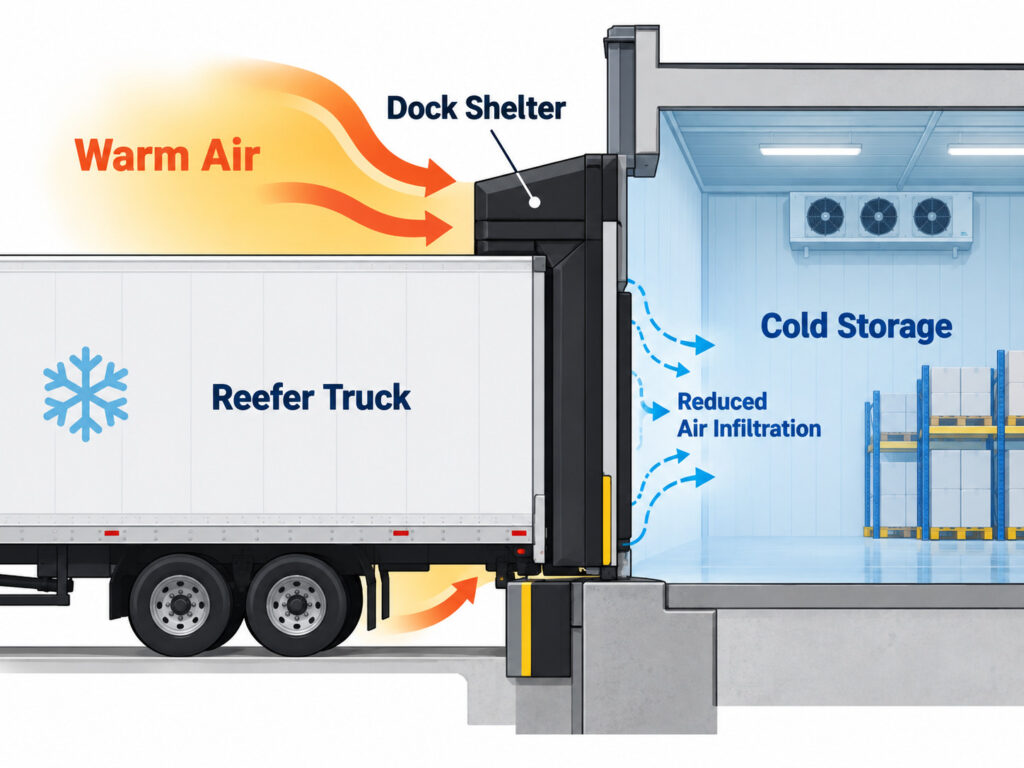
ドックシェルター対ドックシール:冷蔵倉庫にはどちらが適しているか?
Although the terms are sometimes used together, dock shelters and dock seals are not exactly the same.
A dock seal typically uses compressible pads around the opening to create contact with the trailer.
A dock shelter generally uses curtains or flexible panels that surround the trailer while allowing greater variation in vehicle dimensions.
For cold storage warehouse construction, the correct choice depends less on which product name sounds better and more on:
how effectively the system seals the actual vehicle fleet.
Facilities receiving highly consistent trailers may use a different sealing configuration from third-party logistics warehouses receiving many truck sizes.
The primary objective should be:
reduce uncontrolled air exchange without interfering with safe vehicle docking and loading.
適切な産業用ドアを選ぶ
The next thermal boundary is the industrial door.
For refrigerated warehouse applications, two characteristics are particularly important:
断熱 そして opening time.
These requirements can sometimes conflict.
A thick insulated sectional door may provide strong thermal separation when closed.
A high speed door can minimize how long the opening remains exposed during frequent traffic.
The correct solution therefore depends on how the loading bay operates.
断熱産業用ドアが合理的な場合
An insulated sectional door may be suitable where:
- thermal insulation is important;
- loading cycles are moderate;
- the exterior opening needs good sealing;
- the door remains closed for significant periods.
For loading docks that remain unused for long periods, reducing heat transfer while the door is closed becomes particularly important.
高速ドアが価値を持つ場合
High speed doors are particularly useful where forklifts or material-handling vehicles pass frequently between temperature zones.
Their major advantage is not simply opening faster.
It is reducing the amount of time the opening is exposed.
例えば:
Slow Door
Open
↓
Forklift waits
↓
Loading
↓
Door remains open
↓
More air exchange
versus:
High Speed Door
Vehicle detected
↓
Fast opening
↓
Vehicle passes
↓
Fast closing
↓
Shorter exposure time
In high-frequency refrigerated warehouse operations, this can become an important part of air-infiltration control.
The operating environment still needs to be considered carefully because cold conditions can introduce frost, condensation and heating requirements for certain door components.
ドックレベラーも熱境界の一部である
The dock leveler is normally discussed in terms of:
- capacity;
- platform size;
- truck-bed height;
- forklift traffic.
But in a refrigerated loading dock, it can also influence sealing.
ASHRAE specifically advises refrigerated-facility designers to avoid gaps beneath the leveling plate between the truck and dock.
This is important because the opening around or below a poorly sealed dock leveler can create another route for air infiltration.
Therefore, selecting a dock leveler for cold storage requires consideration of both:
material handling
そして
temperature separation.
冷蔵倉庫用ドックレベラーの選定方法
Start with the vehicle range.
Determine:
- トラック荷台の最低高さ;
- トラック荷台の最高高さ;
- dock height;
- trailer dimensions.
Then confirm the material-handling load:
- フォークリフト重量;;
- maximum cargo;
- 稼働頻度;;
- wheel loads;
- AGV specifications where applicable.
The platform must provide an appropriate transition between the warehouse floor and trailer while handling the intended operating load.
For refrigerated warehouses, also evaluate:
- sealing around the pit;
- gaps beneath the platform;
- moisture exposure;
- drainage;
- corrosion conditions;
- maintenance accessibility.
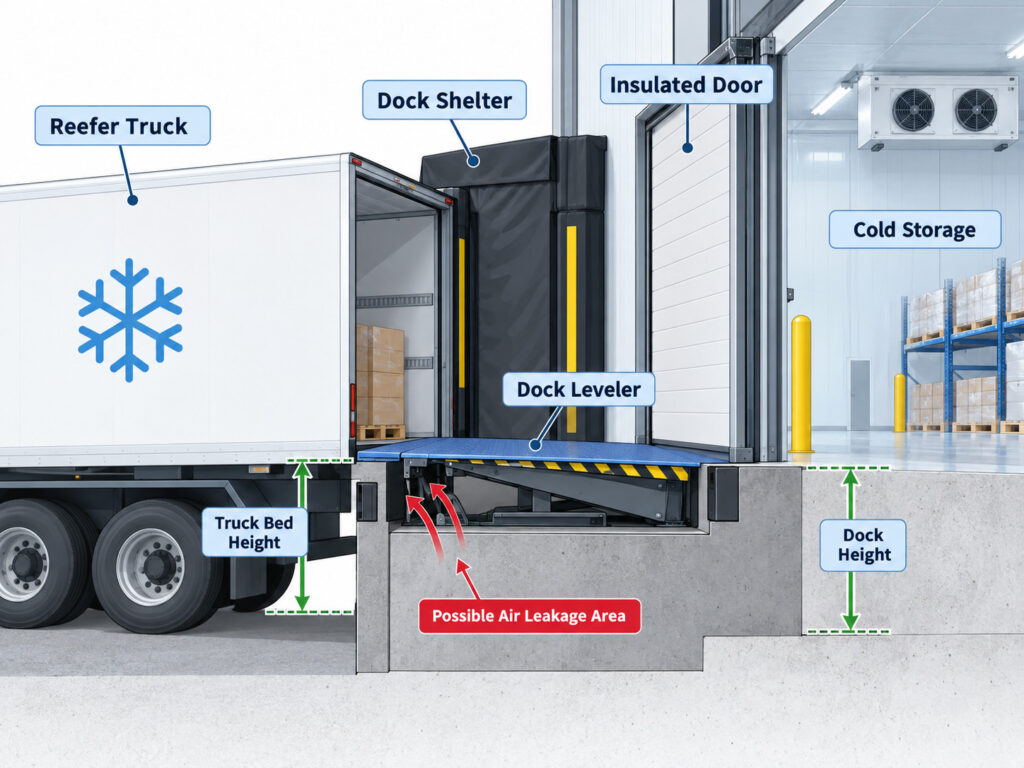
扉の開放時間がこれほど重要な理由
An important design variable is surprisingly simple:
How long is the loading opening actually exposed?
ASHRAE’s refrigerated-facility guidance treats door-opening frequency and duration as important components of dock refrigeration load.
Therefore, energy efficiency is not only an equipment-selection issue.
It is also an operating-sequence issue.
Consider this loading process:
Truck arrives.
↓
Door opens.
↓
Operator prepares the dock.
↓
Dock leveler deploys.
↓
Forklift starts loading.
The door may already have been open for a considerable period before actual material movement starts.
A better sequence can be:
Truck correctly positioned.
↓
Dock status confirmed.
↓
Door opens.
↓
Dock leveler deploys.
↓
Loading begins immediately.
↓
Leveler returns.
↓
Door closes.
目的は単純です:
do not expose the refrigerated space before it is necessary.
ドアとドックレベラーの統合
This is where warehouse loading dock equipment can move beyond standalone products.
An industrial door and dock leveler can be configured with interlocking logic so that specific operations occur in the correct sequence.
例えば:
トラック準備完了
↓
Door Open
↓
Dock Leveler Deploy
↓
Loading Allowed
↓
Loading Complete
↓
Dock Leveler Stored
↓
Door Closed
Depending on the project, sensors or control signals can also be used to confirm equipment status.
これは特に以下の場合に有用です:
- large distribution centers;
- pharmaceutical warehouses;
- automated warehouses;
- facilities with many loading bays;
- high-frequency cold storage operations.
The purpose is not automation for its own sake.
It is to reduce unnecessary open-door time while maintaining a controlled loading process.
冷蔵ドックが冷凍機の負荷を軽減できる理由
Some large cold storage facilities use a refrigerated loading dock or temperature-controlled staging area rather than allowing the freezer itself to open directly toward ambient outdoor conditions.
The concept is similar to an airlock.
Instead of:
Outdoor 30°C → Freezer -20°C
the transition becomes:
Outdoor → Refrigerated Dock → Freezer
ASHRAEは describes refrigerated dock arrangements as a way to reduce infiltration into freezer areas. Its meat-products guidance estimates that, under the example conditions discussed, a refrigerated dock can substantially reduce the infiltration load imposed directly on the freezer.
This does not mean every warehouse should build a refrigerated dock.
The additional refrigeration, construction cost and space requirements must be evaluated.
But for high-throughput freezer warehouses, it is an important design option.
医薬品コールドチェーンがリスクを高める
Energy efficiency is important in food logistics.
For pharmaceuticals, temperature excursions can also directly threaten product integrity.
DHL’s September 2026 Singapore announcement highlights this challenge. The company’s planned Coldchain Hub will provide dedicated 2°C–8°C and 15°C–25°C handling environments for temperature-sensitive healthcare products and is designed to reduce exposure during transfers.
DHL’s existing Singapore Pharma Hub also uses temperature-controlled infrastructure, including airtight loading docks and dedicated anterooms, to support temperature stability throughout the logistics process.
This provides a useful lesson beyond pharmaceutical logistics:
The loading interface itself must be considered part of cold-chain integrity.
Cold storage facilities cannot rely only on refrigeration capacity inside the building.
The handoff between:
truck → dock → warehouse
also needs to be controlled.
結露制御は後処理ではなく設計すべきものである
A common mistake is treating condensation or frost as a maintenance issue after the warehouse begins operation.
It should be addressed during design.
Key factors include:
- air leakage;
- humidity;
- temperature differences;
- doorway exposure time;
- drainage;
- door sealing;
- traffic frequency.
Where warm and humid air continuously enters a freezer loading area, ice can form repeatedly even if employees remove it.
That means the cause is not simply:
“the floor needs cleaning.”
The cause may be uncontrolled moisture infiltration.
The long-term solution may require changes to:
- door operation;
- dock sealing;
- traffic flow;
- humidity control;
- loading procedures.
エネルギー効率の高い冷蔵倉庫荷役ドックのための8つの設計チェック項目
Before finalizing cold storage warehouse construction, buyers and designers should check the complete loading interface.
| Design Check | 重要性 |
|---|---|
| トラック寸法 | Determines shelter/seal compatibility |
| ドック高さ | Influences dock leveler operating range |
| トラック荷台高さ範囲 | Determines platform angle and leveler selection |
| Door insulation | Reduces heat transfer while closed |
| ドア速度 | Reduces exposure during frequent traffic |
| Dock shelter/seal | Reduces air leakage around the truck |
| Dock leveler sealing | Helps control leakage around the pit/platform |
| Control sequence | Reduces unnecessary door-open time |
For cold storage projects, I would add three more questions:
1日に何回の荷役サイクルが発生するか?
Twenty truck movements and two hundred truck movements require very different operating strategies.
各荷役扉はどのくらいの時間開放されたままになるか?
Door-open duration may matter as much as the nominal insulation performance of the door.
冷蔵室は直接外気条件に開放されているか?
For high-temperature differences or sensitive products, a staging room, anteroom or refrigerated dock may deserve consideration.
冷蔵倉庫荷役ドック設計のよくあるミス
ミス1:まずドックレベラーを購入すること
The platform cannot be properly selected without understanding:
- trucks;
- dock height;
- building pit;
- フォークリフト;;
- sealing;
- door configuration.
Treat the dock leveler as part of the complete loading bay.
ミス2:車両のばらつきを無視すること
A dock shelter must work with actual trailers.
If vehicles have large differences in width and height, the sealing system needs sufficient flexibility.
ミス3:扉の断熱のみに注目すること
A highly insulated door is useful when closed.
But if operational delays leave it open for long periods, air infiltration can still become substantial.
ミス4:荷役ベイ周囲に隙間を残すこと
確認事項:
- top of trailer;
- trailer sides;
- dock leveler;
- pit;
- threshold;
- door seals.
Even relatively small leakage areas can matter in refrigerated facilities with large temperature differences. ASHRAE notes that leakage around truck loading doors can remain significant even at well-maintained docks.
ミス5:結露を清掃問題としてのみ扱うこと
Repeated ice formation often indicates moisture entering the cold environment.
Removing the ice without reducing infiltration addresses the symptom rather than the cause.
効率的な冷蔵倉庫荷役ベイとはどのようなものか?
A practical system may look like this:
REFRIGERATED TRUCK
        ↓
DOCK SHELTER / DOCK SEAL
        ↓
HYDRAULIC DOCK LEVELER
        ↓
INSULATED INDUSTRIAL DOOR
        ↓
HIGH SPEED TEMPERATURE-ZONE DOOR
        ↓
COLD STORAGE WAREHOUSE
The control layer can then connect:
Vehicle Detection
        ↓
Door Status
        ↓
Dock Leveler Status
        ↓
Loading Permission
        ↓
Automatic Closing
The exact arrangement depends on the facility.
A pharmaceutical cold room, frozen-food warehouse and fresh-produce distribution center may all require different temperatures, traffic patterns and equipment configurations.
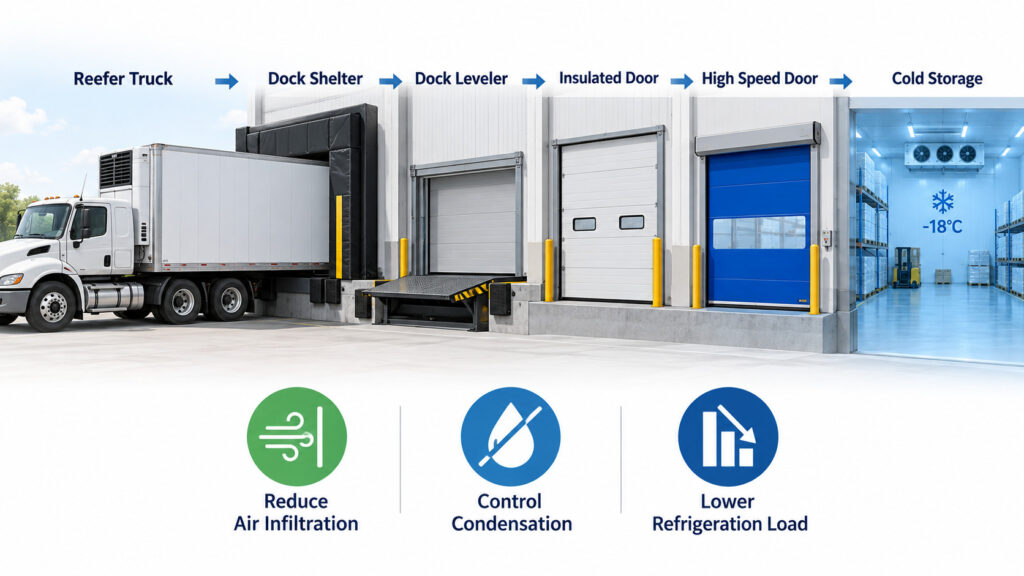
設備購入前にエネルギー効率を評価する方法
Do not evaluate products only by individual specifications.
例えば:
Door U-value
Dock leveler capacity
Shelter dimensions
are useful, but they do not tell you how the complete loading bay will perform.
Instead, evaluate the system around three questions.
1. 荷役ベイの密閉性はどの程度か?
Review the interfaces between:
Truck + Shelter + Door + Dock Leveler
2. 温度境界はどのくらいの時間開放されているか?
確認事項:
- detection method;
- opening speed;
- forklift waiting;
- loading sequence;
- automatic closing delay.
3. 荷役サイクルはどのくらいの頻度で発生するか?
Small thermal losses become significant when repeated hundreds of times every day.
For large projects, the refrigeration engineer should calculate the actual load rather than relying on a generic percentage.
SEPPESによる統合型冷蔵倉庫荷役ベイの構築
Cold storage loading equipment performs best when the individual products are selected around the same operating process.
セッペス can configure loading bay systems using equipment such as:
- 油圧式ドックレベラー;
- ドックシェルター;
- 工業用セクショナルドア;
- 高速ドア;
- cold-storage doors;
- activation and control systems.
For cold-storage applications, the engineering stage should consider truck dimensions, dock height, forklift or AGV traffic, loading frequency, temperature conditions and required control logic.
For projects involving automatic operation, the industrial door and dock leveler can also be evaluated as part of a coordinated loading sequence rather than as completely independent equipment.
When requesting a solution, provide:
- loading bay opening size;
- dock height;
- トラックベッドの高さ範囲;;
- vehicle dimensions;
- フォークリフトまたはAGVの仕様;;
- required capacity;
- warehouse temperature;
- outside design conditions;
- daily loading frequency;
- number of loading bays.
This makes it possible to design the dock around the actual operating environment.
よくある質問
冷蔵倉庫の荷役ドックはなぜこれほど多くのエネルギーを失うのか?
The main reason is usually air infiltration. Opening a loading door connects warm, humid outdoor air with a much colder indoor environment. Door-open frequency, duration, sealing quality and temperature difference all influence the resulting refrigeration load.
ドックシェルターは冷蔵倉庫のエネルギー効率をどのように改善するか?
A dock shelter helps reduce the open space between the truck and building, limiting uncontrolled outdoor air entering around the trailer. The effectiveness depends on vehicle dimensions, sealing condition and correct installation.
高速ドアは冷蔵倉庫で有用か?
Yes, particularly in high-traffic applications. Their fast opening and closing can reduce doorway exposure time and therefore help limit air infiltration. The U.S. Department of Energy identifies fast-acting doors as an energy-saving measure for refrigerated warehouses.
ドックレベラーは冷蔵倉庫の効率に影響を与えますか?
It can. In addition to providing a safe transition between the warehouse and truck, gaps around or beneath the dock leveler can create paths for air infiltration. ASHRAE recommends paying attention to gaps beneath leveling plates in refrigerated dock design.
医薬品コールドチェーン施設では、どのような温度範囲が一般的ですか?
Requirements depend on the product. DHL’s current healthcare logistics materials identify common ranges including chilled 2°C–8°C and controlled room temperature 15°C–25°C, with some healthcare products requiring frozen, deep-frozen or cryogenic environments.
すべての冷凍倉庫に冷蔵荷役ドックを設置すべきですか?
No. It depends on throughput, climate, temperature difference, product sensitivity and project economics. High-volume facilities may benefit from a refrigerated dock or temperature-controlled staging area, but the actual refrigeration load and investment should be evaluated by the project engineer.