ロボット中心型倉庫向け自動高速ドア

At 2:00 a.m., a robot-centric warehouse is still receiving pallets, feeding conveyors, and moving inventory. An AMR approaches a doorway, but no operator is waiting. Automatic high speed doors must recognize the request, open completely, confirm clearance, and close after the vehicle passes. The doorway then becomes part of automated material flow instead of a recurring delay.

automatic high speed doors for robot-centric warehouses

Robotic facilities depend on repeatable travel times. A slow or unreliable door creates AMR queues, interrupts conveyor timing, and forces the warehouse control system to calculate another route. Automatic high speed doors reduce these interruptions by opening only for authorized traffic and closing immediately after the load clears.

The door becomes a checkpoint between storage areas, production cells, conveyors, and temperature zones. Growing robot adoption means that infrastructure must support automated movement. The International Federation of Robotics documents this continued expansion through its World Robotics reporting.

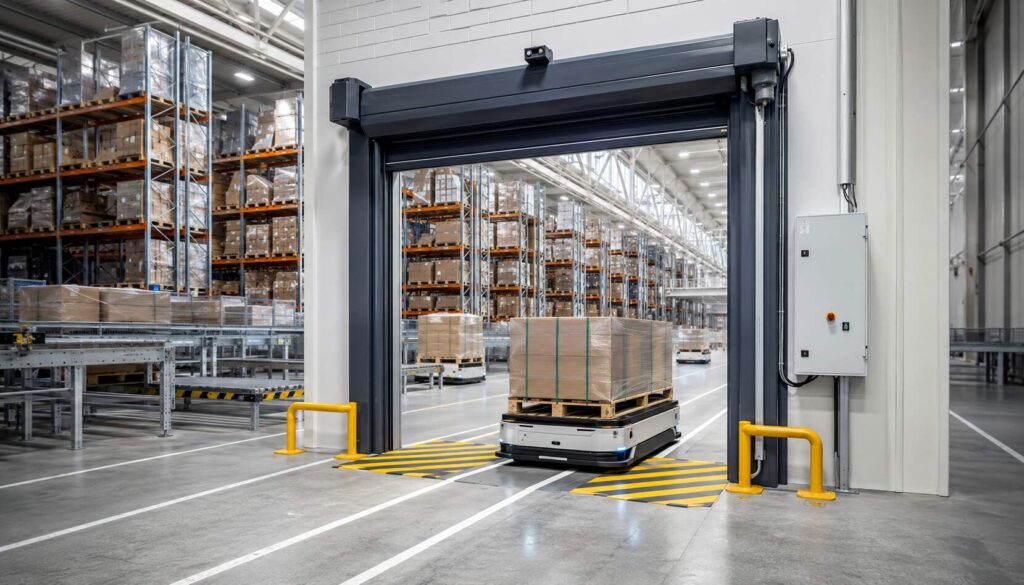
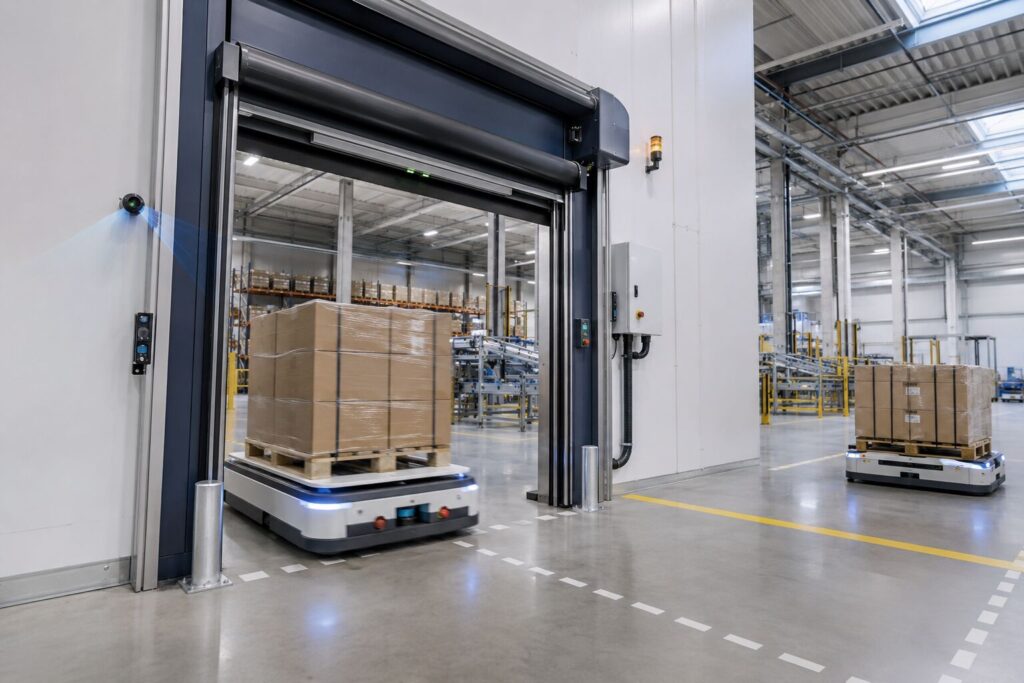
automatic high speed doors opening for AMR traffic

How Automatic High Speed Doors Communicate with AMRs and PLCs

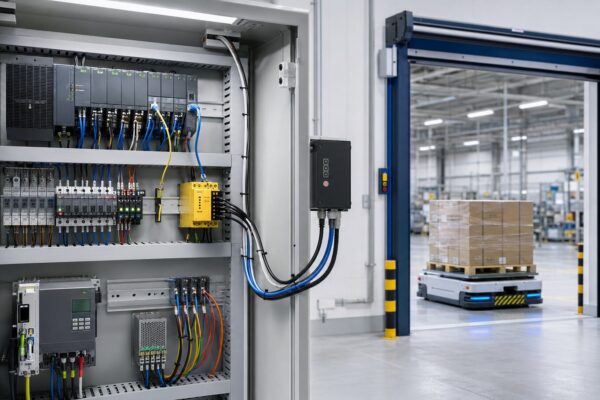
Automatic high speed doors can receive requests through a PLC, digital input, RFID reader, radar, or warehouse control system. The controller starts opening, but the traffic system should release the AMR only after receiving confirmation that the door is fully open.

Photoelectric sensors monitor passage. After the robot and its load leave the protection zone, automatic high speed doors close and report position. This handshake prevents entry through a partially opened doorway and blocks conflicting traffic from the opposite direction.

Selecting PVC or Rigid Automatic High Speed Doors

PVC high speed roll up doors suit interior robot routes. Lightweight reinforced curtains support rapid cycles, while compact frames fit around conveyors and narrow openings. A self-repairing curtain is useful where minor contact may occur because it can return to its guides and reduce interruptions.

剛性 high speed spiral doors suit exterior openings, secure areas, and conditioned zones requiring insulation or wind resistance. Insulated panels move through a non-contact spiral track, combining fast travel with environmental separation. A facility may use flexible automatic high speed doors inside and rigid models externally.

Safety Controls for Automatic High Speed Doors

Robots require predictable doorway states. Automatic high speed doors can combine light curtains, photoelectric sensors, radar activation, monitored bottom edges, warning lights, and position feedback. Activation sensors request opening, while safety sensors protect the passage.

The detection field must cover the vehicle and its load. If a pallet projects beyond an AMR, sensors should keep the automated high speed door open until it clears. Interlocking can prevent simultaneous openings where traffic, contamination control, or pressure management creates risk.

OSHA notes that poorly integrated automation can introduce struck-by and caught-between hazards. Its warehouse hazards and solutions guidance supports facility safety planning.

Faster Robotic Flow and Better Environmental Control

Speed is not only about robot journeys. Every open second allows air, dust, insects, or odors to move between zones. Automatic high speed doors shorten exposure time while keeping robotic routes available.

Engineers can adjust activation distance, hold-open time, closing delay, and sensor zones according to AMR speed and load length. Correct settings create smooth movement without leaving industrial high speed roll up doors open unnecessarily.

Preventing Door Downtime During Unattended Operation

A lights-out warehouse cannot depend on constant human attention. Automatic high speed doors should report open, closed, moving, stopped, and fault states. If a door misses its expected position, the system can pause the route and redirect robots before congestion spreads.

Cycle counts and fault histories support preventive maintenance. Manual release, emergency opening, remote diagnosis, and recovery procedures should be established before unattended operation. Self-repairing PVC curtains reduce disruption after light impacts, while rigid high speed industrial doors protect exposed openings.

Why Choose SEPPES Automatic High Speed Doors

SEPPES configures automatic high speed doors around the operating scenario. Engineering inputs include doorway dimensions, robot size, maximum load, daily cycles, direction, environmental conditions, mounting space, safety zones, and control interface.

Available configurations include reinforced PVC curtains, self-repairing structures, insulated panels, galvanized or stainless steel frames, servo drives, radar, light curtains, and photoelectric protection. SEPPES provides drawings, wiring information, installation guidance, and remote support through its high speed door range.

Automatic High Speed Doors FAQ

Can Automatic High Speed Doors Connect Directly with AMRs?

Yes. A PLC, digital signal, RFID reader, radar, or gateway can request opening. Position feedback should confirm that automatic high speed doors are fully open before the AMR enters.

Which High Speed Door Is Best for Indoor Robot Traffic?

A PVC high speed roll up door suits indoor routes through fast cycling, compact installation, and self-repair. A rigid spiral door is better when insulation, security, durability, or wind resistance is required.

What Happens When an Automatic High Speed Door Develops a Fault?

The controller should report the fault, prevent unsafe entry, and allow traffic redirection. Remote diagnosis, manual operation, and a recovery process help restore movement without a wider stoppage.

Build Automatic High Speed Doors into the Robotic Workflow

Automatic high speed doors perform best when designed with robot routes and control logic. Share AMR dimensions, maximum load, approach speed, PLC interface, safety requirements, cycles, and environmental conditions with SEPPES. The entrance can then become a reliable part of the robotic workflow.

コメントを残す

メールアドレスが公開されることはありません。 が付いている欄は必須項目です

トップに戻る