
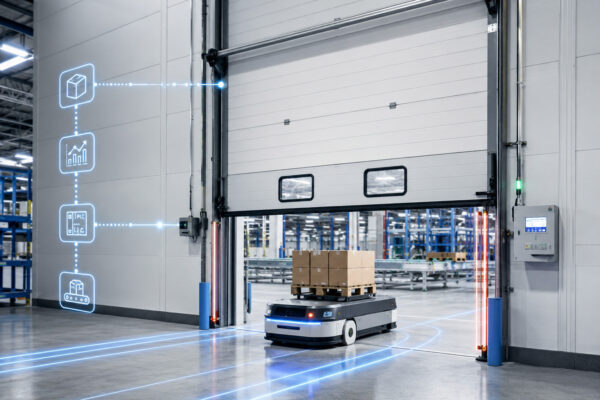
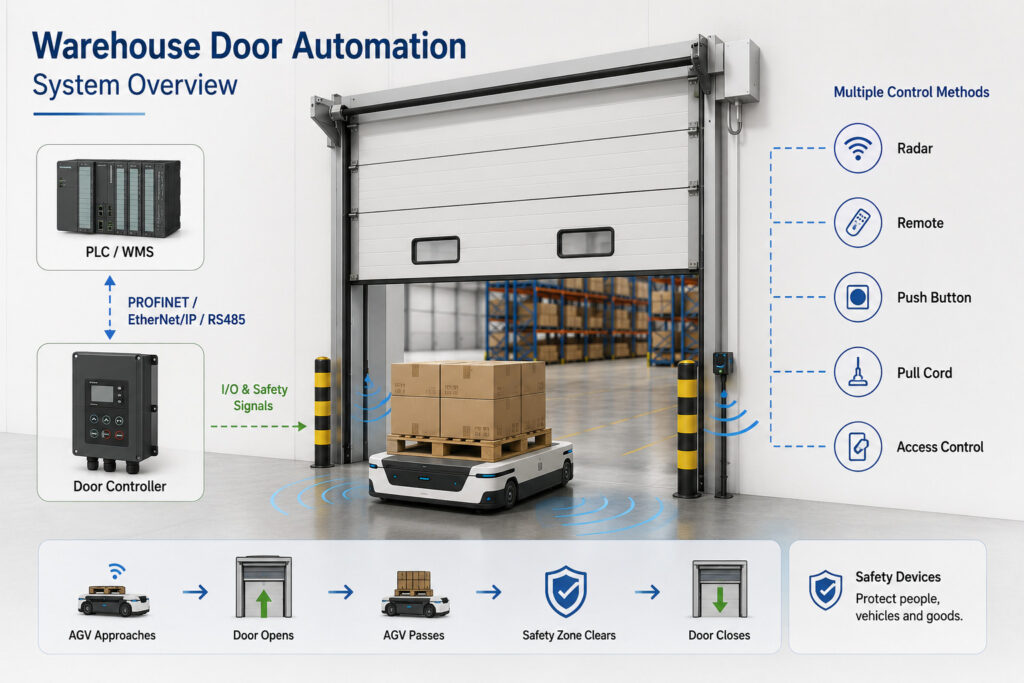
Warehouse door automation allows industrial sectional doors to operate as part of an automated logistics system instead of functioning as standalone equipment.
In a traditional warehouse, an operator presses a button or uses a remote control to open the door. In an automated facility, the opening command can come from an AGV, PLC, sensor, RFID system or other warehouse control equipment.
A typical automated sequence is simple:
Vehicle detected → Opening request → Door opens → Open position confirmed → Vehicle passes → Safety zone clears → Door closes
For warehouses using AGVs, AMRs, conveyors or automated production lines, this type of industrial door automation can reduce manual intervention and help create smoother material flow.
However, automation is not simply about connecting a motor to a sensor. Door position feedback, safety devices, communication interfaces and traffic frequency must all be considered when designing automated warehouse doors.
目次
トグルHow Does Warehouse Door Automation Work?
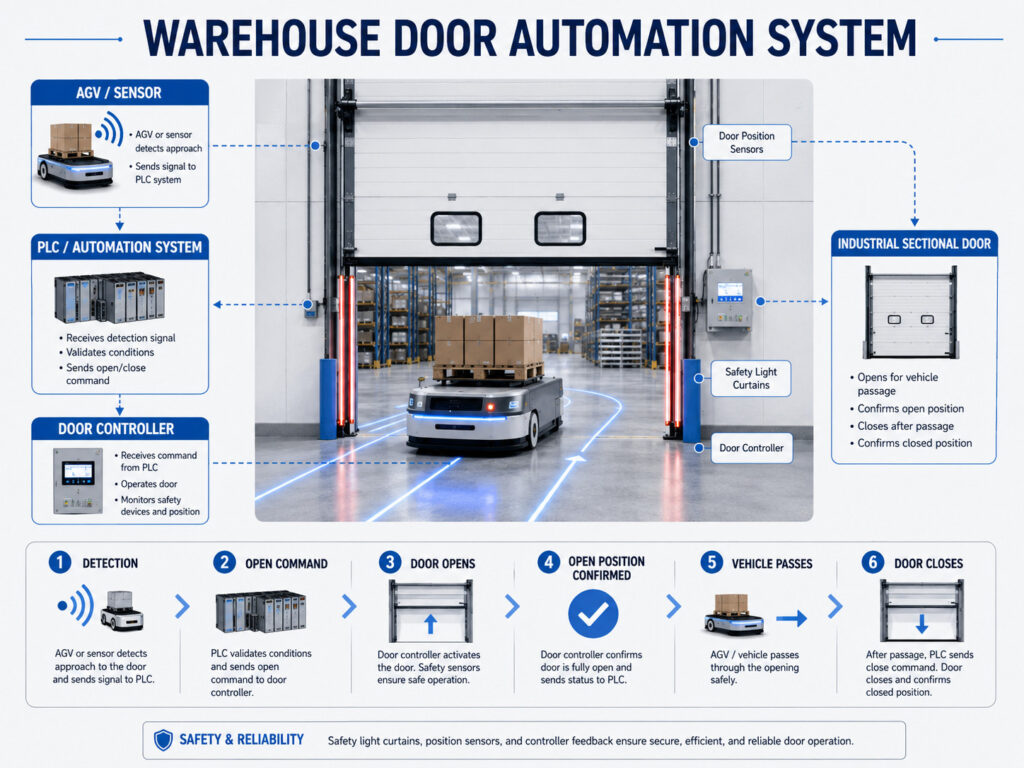
Warehouse door automation normally involves three main systems:
| System | Main Function |
|---|---|
| Detection / automation system | Determines when the door needs to open |
| Door controller | Receives commands and controls the motor |
| Safety system | Prevents unsafe closing or movement |
The door can receive an opening request from equipment such as:
- AGV
- AMR
- PLC
- レーダーセンサー
- loop detector
- RFID reader
- アクセス制御
- remote control
- push button
- pull cord
For more advanced projects, the door controller can also send status information back to the warehouse automation system.
This is particularly important for AGV door control and PLC door control.
How Industrial Sectional Doors Work with AGVs
AGVs are commonly used to transport pallets, materials and components between warehouses and production areas.
If an AGV reaches a closed industrial sectional door and has to wait for an employee to manually open it, the material-handling process is no longer fully automated.
Instead, the AGV system can send an automatic opening request.
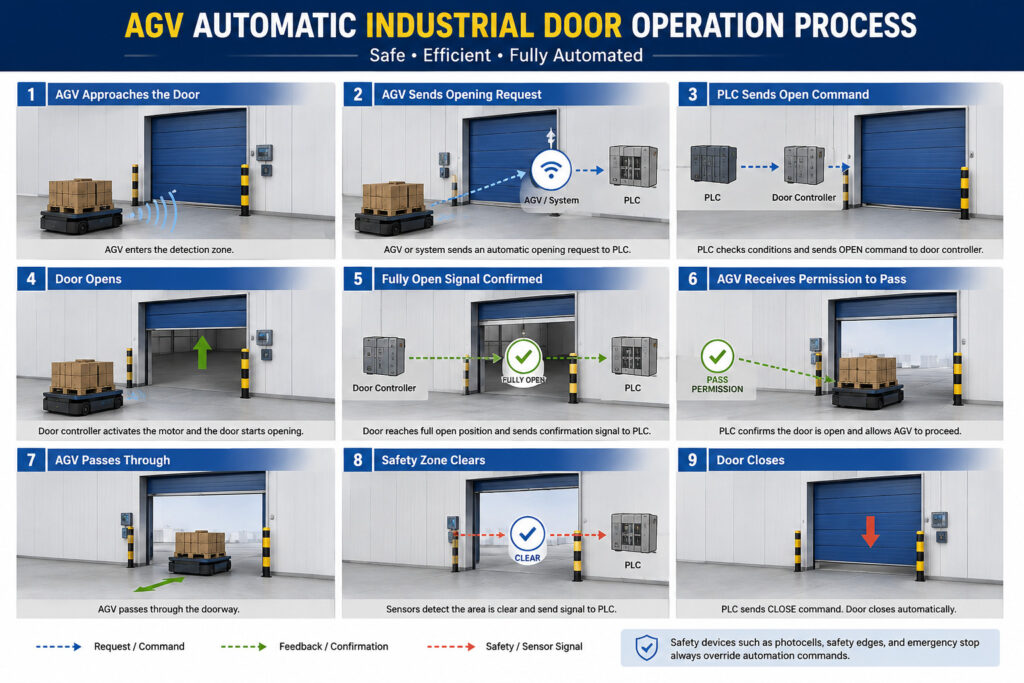
A typical sequence may look like this:
- The AGV approaches the door.
- The AGV or central control system sends an opening request.
- The door controller receives the signal.
- The sectional door begins opening.
- The system confirms that the door is fully open.
- The AGV receives permission to continue.
- The AGV passes through the doorway.
- Sensors confirm that the opening is clear.
- The door closes automatically.
The most important point is step 5.
The AGV should not simply assume that the door has opened because an OPEN command was sent.
For safer AGV door control, the automation system should ideally receive a fully open confirmation signal before allowing the vehicle to enter the doorway.
PLC Door Control
PLC door control is one of the most practical methods for integrating industrial doors into automated warehouses and production facilities.
Instead of allowing individual sensors or machines to control the sectional door independently, the PLC acts as the central controller.
For example:
AGV approaching
↓
PLC receives request
↓
PLC checks operating conditions
↓
OPEN signal sent to door controller
↓
Door opens
↓
Open-position feedback returned
↓
PLC releases AGV
The PLC can therefore coordinate the door with other equipment, including:
- conveyors
- robotic systems
- automated production lines
- AGVs
- traffic lights
- alarms
- アクセス制御
- other industrial doors
This makes PLC door control especially useful where the doorway forms part of a larger automated process.
What Signals Does an Automated Industrial Door Need?
One of the first questions during an industrial door automation project should be:
What signal will the customer’s automation system provide?
For many projects, a simple input/output arrangement is sufficient.
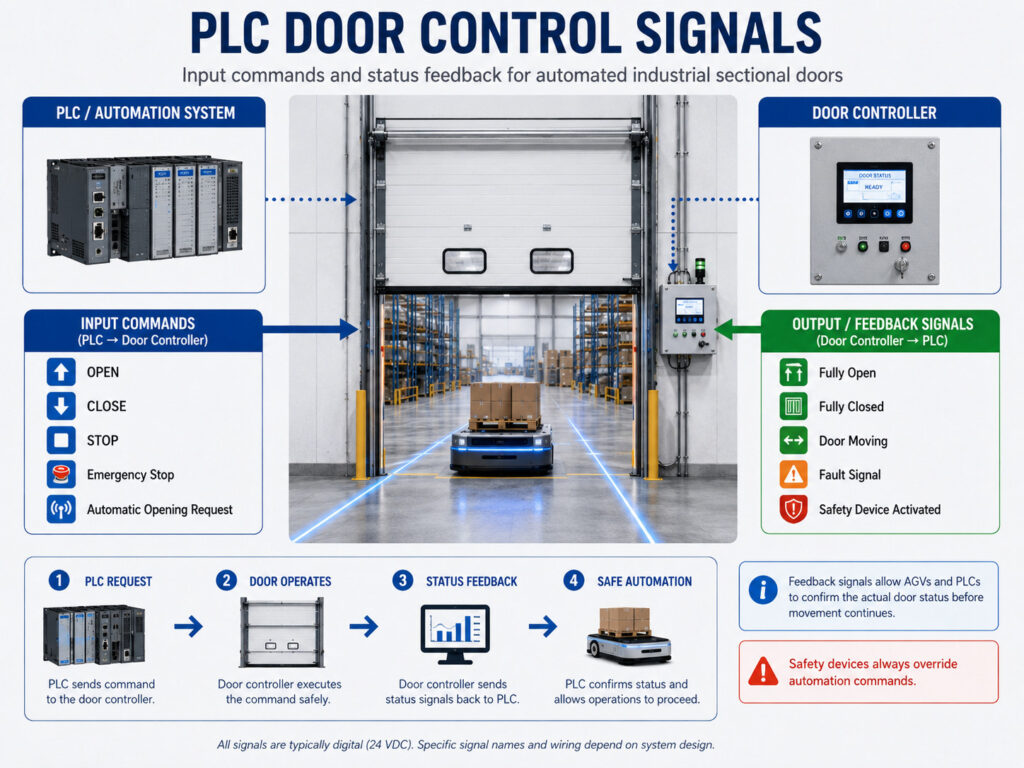
Typical input commands may include:
- OPEN
- CLOSE
- STOP
- emergency stop
- automatic opening request
Typical output or feedback signals can include:
- door fully open
- door fully closed
- door moving
- fault
- safety device activated
These signals allow the warehouse automation system to know the actual status of the door.
Without feedback, the PLC may know that it requested the door to open but not whether the opening process was successfully completed.
Dry Contact Control
Dry contact is one of the simplest ways to connect an industrial sectional door with warehouse automation.
A relay contact from the customer’s automation system can trigger an input on the door controller.
For example:
Contact closes → Door receives OPEN command
Dry contact interfaces can be useful for connecting a sectional door with:
- AGVs
- PLCs
- access-control systems
- RFID systems
- remote receivers
- equipment controllers
The advantage is simplicity.
If the project only requires basic OPEN/CLOSE commands and status feedback, complex network communication may not be necessary.
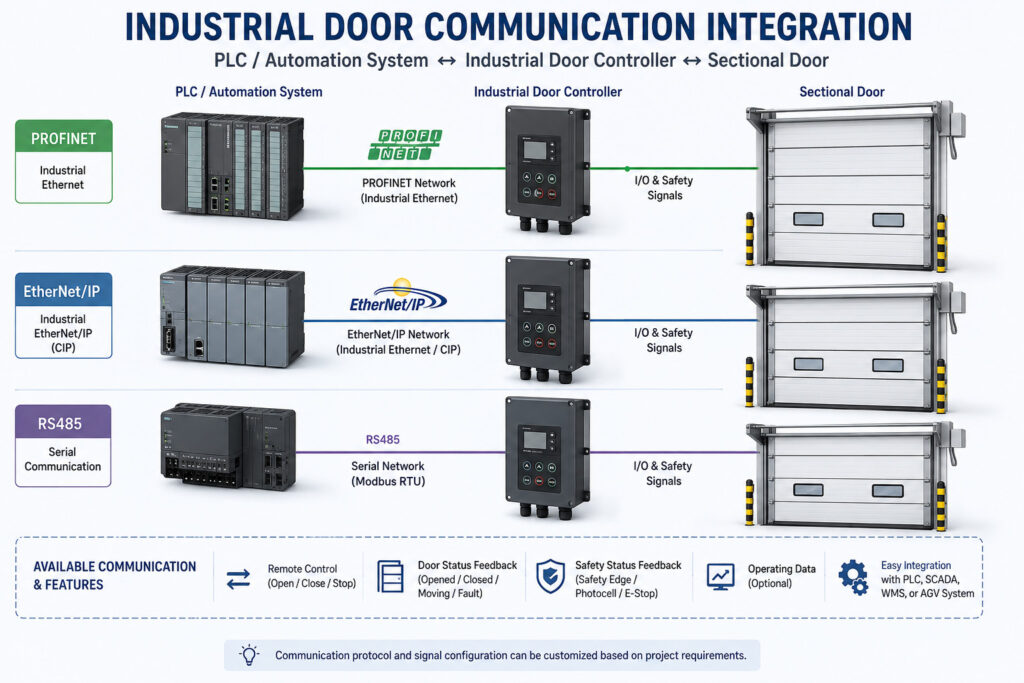
RS485, PROFINET そして EtherNet/IP Integration
More advanced warehouse automation systems may require communication interfaces rather than only simple relay signals.
Depending on the controller and project configuration, industrial doors can be integrated using communication methods such as:
- RS485
- PROFINET
- EtherNet/IP
These interfaces can support more structured communication between the industrial door and the automation system.
For example, the PLC may need to receive information about:
- door position
- operational status
- fault status
- safety condition
The exact communication method should be confirmed before manufacturing because different factories use different PLC brands, control architectures and network protocols.
について セッペス projects involving AGVs or automated production lines, the automation interface can be configured according to the customer’s control requirements.
Radar Sensors for Automatic Warehouse Doors
Not every warehouse automation project requires a PLC.
Radar sensors provide a simpler method for automatic door opening.
When a forklift or vehicle enters the detection zone, the radar sends an activation signal to the door controller.
The sequence is:
Vehicle approaches → Radar detects movement → Door opens → Vehicle passes → Door closes
Radar can be useful for:
- warehouse entrances
- forklift routes
- 生産地域
- internal logistics passages
One important factor is the detection area.
If the detection range is too wide, nearby traffic may repeatedly trigger the door even when vehicles are not actually entering.
Sensor position and sensitivity should therefore match the actual traffic route.
Loop Detectors
A loop detector can be installed in the floor near the entrance.
When a vehicle enters the detection area, the system sends an opening request to the automated warehouse door.
Compared with radar, a loop detector can be useful when the facility primarily wants to identify vehicles.
Typical applications include:
- forklift entrances
- truck access
- warehouse vehicle lanes
- 物流センター
- loading areas
The correct activation method depends on whether the door is used by vehicles, pedestrians or both.
RFID and Access-Control Integration
Warehouse door automation can also include access control.
Instead of opening for every approaching vehicle, the system can first determine whether access is authorized.
A simplified RFID sequence could be:
Vehicle approaches
↓
RFID tag detected
↓
Access authorization checked
↓
Opening command released
↓
Industrial door opens
This type of system can be useful for:
- restricted warehouse areas
- high-value storage
- 製薬施設
- controlled production zones
- automated material routes
RFID does not necessarily need to communicate directly with the industrial door.
In many systems, RFID information is first processed by an access controller or PLC, which then sends the opening command.
How Automated Warehouse Doors Communicate with WMS
Warehouse automation often includes several control layers.
A simplified architecture may look like:
WMS
↓
WCS / Automation System
↓
PLC or AGV Controller
↓
Industrial Door Controller
↓
セクション・ドア
The Warehouse Management System typically manages information such as inventory and material movement.
The physical door opening is more commonly controlled at the PLC, WCS or equipment-control level.
This means an automated industrial door does not always need direct WMS communication.
Instead, the local automation controller manages opening, closing and feedback while the higher-level system determines where materials need to move.
Why Door Position Feedback Matters
Position feedback is one of the most important elements in warehouse door automation.
Consider an AGV approaching a closed door.
The AGV sends an opening request.
The sectional door starts moving.
But what happens if:
- the motor develops a fault?
- the door is blocked?
- a safety device prevents opening?
- the door does not reach the fully open position?
Without feedback, the AGV system may still think the route is clear.
A better control sequence is:
Opening request
↓
Door opens
↓
Fully open signal confirmed
↓
AGV allowed to pass
This creates a simple interlock between the automated vehicle and the door.
Safety Must Override Automation Commands
Warehouse automation should never bypass the door’s safety functions.
The automation system determines when the door should operate.
The safety system determines whether that movement can continue safely.
Depending on the door configuration, protective devices may include:
- photocells
- safety edge
- emergency stop
- cable break protection
- spring break protection
- position monitoring
For example, if a PLC sends a CLOSE command while a forklift remains in the doorway, the appropriate safety system should detect the obstruction and respond according to the configured safety logic.
Automation efficiency should never be achieved by disabling protective devices.
Interlocking Two Industrial Doors
Warehouse door automation can also be used to interlock two sectional doors.
This is particularly useful where two zones need to remain separated.
Typical applications include:
- 食品加工
- temperature-controlled warehouses
- 製薬
- 遮断するシール構造
- controlled manufacturing environments
A typical interlocking sequence is:
Door A opens
↓
Vehicle enters intermediate area
↓
Door A closes
↓
Closed position confirmed
↓
Door B opens
The control system prevents both doors from remaining open simultaneously.
This can help reduce uncontrolled air exchange and improve process control.
吾輩は猫である。名前はまだない。どこで生れたか頓と見当がつかぬ。何でも薄暗いじめじめした所でニャーニャー泣いていた事だけは記憶している。
Are Industrial Sectional Doors Suitable for Warehouse Automation?
Yes, but the traffic frequency must be considered.
Industrial sectional doors are particularly suitable where the opening requires:
- insulation
- セキュリティ
- exterior weather protection
- wind resistance
- large door sizes
- moderate automated traffic
However, sectional doors are generally not designed to compete with dedicated high-speed doors for extremely frequent opening cycles.
For example:
Warehouse vehicle entrance:
A sectional door may be appropriate.
AGV crossing every 30–60 seconds:
A high-speed door may often provide better cycle efficiency.
The door type should therefore be selected according to both building requirements and automation frequency.
Sectional Door vs High-Speed Door for Automation
| Requirement | セクション・ドア | 高速ドア |
|---|---|---|
| セキュリティ | 素晴らしい | Moderate–High |
| 断熱 | 素晴らしい | Depends on model |
| 耐風性 | 強い | Depends on model |
| オープニング・スピード | 中程度 | Very fast |
| High-frequency cycles | 中程度 | 素晴らしい |
| External entrance | 素晴らしい | Model dependent |
| AGV integration | はい | はい |
| PLC integration | はい | はい |
In many automated factories, the two door types are actually used together.
A sectional door may protect the main external entrance, while a high-speed door controls frequent internal AGV traffic.
What Should Buyers Provide for an Automation Project?
For automated warehouse doors, width and height are not enough.
Buyers should also provide:
| Information | Example |
|---|---|
| 断熱材の厚さ | W 3,500 × H 4,000 mm |
| 数量 | 8 doors |
| 申し込み | Automated warehouse |
| 交通 | AGV |
| Opening frequency | 60 cycles/day |
| PLC | Siemens |
| Opening command | Dry contact |
| Door feedback | Fully open / fully closed |
| Communication | PROFINET |
| 安全性 | Photocell + safety edge |
| インストール | Internal |
| Automation sequence | AGV → PLC → Door |
The earlier this information is confirmed, the easier it is to configure the correct controller and communication interface.
Questions to Ask an Industrial Door Supplier
Before ordering an automated industrial sectional door, ask:
- Can the controller receive external opening signals?
- Can the door provide fully open and fully closed feedback?
- Does the controller support dry contact?
- Which industrial communication protocols are available?
- Can the door integrate with an AGV?
- Can it work with a PLC?
- What happens if the door fails to open?
- Which safety devices override an automatic closing command?
- Can two doors be interlocked?
- Can the control cabinet be installed remotely?
These questions are often more important than simply asking whether the door is “automatic.”
SEPPES Industrial Door Automation
SEPPES industrial sectional doors can be configured for different warehouse automation requirements.
Depending on the project, available control and integration options can include:
- dry contact
- RS485
- PROFINET
- EtherNet/IP
- PLC control
- AGV integration
- radar
- loop detector
- RFID
- remote control
- push button
- pull cord
For AGV and automated production applications, the control logic should ideally be confirmed before the door is manufactured.
This allows the motor, control box, external interface, feedback signals and safety system to be configured according to the automation architecture.
よくあるご質問
What is warehouse door automation?
Warehouse door automation means connecting an industrial door with sensors, AGVs, PLCs or other control equipment so the door can open and close automatically according to warehouse traffic or process requirements.
Can an AGV automatically open an industrial sectional door?
Yes. The AGV or automation controller can send an opening request to the door controller. A fully open feedback signal can then be used to confirm that the route is ready before the AGV passes.
Can a PLC control a warehouse door?
Yes. PLC door control can use input/output signals or supported industrial communication interfaces to control door movement and receive status feedback.
What is the simplest way to automate an industrial door?
A radar sensor, loop detector or dry contact signal is often sufficient for basic automation.
What is AGV door control?
AGV door control allows an automated guided vehicle or its control system to request door opening and receive door-position confirmation before moving through the doorway.
Can automated warehouse doors use RFID?
Yes. RFID can be used to identify authorized vehicles, equipment or personnel before the control system releases the door-opening command.
Can industrial doors communicate through PROFINET?
Compatible industrial door controllers can be configured for different communication requirements, including PROFINET in suitable projects. The exact interface should be confirmed before manufacturing.
Do warehouse doors connect directly to a WMS?
Not necessarily. In many projects, the WMS communicates with a WCS, PLC or AGV system, while the local automation controller communicates with the door.
Are sectional doors suitable for high-frequency AGV routes?
They can be used for automated traffic, but very high-frequency routes may be better suited to high-speed doors. Traffic frequency should be evaluated before selecting the door type.
Warehouse automation increasingly connects not only AGVs, robots and conveyors but also industrial doors.
With the correct warehouse door automation system, an industrial sectional door can receive an opening request from an AGV or PLC, open automatically, provide position feedback and close again after the passage is clear.
The key is designing the control logic before ordering the door.
For reliable industrial door automation, buyers should define the AGV or PLC system, communication method, required input and output signals, safety devices and expected operating frequency.
セッペス can configure industrial sectional doors for different warehouse automation requirements, including AGV door control, PLC door control and industrial communication interfaces.
Provide your W × H dimensions, quantity, PLC or AGV information and required control method to determine a suitable automation configuration.