
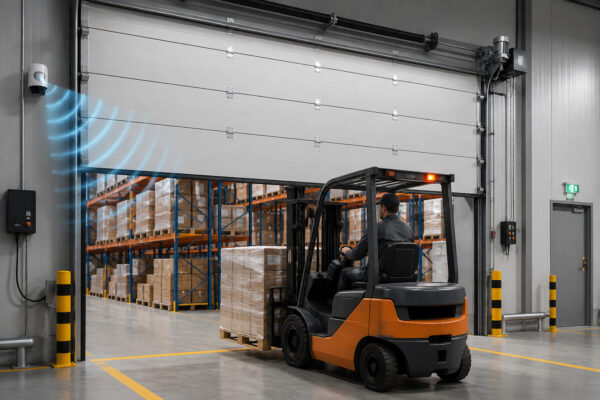
Automatic door systems for 工業用セクショナルドア can use sensors, access control, remote controls, and smart control technology to improve traffic flow, safety, and operating efficiency in warehouses and manufacturing facilities. The right control configuration depends on the door’s operating frequency, traffic conditions, security requirements, and the level of automation required.
For modern industrial facilities, smart controls can reduce manual operation, improve access management, and help integrate industrial sectional doors with existing automation systems. From radar and photoelectric sensors to RFID access control and PLC integration, different control options can be configured according to the specific requirements of each facility.
目次
トグルHow Do Automatic Door Systems Work with Industrial Sectional Doors?
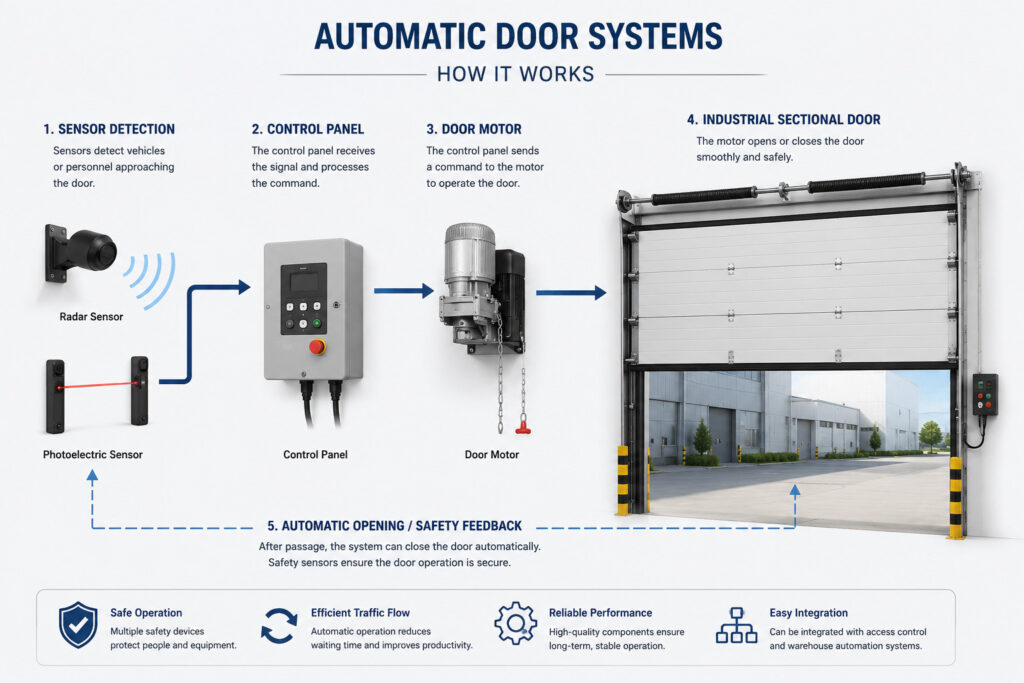
A smart control system connects the industrial sectional door to devices that detect vehicles, people, access credentials, or operating conditions.
A typical system works through four basic components:
Input → Control System → Door Motor → Sectional Door
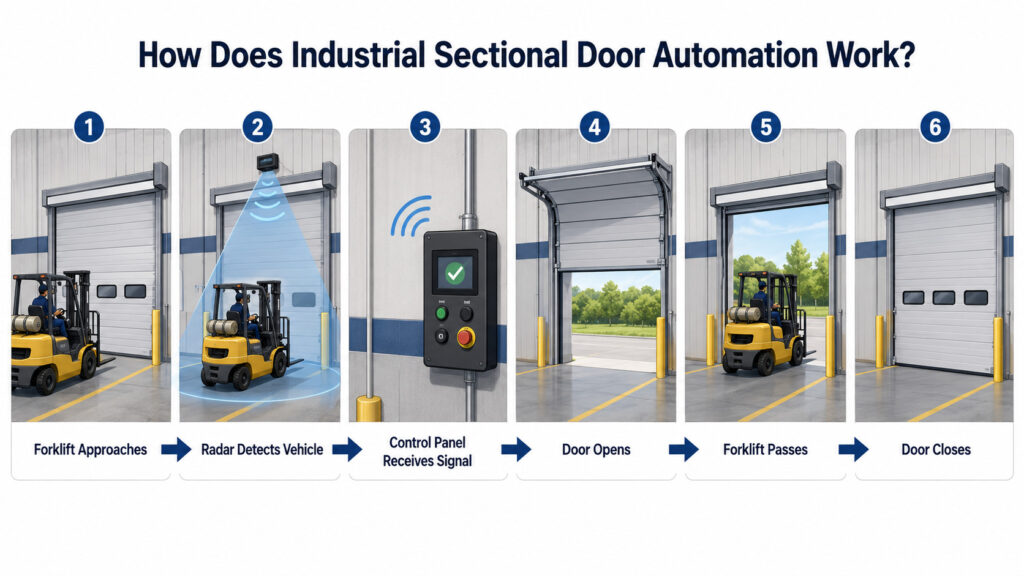
For example, a forklift approaches a warehouse door. A radar sensor or other detection device identifies the approaching vehicle and sends a signal to the control panel. The control system activates the door motor, allowing the industrial sectional door to open automatically.
After the vehicle passes through, the control system can receive a signal from a sensor and close the door automatically.
This type of industrial door automation reduces the need for operators to stop and manually open the door every time a vehicle needs to pass.
What Sensors Can Be Used with Industrial Sectional Doors?
Sensors are an important part of an automated industrial door system. Different sensors perform different functions depending on the application.
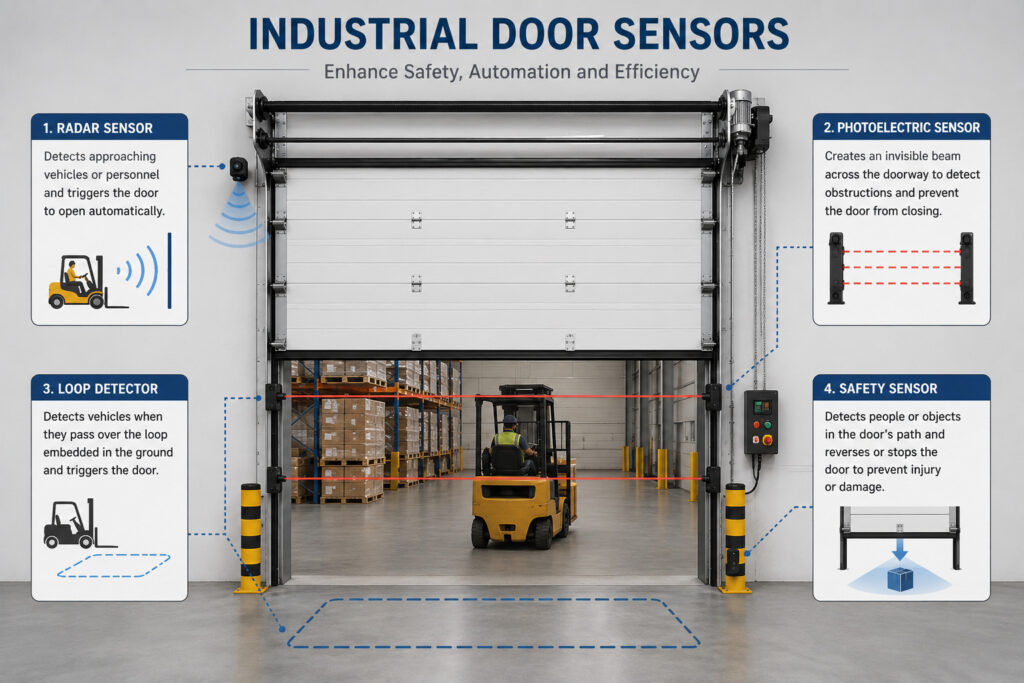
光電センサー
Photoelectric sensors use a light beam to detect objects or movement near the door opening.
They can help prevent the door from closing when an object, vehicle, or person is detected in the opening.
For busy warehouse entrances, photoelectric sensors can provide an additional layer of safety while supporting automatic door operation.
Radar Sensors
Radar sensors can detect approaching vehicles or people without requiring physical contact.
They are useful for applications where a door needs to open automatically when a forklift, truck, or other vehicle approaches.
A typical application is:
Vehicle approaches → Radar detects movement → Door opens → Vehicle passes → Door closes
This can improve traffic flow at frequently used warehouse and production entrances.
Loop Detectors
Loop detectors can be installed in the floor near a door opening to detect vehicles.
They are particularly useful at vehicle access points where automatic opening is required based on vehicle presence.
For example, a loading area may use a vehicle detection system to trigger an industrial sectional door when a forklift enters a designated detection zone.
Safety Sensors
Safety sensors are designed to help detect obstacles during door operation.
When combined with automatic controls, they can help reduce the risk of the door closing while a person, vehicle, or object is in the opening.
The appropriate sensor configuration depends on the door design, operating environment, traffic pattern, and required safety functions.
Access Control for Industrial Sectional Doors
Not every industrial door should open automatically for every person or vehicle.
Facilities with restricted areas may need to control who can open the door and when it can be opened.
An industrial sectional door can be integrated with different access control methods, including:
| Control Method | Typical Application | Main Benefit |
|---|---|---|
| リモコン | Warehouses and workshops | 簡単な操作 |
| Keypad | Restricted areas | Controlled access |
| RFID / Card Reader | 製造施設 | Employee access management |
| Vehicle Detection | 荷積みエリア | Automatic vehicle access |
| PLC Control | Automated facilities | System integration |
| Central Access Control | Secure facilities | Centralized management |
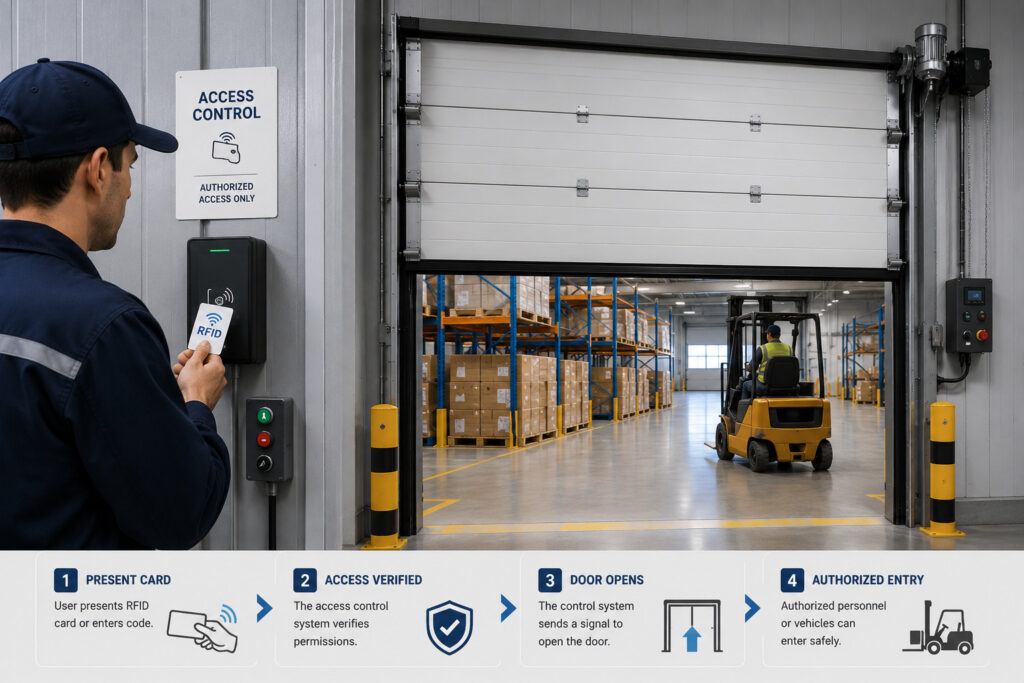
For example, an RFID reader can verify an authorized employee before sending an opening signal to the door control system.
This allows the sectional door to become part of a wider industrial door access control system rather than operating as an isolated piece of equipment.
How Does Industrial Sectional Door Automation Work?
A typical automated door sequence may look like this:
Step 1: Detection
A sensor detects an approaching forklift, vehicle, or authorized user.
Step 2: Signal Transmission
The sensor or access control device sends a signal to the door control panel.
Step 3: Door Opening
The control system activates the motor and opens the industrial sectional door.
Step 4: Vehicle or Personnel Passage
The forklift, truck, or employee passes through the opening.
Step 5: Door Closing
After the passage is completed, the control system receives the appropriate signal and closes the door.
Step 6: Safety Monitoring
Safety sensors continue monitoring the door opening and closing area during operation.
This automated sequence can reduce unnecessary manual operation and help maintain smoother traffic flow in busy industrial facilities.
Can Industrial Sectional Doors Integrate with Warehouse Automation?
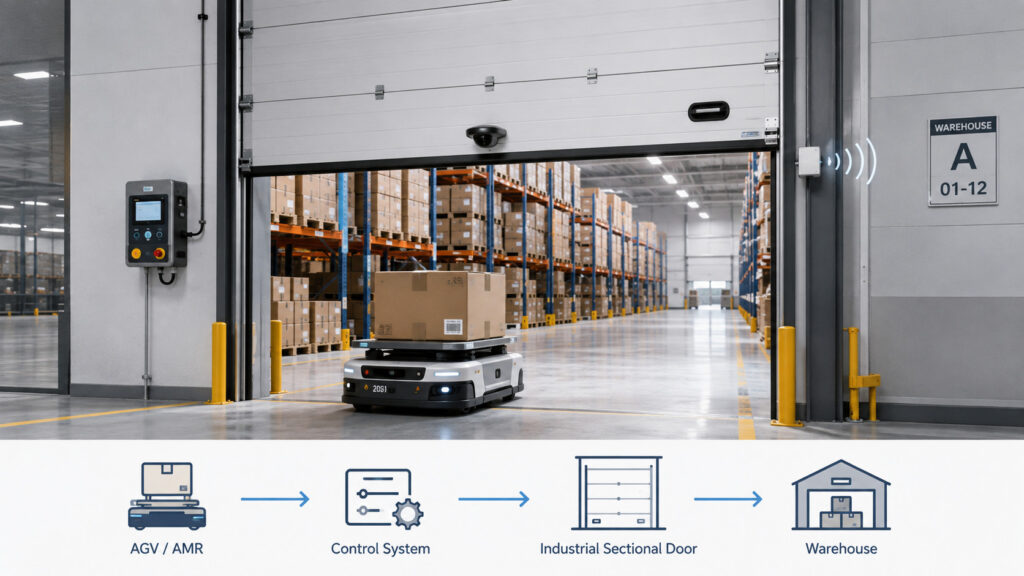
Yes. Industrial sectional doors can be incorporated into larger warehouse and facility automation systems when the appropriate control interfaces are available.
Depending on the project, the door control system may interact with:
- PLC systems
- AGVs
- AMRs
- Access control systems
- Vehicle detection systems
- Warehouse automation equipment
- Interlocking door systems
For example, an automated warehouse may require a sectional door to open when an AGV approaches a designated passage.
The basic logic can be:
AGV approaches → Detection system identifies AGV → Control system receives signal → Door opens → AGV passes → Door closes
This type of integration can help coordinate material movement between different areas of a facility.
The exact integration method depends on the automation architecture, control interface, safety requirements, and equipment used in the facility.
Smart Controls vs. Manual Door Operation
The main difference between manual and smart operation is how the opening signal is generated and how the door interacts with other systems.
| 特徴 | Manual Control | スマート制御 |
| Door Opening | Button or manual command | Automatic or remote signal |
| Vehicle Detection | いいえ | 利用可能 |
| Access Management | 限定 | 利用可能 |
| Safety Sensors | Optional depending on configuration | Can be integrated |
| PLC Integration | 限定 | 利用可能 |
| 自動化 | 低い | 高い |
| System Integration | 限定 | Possible |
| Suitable for High Traffic | Less efficient | More suitable |
Manual control can be sufficient for doors with relatively low traffic.
For high-traffic warehouse entrances, production areas, or automated logistics facilities, smart controls can provide a more efficient operating method.

How to Choose an Industrial Sectional Door Control System
The right control configuration should be selected according to the actual operating environment rather than simply choosing the most advanced system available.
Consider the following factors.
1. Operating Frequency
How many times does the door open and close each day?
A frequently used warehouse entrance may require a different control configuration from a door used only several times per shift.
2. Traffic Type
Determine whether the door is primarily used by:
- フォークリフト
- Trucks
- AGVs
- AMRs
- Employees
- Pedestrians
The traffic type determines which detection and access methods are most appropriate.
3. Access Requirements
If the door separates public and restricted areas, consider:
- Keypads
- RFID
- Card readers
- リモートコントロール
- Central access control
4. Safety Requirements
Consider how the door should respond when an obstacle is detected.
Safety sensors and other protective devices should be selected according to the door configuration and application requirements.
L
5. 自動化レベル
A simple automatic opening system may be sufficient for a warehouse.
A highly automated logistics facility may require integration with PLCs, AGVs, AMRs, or other automation equipment.
6. Existing Control Infrastructure
If your facility already has an access control or automation system, the sectional door control system should be evaluated for compatibility with the existing infrastructure.
What Are the Benefits of Industrial Door Automation?
A properly configured industrial sectional door automation system can provide several practical benefits.
Reduced Manual Operation
Employees and forklift operators do not always need to stop and manually operate the door.
搬送動線の改善
Automatic opening and closing can help reduce unnecessary waiting at frequently used entrances.
Better Access Management
Access control systems can restrict door operation to authorized personnel or vehicles.
安全性の向上
Sensors and safety devices can monitor the door opening and help reduce the risk of accidental closing.
Easier Integration
Industrial doors can become part of a larger automated workflow instead of operating independently.
Smart Controls for Different Industrial Applications
Different facilities may require different control configurations.
倉庫
Common requirements include:
- Vehicle detection
- Automatic opening
- Remote control
- Safety sensors
- Access control
製造施設
Production facilities may require sectional doors to coordinate with forklifts, production areas, or internal logistics systems.
物流センター
High traffic volumes can make automatic door operation particularly useful for maintaining efficient movement between loading and storage areas.
Automated Warehouses
Automated warehouses may require integration between sectional doors and AGVs, AMRs, PLCs, or other material-handling systems.
Restricted Industrial Areas
Factories and facilities with controlled access may combine industrial sectional doors with RFID, card readers, keypads, or centralized access control.
Industrial Sectional Door Automation: What Should You Specify?
When requesting an automated industrial sectional door solution, it is useful to provide the manufacturer with the following information:
| Project Information | Example |
| Door Width | 4000 mm |
| Door Height | 4500 mm |
| 申し込み | 倉庫 |
| Traffic Type | Forklift |
| Operating Frequency | 高い |
| 開閉方式 | Radar / Remote / Access Control |
| Safety Device | 光電センサー |
| 自動化 | PLC Integration |
| アクセス制御 | RFID / Card Reader |
| 設置環境 | Indoor / Outdoor |
Providing these details allows the manufacturer to evaluate the appropriate door configuration, motor, control system, sensors, and integration requirements.
Smart controls can turn an industrial sectional door from a manually operated access point into an integrated part of a modern industrial facility.
Sensors can detect vehicles and obstacles, access control systems can manage authorized entry, and automation interfaces can connect the door with PLCs, AGVs, AMRs, and other warehouse systems.
For warehouses, manufacturing facilities, logistics centers, and automated facilities, the best solution depends on the door size, traffic frequency, vehicle type, safety requirements, and existing automation infrastructure.
セッペス provides customized industrial sectional door solutions and can configure door control systems according to project requirements, including automatic operation, safety sensors, access control, and automation integration.
Looking for an industrial sectional door automation solution? Contact SEPPES with your door dimensions, application, traffic type, and control requirements to discuss the appropriate configuration.
よくある質問
Can an industrial sectional door be automated?
Yes. An industrial sectional door can be equipped with automatic controls, sensors, remote controls, access control systems, and other automation components depending on the application.
What sensors are used for industrial sectional doors?
Common options include photoelectric sensors, radar sensors, loop detectors, and safety sensors. The appropriate combination depends on the traffic and safety requirements of the facility.
Can industrial sectional doors integrate with access control systems?
Yes. Industrial sectional doors can be connected with systems such as keypads, RFID readers, card readers, and centralized access control systems, depending on the control interface.
Can an industrial sectional door connect to a PLC?
Yes, when the door control system provides a suitable interface. PLC integration can allow the sectional door to participate in automated production or warehouse workflows.
Can a sectional door open automatically when a forklift approaches?
Yes. A vehicle detection device such as a radar sensor or loop detector can be used to send an opening signal when a forklift approaches, subject to the selected control configuration.
Are automatic industrial sectional doors safe?
Automatic doors can incorporate safety sensors and protective devices to help detect obstacles and prevent unsafe closing. The safety configuration should be selected according to the door design and application.
Can industrial sectional doors work with AGVs or AMRs?
They can be integrated with automated material-handling systems when the door control system and automation equipment have compatible interfaces and the project is properly configured.
How do I choose the right control system for an industrial sectional door?
Consider the door’s operating frequency, traffic type, access requirements, safety requirements, desired automation level, and compatibility with the facility’s existing control infrastructure.