

مأوى الرصيف مقابل عزل الرصيف: أيهما أفضل؟
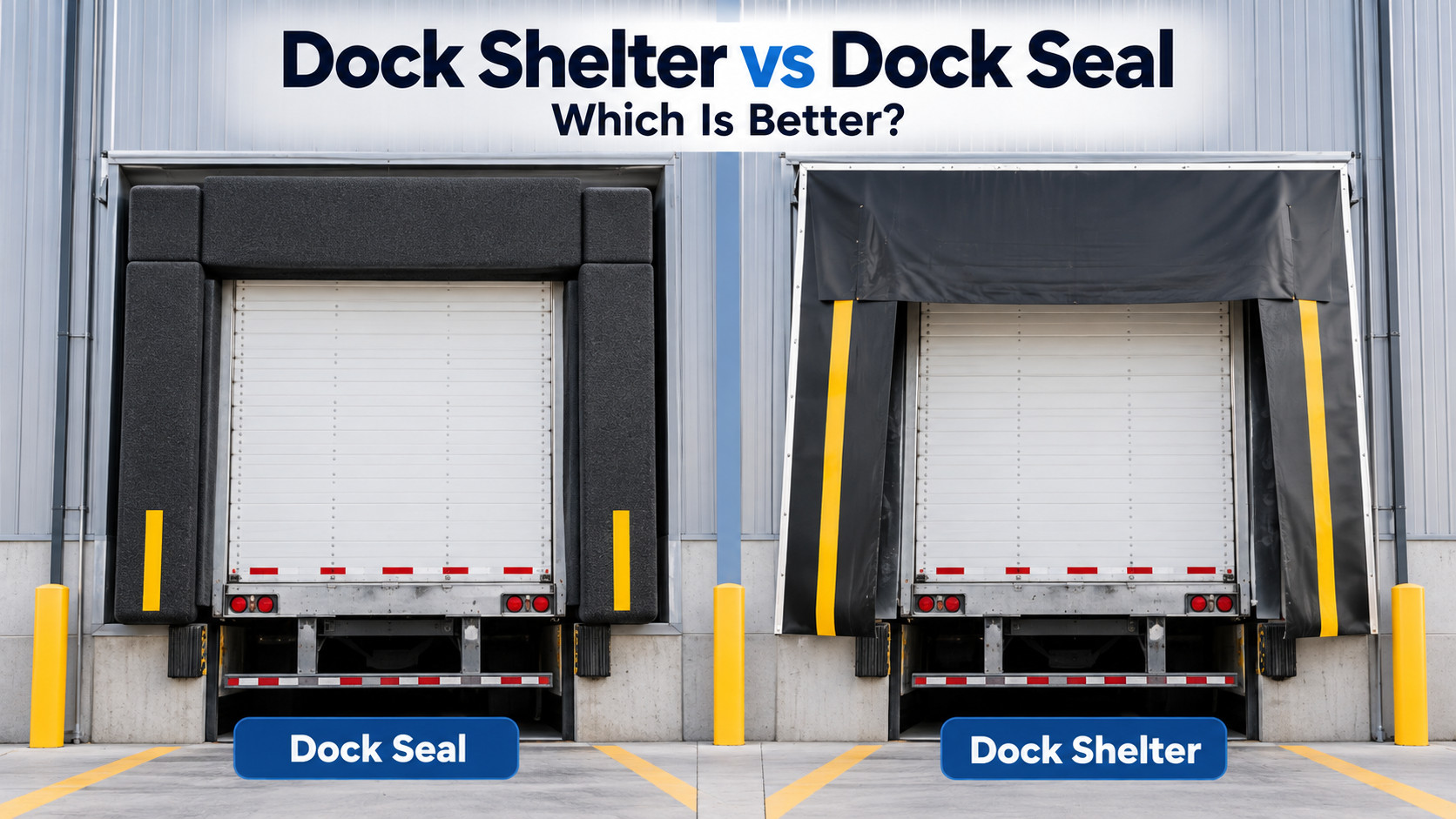
Dock shelter vs dock seal is an important comparison for warehouse operators, logistics managers, cold storage engineers, and industrial buyers selecting equipment for loading docks.
Both solutions help reduce the gaps between parked trucks and warehouse loading bays. However, they use different sealing structures, accommodate different vehicle configurations, and offer different advantages in weather protection, temperature control, loading access, and maintenance.
Imagine a distribution center handling dozens of trailers every day. Some vehicles have consistent dimensions, while others vary in height and width. The loading bay must protect cargo from rain, wind, and dust without interfering with forklift operations.
Should the facility choose a foam dock seal, a mechanical dock shelter, or an inflatable dock shelter?
The answer depends on actual loading conditions rather than product names alone.
This guide explains seven key differences between dock seals and dock shelters, compares their performance in different industrial applications, and provides practical selection advice for warehouses, distribution centers, and cold-chain facilities.
What Is the Difference Between a Dock Shelter and a Dock Seal?
The main difference between a dock shelter and a dock seal is how each system contacts the parked trailer.
A dock seal typically uses foam-filled compression pads positioned around the loading dock opening. When a truck reverses into the dock, its rear body compresses the pads to create a seal.
A ملجأ الرصيف generally uses flexible curtains attached to a frame. These curtains contact the sides and top of the trailer while helping maintain access through the vehicle's rear opening.
Both designs can reduce exposure to outside air, wind, rain, and dust, but their suitability depends on truck dimensions and loading bay requirements.
What Is a Foam Dock Seal?

A foam dock seal, also known as a compression dock seal, consists of foam-filled pads installed around the top and sides of a loading dock doorway.
When a trailer backs into position, its rear body compresses the foam pads and creates contact with the building.
This contact helps reduce outside air infiltration and weather exposure during loading and unloading.
Advantages of Foam Dock Seals
- Simple construction: Foam pads provide a passive sealing solution without a powered inflation system.
- Effective contact sealing: Properly sized pads can provide close contact with consistent trailer dimensions.
- Cost-conscious selection: Conventional foam seals may have a lower initial cost than powered inflatable systems.
- Easy operation: The trailer compresses the pads during normal docking.
- Suitable for standardized fleets: Works well when vehicle dimensions are relatively uniform.
Limitations of Foam Dock Seals
The main limitation of foam dock seals is their dependence on direct contact with the trailer body.
If vehicles vary significantly in width or height, some may not compress the pads correctly.
Large foam pads may also reduce usable access around the trailer opening, especially if the seal is incorrectly sized.
Repeated compression and rubbing can gradually damage the foam core or protective fabric.
Best applications: Standard warehouses, distribution centers with consistent trailer fleets, and loading bays requiring straightforward passive sealing.
What Is a Mechanical Dock Shelter?

A مأوى الرصيف الميكانيكي uses a supporting frame and flexible curtains positioned around the loading dock opening.
As the trailer moves into the loading position, the flexible curtains contact the vehicle body and help reduce exposure between the truck and warehouse.
Unlike a conventional foam seal, a mechanical shelter generally relies on curtain contact rather than compressing thick foam pads against the trailer.
Advantages of Mechanical Dock Shelters
- Accommodates a specified range of trailer sizes.
- Provides flexible contact around vehicle bodies.
- Helps reduce wind, rain, and dust exposure.
- Can preserve more usable space around the trailer opening.
- Compatible with industrial sectional doors and hydraulic dock levelers.
- Suitable curtain components may be replaceable after wear.
Limitations of Mechanical Dock Shelters
Mechanical shelters do not necessarily provide the same compression contact as a correctly fitted foam dock seal.
Sealing effectiveness depends on the curtain overlap, truck dimensions, docking alignment, and installation geometry.
Repeated trailer movement can also wear the curtain material.
SEPPES Mechanical Dock Shelter Features
SEPPES provides mechanical dock shelters designed for industrial loading bays and warehouse logistics applications.
Available configurations include flexible curtain assemblies, supporting frames, and project-based dimensional customization.
Important selection factors include trailer width, trailer height, loading door dimensions, dock bumper projection, and the intended operating environment.
استكشف SEPPES Mechanical Dock Shelter product page for more information.
Dock Shelter vs Dock Seal: 7 Key Differences
1. Sealing Mechanism
A dock seal creates contact through compressed foam pads.
A mechanical dock shelter uses flexible curtains that contact the trailer around the loading opening.
The most effective arrangement depends on trailer shape, required overlap, and the expected docking conditions.
2. Trailer Size Compatibility
Foam dock seals are usually most suitable when trucks have relatively consistent dimensions.
Mechanical dock shelters can accommodate a defined range of trailer heights and widths through flexible curtain contact.
However, neither system should be assumed to fit every vehicle without checking its dimensions.
3. Loading Opening Clearance
Large foam pads can reduce the usable rear opening of some trailers.
Mechanical dock shelters may preserve more access around the trailer opening, depending on the curtain position and vehicle geometry.
This difference can matter when forklifts carry wide pallets or bulky loads.
4. Air Sealing and Weather Protection
Both systems help limit exposure to rain, wind, dust, and outside air.
A correctly fitted foam seal can provide close contact with standardized trailer bodies.
A properly specified mechanical shelter can provide flexible weather protection, although gaps may remain depending on the vehicle and curtain arrangement.
Where tighter environmental separation is required, an inflatable dock shelter may be worth evaluating.
5. Durability and Wear
Foam seals experience repeated compression and friction from vehicles.
Mechanical shelters experience curtain flexing and contact with the trailer body.
The expected service life depends on material quality, operating frequency, truck alignment, environmental exposure, and maintenance.
6. Installation Requirements
Both systems require accurate loading dock measurements.
Important dimensions include:
- Loading doorway width and height
- Trailer body width and height
- Dock platform height
- Distance between trailer and building
- Dock bumper projection
- Available mounting space
- Wall structural conditions
Incorrect dimensions may cause poor sealing, premature wear, or interference with cargo handling.
7. Purchase Price and Lifecycle Cost
Conventional foam dock seals may offer lower initial costs for suitable standardized loading applications.
Mechanical shelters may provide operational advantages where variable trailer sizes and loading clearance are more important.
The total cost should account for equipment, installation, replacement materials, repairs, and the facility's environmental-control requirements.
Dock Shelter vs Dock Seal Comparison Chart
| الميزة | Foam Dock Seal | مأوى الرصيف الميكانيكي | مأوى الرصيف القابل للنفخ |
|---|---|---|---|
| Sealing method | 泡沫压缩 | Flexible curtain contact | Inflatable cushion contact |
| Trailer compatibility | Best with consistent dimensions | Flexible within specified range | Adjustable within specified range |
| Rear opening clearance | May reduce opening access | Often maintains more access | Configuration-dependent |
| Electrical power | Usually not required | Usually not required | Generally required |
| Maintenance focus | Foam and fabric wear | Curtains and frame | Airbags, blower, and controls |
| Typical application | Standardized loading fleet | General logistics | Cold storage and controlled environments |
| Initial complexity | Relatively simple | معتدل | 更复杂 |
Key takeaway: There is no universally superior loading dock sealing solution. The best choice depends on trailer dimensions, loading frequency, required environmental separation, and available installation space.
When Should You Choose an Inflatable Dock Shelter?
An inflatable dock shelter uses powered air cushions that expand around a parked trailer after it has reached the correct loading position.
This allows the inflatable components to make contact with the vehicle body without remaining fully extended during truck approach.
Inflatable dock shelters can be useful where minimizing external air exchange is a major priority.
Main Advantages of Inflatable Dock Shelters
- Controlled inflation after the vehicle is positioned
- Contact around appropriately sized trailer bodies
- Potentially closer environmental separation
- Suitable for certain mixed vehicle fleets
- Can be integrated with compatible dock operating controls
Applications in Cold-Chain Warehouses
Refrigerated distribution centers frequently experience temperature differences between indoor storage areas and outdoor truck loading spaces.
Warm, humid outdoor air entering refrigerated environments can contribute to refrigeration demand and condensation.
Properly specified inflatable shelters may help reduce uncontrolled air exchange during loading.
However, actual thermal performance depends on the entire loading bay design, trailer positioning, door operation, and environmental conditions.
Learn more about SEPPES Inflatable Dock Shelters.
Which Is Better for Cold Storage: Dock Seal or Dock Shelter?
Cold storage facilities must consider temperature stability, moisture control, loading frequency, and truck compatibility when selecting dock sealing equipment.
For standardized refrigerated truck fleets, correctly sized foam dock seals may provide practical contact sealing.
For loading bays serving trailers of different dimensions, mechanical dock shelters may offer greater flexibility.
For projects where controlled sealing around the parked trailer is particularly important, inflatable dock shelters may be a suitable option.
Why Cold-Chain Energy Efficiency Matters in 2026
Recent industry research continues to emphasize the importance of coordinated energy-efficiency measures across refrigerated logistics and food cold chains.
For example, a September 2026 research review in Energies examines energy-efficiency measures within food cold-chain systems.
Source: Energy-Efficiency Actions in Food Cold Chains (2026).
For warehouse buyers, the practical implication is that dock sealing should be considered alongside refrigeration equipment, dock doors, traffic management, and overall loading bay operation.
An effective sealing system may help limit unwanted air exchange, but energy savings must be assessed using project-specific data.
Industry Example: Integrated Refrigerated Loading Dock Design
In a customer case published in May 2025, ASSA ABLOY described an energy-efficiency project involving a refrigerated distribution center operated by Brakes in Glasgow, Scotland.
The project combined insulated loading dock doors, inflatable dock shelters, and additional sealing measures.
The case reported estimated annual energy savings for the combined loading dock solution.
This is an ASSA ABLOY project, not a SEPPES installation or a performance guarantee for dock shelters alone.
Reference: ASSA ABLOY: Reduced Energy Use in Chilled Warehouse.
The engineering lesson is that loading dock equipment performs best when selected as part of an integrated facility design.
Dock Shelter vs Dock Seal for Different Warehouse Applications
المستودعات العامة
For facilities handling relatively consistent trailer sizes, foam dock seals can offer straightforward, cost-conscious protection.
Mixed-Fleet Logistics Centers
Where vehicles vary in size, mechanical dock shelters may provide useful flexibility within their designed operating range.
مراكز توزيع سلسلة التبريد
Cold storage facilities may require increased attention to air infiltration, condensation, and environmental separation.
Inflatable dock shelters may be appropriate where closer sealing is required, subject to the actual vehicle and building configuration.
مرافق تجهيز الأغذية
Food-related loading environments may require appropriate separation from dust, outside air, rain, and other environmental conditions.
Sealing equipment should be selected in coordination with the facility's hygiene and operating requirements.
Manufacturing and Industrial Logistics
Industrial facilities may prioritize weather protection, frequent loading, robust materials, and ease of maintenance.
Truck dimensions, operating frequency, and expected wear should influence equipment selection.
How to Measure a Loading Dock for Dock Seals and Shelters
Accurate dimensions are essential when selecting a loading dock sealing system.
Step 1: Measure the Door Opening
Record the clear opening width and height of the finished loading dock doorway.
Step 2: Measure Trailer Dimensions
Confirm the minimum and maximum width and height of vehicles using the loading bay.
Step 3: Confirm Dock Platform Height
Measure the finished dock height and compare it with the expected vehicle range.
Step 4: Check Dock Bumper Projection
Determine the expected gap between the truck and building wall when the vehicle rests against the bumpers.
Step 5: Inspect Mounting Conditions
Check the wall structure, available space, and mounting requirements.
Step 6: Review Associated Dock Equipment
Consider the position of sectional doors, dock levelers, restraints, dock lights, and control systems.
Step 7: Request a Manufacturer-Specific Drawing
Provide site measurements and photographs to the supplier before confirming the final shelter or seal dimensions.
How Dock Shelters and Dock Seals Work with Loading Dock Equipment
A dock shelter or dock seal is one part of a complete loading dock system.
Other components may include:
- Industrial Loading Dock Doors
- معدات تعديل أرصفة الشحن الهيدروليكية
- Mechanical Dock Shelters
- Inflatable Dock Shelters
- Dock bumpers and suitable vehicle restraints
The sectional door closes the building entrance when the dock is not in use.
The shelter or seal reduces gaps around a correctly positioned trailer, while the dock leveler provides a loading transition between the dock platform and truck bed.
SEPPES offers integrated loading dock equipment for industrial applications.
For U.S. workplace safety considerations, consult OSHA 29 CFR 1910.26 — Dockboards.
Dock Shelter vs Dock Seal: Buying Checklist
Before requesting a quotation, collect the following project information:
| Project Detail | Required Information |
|---|---|
| Loading doorway | Clear width × height in mm |
| Truck dimensions | Minimum and maximum vehicle width and height |
| ارتفاع الرصيف | Finished loading platform elevation |
| Bumper projection | Distance from building to parked trailer |
| Truck fleet | Standardized or mixed vehicles |
| Loading frequency | Estimated vehicles per day |
| Environment | Temperature, weather, humidity |
| 装卸货设备 | Existing doors, levelers and restraints |
| Project location | Country and installation city |
| الكمية | Number of loading bays |
Why Choose SEPPES for Loading Dock Sealing Solutions?
SEPPES manufactures customizable industrial door and loading dock equipment for warehouses, manufacturing facilities, logistics centers, and cold-chain applications.
Its product range includes mechanical dock shelters, inflatable dock shelters, hydraulic dock levelers, and industrial sectional loading dock doors.
Instead of considering each component independently, industrial buyers can evaluate the complete loading dock arrangement according to the facility's requirements.
SEPPES can review project dimensions, trailer compatibility, loading frequency, sealing requirements, and equipment configurations.
Final product selection and performance must be confirmed for the specific installation and operating conditions.
Frequently Asked Questions About Dock Shelters and Dock Seals
What is the difference between a dock shelter and a dock seal?
A dock seal uses foam-filled pads that compress against a parked trailer, while a mechanical dock shelter uses flexible curtains to contact the trailer around the loading opening.
Which is better for cold storage?
The best solution depends on trailer dimensions and environmental requirements. Properly specified inflatable dock shelters may offer advantages where closer sealing is needed.
Are dock shelters more expensive than dock seals?
Costs depend on equipment type, dimensions, materials, and installation. Conventional foam seals may cost less initially than powered inflatable systems.
Can dock shelters fit different truck sizes?
Mechanical and inflatable shelters can accommodate specified ranges of vehicle dimensions. Their exact compatibility must be confirmed before purchase.
Do dock seals help reduce energy loss?
Correctly installed dock seals can reduce unwanted air exchange around parked vehicles. Actual energy performance depends on the complete loading bay and operating conditions.
What is the difference between mechanical and inflatable dock shelters?
Mechanical dock shelters use passive flexible curtains. Inflatable shelters use powered air cushions that expand around the truck after docking.
Can foam dock seals restrict the loading opening?
Yes. If the foam pads are oversized or incorrectly positioned, they may reduce usable access around the trailer's rear opening.
What information is needed for a dock shelter quotation?
Provide loading dock dimensions, trailer size range, dock height, bumper projection, environmental conditions, and the required quantity.
Conclusion: Which Is Better, Dock Shelter or Dock Seal?
The choice between a dock shelter and dock seal depends on how the loading dock is used.
Foam dock seals are often practical for loading bays receiving trucks with relatively consistent dimensions.
Mechanical dock shelters may be preferable where flexible curtain contact and wider trailer compatibility are important.
ملاجئ الأرصفة القابلة للنفخ should be considered where controlled sealing and environmental separation are key requirements.
For the most effective solution, compare vehicle dimensions, usable loading clearance, sealing requirements, maintenance, and total operating costs.
Get a Customized Dock Shelter or Dock Seal Solution from SEPPES
SEPPES provides industrial loading dock equipment for warehouses, distribution centers, manufacturing facilities, and refrigerated logistics operations.
Our team can help review your loading dock dimensions, trailer specifications, operating environment, and sealing requirements.
For a project recommendation and quotation, please provide the loading opening width and height, truck body dimensions, dock height, required quantity, and project location.
Request a Loading Dock Equipment Quote