

Choosing the right warehouse door for a large logistics facility is not simply a matter of selecting the largest industrial door available. A modern warehouse can have truck loading bays, high-frequency forklift routes, automated conveyor passages, temperature-controlled zones and large exterior openings—all with different operating requirements.
For this reason, one warehouse may need several door types rather than one standard specification throughout the entire building.
A sectional overhead door may work well at a main exterior entrance, while a high speed door is more suitable for a forklift route that opens hundreds of times per day. Loading docks require another system entirely, where the door must work together with dock levelers, shelters and truck-safety equipment.
Explore the full SEPPES industrial door range for warehouse, logistics and industrial applications.
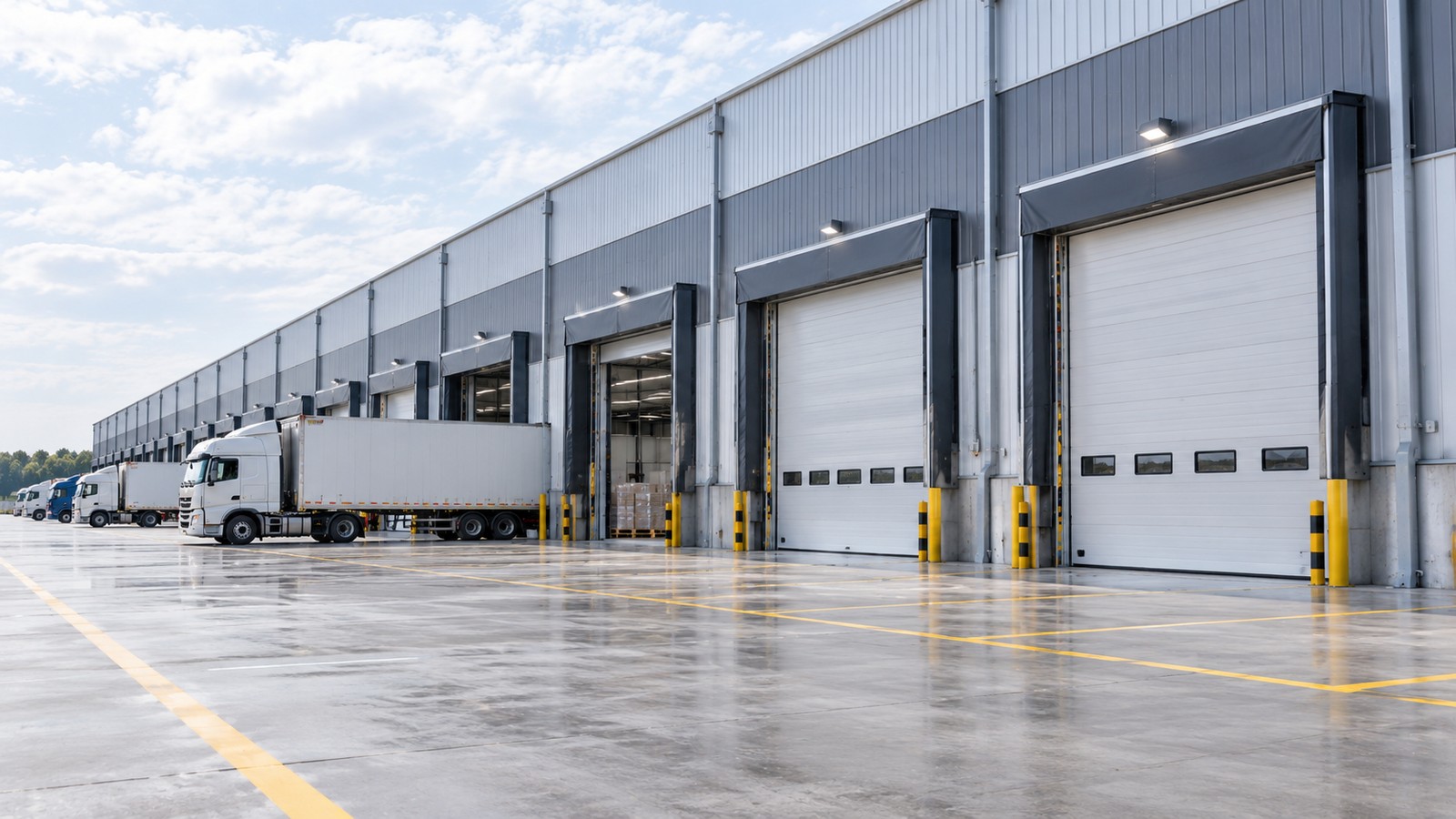
Which warehouse door is best for each logistics area?
The first step is to match the warehouse door to the function of the opening.
| Warehouse area | Recommended door | Main requirement |
|---|---|---|
| Main exterior entrance | باب علوي قطاعي | Durability, insulation and structural protection |
| High-frequency forklift route | الباب عالي السرعة | Short opening time and efficient vehicle traffic |
| Automated conveyor passage | High speed door with control integration | Sensor, PLC or equipment linkage |
| Truck loading bay | 答:泡沫式装卸货平台,或称海绵式装卸货平台,利用填充泡沫的侧垫以及顶部帘或垫,密封装卸货平台开口与卡车尾部之间的区域。这防止装卸过程中平台区域暴露于外界环境、害虫及温度变化。 | Integration with leveler, shelter and truck loading |
| Large warehouse exterior opening | Large sectional or industrial lifting door | Large clear opening and structural stability |
| Secondary or low-frequency access | باب مصراع الأسطوانة | Compact installation and basic security |
| Temperature-controlled warehouse | Insulated sectional or insulated high speed door | Reduce air exchange and improve thermal separation |
Sectional overhead doors for main warehouse entrances
For large exterior entrances that do not need extremely fast opening speeds, sectional overhead doors are one of the most common industrial warehouse solutions.
The door panels move vertically and then follow tracks beneath the roof or along the building structure. This keeps the area directly in front of the opening clear for trucks and forklifts.
سيبس الأبواب المقطعية الصناعية are designed for warehouses, factories and logistics centers that require durable daily access.
An insulated sectional configuration may be particularly suitable where the warehouse needs:
- better thermal insulation;
- weather protection;
- large vehicle access;
- industrial durability;
- vertical space utilization;
- optional vision windows;
- standard, high-lift or vertical-lift track arrangements.
For temperature-sensitive warehouses, see the insulated sectional overhead door , which is available with 40 mm and 50 mm insulated panel configurations.
High speed doors for frequent forklift traffic
Opening speed becomes much more important when forklifts repeatedly pass through the same warehouse doorway.
A conventional warehouse door may provide excellent structural closure but can create unnecessary waiting time if it must open and close every few minutes.
A باب قابل للطي بسرعة عالية is more suitable for frequent internal traffic because the curtain opens and closes rapidly while occupying relatively little space around the doorway.
SEPPES high speed roll up doors provide an adjustable reference opening speed of approximately 1.0–2.0 m/s, depending on the door configuration and opening size.
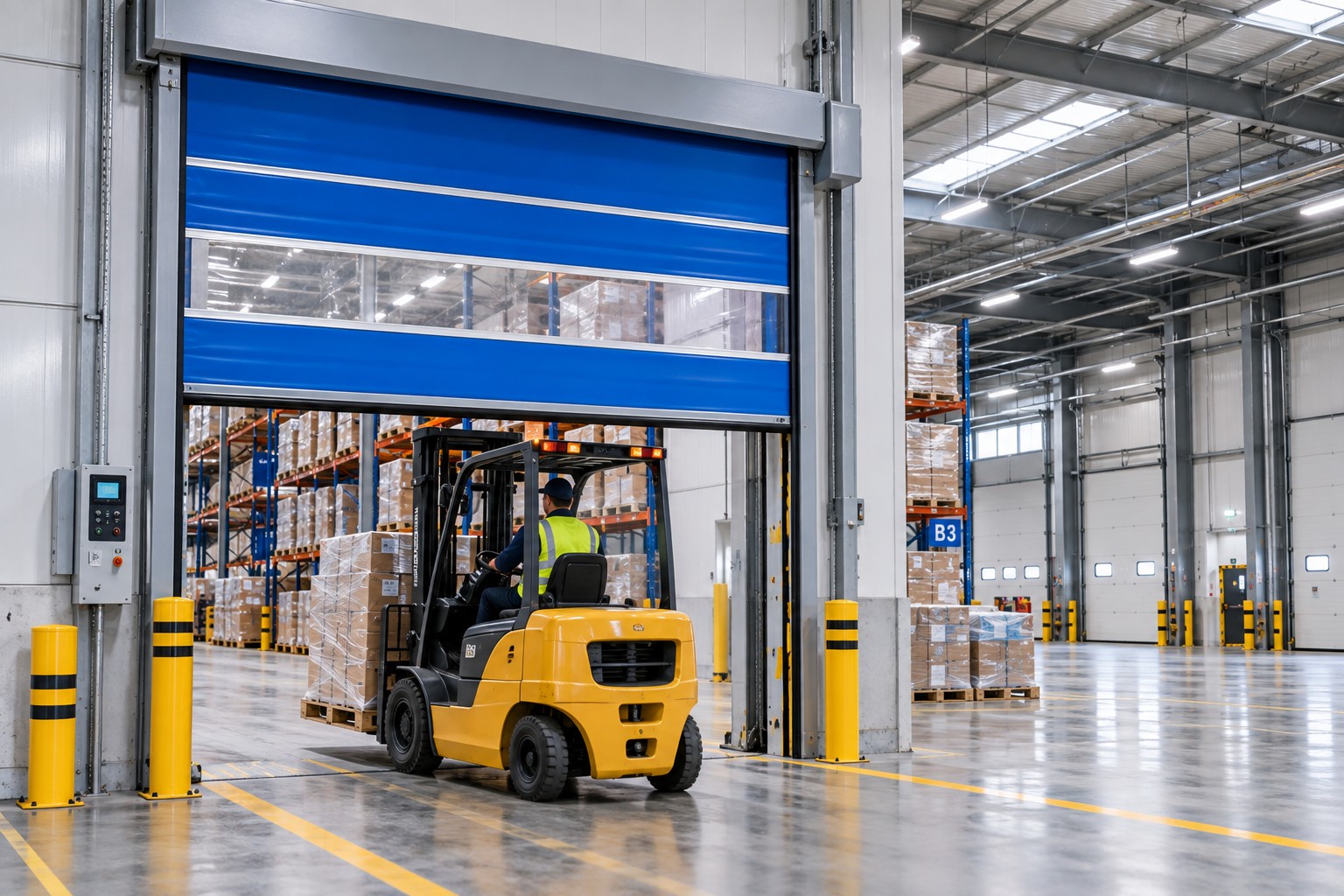
When should a logistics warehouse use a high speed door?
High speed doors are particularly useful where the cost of keeping the opening exposed is greater than the need for a heavy structural door.
Typical applications include:
- forklift routes between warehouse zones;
- packing and sorting areas;
- warehouse-to-production passages;
- temperature-controlled internal routes;
- high-frequency pallet traffic;
- automated logistics passages.
Activation can be configured according to the traffic route using radar, loop detectors, push buttons, remote controls or equipment signals.
Warehouse doors for conveyor and automated logistics systems
Large logistics facilities increasingly use conveyors, AGVs, automated sorting equipment and warehouse management systems to reduce manual handling.
A door installed on one of these automated routes should not require an operator to manually press a button every time a pallet approaches.
Instead, the high speed door can be integrated with the material-handling system so that it receives an opening signal when cargo approaches and closes again after the route is clear.
Depending on the project, control integration may use dry contacts, sensors, PLC signals or industrial communication interfaces.
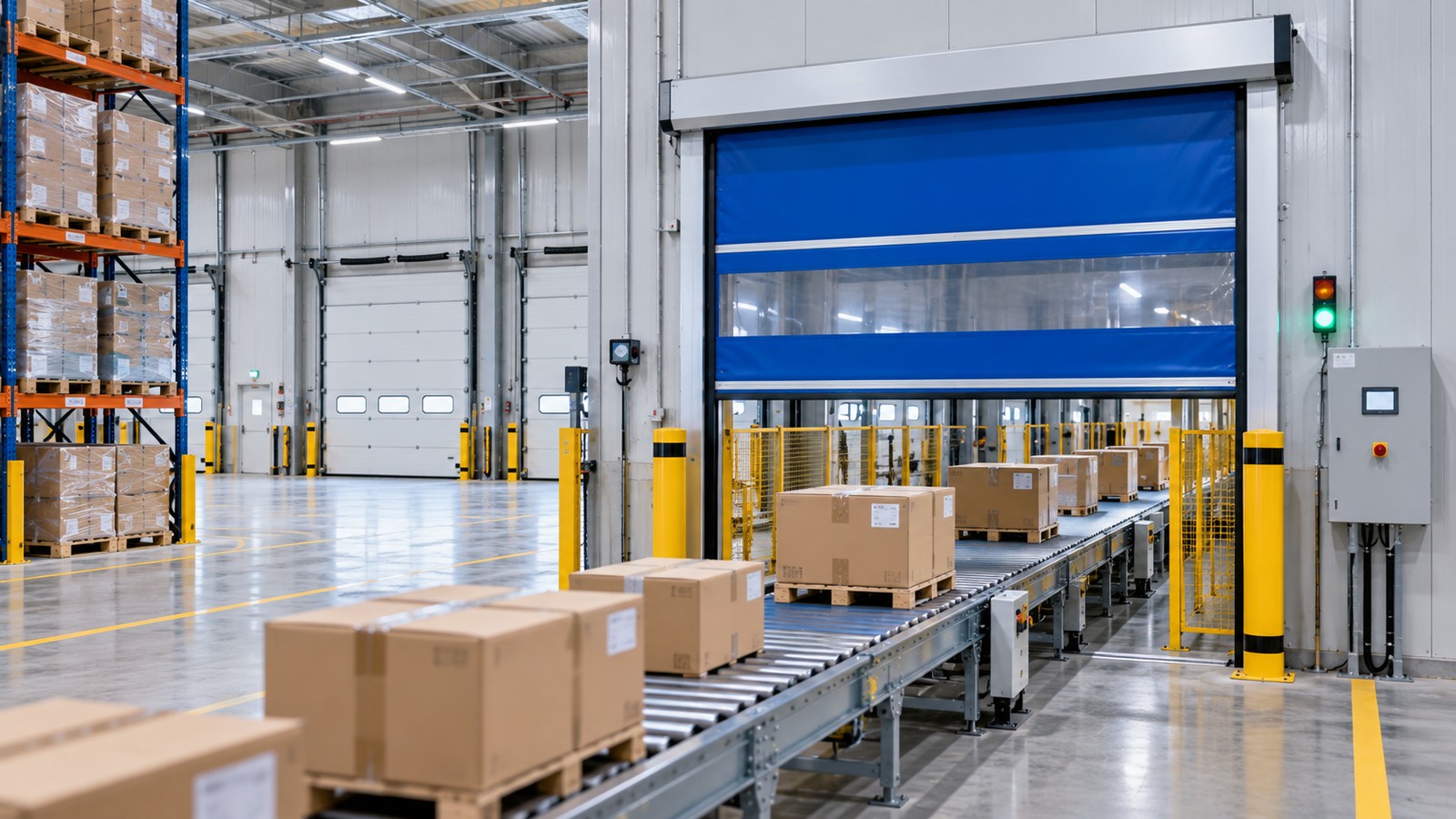
For a broader material-handling perspective, MHI notes that conveyors continue to play an important role in warehouse and loading operations as distribution activity becomes faster and more automated.
External reference: MHI – Using Conveyors for Loading and Unloading .
Loading dock doors for truck loading areas
A truck loading bay requires more than an ordinary warehouse door.
إن باب رصيف التحميل controls access between the warehouse and the trailer interface, but the complete loading process may also require:
- hydraulic dock leveler;
- dock shelter or dock seal;
- loading dock bumpers;
- vehicle restraint;
- traffic lights;
- loading bay control system.
The door, leveler and shelter should be planned around the same truck position instead of being specified as independent products.
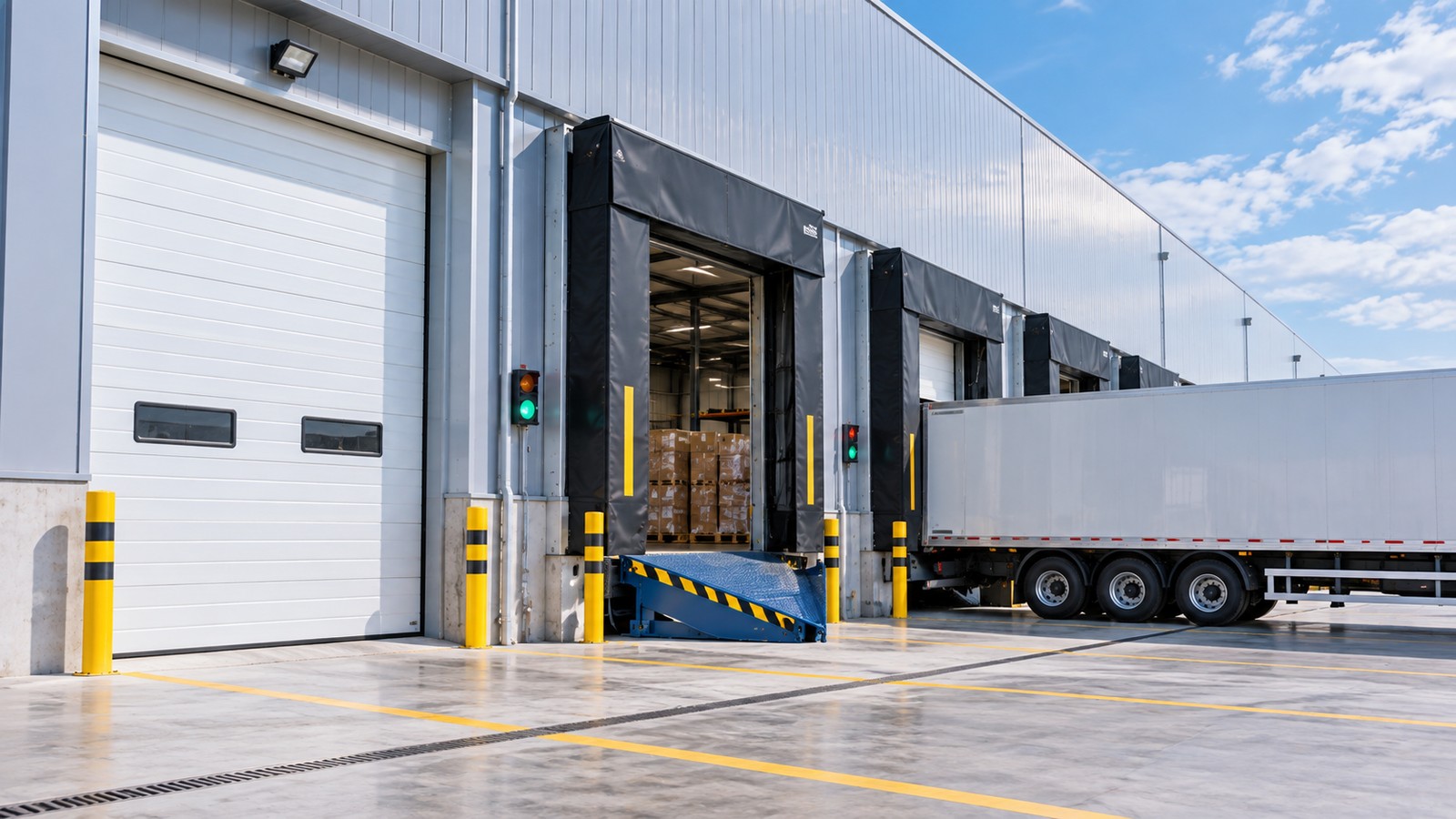
Hydraulic dock levelers for logistics warehouses
Different trucks can arrive at different bed heights. A جهاز تسوية الرصيف الهيدروليكي bridges the height difference between the fixed warehouse platform and the truck floor.
SEPPES currently offers reference rated-load configurations including 6T, 8T, 10T and 12T.
Capacity should be selected according to:
- forklift operating weight;
- cargo weight;
- truck-bed height range;
- crossing frequency;
- pit dimensions;
- loading environment.
For a detailed capacity selection explanation, see: What Dock Leveler Capacity Do I Need?
Dock shelters for logistics loading bays
The gap around a truck can expose the loading area to rain, wind, dust and outside air.
A mechanical or inflatable dock shelter surrounds part of the truck body and reduces this exposed space during loading.
SEPPES offers:
- mechanical dock shelters for flexible daily logistics operations;
- inflatable dock shelters where tighter truck-to-building sealing is required.
The correct shelter should be selected according to the minimum and maximum truck dimensions, dock height and required sealing performance.
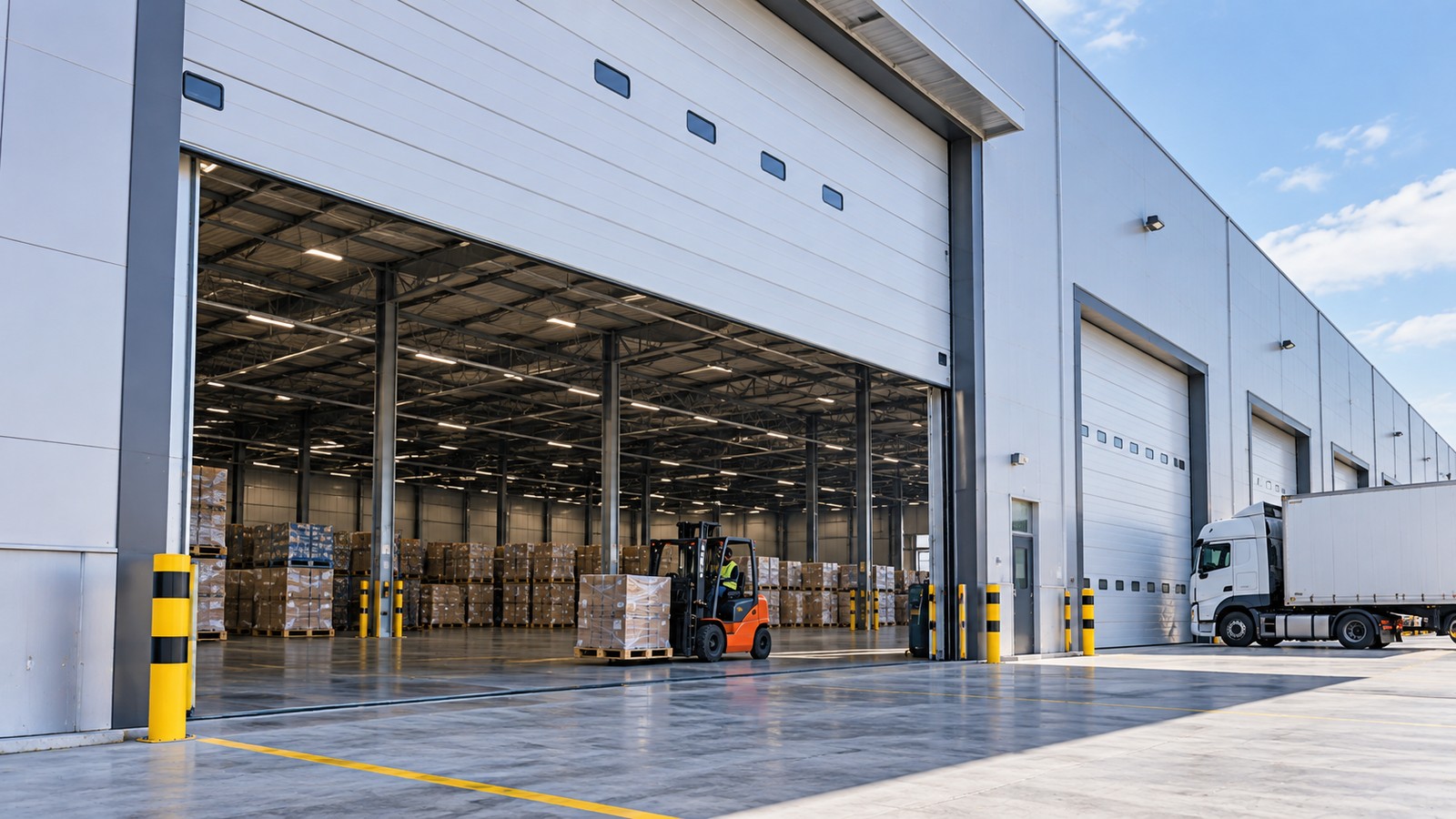
Large overhead doors for oversized warehouse openings
Some logistics warehouses require very large clear openings for high vehicles, large cargo, special equipment or workshop access.
In these applications, opening size becomes a major engineering factor.
A large sectional or industrial lifting door should be selected after checking:
- clear opening width;
- clear opening height;
- headroom;
- left and right side room;
- ceiling beams and obstructions;
- wind exposure;
- door weight;
- track arrangement;
- motor configuration.
Roller shutter doors for secondary warehouse access
Not every warehouse opening requires a high-speed or heavily insulated door.
For low-frequency storage rooms, secondary access points or areas where compact installation and security are the main priorities, a باب مصراع الأسطوانة can be a practical option.
Because the curtain coils above the opening, roller shutter doors use relatively little side space.
However, they are generally not the best choice for a forklift route that must open hundreds of times per day. In that situation, a high speed door may provide a more efficient traffic solution.
Insulated warehouse doors for temperature-controlled areas
Warehouses storing food, beverages, pharmaceuticals or other temperature-sensitive goods may need to limit air exchange between different zones.
The door choice depends largely on opening frequency.
| Traffic condition | Possible door choice | Main advantage |
|---|---|---|
| Low or moderate frequency | Insulated sectional overhead door | Strong thermal barrier while closed |
| High-frequency internal traffic | باب معزول عالي السرعة | Shorter opening time |
| Refrigerated truck loading | Insulated loading dock door + dock shelter | Door insulation plus truck-interface sealing |
See the cold storage doors and loading dock equipment solution for refrigerated warehouse applications.
How to choose a warehouse door by traffic frequency
Traffic frequency is one of the most useful questions to ask before comparing warehouse door products.
| Opening frequency | Typical requirement | Door direction |
|---|---|---|
| Occasional access | Security and structural closure | Sectional or roller shutter door |
| Regular truck / forklift traffic | Reliable motorized operation | باب قطاعي صناعي |
| Very frequent forklift traffic | Reduce waiting and door-open time | الباب عالي السرعة |
| Automated equipment passage | Fast cycles and control integration | High speed automated door |
Do not choose a warehouse door by opening size alone
Another common mistake is selecting the door only from width and height.
Two warehouse openings of exactly the same size may need completely different doors.
For example:
- Door A opens five times per day for trucks.
- Door B opens 150 times per day for forklifts.
- Door C connects to an automated conveyor.
- Door D faces strong outdoor wind.
Although all four openings could have the same dimensions, their operating requirements are very different.
Warehouse door safety for forklift routes
Forklift routes should be reviewed together with the door opening and activation method.
Common safety options can include:
- safety photoelectric sensors;
- light curtains;
- safety bottom edges;
- vision windows;
- warning lights;
- vehicle detection sensors;
- controlled opening signals.
The U.S. Occupational Safety and Health Administration notes that warehouses combine constant movement of people, forklifts and equipment, and recommends keeping safe clearance around loading docks and workplace traffic routes.
External reference: OSHA – Warehousing Hazards and Solutions .
Plan loading dock equipment as one system
At truck loading positions, warehouse doors should not be planned independently from the rest of the dock.
MHI's Loading Dock Equipment Manufacturers group defines loading dock equipment broadly to include dock levelers, dockboards, bumpers, seals, shelters, vehicle restraints and traffic doors.
External reference: MHI LODEM – Loading Dock Equipment .
For warehouse projects, it is therefore useful to review:
- door opening size;
- sectional door track;
- dock leveler pit;
- truck-bed height range;
- dock shelter dimensions;
- bumper projection;
- vehicle restraint position;
- forklift route;
- maintenance clearance.
Common warehouse door selection mistakes
Using the same door type throughout the warehouse
An exterior vehicle entrance and a high-frequency internal forklift route normally have different operating requirements.
Choosing only by purchase price
A lower-cost door can become expensive if slow operation creates forklift waiting or frequent exposure increases energy loss.
Ignoring available headroom
Sectional overhead doors need an appropriate track configuration. Ceiling beams, sprinkler pipes and other equipment should be checked before production.
Ignoring automation requirements
A warehouse that plans to add conveyors, AGVs or automated equipment should consider control interfaces before ordering the door.
Planning the loading dock door separately from the leveler
The door, shelter, leveler and truck position all use the same loading-bay space and should be coordinated together.
What information should you provide before ordering warehouse doors?
- Door opening width × height
- Number of doors
- Installation location
- Main exterior, internal route or loading dock
- Expected daily opening frequency
- Forklift or truck traffic
- Available headroom
- Left and right side room
- Indoor and outdoor temperature
- Wind conditions for exterior doors
- Required insulation
- Automatic activation method
- PLC, conveyor or AGV integration requirements
- Loading platform height if used at a dock
- Truck-bed height range
- Site photos or drawings
- Destination country or port
If the logistics facility is still in the design stage, sharing architectural drawings before finalizing the door openings can help avoid conflicts with beams, tracks, loading dock equipment and automated systems.
Frequently asked questions
What is the best warehouse door for a large logistics facility?
There is no single best door for every opening. Sectional overhead doors are commonly used at exterior entrances, high speed doors suit frequent forklift routes, and loading dock doors are designed to work with truck loading equipment.
Are high speed doors better than sectional overhead doors?
They serve different purposes. High speed doors prioritize rapid traffic flow and short opening time, while sectional overhead doors provide stronger structural closure, insulation and exterior protection.
Which warehouse door is best for frequent forklift traffic?
A high speed door is generally more suitable for frequently used internal forklift routes because it reduces waiting time and the period the opening remains exposed.
What door should be used at a loading dock?
An industrial sectional loading dock door is commonly used together with a dock leveler and dock shelter or seal. The complete loading bay should be designed around the truck fleet and warehouse platform.
What warehouse door works with conveyors?
High speed industrial doors can be integrated with conveyor systems using sensors, dry contacts or PLC signals so the door opens when cargo approaches and closes after the passage is clear.
What type of door is suitable for a very large warehouse opening?
Large sectional overhead doors or other heavy industrial door systems can be considered, depending on opening size, wind exposure, available headroom and structural conditions.
Are roller shutter doors suitable for logistics warehouses?
Yes, especially for secondary or lower-frequency openings where compact installation and security are priorities. For high-frequency forklift traffic, a high speed door may be more efficient.
Planning warehouse doors for a large logistics facility?
Send us your opening sizes, traffic frequency, available headroom, loading dock dimensions, automation requirements and project drawings. SEPPES can recommend different warehouse door configurations for exterior access, forklift routes, automated passages and loading bays.
Request a warehouse door quote 查看工业门